
Unveiling the Best Real-Time Path: SSE vs. WebSockets for Your Rust & Axum Event Firehose
Navigate the complexities of streaming massive event data to numerous clients with the right technology choice.
When tasked with delivering a "firehose of events" to a multitude of clients using a Rust server built with the Axum framework, choosing the right real-time communication technology is paramount. The two primary contenders, Server-Sent Events (SSE) and WebSockets, offer distinct advantages and come with their own set of trade-offs. This comprehensive guide will dissect these technologies, helping you make an informed decision tailored to your high-volume streaming needs.
Key Insights at a Glance
Essential Takeaways for Your Decision
- SSE excels in simplicity and efficiency for unidirectional data: If your primary need is to push data from server to clients without return communication, SSE's HTTP-based nature and built-in features like automatic reconnection make it a lighter, easier-to-implement choice.
- WebSockets provide powerful bidirectional communication: For scenarios requiring two-way interaction, low-latency responses from clients, or binary data transmission, WebSockets offer a robust, full-duplex channel, albeit with increased complexity.
- Axum offers strong native support for both: Rust's Axum framework provides convenient abstractions for implementing both SSE (
axum::response::sse) and WebSockets (axum::extract::ws), simplifying development regardless of your choice.
Deep Dive: Server-Sent Events (SSE)
Understanding the Unidirectional Stream
Server-Sent Events (SSE) establish a persistent, unidirectional communication channel where a server can push data to clients over a standard HTTP connection. Once the connection is established, the server can send events as they occur. Clients listen for these events using the EventSource API in browsers.
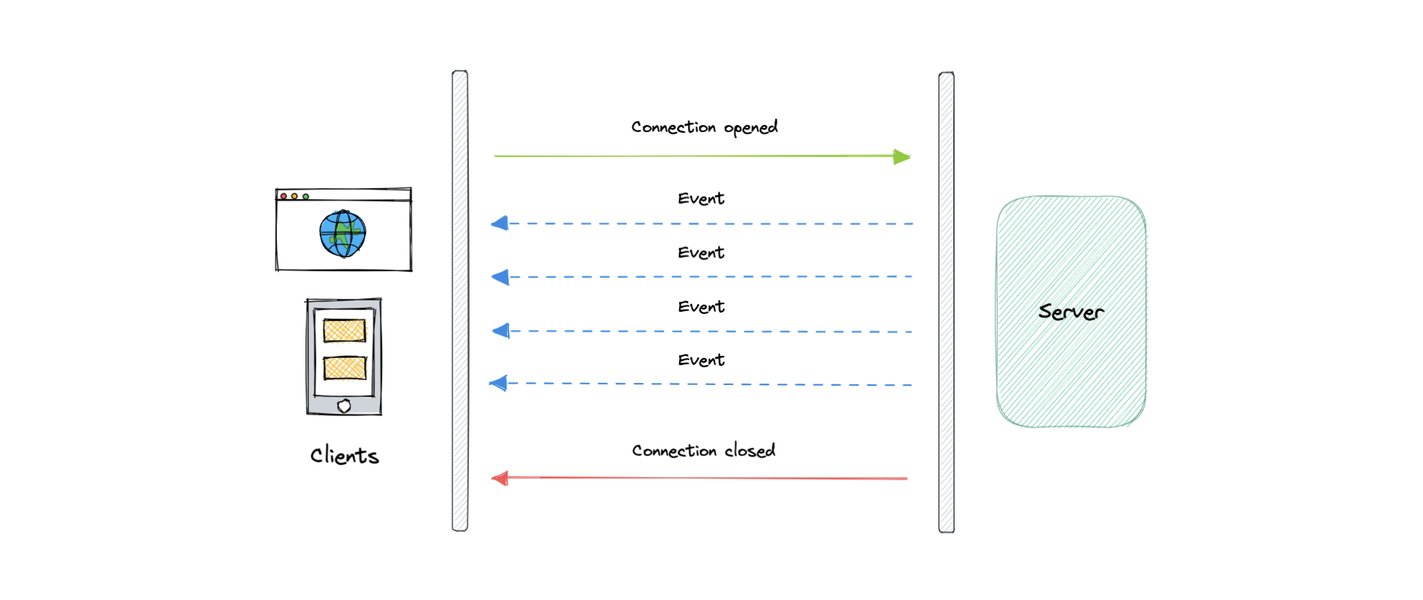
A conceptual diagram illustrating the unidirectional flow of data from server to client using Server-Sent Events.
Advantages of SSE for an Event Firehose:
- Simplicity: SSE leverages the well-understood HTTP protocol. Implementation is generally simpler than WebSockets, especially on the server side. There's no complex handshake beyond a standard HTTP request.
- Automatic Reconnection: Browsers with
EventSourcesupport automatically handle reconnections if the connection drops. Event IDs can be used to ensure clients receive any missed messages after a disconnection. - Efficiency for Unidirectional Flow: For a firehose scenario where data predominantly flows from server to client, SSE is highly efficient. It avoids the overhead of maintaining a bidirectional channel.
- HTTP/2 Benefits: When used over HTTP/2, SSE can overcome the traditional browser limit of ~6 concurrent HTTP/1.1 connections per domain by multiplexing streams over a single TCP connection. This is crucial for handling "a lot of clients."
- Proxy and Firewall Friendliness: Since SSE operates over HTTP, it typically passes through firewalls and proxies with less friction than WebSockets, which use a different protocol (ws/wss).
Drawbacks of SSE:
- Unidirectional Only: SSE is strictly server-to-client. If clients need to send data back to the server over the same persistent connection (e.g., acknowledgments, filter criteria for the stream), SSE is not suitable. Separate HTTP requests would be required.
- Text-Based: SSE messages are text-encoded (UTF-8). Binary data must be encoded (e.g., Base64), which adds overhead.
- Connection Limits (pre-HTTP/2): With HTTP/1.1, browsers enforce a limit on the number of open connections per domain, which could be an issue if clients open multiple tabs or your application uses SSE extensively without HTTP/2.
Exploring WebSockets
The Power of Bidirectional Communication
WebSockets provide a full-duplex communication channel over a single, long-lived TCP connection. After an initial HTTP handshake to upgrade the connection, both the client and server can send messages to each other independently and concurrently.
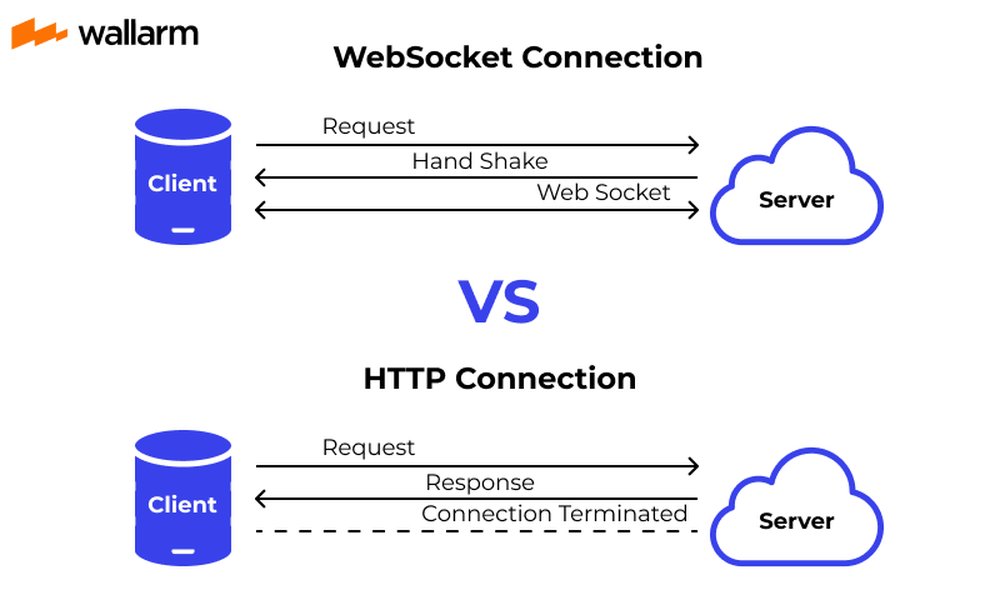
An illustration showing the bidirectional communication path enabled by WebSocket technology.
Advantages of WebSockets for an Event Firehose:
- Bidirectional Communication: This is the hallmark of WebSockets. Clients can send data to the server over the same connection used for receiving the event firehose. This is ideal for interactive applications.
- Low Latency: Once established, the WebSocket connection offers a low-latency path for messages, as it bypasses HTTP overhead for each message.
- Binary Data Support: WebSockets can transmit both UTF-8 text and binary data efficiently, which is beneficial if your events include non-textual information.
- Flexibility: The full-duplex nature allows for more complex interaction patterns, such as client-specific subscriptions or real-time control over the event stream.
Drawbacks of WebSockets:
- Complexity: Implementing and managing WebSocket connections is generally more complex than SSE. This includes the initial handshake, connection state management, and scaling considerations.
- No Built-in Reconnection: Unlike SSE's
EventSource, WebSockets do not have automatic reconnection built into the browser API. This logic must be implemented client-side, often with the help of libraries. - Resource Intensive: Maintaining a large number of persistent WebSocket connections can be more resource-intensive on the server compared to SSE for purely unidirectional data, due to the overhead of a full-duplex channel.
- Proxy/Firewall Traversal: While widely supported, WebSockets can sometimes face issues with older or misconfigured proxies and firewalls that aren't set up to handle the
ws://orwss://protocols or the HTTP upgrade mechanism. - Scalability Challenges: Scaling WebSockets, especially with stateful connections or sticky sessions, can be more challenging than scaling stateless HTTP-based SSE.
Comparative Analysis: SSE vs. WebSockets
Visualizing Key Differences
To better understand how Server-Sent Events and WebSockets stack up against each other for a high-volume event firehose scenario, the following radar chart highlights their strengths and weaknesses across several key attributes. Higher scores indicate better performance or suitability for that attribute in the context of this use case.
This chart visually represents that SSE often scores higher in simplicity, unidirectional scalability, resource efficiency for such scenarios, ease of integration with existing HTTP infrastructure, and built-in reconnection. WebSockets, on the other hand, dominate in bidirectional capability, raw latency performance, and binary data support.
Feature Comparison Table
Here's a direct comparison of key features relevant to your "firehose of events" scenario:
| Feature | Server-Sent Events (SSE) | WebSockets |
|---|---|---|
| Communication Model | Unidirectional (Server-to-Client) | Bidirectional (Full-Duplex) |
| Underlying Protocol | HTTP/HTTPS | ws/wss (upgraded from HTTP) |
| Data Format | Text (UTF-8 encoded) | Text (UTF-8) and Binary |
| Automatic Reconnection | Yes (built into browser EventSource API) |
No (requires manual client-side implementation) |
| Implementation Complexity | Generally simpler | More complex |
| Overhead for Unidirectional Firehose | Lower | Potentially higher (maintaining full-duplex capability) |
| Browser Connection Limits (pre-HTTP/2) | Typically ~6 per domain (mitigated by HTTP/2) | Generally higher limits, primarily server-resource bound |
| Firewall/Proxy Compatibility | Usually good (standard HTTP) | Can sometimes be problematic if not configured for ws/wss |
| Primary Use Case Fit | News feeds, live score updates, notifications, log streaming | Chat applications, real-time gaming, collaborative editing tools |
Decision Mindmap: Choosing Your Path
Visualizing the Selection Process
The following mindmap outlines the core considerations and characteristics of SSE and WebSockets, aiding in the decision-making process for your event firehose application.
axum::response::sse::Sse"]
id1_4_2["axum::response::sse::Event"]
id1_4_3["Often paired with tokio::sync::broadcast"]
id2["WebSockets"]
id2_1["Core Nature"]
id2_1_1["Bidirectional (Client <--> Server)"]
id2_1_2["Separate Protocol (ws:// or wss://)"]
id2_1_3["Supports Text & Binary Data"]
id2_1_4["Manual Reconnection Logic Needed"]
id2_2["Key Advantages"]
id2_2_1["Full-Duplex, Interactive Communication"]
id2_2_2["Low Latency for Real-Time Interaction"]
id2_2_3["Flexible for Complex Data Types"]
id2_3["Key Drawbacks"]
id2_3_1["Higher Implementation Complexity"]
id2_3_2["More Resource Intensive per Connection"]
id2_3_3["Potential Firewall/Proxy Issues"]
id2_3_4["Requires Custom Error/Reconnection Handling"]
id2_3_5["Scaling Can Be More Complex"]
id2_4["Axum Implementation"]
id2_4_1["axum::extract::ws::WebSocketUpgrade"]
id2_4_2["axum::extract::ws::WebSocket"]
id2_4_3["Can integrate with tokio-tungstenite for advanced features"]
Implementing with Rust and Axum
Leveraging Axum's Capabilities
The Axum framework provides robust and ergonomic support for both Server-Sent Events and WebSockets, making it a great choice for building real-time applications in Rust.
Server-Sent Events (SSE) with Axum
Axum makes implementing SSE straightforward using its axum::response::sse::Sse type and axum::response::sse::Event struct. You typically create a stream of events (e.g., using a tokio::sync::broadcast channel to fan out messages to multiple clients) and return it from your handler.
Key elements:
- Set the
Content-Typeheader totext/event-stream. - Format messages according to the SSE specification (e.g.,
data: message\n\n,event: custom_event\ndata: message\n\n,id: event_id\ndata: message\n\n). Axum'sEventstruct handles this formatting. - Manage client connections and the event stream, often using asynchronous Rust features.
// Example (conceptual) SSE handler in Axum
use axum::{
    response::sse::{Event, Sse, KeepAlive},
    routing::get,
    Router,
};
use std::convert::Infallible;
use std::time::Duration;
use tokio_stream::StreamExt as _; // Import StreamExt
use futures::stream::{self, Stream}; // Import stream and Stream

async fn sse_handler() -> Sse<impl Stream<Item = Result<Event, Infallible>>> {
    // Example: A stream that sends an event every second
    let stream = stream::repeat_with(|| Event::default().data("current time"))
        .throttle(Duration::from_secs(1)) // Ensure this is available or use alternative
        .map(Ok);

    Sse::new(stream).keep_alive(
        KeepAlive::new()
            .interval(Duration::from_secs(10))
            .text("keep-alive-text"),
    )
}

// To use this handler in your Axum app:
// let app = Router::new().route("/sse", get(sse_handler));
For a true "firehose" fanning out to many clients, you'd typically use a tokio::sync::broadcast channel. Each connected client would subscribe to this channel to receive events.
WebSockets with Axum
Axum provides native WebSocket support through the axum::extract::ws::WebSocketUpgrade extractor and axum::extract::ws::WebSocket type. The extractor handles the HTTP upgrade request, and then you manage the bidirectional message flow.
Key elements:
- Define a handler that accepts
WebSocketUpgrade. - Call
on_upgradeon the extractor to get aWebSocketstream. - In the upgraded connection handler, you'll typically loop, receiving messages from the client (
socket.recv()) and sending messages to the client (socket.send()).
// Example (conceptual) WebSocket handler in Axum
use axum::{
    extract::ws::{Message, WebSocket, WebSocketUpgrade},
    response::IntoResponse,
    routing::get,
    Router,
};

async fn websocket_handler(ws: WebSocketUpgrade) -> impl IntoResponse {
    ws.on_upgrade(handle_socket)
}

async fn handle_socket(mut socket: WebSocket) {
    // Example: Echo server
    while let Some(msg) = socket.recv().await {
        if let Ok(msg) = msg {
            match msg {
                Message::Text(t) => {
                    println!("Client sent: {:?}", t);
                    if socket
                        .send(Message::Text(String::from("Hello from server!")))
                        .await
                        .is_err()
                    {
                        // Client disconnected
                        return;
                    }
                }
                Message::Binary(_) => {
                    println!("Client sent binary data");
                }
                Message::Ping(_) => {
                    // Axum handles pongs automatically
                }
                Message::Pong(_) => {
                    println!("Received pong");
                }
                Message::Close(_) => {
                    println!("Client disconnected");
                    return;
                }
            }
        } else {
            // Client disconnected
            return;
        }
    }
}

// To use this handler in your Axum app:
// let app = Router::new().route("/ws", get(websocket_handler));
For more advanced WebSocket features or alternative implementations, libraries like tokio-tungstenite can be integrated, or you might explore crates like axum-typed-websockets for type-safe message handling or axum-tws which builds on tokio-tungstenite.
Guidance for Your "Firehose of Events"
Making the Right Choice
For a "firehose of events" primarily pushing data from server to "a lot of clients":
- Server-Sent Events (SSE) is often the more straightforward and resource-efficient choice if:
- The communication is strictly unidirectional (server-to-client).
- Text-based events are sufficient.
- Simplicity of implementation and leveraging existing HTTP infrastructure (including HTTP/2 for scaling connections) are priorities.
- Built-in automatic reconnection is a desired feature.
- WebSockets become necessary or preferable if:
- Any form of client-to-server communication related to the event stream is required (e.g., acknowledgments, dynamic filtering, subscription changes).
- Binary data needs to be transmitted efficiently.
- The absolute lowest latency is critical for interactive components tied to the event stream.
- You anticipate future needs for bidirectional features.
Given that your server will be in Rust with Axum, both options are well-supported. Start by carefully analyzing your exact requirements for data flow direction, data types, and interactivity. If SSE meets these core needs, its simplicity and efficiency for unidirectional push make it a strong contender for a large-scale event firehose.
This video provides a helpful overview comparing WebSockets, Server-Sent Events, Long Polling, and other real-time technologies, which can further inform your decision.
Frequently Asked Questions (FAQ)
When is SSE definitively better than WebSockets for an event firehose?
SSE is generally better when your event firehose is strictly unidirectional (server pushing data to passive clients), simplicity of implementation is a high priority, and you want to leverage standard HTTP infrastructure easily. Its built-in automatic reconnection and lower overhead for one-way streams are significant advantages in such cases, especially with HTTP/2.
When should I absolutely use WebSockets over SSE?
You should absolutely use WebSockets if your application requires bidirectional communication (clients need to send data or commands back to the server over the same persistent connection), if you need to transmit binary data efficiently, or if your application involves highly interactive features demanding the lowest possible latency for two-way exchanges.
How does HTTP/2 affect the choice for SSE when dealing with many clients?
HTTP/2 significantly benefits SSE by enabling multiplexing. This means multiple SSE streams (e.g., from different browser tabs or to different components) can run over a single TCP connection to the same origin. This effectively overcomes the browser's limitation of ~6 concurrent HTTP/1.1 connections per domain, making SSE much more scalable for scenarios with many clients or multiple event streams per client.
Can I use both SSE and WebSockets in the same Axum application?
Yes, absolutely. It's common to use different real-time technologies for different features within the same application. For example, you might use SSE for broadcasting general notifications or updates (unidirectional firehose) and WebSockets for a specific feature like a real-time chat module that requires bidirectional communication. Axum allows you to define routes for both SSE and WebSocket endpoints within the same application.
Recommended Further Exploration
Delve Deeper into Related Topics
- How can I effectively scale Axum WebSocket servers to handle thousands of concurrent client connections?
- What are the best practices for implementing reliable message delivery and handling missed events with Server-Sent Events in a Rust application?
- What strategies and libraries are recommended for robust error handling and automatic reconnection logic in client-side WebSocket implementations?
- How does the server resource usage (CPU, memory) compare between SSE and WebSockets when implemented in Axum and subjected to high load from many clients?
References
Sources and Further Reading
Last updated May 12, 2025