
Stalin's Shifting Propaganda: Mobilizing a Nation for War and Cultivating a Leader's Image
The Evolution of Soviet Propaganda During the Great Patriotic War (WWII)
Key Insights into Stalin's Wartime Propaganda
- Initial Mobilization and Patriotism: At the onset of World War II, Soviet propaganda dramatically shifted to rallying national support, emphasizing the defense of the "Motherland" and instilling a fierce sense of patriotism and nationalism against the Nazi invaders.
- Cult of Personality Reinforcement: While the war effort dominated, propaganda continued to bolster Joseph Stalin's image, portraying him as the wise, all-knowing leader and military strategist, crucial for guiding the Soviet Union to victory.
- Targeted Messaging and Control: The Soviet government exerted complete control over all media, using posters, films, radio, and even "agitation trains" to disseminate carefully crafted messages that aimed to boost morale, justify violence, and demonize the enemy.
During World War II, known in the Soviet Union as the Great Patriotic War (1941-1945), Joseph Stalin's regime masterfully wielded propaganda as a critical tool for national mobilization, maintaining morale, and solidifying his leadership. The shift in propaganda focus was a direct response to the existential threat posed by the Nazi invasion, transforming a narrative previously centered on socialist industrialization and collectivization into a potent call for patriotic defense.
From Internal Focus to National Survival: The Wartime Propaganda Shift
Before the war, Soviet propaganda under Stalin primarily focused on internal objectives: promoting rapid economic development through socialist industrialization and the collectivization of land, and solidifying political discipline. This included the pervasive "cult of personality" around Stalin, presenting him as a benevolent, all-knowing figure leading the world to socialism and often referred to as the "Father of Nations." However, with the German invasion on June 22, 1941, through Operation Barbarossa, the priorities of the state, and consequently its propaganda, underwent a drastic transformation.
The Immediate Call to Arms: Defense of the Motherland
The sudden and brutal nature of the Nazi invasion necessitated an immediate shift in propaganda to rally every available resource for defense. The focus moved from abstract ideological goals to the tangible threat to Soviet soil and its people. Posters and other media began to emphasize themes of national unity, heroism, and the dire need to protect the homeland. The iconic "Motherland Calls!" poster, though not explicitly featuring Stalin, encapsulated this urgent patriotic appeal, urging all citizens to contribute to the war effort.

An iconic Soviet propaganda poster urging citizens to defend the Motherland during WWII.
Propaganda during the war aimed to instill a morality that justified the violence against the enemy. It worked to demonize the Nazis, portraying them as fascist saboteurs and brutal invaders, contrasting them with the strength and unity of the Soviet Army and its inevitable victory. Messages often stirred patriotism in the fight against Adolf Hitler's forces, with slogans like "Mercilessly annihilate fascist saboteurs" and "To the West!" becoming common.
Reinforcing Stalin's Leadership Amidst Crisis
Despite the initial emphasis on collective national defense, Stalin's image remained a central symbol. While direct mentions of him as "father" were less frequent in the early war years, his guidance and leadership were consistently invoked. As the tide of the war began to turn in the Soviet Union’s favor, particularly by 1943, Stalin's appearance in propaganda became more frequent. He was increasingly depicted as the "great Warrior" and "military strategist," the "Saviour of the Russian land, and then the whole world." This reinforced the idea that victory was a direct result of his genius. Propaganda posters portrayed him leading the people into battle, often in a triumphant manner post-victory, allowing him to appear independent of his need to appeal to Lenin's legacy.
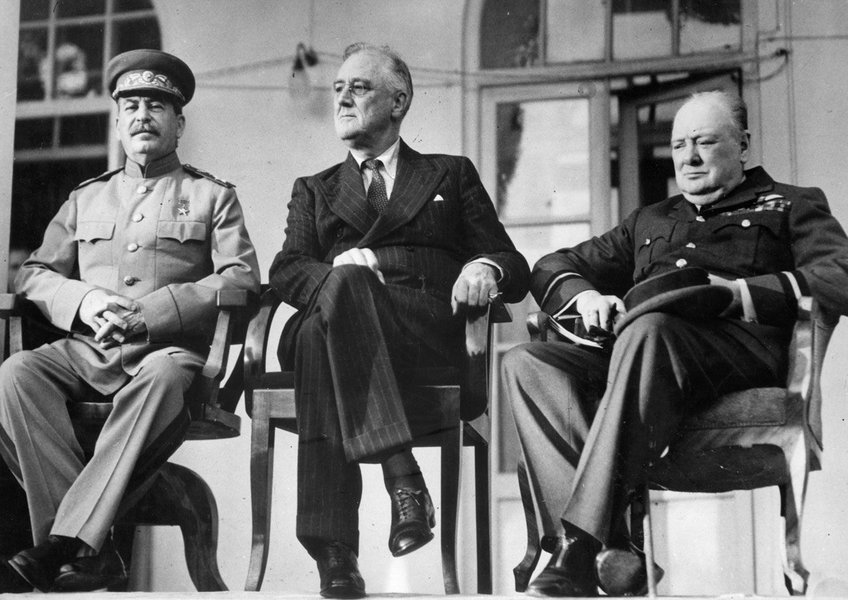
Joseph Stalin (center) alongside Franklin D. Roosevelt and Winston Churchill during the Tehran Conference, reflecting his prominent role during WWII.
Mechanisms and Themes of Wartime Propaganda
The Soviet propaganda machine under Stalin was vast and comprehensive, leveraging various media to ensure its messages permeated every aspect of Soviet society. The government's complete control over information was a defining characteristic, demonstrating its ambition to create a totalitarian state where public attitudes were shaped by official narratives.
Multifaceted Media Channels
Propaganda reached the population through an array of channels:
- Posters: These were perhaps the most visible form, displayed at special stands, often depicting scenes of heroism, national pride, and clear calls to action. They were designed to be easily understandable and emotionally evocative.
- Films and Radio Broadcasts: Cinema and radio were powerful tools for mass communication, used to boost morale, provide updates on the war front, and convey official narratives. Propaganda films focused on the strengthening of socialism and the USSR, as well as the heroic struggle against fascism.
- Newspapers and Literature: By the end of 1941, numerous propaganda newspapers were published in various languages, including German, targeting both internal and external audiences. Literature was also heavily censored and directed to promote socialist realism, focusing on workers and everyday situations that reinforced state ideology.
- Agitation Trains and Steamboats: These unique mobile units, equipped with presses and portable cinemas, traveled across the vast Soviet Union, informing, entertaining, and propagandizing the population in remote areas.
Thematic Pillars of Wartime Propaganda
Several key themes underpinned Soviet wartime propaganda:
- Patriotism and Nationalism: Emphasizing love for the "Motherland" and the historical legacy of Russian resilience against invaders (e.g., Napoleon) was paramount.
- Demonization of the Enemy: Nazis were consistently portrayed as ruthless, inhuman enemies, often caricatured, to incite hatred and justify the fight. This also included counter-propaganda against Nazi narratives, such as the poster questioning "The Stalin Constitution?" which attempted to link Stalin's regime to antisemitic tropes.
- Heroism and Sacrifice: Propaganda lauded the bravery of Soviet soldiers and ordinary citizens, encouraging sacrifice for the common cause.
- Industrial and Agricultural Mobilization: Messages like "Every swing of the hammer strikes the enemy" highlighted the importance of industrial and agricultural output for the war effort.
- Infallibility of Stalin: Despite the collective emphasis, Stalin was always the guiding force, his image used to symbolize victory and unwavering leadership.
The Pervasive Influence of Propaganda on Society
The Stalinist propaganda machine aimed not just to inform but to mold public opinion and behavior. While not capable of complete "brainwashing," it significantly influenced attitudes towards the regime and the war. It fostered an environment where even those who experienced the harsh realities of purges and forced labor often believed the official narrative that these were "corrective labor camps" necessary for the greater good.
The effectiveness of Soviet propaganda, even acknowledged by German intelligence, lay in its emotional appeal and relentless repetition. It did not shy away from inciting terror and fomenting hatred to achieve the state's economic, social, and political goals, especially in justifying violence against perceived "enemies of the people."
Impact on Public Morale and Participation
Propaganda played a vital role in maintaining morale under immense pressure. By constantly reinforcing patriotic feelings and the nobility of the war effort, it helped sustain public support even in the face of devastating losses. The collective nature of the struggle, often extended to include the "larger family" of workmates and fellow soldiers, became a focal point. Women, for instance, were encouraged to fill vacancies in agriculture and industry left by men serving at the front, with posters emphasizing the need to mobilize all resources for defense.
A Visual Representation of Propaganda's Pillars
To better understand the multifaceted nature of Stalin's wartime propaganda, the radar chart below visually represents the perceived emphasis on various thematic pillars. Each spoke of the radar chart corresponds to a core aspect of the propaganda, illustrating how different elements were prioritized and intertwined to achieve the regime's objectives during World War II.
As the chart illustrates, "Mobilization for War" and "National Unity & Patriotism" were at the forefront, reflecting the immediate existential threat. Simultaneously, "Stalin's Leadership Cult" remained a strong element, ensuring that the successes were attributed to his strategic brilliance. The "Demonization of Enemy" and "Optimism & Inevitable Victory" also scored highly, vital for maintaining morale and resolve. The "Justification of Violence," though present, was perhaps a more subtle or implicitly understood aspect of the wartime narrative.
Propaganda Techniques and Cultural Impact
Soviet propaganda under Stalin was not just about messages; it was about shaping an entire cultural landscape. The principles of socialist realism mandated that all art and culture served the state's ideological goals, ensuring a consistent and pervasive message.
Socialist Realism and Cultural Control
Stalin's 1932 decree "On the Reconstruction of Literary and Art Organization" placed socialist realism at the center of all creative endeavors. This artistic style, characterized by its optimistic depiction of communist life and heroic portrayal of workers, ensured that cultural output was accessible and aligned with state objectives. This artistic control extended to all forms, from grand sculptures to everyday illustrations in children's books and school textbooks, which often rewrote history to praise Stalin as Lenin's loyal assistant.
The Power of Repetition and Simplification
Propaganda relied heavily on repetition and simplification. Complex political ideas were distilled into easily digestible slogans and visual motifs. The class enemy was a pervasive feature, with continuous warnings from Stalin that the struggle to build a socialist society would intensify, requiring vigilance against "wreckers" and "enemies of the people." This simplification, coupled with strict censorship by Glavlit, prevented the articulation of alternative views and reinforced the official narrative.
The Role of Youth Organizations and Education
Organizations like the Komsomol (the Communist Youth League) and the education system were crucial conduits for propaganda. Children and young people were indoctrinated from an early age, inculcating "Soviet patriotism" and "fanatical love and defense of Comrade Stalin and our socialist motherland." School uniforms were reintroduced, and new textbooks glorified Stalin's role in history, ensuring that the next generation embraced the regime's ideology.
The Legacy of Stalin's Wartime Propaganda
The propaganda deployed during World War II under Stalin's leadership profoundly impacted the Soviet Union and its people. It played a significant role in mobilizing the nation for war, sustaining public morale, and bolstering Stalin's image as the supreme leader. The visual and thematic elements developed during this period became deeply ingrained in Soviet culture, influencing perceptions of heroism, sacrifice, and national identity for decades to come.
The video below offers further insights into the complexities of Stalin's leadership during World War II, including the pervasive use of propaganda and disinformation. It delves into how these elements shaped public perception and contributed to the Soviet war effort.
This video explores the legacy of Stalin's leadership during World War II, with a focus on his use of propaganda and its impact on the war effort and public perception.
Summary of Propaganda Shifts and Objectives
The table below summarizes the key shifts in Stalin's propaganda focus before and during World War II, highlighting the objectives and methods employed to achieve the regime's goals.
| Aspect | Pre-WWII Propaganda Focus | Wartime Propaganda Focus (WWII) |
|---|---|---|
| Primary Objective | Socialist industrialization, collectivization, political discipline, anti-class enemy campaigns. | National mobilization, defense of Motherland, sustaining morale, ensuring victory. |
| Stalin's Portrayal | "Father of Nations," wise teacher, benevolent leader, Lenin's loyal assistant. | Great Warrior, military strategist, Saviour of the nation, infallible leader guiding victory. |
| Key Themes | Economic progress, Five-Year Plans, class struggle, elimination of "enemies of the people." | Patriotism, national unity, heroism, demonization of Nazis, sacrifice for Motherland. |
| Media Emphasis | Posters, films, literature, new textbooks rewriting history. | Intense use of posters, films, radio, propaganda trains, multi-language newspapers. |
| Target Audience | Broad population, workers, peasants, youth. | All citizens, soldiers, industrial workers, occupied territories, international audiences. |
| Emotional Appeal | Optimism for new society, fear of internal enemies. | Patriotic fervor, hatred for invaders, hope for inevitable victory, resilience. |
Frequently Asked Questions
What was the primary goal of Soviet propaganda during WWII under Stalin?
How did wartime propaganda differ from pre-war propaganda?
What media did Stalin's regime use for wartime propaganda?
How did propaganda portray Joseph Stalin during the war?
Was Soviet propaganda successful in influencing the population?
Recommended Further Reading
- Explore how Stalin's cult of personality evolved and was sustained throughout World War II.
- Delve into the artistic movement of Socialist Realism and its function within Soviet propaganda.
- Understand the broader impact of World War II on Soviet society and cultural landscape.
- Analyze the similarities and differences between Soviet and Nazi propaganda strategies during WWII.
Referenced Search Results
 chariotjournal.wordpress.com