
Unveiling the Whirlwind: Crafting Your Starry Night Presentation
A comprehensive guide to outlining your talk on Van Gogh's most iconic masterpiece.
Vincent van Gogh's "The Starry Night" is more than just a painting; it's an emotional vortex captured on canvas, a dialogue between the artist's inner turmoil and the cosmic majesty he observed. Crafting a presentation about this iconic work requires delving into its creation, style, symbolism, and enduring legacy. This guide provides a detailed outline structure to help you present a compelling narrative.
Essential Highlights
- Context is Key: Understand that "Starry Night" was painted in June 1889 while Van Gogh was voluntarily staying at the Saint-Paul-de-Mausole asylum in Saint-Rémy-de-Provence, France, blending observation with intense imagination.
- Technique and Emotion Intertwined: Recognize Van Gogh's signature impasto technique and swirling brushstrokes as deliberate choices to convey powerful emotions and a dynamic sense of movement, characteristic of Post-Impressionism.
- Symbolism and Debate: Explore the rich, though often debated, symbolism, particularly the prominent cypress tree (traditionally linked to death and eternity) and the turbulent sky, often interpreted as reflecting the artist's mental state.
Structuring Your Presentation
A well-structured presentation flows logically, guiding your audience through the painting's multifaceted story. Here’s a suggested outline:
1. Introduction: Setting the Celestial Stage
Hooking Your Audience
Begin by highlighting the painting's universal recognition. Introduce Vincent van Gogh (1853-1890) as a pivotal Dutch Post-Impressionist painter. Present "The Starry Night" (oil on canvas, 1889) as arguably his most famous work and a cornerstone of modern art. Mention its current home: the Museum of Modern Art (MoMA) in New York City.
Key Facts
- Title: The Starry Night
- Artist: Vincent van Gogh
- Date: June 1889
- Medium: Oil on canvas
- Dimensions: 73.7 cm × 92.1 cm (29 in × 36 1⁄4 in)
- Location: Museum of Modern Art (MoMA), New York City
2. The Artist and His Asylum: Context of Creation
Van Gogh's Life in Saint-Rémy
Explain the circumstances surrounding the painting's creation. Van Gogh admitted himself to the asylum in Saint-Rémy-de-Provence in May 1889 following periods of intense mental distress, including the infamous ear-cutting incident in Arles. Despite his confinement and struggles, this period was remarkably productive; alongside "Starry Night," he painted works like "Irises."
The View from the Window
Detail the painting's perspective: it depicts the view from Van Gogh's east-facing asylum window just before sunrise. Crucially, emphasize that while the landscape elements like the rolling hills are based on the view, the village nestled below is largely imaginary, possibly inspired by his memories of the Netherlands or other sketches. This blend of observation and invention is central to the work.
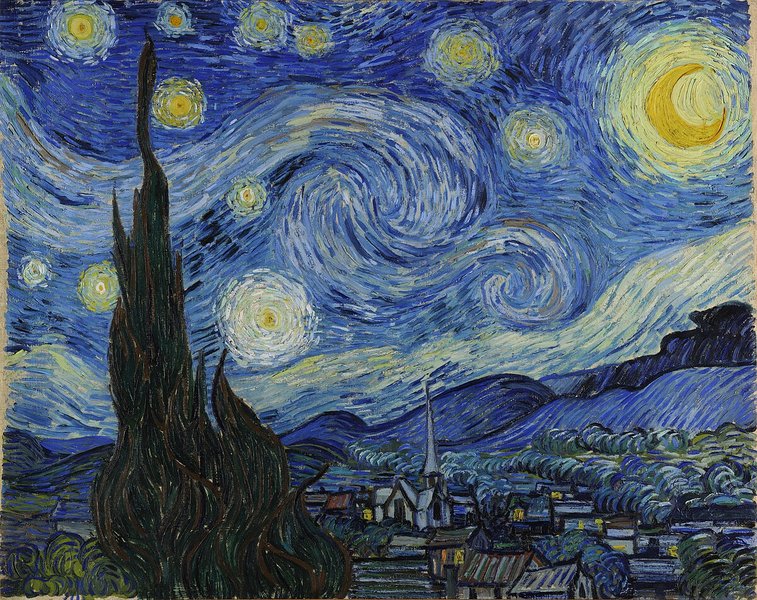
Vincent van Gogh's "The Starry Night" (1889), oil on canvas.
3. Deconstructing the Canvas: Composition and Elements
The Dominating Sky
Analyze the most captivating part: the turbulent night sky. Describe the swirling clouds, the luminous crescent moon, and the intensely bright stars (including what is likely Venus, the "morning star," visible to the left of the cypress). The sky takes up roughly two-thirds of the canvas, emphasizing its power and Van Gogh's fascination with the cosmos.
The Enigmatic Cypress
Focus on the large, dark, flame-like cypress tree dominating the left foreground. It acts as a visual link between the earth and the sky. Discuss its traditional association with death and cemeteries in European culture, but also note that its upward reach could symbolize connection, aspiration, or eternal life. Van Gogh's specific intention remains debated among art historians.
The Quiet Village and Rolling Hills
Describe the village below, rendered in darker, cooler tones (grays, browns, blues) with black outlines, contrasting sharply with the vibrant sky. The steeple of the church pierces the horizon, perhaps representing stability or Van Gogh's complex relationship with religion. The rolling hills provide a dynamic, yet more grounded, rhythm compared to the celestial chaos above.
4. Master Strokes: Artistic Style and Technique
Post-Impressionism in Motion
Position "Starry Night" within the Post-Impressionist movement, which emphasized subjective emotion and symbolic content over the Impressionists' focus on light and naturalistic depiction. Van Gogh pushed these boundaries further, using art to express his intense inner world.
Impasto and Brushwork
Explain Van Gogh's characteristic use of impasto – applying paint thickly, often straight from the tube, so that brushstrokes are visible and create texture. Discuss how the short, directional, often swirling strokes animate the canvas, especially in the sky and cypress tree, conveying energy and turbulence.
Color and Contrast
Detail the bold color choices, particularly the juxtaposition of deep blues and indigos with vibrant yellows and whites. This contrast creates visual tension and enhances the emotional impact, making the celestial bodies pop against the dark expanse. Van Gogh was experimenting with color's expressive potential.
Influence and Imagination
Mention Van Gogh's experimentation during this period, potentially influenced by medieval woodcuts (suggested by the thick outlines and simplified forms) and the artistic ideas of contemporaries like Gauguin and Bernard, who encouraged painting from memory and imagination. He wrote to his brother Theo about the challenges and desires of painting night scenes, confirming the imaginative element.
Comparative Analysis of Key Aspects
This chart provides a visual comparison of different facets of "The Starry Night," reflecting its profound impact and artistic qualities based on critical interpretation. The scores are subjective estimations reflecting the prominence of each aspect within art historical discourse.
The chart highlights the painting's exceptional cultural recognition and emotional impact, alongside its significant technical innovation, color use, and influence. While rich in symbolism, its interpretation remains somewhat more debated compared to its overt visual power.
Visualizing the Themes: A Mindmap
This mindmap provides a conceptual overview of the core themes and elements connected to "The Starry Night," helping to visualize the relationships between the artist's life, the painting's features, and its interpretation.
(Vincent van Gogh, 1889)"] id1["Artist & Context"] id1a["Vincent van Gogh
(Post-Impressionist)"] id1b["Saint-Rémy Asylum Stay
(June 1889)"] id1c["Mental Health Struggles"] id1d["View from Window
(Observation + Imagination)"] id2["Visual Elements"] id2a["Turbulent Sky
(Swirls, Stars, Moon)"] id2b["Flame-like Cypress Tree"] id2c["Imaginary Village"] id2d["Church Steeple"] id2e["Rolling Hills"] id3["Artistic Technique"] id3a["Impasto (Thick Paint)"] id3b["Dynamic Brushstrokes"] id3c["Bold Color Contrast
(Blue/Yellow)"] id3d["Expressive Lines/Outlines"] id3e["Post-Impressionist Style"] id4["Symbolism & Interpretation"] id4a["Cypress: Death/Eternity?"] id4b["Sky: Emotion/Turmoil?"] id4c["Village: Peace/Isolation?"] id4d["Nature & Cosmos"] id4e["Religious Undertones?"] id5["Legacy & Impact"] id5a["Icon of Modern Art"] id5b["Cultural Recognition"] id5c["Influence on Artists"] id5d["Location: MoMA, NYC"] id5e["Popular Culture Presence"] id5f["Educational Use"]
This mindmap connects the central artwork to the key areas discussed: the artist's personal context, the specific visual components, the techniques employed, the layers of meaning, and the painting's lasting significance.
5. Unraveling the Meaning: Symbolism and Interpretations
Emotional Landscape
Discuss how the painting is often read as a direct expression of Van Gogh's turbulent emotional state. The swirling, energetic sky contrasts with the peaceful village, perhaps reflecting his inner conflict or a search for solace amidst chaos. However, caution against overly simplistic biographical interpretations; Van Gogh was also deeply interested in the aesthetic and spiritual power of nature and the night sky.
Decoding the Symbols
Revisit the cypress tree and its potential meanings (death, connection, aspiration). Discuss the stars and moon – are they purely observational, or do they hold deeper spiritual significance for Van Gogh? Some analyses have explored potential religious symbolism (e.g., relating the number of stars to biblical passages), though these are speculative. Mention Van Gogh's famous quote, "Looking at the stars always makes me dream," hinting at his personal connection to the cosmos, though the full quote relates dreaming of stars to thoughts of death.
Scientific Resonance
Interestingly, some modern analyses have noted the similarity between the swirling patterns in the sky and scientific illustrations of turbulence in fluid dynamics. While Van Gogh wouldn't have known this science, it speaks to his intuitive ability to capture complex, dynamic natural phenomena.
6. Enduring Brilliance: Cultural Impact and Legacy
From Obscurity to Icon
While not immediately famous during his lifetime, "The Starry Night" gained immense recognition posthumously. Explain its journey to becoming one of the most famous and beloved paintings globally. Its estimated value is often cited as over $100 million, but it's considered priceless due to its cultural significance.
Influence and Inspiration
Discuss its profound influence on subsequent art movements and individual artists. Highlight its pervasive presence in popular culture – appearing in films, music, merchandise, and countless reproductions. It's frequently used in art education, with many resources available for studying or recreating it.
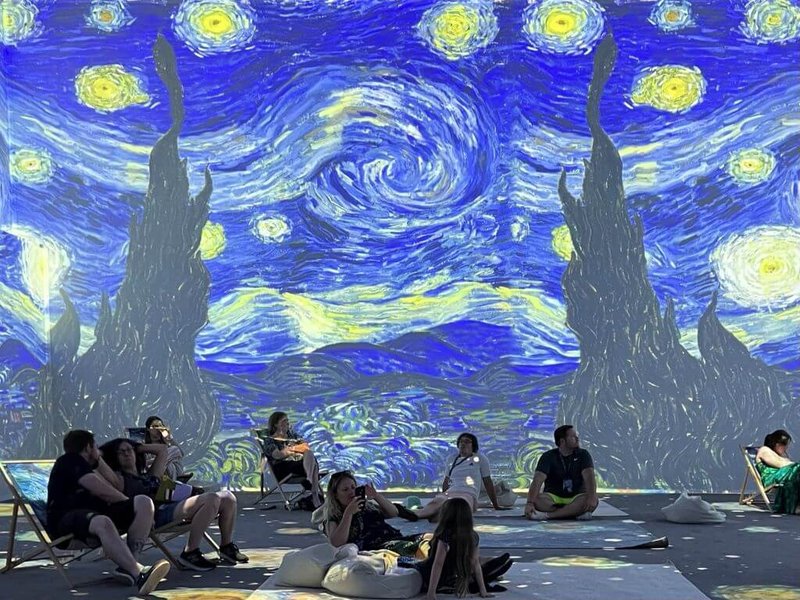
Modern immersive exhibitions bring Van Gogh's work, including "Starry Night," to new audiences.
7. Conclusion: The Everlasting Dream
Summarizing the Masterpiece
Recap the key points: the painting's context, its unique blend of observation and emotion, Van Gogh's innovative techniques, the layers of symbolism, and its enduring legacy. Reiterate its importance as a bridge between the artist's inner world and the external universe.
Final Thought
Conclude by reflecting on why "The Starry Night" continues to captivate viewers worldwide – perhaps its raw emotional honesty, its dynamic beauty, or its universal themes of wonder, struggle, and the search for meaning in the cosmos. End with Van Gogh's sentiment about dreaming under the stars, leaving the audience with the painting's powerful resonance.
Step-by-Step Painting Tutorial
Visual aids can greatly enhance your presentation. Consider showing close-ups of the brushwork or even a short video demonstrating the techniques Van Gogh used. This tutorial provides a step-by-step guide to painting "Starry Night," which can offer insights into the layering and brush techniques involved.
This video, "How to Paint Starry Night | Step by step | Van Gogh Art Lesson," breaks down the process of recreating the painting using acrylics. Watching sections of it can help illustrate the complexity of the impasto technique, the layering of colors, and the creation of the swirling effects that define the artwork.
Quick Facts Table
This table summarizes the essential information about "The Starry Night" for easy reference during your presentation.
| Aspect | Details |
|---|---|
| Artist | Vincent van Gogh |
| Year Completed | June 1889 |
| Medium | Oil on canvas |
| Dimensions | 73.7 cm × 92.1 cm (29 in × 36 1⁄4 in) |
| Location Created | Saint-Paul-de-Mausole asylum, Saint-Rémy-de-Provence, France |
| Current Location | Museum of Modern Art (MoMA), New York City |
| Artistic Movement | Post-Impressionism |
| Key Elements | Swirling sky, cypress tree, crescent moon, stars (Venus), imaginary village, church steeple |
| Key Techniques | Impasto, dynamic brushstrokes, strong color contrast (blue/yellow), expressive lines |
| Primary Subject | View from asylum window (pre-dawn) combined with imagination |
Frequently Asked Questions (FAQ)
Was the village in Starry Night real?
No, the village depicted in "The Starry Night" is largely considered imaginary. While the general landscape and hills were inspired by the view from Van Gogh's asylum window in Saint-Rémy-de-Provence, the specific village arrangement, particularly the prominent church steeple, does not match the actual view. It's believed Van Gogh added the village from memory, possibly recalling scenes from his native Netherlands, or from sketches, blending reality with his imaginative vision.
What does the cypress tree symbolize?
The symbolism of the cypress tree is debated. Traditionally in European culture, cypress trees are associated with death and mourning, often planted in cemeteries. Given Van Gogh's mental state and his later death, some interpret it this way. However, its flame-like shape reaching towards the sky can also suggest aspiration, connection between earth and heaven, or eternal life. Van Gogh himself admired cypress trees for their structure. Without explicit confirmation from the artist, its meaning remains open to interpretation, likely embodying multiple, perhaps even contradictory, ideas.
Why is Starry Night so famous?
"The Starry Night" is famous for several reasons: its striking and unique visual style with swirling brushstrokes and vivid colors; its powerful emotional resonance, often interpreted as reflecting Van Gogh's intense inner life; its status as a key work of Post-Impressionism and modern art; and the compelling story of its creator, Vincent van Gogh, whose life and struggles fascinate many. Its acquisition by MoMA and subsequent widespread reproduction have cemented its iconic status in global culture.
Did Van Gogh paint this outside at night?
No, Van Gogh did not paint "The Starry Night" outdoors at night. Although he was interested in capturing night scenes and had painted outdoors at night previously (like "Starry Night Over the Rhône"), conditions at the asylum and the practical difficulties of painting in the dark meant "The Starry Night" was created during the day in his studio room. He worked from memory, sketches, and the observations made from his window, allowing his imagination and emotions to shape the final composition.
Recommended Further Exploration
- Explore the relationship between Van Gogh's mental health and his artistic output during the Saint-Rémy period.
- How did Post-Impressionism differ from Impressionism, using Van Gogh as an example?
- Analyze the use of color theory in Van Gogh's Starry Night.
- Compare Van Gogh's Starry Night with his earlier night painting, Starry Night Over the Rhône.
References
 practicalpages.wordpress.com
practicalpages.wordpress.com
practicalpages.wordpress.com
practicalpages.wordpress.com
practicalpages.wordpress.com
Last updated May 3, 2025