
Unlocking the Power of Value Functions: How Reinforcement Learning Agents Evaluate Their World
Discover how state value functions (V) and action value functions (Q) drive decision-making in reinforcement learning systems
Key Insights into Value Functions
- Value functions quantify future rewards - They help agents evaluate the expected long-term return from states or actions
- State value functions (V) measure state quality - They tell us how "good" it is to be in a specific state when following a policy
- Action value functions (Q) measure action quality - They tell us how "good" it is to take a specific action from a specific state
Understanding Value Functions in Reinforcement Learning
In reinforcement learning (RL), agents learn to make decisions by interacting with an environment and receiving rewards. To make optimal decisions, agents need a way to evaluate states and actions. This is where value functions come in - they're mathematical tools that help quantify the "goodness" of states or actions in terms of expected future rewards.
There are two primary types of value functions that serve distinct purposes in the RL framework: state value functions and action value functions. Understanding these functions is fundamental to grasping how reinforcement learning algorithms work.
What are Value Functions?
At their core, value functions estimate the expected cumulative rewards an agent can achieve starting from a particular state or taking a specific action. They allow agents to evaluate different states and actions in terms of their long-term value, helping to guide decision-making processes.
The State Value Function (V)
The state value function, denoted as V(s) or Vπ(s) when associated with a specific policy π, estimates the expected return (cumulative discounted reward) when starting from state s and following policy π thereafter.
Mathematically, it's expressed as:
\[ V^{\pi}(s) = \mathbb{E}_{\pi} [G_t | S_t = s] \]Where:
- Gt is the return at time t (the total discounted reward from time t onwards)
- St represents the state at time t
- π is the policy being followed
- 𝔼π denotes the expectation when following policy π
Intuitively, V(s) tells us how good it is to be in state s when following policy π. Higher V(s) values indicate states with better expected long-term returns.
The Action Value Function (Q)
The action value function, denoted as Q(s, a) or Qπ(s, a), estimates the expected return when taking action a in state s and then following policy π thereafter.
Mathematically, it's expressed as:
\[ Q^{\pi}(s, a) = \mathbb{E}_{\pi} [G_t | S_t = s, A_t = a] \]Where:
- Gt is the return at time t
- St represents the state at time t
- At represents the action taken at time t
- π is the policy being followed
- 𝔼π denotes the expectation when following policy π
Intuitively, Q(s, a) tells us how good it is to take action a in state s and then follow policy π. Higher Q(s, a) values indicate better state-action pairs in terms of expected long-term returns.
The Critical Relationship Between V and Q
The state value function V(s) and action value function Q(s, a) are closely related. In fact, V(s) can be derived from Q(s, a) as follows:
\[ V^{\pi}(s) = \sum_{a} \pi(a|s) \cdot Q^{\pi}(s, a) \]This equation shows that the value of a state under policy π is the expected value of the action values Q(s, a) when actions are selected according to policy π. Essentially, V(s) is the weighted average of Q(s, a) values, where the weights are the probabilities of taking each action according to policy π.
Value Functions in Action: Practical Examples
Example: A Robot Navigation Task
Consider a robot learning to navigate through a maze to find a charging station. In this scenario:
- States (s): Different positions in the maze
- Actions (a): Move forward, turn left, turn right, etc.
- Rewards: Small negative rewards for each step (representing energy consumption), large positive reward for reaching the charging station
The state value function V(s) would tell the robot how valuable each position in the maze is - positions closer to the charging station would typically have higher values than positions that are farther away or lead to dead ends.
The action value function Q(s, a) would tell the robot the value of taking each possible action from each position. For example, from a position near a dead end, turning around might have a higher Q-value than continuing forward.
Example: Playing Chess
In a chess game:
- States (s): Different board configurations
- Actions (a): Legal chess moves
- Rewards: +1 for winning, -1 for losing, 0 for draw
The state value function V(s) would estimate how likely the player is to win from a given board position when following their policy. Favorable positions would have higher V-values.
The action value function Q(s, a) would estimate how likely the player is to win if they make a specific move from a given position and then follow their policy. Better moves would have higher Q-values.
Visualizing Value Function Properties
Comparative Analysis of Value Functions
The radar chart below compares various properties of state value functions (V) and action value functions (Q) across different dimensions. This visualization helps understand when each type of value function might be more appropriate to use:
As we can see from the radar chart, state value functions (V) excel in memory efficiency and learning speed, as they only need to store values for states rather than state-action pairs. On the other hand, action value functions (Q) are superior for direct action selection and perform better in model-free settings where the environment dynamics are unknown.
Conceptual Framework of Value Functions
The following mindmap illustrates the conceptual framework of value functions in reinforcement learning, showing how they relate to other key concepts in the field:
Mathematical Foundations: The Bellman Equations
The Bellman equations provide the mathematical foundation for computing value functions. They express value functions recursively in terms of expected immediate rewards and future values.
Bellman Equation for State Value Function
The Bellman equation for the state value function is:
\[ V^{\pi}(s) = \sum_{a} \pi(a|s) \sum_{s', r} p(s', r|s, a) [r + \gamma V^{\pi}(s')] \]Where:
- π(a|s) is the probability of taking action a in state s under policy π
- p(s', r|s, a) is the probability of transitioning to state s' and receiving reward r when taking action a in state s
- γ (gamma) is the discount factor that determines how much future rewards are valued compared to immediate rewards
Bellman Equation for Action Value Function
The Bellman equation for the action value function is:
\[ Q^{\pi}(s, a) = \sum_{s', r} p(s', r|s, a) [r + \gamma \sum_{a'} \pi(a'|s') Q^{\pi}(s', a')] \]Where:
- p(s', r|s, a) is the probability of transitioning to state s' and receiving reward r when taking action a in state s
- π(a'|s') is the probability of taking action a' in state s' under policy π
- γ (gamma) is the discount factor
Optimal Value Functions
The optimal value functions, denoted as V*(s) and Q*(s, a), represent the maximum possible expected return achievable from any state or state-action pair. They satisfy the Bellman optimality equations:
\[ V^*(s) = \max_{a} \sum_{s', r} p(s', r|s, a) [r + \gamma V^*(s')] \] \[ Q^*(s, a) = \sum_{s', r} p(s', r|s, a) [r + \gamma \max_{a'} Q^*(s', a')] \]The optimal policy can be derived from the optimal value functions by selecting actions that maximize the expected return.
Comparative Analysis: When to Use Each Value Function
Understanding when to use state value functions versus action value functions is crucial for designing effective reinforcement learning systems. The table below provides a comprehensive comparison to guide your choice:
| Characteristic | State Value Function (V) | Action Value Function (Q) |
|---|---|---|
| Memory Requirements | Lower (stores value per state) | Higher (stores value per state-action pair) |
| Learning Speed | Typically faster due to fewer parameters | Typically slower due to more parameters |
| Model Requirement | Requires model for action selection | No model needed for action selection |
| Policy Extraction | Requires additional computation to derive policy | Policy can be directly extracted (e.g., by selecting max Q-value) |
| Exploration Strategy | Less direct implementation of exploration | Naturally supports exploration strategies (e.g., ε-greedy) |
| Typical Algorithms | Policy Iteration, Value Iteration | Q-Learning, SARSA, Deep Q-Networks |
| Function Approximation | Works well with simpler function approximators | Often used with complex function approximators (e.g., neural networks) |
| Best Use Cases | Known environment dynamics, simpler state spaces | Unknown environment dynamics, complex environments, off-policy learning |
Value Functions in Modern Reinforcement Learning Algorithms
Value functions are the backbone of many modern reinforcement learning algorithms. Here's how they're used in some popular approaches:
Value-Based Methods
These methods directly learn value functions and derive policies from them:
- Q-Learning: A model-free algorithm that learns the optimal action value function Q*(s, a) directly, without needing to learn the transition model of the environment.
- Deep Q-Networks (DQN): Combines Q-learning with deep neural networks to approximate the action value function, enabling RL in high-dimensional state spaces like Atari games.
- SARSA: Similar to Q-learning but follows an on-policy approach, updating Q-values based on the policy being followed.
Policy-Based Methods
These methods learn the policy directly, but often use value functions for policy evaluation:
- Policy Gradient Methods: Use value functions to estimate the expected return and guide the policy optimization process.
- Actor-Critic Methods: Combine policy-based and value-based approaches, where the "critic" uses value functions to evaluate the "actor's" policy.
Model-Based Methods
These methods learn a model of the environment and use value functions for planning:
- Dynamic Programming: Uses Bellman equations to compute optimal value functions when the environment model is known.
- Monte Carlo Tree Search: Uses value estimates to guide the search for optimal actions in a decision tree.
Visual Explanations of Value Functions
The following video provides an excellent visual explanation of value functions in reinforcement learning:
This video breaks down the concepts of state and action value functions in an approachable way, using clear examples to illustrate how these functions help reinforcement learning agents evaluate states and actions.
Visual Representations of Value Functions
The following images show visual representations of value functions in different reinforcement learning scenarios, helping to illustrate how these functions guide decision-making:
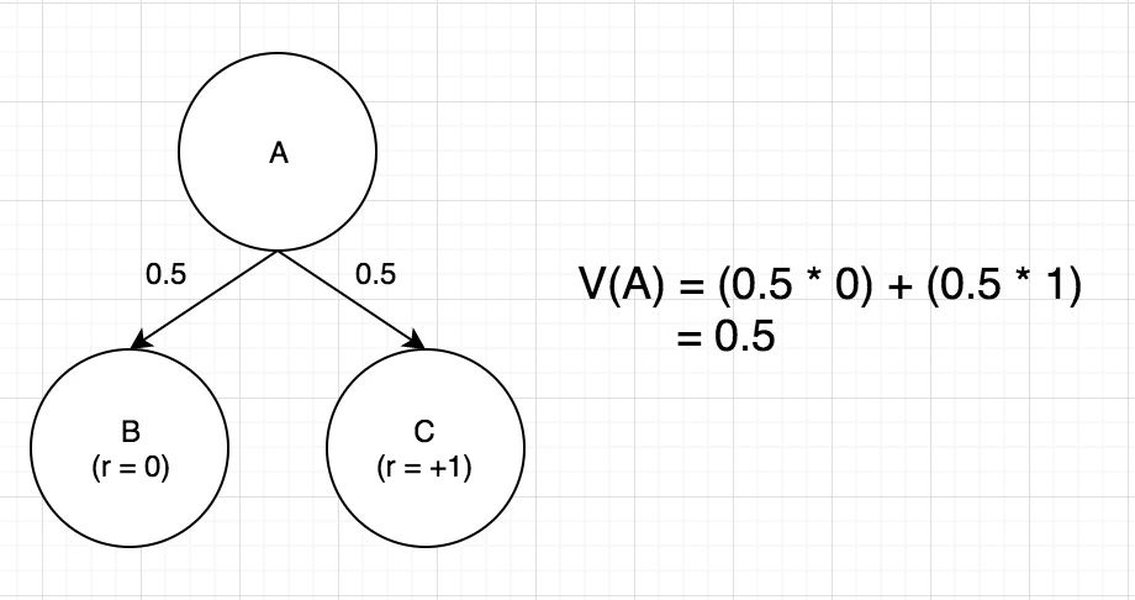
A visualization of state value functions in a grid world environment. Brighter colors indicate higher value states.
Illustration of the relationship between state value functions and action value functions.
Frequently Asked Questions
References
- Reinforcement Learning Value Function: A Detailed Analysis - LinkedIn
- A Brief Explanation of State-Action Value Function (Q) in RL - Medium
- Spinning Up in Deep RL: Introduction to RL - OpenAI
- Action/State Value Functions, Bellman Equations, Optimal Functions - Gurpreet AI
- When to Use the State Value Function vs. Action Value Function - AI Stack Exchange
- Reinforcement Learning — The Value Function - Hong Jing
- An Introduction to Q-Learning Part 1 - Hugging Face
Recommended Explorations
Last updated April 9, 2025