
D. Structure-Oriented Methodologies
Exploring the Core Concepts and Applications in System Design
Key Takeaways
- Foundation of Organization: These methodologies emphasize system structure, breaking down complex problems into manageable components.
- Systematic Analysis and Design: A focus on data flow, control hierarchies, and the interrelationships of system components ensures clarity in design.
- Versatility in Application: They are applied across diverse domains, from software engineering to business process modeling, yielding optimized, maintainable systems.
Introduction
Structure-oriented methodologies are a category of systematic approaches that prioritize the architectural arrangement of systems. By focusing primarily on the organization of data, processes, and their interrelationships, these methodologies seek to provide an underlying framework that facilitates both the analysis and design phases of system development. Whether in the context of software engineering or broader applications such as organizational design, the core idea remains the same: understanding the inherent structure of the problem space leads to more efficient, comprehensible, and maintainable solutions.
Historical Background and Evolution
Originating in the 1970s, structure-oriented methodologies emerged as a response to the growing complexity in the design and implementation of information systems. Early software projects frequently encountered costly errors and unpredictable design outcomes. To address these challenges, pioneers in the field began emphasizing a systematic breakdown of systems into clearly defined components. Early methods such as Structured Analysis and Design Techniques (SADT) and Data Flow Diagrams (DFDs) laid the groundwork for how these approaches evolved.
During these formative years, the importance of mapping data interactions and control flows became central to designing systems that were not only functionally sound but also easier to maintain and enhance. Over time, the principles embedded within structure-oriented methodologies have influenced other design paradigms, including object-oriented design, which further integrate the concept of modularity and data encapsulation.
Core Concepts of Structure-Oriented Methodologies
1. Emphasis on System Organization
At the heart of structure-oriented methodologies is the need to thoroughly understand and organize the various components of a system. This involves:
Data Structure Evaluation
The first step in many structure-oriented methods is to evaluate the data structures that will underlie the system. This includes understanding data hierarchies, the relationships between different data items, and how these relationships influence processing requirements.
Data Representation and Decomposition
Systems are often analyzed by breaking them down into simpler components. Functional decomposition or top-down design is a common strategy where a system is divided into smaller modules. These modules can be further refined until the basic building blocks are identified. This step-by-step refinement (or stepwise refinement) allows designers to iteratively develop a complete and detailed system plan.
A well-structured decomposition enables designers to create accurate models that detail the flow of data and elucidate the relationships among various system parts, leading to robust procedural descriptions and a coherent control hierarchy.
2. Mapping Data to Control Structures
Once the essential data structures are evaluated, the next challenge is constructing the control framework that orchestrates these data flows. The goal is to define how data moves through the system and how it gets processed.
Control Hierarchy Mapping
In structure-oriented methodologies, control hierarchies are mapped to represent the sequence, repetition, and conditional operations evident in the system. This mapping helps in visualizing how different modules interact, ensuring that data processing is both ordered and efficient.
Diagrammatic Representations
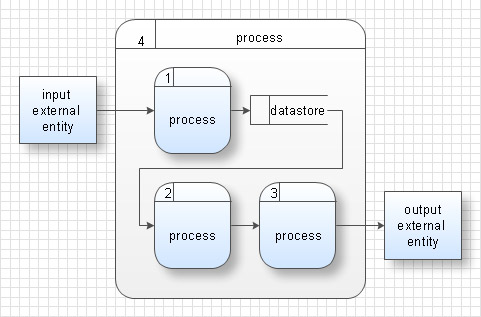
Tools like Data Flow Diagrams (DFDs) are widely used as they provide a clear visual overview of how information is transformed and transferred between system modules. Alongside DFDs, structure charts can further detail the relationships between program modules, presenting a hierarchical view of the software system.
3. Refinement and Procedural Description
After establishing the basic data and control structures, refinement ensures that the system is decomposed to a level where each component's function is well understood and clearly documented.
Stepwise Refinement
This process involves breaking larger processes into increasingly detailed steps, ensuring that each module can be developed, analyzed, and tested independently. A refined control hierarchy and detailed procedural descriptions are critical in achieving an efficient, bug-resistant system design.
Role in Software Design Methodology
The refinement process is vital in reducing potential design errors by ensuring that all aspects of system functionality are addressed from the outset. This systematic approach not only minimizes costly revisions later in the development cycle but also sets a clear direction for subsequent phases such as coding and testing.
Comparison with Other Methodologies
While structure-oriented methodologies primarily focus on the organization and representation of data structures and control hierarchies, it is useful to compare them with related approaches:
Process-Oriented Methodologies
Process-oriented methodologies emphasize the sequences and operations performed within a system. Instead of focusing on the static structure, these methodologies deal more with the “flow” of operations, making them ideal for applications where the transformation of data is critical.
Object-Oriented Methodologies
Object-oriented approaches differ by integrating both data and behavior into unified entities known as objects. While structure-oriented methodologies stress the mapping of data relationships into control structures, object-oriented methodologies encapsulate these components to promote reusability, modularity, and iterative development.
In practice, many modern systems adopt a hybrid approach, combining the clarity of structure-oriented methods with the flexibility of object-oriented designs. This integration allows for a more comprehensive model that can cater to both the complexity of data organization and the dynamism introduced by iterative design and continuous change.
Practical Applications Across Domains
The principles of structure-oriented methodologies are not confined to software engineering alone. They have broad applications in numerous fields:
Software Engineering
In software development, structuring systems to reflect data interrelationships and control hierarchies is critical. For instance, methodologies such as Structured Analysis have become a mainstay in large-scale projects where clear, modular organization can significantly reduce development errors and improve maintainability. Breaking down a complex system into manageable parts allows teams to work in parallel, coordinated by diagrams and standardized notations.
Systems Engineering
Beyond traditional software applications, systems engineering often utilizes structure-oriented strategies to manage the interplay between various subsystem components. This approach assists in coordinating hardware and software elements, ensuring seamless integration across the overall system architecture.
Business Process Modeling and Organizational Design
In the realm of business process modeling, structure-oriented methods are key for visualizing workflows and identifying interdependencies among various business processes. Creating structured models helps in streamlining operations, clarifying role designations, and identifying potential bottlenecks in organizational communication.
Other Domains
These methodologies are equally valuable in specialized contexts such as healthcare management, curriculum design, and even emergency room operations, where systematic organization of complex procedures and information is crucial. By structuring tasks and data flows accurately, organizations can enhance efficiency and adapt more rapidly to changes.
Benefits and Limitations
Benefits
The advantages of employing structure-oriented methodologies are numerous:
Enhanced Clarity
Systematic organization and the use of diagrammatic representations, such as DFDs and structure charts, lead to a deeper understanding of complex systems. This clarity helps in identifying potential issues and simplifying the design process.
Improved Communication
When complex systems are broken down into smaller, clearly defined modules, it becomes easier for teams to collaborate. The visual models and standardized notation serve as a common language among various stakeholders, including developers, engineers, and project managers.
Ease of Maintenance and Scalability
A well-organized system is inherently easier to update. When changes are needed, the modular design allows developers to target specific areas without destabilizing the entire architecture. This attribute also supports scalability as systems grow in complexity.
Risk Mitigation
By identifying the interdependencies within the system early on, designers can foresee potential design flaws or integration issues. Early detection of these risks translates into fewer errors during later stages of development.
Limitations
Despite the many benefits, structure-oriented methodologies are not without their limitations:
Rigidity in Early Stages
Since many of these methodologies rely on a top-down approach and detailed preliminary models, there can be reduced flexibility in accommodating later changes. Early design decisions heavily influence the subsequent phases, which might lead to increased overhead if requirements evolve.
Overemphasis on Structure Over Behavior
These methods can sometimes focus too much on static data structures, which may neglect the dynamic aspects of system behavior. In rapidly changing environments, a purely structure-oriented approach might prove to be less adaptive compared to methodologies that integrate both workflow and data representation.
Complexity in Representing Non-Hierarchical Data
Systems that do not exhibit clear hierarchical relationships can challenge the assumptions underlying structure-oriented methodologies. In such cases, reconciling the design with non-hierarchical data flows may necessitate additional modeling techniques.
Integrating Structure-Oriented Methodologies with Other Approaches
Modern system development often benefits from a hybrid approach. Structure-oriented methodologies may be integrated with other design paradigms to capitalize on the strengths of each:
Combination with Object-Oriented Design
While structure-oriented approaches provide a clear blueprint of data hierarchies and control flows, object-oriented design adds flexibility via encapsulation, inheritance, and polymorphism. Combining these techniques can lead to robust architectures that support the iterative and evolving nature of software projects.
For example, designers might begin with a structure-oriented analysis to establish core system frameworks and then apply object-oriented principles to define objects that encapsulate specific behaviors and data. This eventual merging allows for both a stable high-level design and adaptive, reusable software components.
Integration with Process-Oriented Methods
Alternatively, a hybrid approach integrating process-oriented and structure-oriented methodologies can be used. This offers the benefits of a clear data organizational framework combined with a keen focus on the operational flow of system functions. Such integration is particularly useful in domains where both the static and dynamic aspects of a system are equally critical.
Illustrative Table: Comparison of Key Methodology Characteristics
| Characteristic | Structure-Oriented Methodologies | Alternate Approaches |
|---|---|---|
| Primary Focus | Data organization, control hierarchies, system decomposition | Process flows (Process-Oriented); Encapsulation of data and behavior (Object-Oriented) |
| Analysis Method | Top-Down Decomposition, Stepwise Refinement | Iterative prototyping, Component reusability |
| Diagrammatic Tools | Data Flow Diagrams (DFDs), Structure Charts | Workflow Diagrams, Unified Modeling Language (UML) Diagrams |
| Primary Benefit | Enhanced clarity, maintainability, and communication across teams | Flexibility, dynamic adaptation, and code reusability |
| Limitations | Potential rigidity and complexity in non-hierarchical systems | May lack detailed structural clarity in early phases |
Practical Steps for Implementing Structure-Oriented Methodologies
Transitioning to a structure-oriented approach typically involves several key phases:
Initial Data Analysis
Begin by thoroughly analyzing the nature of the data to be processed. Identify data types, hierarchical relationships, and key functional requirements. Whether the data is repetitive, sequential, or conditional will determine the necessary control structures.
Developing the Data Model
Create precise models that reflect the data, its interactions, and the expected outputs. Visual tools such as DFDs and structure charts are especially useful during this stage to capture a holistic view of the system.
Mapping to a Control Hierarchy
With a clear data model in place, the next step is to design the control hierarchy. This process involves defining modules in a way that mirrors the structure of the data model, ensuring that logical sequences, iterations, and decision points are properly mapped out.
Iterative Refinement and Testing
Once the initial design is complete, adopt an iterative refinement process. Each module should be independently validated through testing and rigorous reviews. This exercise not only helps in identifying discrepancies but also in ensuring that the system meets all specified requirements.
Iterative testing, coupled with constant recalibration based on feedback, is critical to minimizing design errors and ensuring that the final implementation remains robust in the face of future changes.
Conclusion
In summary, structure-oriented methodologies provide a disciplined and systematic approach to system design. By focusing on data organization, control hierarchy mapping, and iterative refinement, these methodologies lay the foundation for creating systems that are clear, maintainable, and scalable. The core advantages lie in enhanced clarity, improved communication, and the ability to manage complexity through modular design. Moreover, when integrated with other methodologies such as object-oriented and process-oriented approaches, the benefits are amplified, leading to comprehensive and evolution-ready solutions. While potential limitations such as rigidity and initial overemphasis on static structure exist, thoughtful application and customization of these methodologies can mitigate many of these issues, producing systems that effectively balance clarity and flexibility.
References
Data Structure Oriented Design – MyRajendrak Blog
Survey on Structure-Oriented Methodologies – UMBC
Structured Design – ScienceDirect
Analysis of Structure-Oriented Models – PubMed
Structure-Oriented versus Process-Oriented – LWW Journals
Learn More
How can structure-oriented methodologies improve software system design?
What are the advantages of integrating structure-oriented and object-oriented design approaches?
What are the key steps in implementing a structure-oriented design process?
Last updated February 18, 2025