
Comprehensive Calibration Workflow for the SUMMA Hydrological Model
Optimizing Hydrological Simulations for Accurate Watershed Management
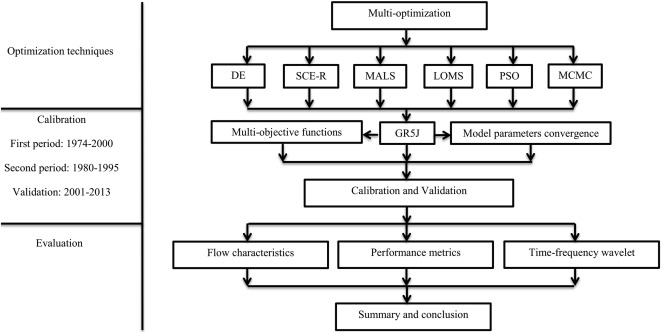
Key Takeaways
- Define clear objectives and select appropriate performance metrics to guide the calibration process.
- Prepare and preprocess all necessary data to ensure consistency and quality for modeling.
- Employ systematic calibration methods and validate the model to achieve robust and reliable results.
1. Define Calibration Objectives and Performance Metrics
Establishing Clear Goals
Begin by identifying the primary objectives of the calibration process. This could include optimizing streamflow predictions, enhancing evapotranspiration modeling, or improving snowmelt simulations. Clear objectives will guide the selection of appropriate performance metrics and calibration strategies.
Select objective functions that best reflect your calibration priorities. Commonly used metrics in hydrological modeling include:
- Nash-Sutcliffe Efficiency (NSE): Measures how well the model predictions match the observed data. Calculated as:
$$\text{NSE} = 1 - \frac{\sum(O_t - S_t)^2}{\sum(O_t - \overline{O})^2}$$
- Root Mean Square Error (RMSE): Represents the square root of the average of squared differences between predicted and observed values. Calculated as:
$$\text{RMSE} = \sqrt{\frac{1}{N} \sum(O_t - S_t)^2}$$
Where \( O_t \) is the observed value, \( S_t \) is the simulated value, and \( \overline{O} \) is the mean of the observed data.
2. Data Preparation
Gathering and Preprocessing Input Data
Accurate calibration relies on high-quality input data. The following data types are essential:
- Meteorological Forcing Data: Includes precipitation, temperature, humidity, and shortwave radiation.
- Terrain Data: Digital Elevation Models (DEM), slope, and aspect information.
- Land Cover/Land Use Data: Information on vegetation types and land use patterns.
- Soil Properties: Soil types, hydraulic conductivity, and moisture retention characteristics.
- Observed Hydrological Data: Streamflow measurements, snow water equivalent, and groundwater levels.
Ensure that all datasets are preprocessed to match the spatial and temporal resolution requirements of the SUMMA model. This includes aligning time steps, handling missing data, and verifying data quality.
3. Model Setup
Configuring the SUMMA Model
Define the study area by delineating the catchment or basin to be modeled. Configure the SUMMA model by selecting appropriate spatial discretization and initializing model domains based on the terrain and land cover data.
Set up initial conditions and select flux parameterizations that reflect the hydrological processes relevant to your study area. Proper model setup ensures that the calibration process targets the most influential parameters.
4. Identify and Select Calibration Parameters
Focusing on Sensitive Parameters
Identify parameters within the SUMMA model that have significant influence on the hydrological outputs. Common calibration parameters include:
- Soil hydraulic properties (e.g., hydraulic conductivity, porosity)
- Vegetation parameters (e.g., root depth, leaf area index)
- Snowpack-related parameters (e.g., albedo, snowmelt coefficients)
- Routing parameters (e.g., channel routing coefficients)
Conduct sensitivity analyses to determine which parameters most affect the model’s performance. Focusing on these parameters enhances the efficiency and effectiveness of the calibration process.
5. Choose an Optimization Method
Selecting Appropriate Calibration Techniques
Calibration methods can be broadly categorized into manual, guided, and automated optimization approaches:
- Manual or Guided Calibration: Involves iterative adjustments of parameter values based on performance metrics observed from model runs.
- Automated Optimization: Utilizes algorithms to systematically explore the parameter space. Common methods include:
- Dynamically Dimensioned Search (DDS): An efficient parameter estimation method.
- Shuffled Complex Evolution (SCE-UA): A technique that combines genetic algorithms with evolutionary strategies.
- OSTRICH: A tool that offers various optimization algorithms compatible with SUMMA.
- hydroCNN+DDS: Combines Convolutional Neural Networks with DDS for faster and spatially transferable parameter estimation.
6. Set Up Calibration Environment
Preparing the Computational Framework
Ensure that all necessary software and tools are installed and properly configured. This includes:
- SUMMA hydrological model
- Optimization tools such as OSTRICH or DDS scripts
- Scripting environments like Python or Bash for automating workflows
- Routing tools like mizuRoute if required
Configure paths and control files to ensure seamless integration between SUMMA and the chosen optimization tools. Proper setup minimizes errors and enhances the efficiency of the calibration process.
7. Run Calibration Experiments
Executing Model Runs and Evaluating Performance
Conduct model runs using the initial parameter estimates and compare the simulated outputs against observed data. Utilize the selected performance metrics (e.g., NSE, RMSE) to assess the model’s accuracy.
Generate diagnostic plots and track performance metrics for each calibration iteration. This continuous evaluation helps in identifying trends and making informed adjustments to the parameters.
Example of performance metrics:
- Nash-Sutcliffe Efficiency (NSE): $$\text{NSE} = 1 - \frac{\sum(O_t - S_t)^2}{\sum(O_t - \overline{O})^2}$$
- Root Mean Square Error (RMSE): $$\text{RMSE} = \sqrt{\frac{1}{N} \sum(O_t - S_t)^2}$$
8. Iterative Refinement
Enhancing Model Performance
Based on the initial calibration results, iteratively adjust the parameter ranges and refine the optimization settings to improve model performance. This may involve:
- Narrowing parameter bounds to focus on the most promising regions of the parameter space.
- Adjusting algorithm settings in optimization tools to enhance convergence.
- Monitoring for potential overfitting by validating model performance across different periods or sites.
Continuous refinement ensures that the model accurately represents the hydrological processes and maintains robustness across various conditions.
9. Validate the Final Model Setup
Ensuring Robustness and Reliability
After achieving satisfactory calibration results, validate the model using an independent dataset that was not used during the calibration phase. This validation step assesses the model’s ability to generalize and perform under different conditions.
Evaluate performance using multiple metrics and conduct visual inspections of hydrographs to ensure that the model accurately captures the timing and magnitude of hydrological events.
Perform uncertainty analysis to quantify the confidence in the calibrated parameters and the reliability of the model predictions.
10. Documentation and Archiving
Maintaining Comprehensive Records
Document all aspects of the calibration process to ensure transparency and reproducibility. This includes:
-
Final parameter sets and their corresponding values.
-
Performance metrics and diagnostic plots.
-
Details of the calibration and validation periods.
-
Scripts and configuration files used in the calibration process.
-
Assumptions made and any data transformations applied.
Archiving these records facilitates future model updates, collaborations, and peer reviews, ensuring that the calibration workflow can be replicated and validated by others.
Summary of Calibration Workflow
| Step | Description |
|---|---|
| 1. Define Objectives and Metrics | Establish calibration goals and select appropriate performance indicators. |
| 2. Data Preparation | Gather, preprocess, and validate all necessary input and observed data. |
| 3. Model Setup | Configure the SUMMA model domain, spatial discretization, and initial conditions. |
| 4. Identify Calibration Parameters | Select sensitive parameters for calibration based on sensitivity analysis. |
| 5. Choose Optimization Method | Select suitable calibration techniques (manual or automated) based on project needs. |
| 6. Setup Calibration Environment | Prepare the computational framework, including software and scripting tools. |
| 7. Run Calibration Experiments | Execute model runs, compare outputs with observations, and evaluate performance. |
| 8. Iterative Refinement | Adjust parameters and calibration settings to enhance model accuracy. |
| 9. Validate Model Setup | Assess model performance using independent datasets to ensure robustness. |
| 10. Documentation and Archiving | Record all calibration steps, parameters, and results for reproducibility. |
Conclusion
Designing a calibration workflow for the SUMMA hydrological model involves a systematic approach that encompasses defining clear objectives, preparing high-quality data, selecting sensitive parameters, and employing robust calibration methods. Iterative refinement and validation are crucial to achieving a model setup that accurately represents the hydrological processes within the study area. Comprehensive documentation ensures that the calibration process is transparent and reproducible, facilitating future enhancements and collaborative efforts.
References
Last updated January 29, 2025