

Key Insights into Surface Area Calculation with Integration
- Foundation of Exact Measurement: Integration provides a robust mathematical framework for determining the precise surface area of complex and curved three-dimensional objects, where traditional geometric formulas fall short.
- Two Core Approaches: The primary methods involve calculating the surface area of "solids of revolution" (where a 2D curve rotates around an axis) using single integrals, and finding the surface area of "general surfaces" (defined by functions of multiple variables) using double integrals.
- Bridging Geometry and Calculus: The formulas for surface area via integration combine the concept of circumference (for solids of revolution) or infinitesimal surface patches (for general surfaces) with the arc length element or gradient magnitude to account for the object's curvature and extent.
The Essence of Surface Area
Surface area refers to the total measure of the outer two-dimensional extent of a three-dimensional object. While straightforward for basic geometric shapes like cubes or spheres, the calculation becomes significantly more intricate for curved or irregular surfaces. This is where the power of integral calculus becomes indispensable, offering a systematic and precise methodology to quantify these complex surface areas.
Why Integration is Crucial for Surface Area
Traditional geometric formulas are limited to simple, well-defined shapes. For objects with varying curvature or those generated by the rotation of complex curves, integration provides the necessary tools. The core idea is to break down the complex surface into infinitesimally small elements, calculate the area of each tiny piece, and then sum these areas using the integral. This summation process, an accumulation of these infinitesimal parts, yields the exact total surface area.
The development of integration, particularly by Gottfried Leibniz in the late 17th century, revolutionized the calculation of cumulative quantities, extending from areas under curves to lengths and surface areas. This mathematical innovation allows for rigorous computation of surface properties critical in fields ranging from engineering to computer graphics.
Methods of Surface Area Calculation Using Integration
Integral calculus offers two primary methods for computing surface area, each tailored to different types of three-dimensional objects:
1. Surface Area of Solids of Revolution
One common application involves calculating the surface area of a "solid of revolution." This type of solid is formed by rotating a two-dimensional curve around an axis (typically the x-axis or y-axis). The surface area generated is essentially the sum of the circumferences of infinitesimal circular slices formed as the curve revolves.
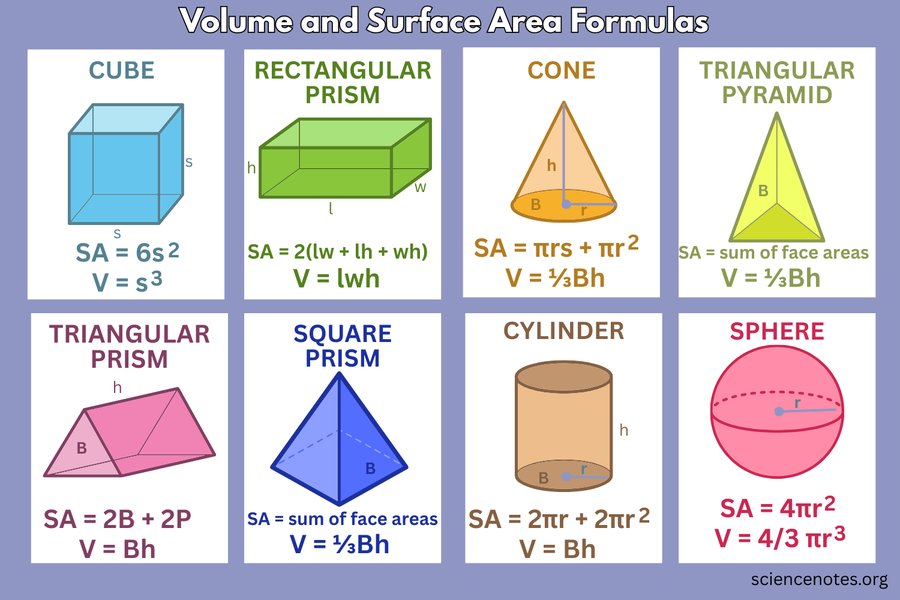
Visual representation of common surface area formulas, which are often derived using integral calculus.
Rotation Around the X-axis
If a continuous and differentiable curve \( y = f(x) \) is rotated around the x-axis over an interval \( [a, b] \), the surface area \( S \) is given by the formula:
\[ S = \int_a^b 2\pi |y| \sqrt{1 + \left(\frac{dy}{dx}\right)^2} \, dx \]In this formula:
- \( 2\pi y \) represents the circumference of an infinitesimally thin circular strip generated by rotating a point \( (x, y) \) on the curve.
- \( \sqrt{1 + \left(\frac{dy}{dx}\right)^2} \, dx \) is the differential arc length element of the curve. This term accounts for the actual length of a tiny segment along the curve, not just its horizontal projection.
- Multiplying these two components yields the area of a narrow band-shaped strip (a frustum of a cone), and integrating over the interval \( [a, b] \) sums these strips to provide the total surface area.
Rotation Around the Y-axis
Similarly, if the curve \( x = g(y) \) is rotated about the y-axis over an interval \( [c, d] \), the surface area \( S \) is given by:
\[ S = \int_c^d 2\pi |x| \sqrt{1 + \left(\frac{dx}{dy}\right)^2} \, dy \]Here, \( 2\pi x \) represents the circumference of the circular slice, and \( \sqrt{1 + \left(\frac{dx}{dy}\right)^2} \, dy \) is the differential arc length element along the curve when expressed as a function of \( y \).
2. Surface Area of General Surfaces (Using Double Integrals)
For surfaces not generated by simple revolution, such as those defined explicitly by a function \( z = f(x, y) \) over a two-dimensional region \( D \) in the xy-plane, the surface area is calculated using a double integral. This method extends the concept of arc length to two dimensions, considering the curvature of the surface in both x and y directions.
The Double Integral Formula
The formula for the surface area \( S \) of a surface \( z = f(x, y) \) over a region \( D \) is:
\[ S = \iint_{D} \sqrt{1 + \left(\frac{\partial z}{\partial x}\right)^2 + \left(\frac{\partial z}{\partial y}\right)^2} \, dA \]In this formula:
- \( \frac{\partial z}{\partial x} \) and \( \frac{\partial z}{\partial y} \) are the partial derivatives of \( f \) with respect to \( x \) and \( y \), respectively. These partial derivatives measure the rate of change of the surface in the \( x \) and \( y \) directions.
- The term \( \sqrt{1 + \left(\frac{\partial z}{\partial x}\right)^2 + \left(\frac{\partial z}{\partial y}\right)^2} \) is a scaling factor, often referred to as the "magnification factor" or "surface element," which accounts for the distortion caused by the surface's curvature. It essentially represents the area of an infinitesimal parallelogram tangent to the surface.
- \( dA \) is the differential area element in the region \( D \), typically \( dx \, dy \) or \( dy \, dx \).
This double integral effectively sums the areas of infinitesimal surface patches, giving the total area of the curved surface. This method is fundamental in multivariable calculus and is crucial for applications in physics, engineering, and computer graphics, especially for calculating properties like the flux of vector fields.
Challenges and Considerations in Integral Calculations
While integration offers a powerful framework, calculating surface areas, especially using double integrals, can present significant challenges. The integrals themselves can often be complex and difficult to evaluate analytically, frequently requiring advanced techniques such as trigonometric substitution, numerical methods, or even computer-aided computation.
Another important consideration is the proper setup of the integral, including determining the correct limits of integration and ensuring that the function defining the surface is continuous and differentiable over the chosen region. Missteps in parameterization or handling of discontinuities can lead to inaccurate results. Despite these complexities, integral calculus remains the most rigorous and accurate method for determining the surface area of intricate three-dimensional forms.
Applications of Surface Area Integrals
The ability to accurately calculate surface area using integration has wide-ranging applications across various scientific and engineering disciplines. Understanding the total surface exposure of an object is critical for many real-world problems.
This mindmap visually organizes the diverse applications of surface area integrals. From engineering design and material science to environmental modeling and biological studies, the precise quantification of surface area provides critical data for analysis, prediction, and design.
Delving Deeper: Visualizing Surface Area of Revolution
The concept of a surface of revolution can be quite abstract. This video provides an excellent visual and conceptual explanation of how the surface area of revolution is derived and calculated using integration. It illustrates the process of taking a 2D curve and rotating it to form a 3D surface, then breaking down that surface into infinitesimally small bands to sum their areas via integration.
The video, "Surface Area of Revolution By Integration Explained, Calculus ...", breaks down complex mathematical concepts into understandable segments, showing how the formula \( S = \int_a^b 2\pi |y| \sqrt{1 + \left(\frac{dy}{dx}\right)^2} \, dx \) is a logical extension of geometric principles applied to infinitesimal elements. It highlights how the circumference of a generated circle \( 2\pi y \) combines with the arc length element \( ds = \sqrt{1 + (dy/dx)^2} \, dx \) to form the area of a cylindrical strip, which is then integrated over the interval to yield the total surface area. This visual approach clarifies the intricate relationship between differential geometry and integral calculus, making the derivation of the formula intuitive.
A Comparative Overview of Surface Area Formulas
This table summarizes key characteristics of various surface area formulas, emphasizing the distinction between direct geometric calculations and those requiring integration, along with their respective applications and complexities.
| Formula Type | Description | Typical Formula Example | Applications |
|---|---|---|---|
| Basic Geometric | For standard, regular 3D shapes with uniform surfaces. | Sphere: \(SA = 4 \pi r^2\) | Simple object design, basic measurements. |
| Surface of Revolution (Single Integral) | For surfaces formed by rotating a 2D curve around an axis. | \(S = \int_a^b 2\pi |y| \sqrt{1 + (dy/dx)^2} \, dx\) | Engineering components (e.g., shafts, domes), architectural elements. |
| General Surface (Double Integral) | For any surface defined by \(z=f(x,y)\) over a region. | \(S = \iint_D \sqrt{1 + (f_x)^2 + (f_y)^2} \, dA\) | Complex geometric modeling, fluid dynamics, electromagnetism, mapping irregular terrains. |
Frequently Asked Questions (FAQ)
What is the fundamental idea behind using integration for surface area?
What is a "solid of revolution" in the context of surface area?
When would I use a double integral instead of a single integral for surface area?
Are there any limitations or difficulties in calculating surface area using integration?
What are some real-world applications of surface area calculation using integration?
Conclusion
The calculation of surface area using integration stands as a testament to the power and versatility of calculus. For simple, uniform shapes, direct geometric formulas suffice. However, for the myriad of complex, curved, or irregularly shaped objects found in nature and engineering, integral calculus provides a rigorous way to express and calculate surface area. By conceptually dividing a surface into infinitesimal components and summing their areas through either single integrals (for solids of revolution) or double integrals (for general surfaces), mathematicians and scientists can accurately quantify the outer extent of any three-dimensional form. This fundamental capability underpins critical advancements across diverse fields, from designing efficient aerospace components to modeling complex biological systems, making mastery of these techniques indispensable for advanced scientific and technical endeavors.
Recommended Further Exploration
- How to calculate arc length using integration?
- What are the applications of surface integrals in physics?
- How do parameterizations simplify surface area calculations?
- Explore numerical methods for evaluating complex integrals.