
Unveiling Synergetics: The Science of Self-Organization and Holistic Systems
Exploring the Interdisciplinary Fields Pioneered by Buckminster Fuller and Hermann Haken
Key Highlights of Synergetics
- Dual Foundations: Synergetics encompasses two distinct yet complementary fields: Buckminster Fuller's empirical study of systems in transformation, focusing on geometry and holistic behaviors, and Hermann Haken's interdisciplinary science explaining self-organization in complex systems.
- Emergent Properties: At its core, Synergetics emphasizes that the behavior of a whole system is often unpredicted by the sum of its individual parts. This "synergy" leads to the spontaneous formation of macroscopic structures or patterns.
- Wide-Ranging Applications: From explaining laser light formation and fluid instabilities in physics to analyzing cognitive processes, economic systems, and even informing architectural design and therapeutic practices, Synergetics offers a powerful framework for understanding complex phenomena across diverse disciplines.
Synergetics is a captivating and multifaceted concept that transcends traditional disciplinary boundaries, offering profound insights into how complex systems organize themselves and how emergent properties arise from the interaction of individual components. The term "Synergetics" itself derives from the Greek word "synergia," meaning "working together," underscoring its central theme of cooperative interaction leading to a greater whole. This field has been independently developed and championed by two prominent thinkers: R. Buckminster Fuller, an American architect, systems theorist, and inventor, and Hermann Haken, a German physicist specializing in laser theory.
Buckminster Fuller's Synergetics: The Geometry of Thinking
A Holistic and Empirical Approach to Systems
R. Buckminster Fuller (1895–1983) named and pioneered his version of Synergetics as the empirical study of systems in transformation. His magnum opus, "Synergetics: Explorations in the Geometry of Thinking," a two-volume work published in collaboration with E. J. Applewhite, distills a lifetime of research into a comprehensive conceptual system. Fuller's Synergetics is deeply rooted in geometry, with the tetrahedron serving as his fundamental model for the simplest system. He believed that this approach could provide a comprehensive, rational, and coordinating system inherent in nature, challenging traditional mechanistic worldviews.
Core Principles of Fuller's Synergetics
- Whole System Behaviors: Fuller emphasized that the behavior of a whole system cannot be predicted merely by analyzing its individual components in isolation. This concept highlights the emergent properties that arise from the interaction of parts.
- Geometric Foundation: At the heart of Fuller's Synergetics is a unique geometric understanding of the universe. He proposed that nature employs a coordinate system based on principles of synergy, with the tetrahedron being a prime example of fundamental structural integrity.
- Interdisciplinarity: Fuller's work inherently crosses disciplines, embracing scientific and philosophical topics. He sought to overcome the "excruciating awkwardness" of treating independent scientific disciplines separately, advocating for a unified understanding of reality.
- Operational Mathematics: Fuller's approach often involved "operational mathematics," encouraging hands-on, buildable introductions to his geometrical modeling techniques. This practical application of principles aimed to make complex concepts clear and understandable.
Fuller's vision extended to an "integration of geometry and philosophy in a single conceptual system providing a common language and accounting for both the physical and metaphysical." He critiqued ancient Greek metaphysics and its "right-angled orthodoxies," advocating for a topological and structural understanding of phenomena. His work has inspired numerous offshoots, particularly in geodesic dome and dwelling designs, and has been extended to applications in social dynamics.
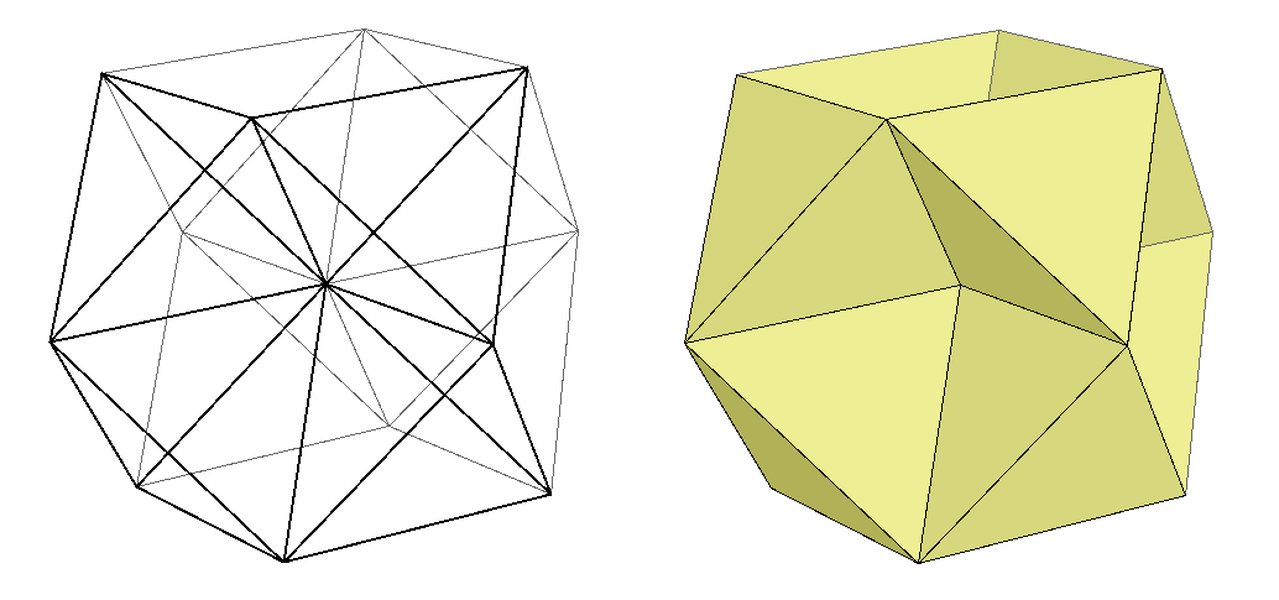
An illustration of a Vector Equilibrium, a key concept in Buckminster Fuller's Synergetics, representing a foundational geometric form in nature.
Hermann Haken's Synergetics: The Science of Self-Organization
Explaining Pattern Formation in Complex Systems
Concurrently, Hermann Haken, a German physicist, developed his own interdisciplinary science of Synergetics, particularly inspired by his work on laser theory. Haken's Synergetics focuses on explaining the spontaneous formation and self-organization of patterns and structures in open systems that are far from thermodynamic equilibrium. This theory posits that cooperative interactions among individual components within a system lead to the emergence of macroscopic structures or patterns.
Key Concepts in Haken's Synergetics
- Self-Organization: Haken's Synergetics provides a framework to understand how complex systems spontaneously organize themselves into coherent structures without external instruction. This phenomenon is often observed through "nonequilibrium phase transitions."
- Order Parameters: Central to Haken's theory is the concept of order parameters. These are macroscopic variables that describe the collective behavior of a system and dictate the dynamics of its individual components through what is known as the "slaving principle."
- Control Parameters: External or internal factors that influence the system's behavior and can lead to qualitative changes in its macroscopic state are known as control parameters. Continuous variation of these parameters can trigger phase transitions.
- Interdisciplinary Relevance: While rooted in physics (e.g., explaining laser light and fluid instabilities like the Bénard-instability), Haken's Synergetics has found broad applicability across natural and social sciences, including biology, medicine, cognitive science, and economics.
Haken's Synergetics offers a powerful alternative to traditional mechanistic views, emphasizing the nonlinear interaction of elements and subsystems within a system. It provides a means to analyze, explain, and potentially predict phenomena of self-organization in diverse contexts, from brain activities and heart rhythms to the dynamics of collaborative innovation and even the complexities of entrepreneurship education.
Synergetics Across Diverse Fields
Unifying Principles for Complex Systems
Despite their distinct origins, both Fuller's and Haken's interpretations of Synergetics share a fundamental focus on the emergent properties of systems where the whole is greater than the sum of its parts. This overarching theme has led to the application of Synergetics in a wide array of fields, demonstrating its versatility and explanatory power.
Applications in Science and Engineering
In the scientific and engineering realms, Synergetics provides a framework for understanding complex phenomena:
- Physics and Chemistry: Beyond lasers and fluid dynamics, Synergetics helps explain pattern formation in chemical reactions and the behavior of systems far from thermal equilibrium.
- Biology and Medicine: It informs models of evolution, morphogenesis, movement science (e.g., coordination between limbs), and the dynamics of brain activities and heart rhythms.
- Computer Science and AI: Synergetics contributes to understanding self-organization in computing systems, synergetic computers, and attractor networks. Companies like Synergetics AI are leveraging generative AI for real-time human-like communication in areas like insurance claims.
Impact in Social Sciences and Humanities
The principles of Synergetics also extend to understanding human and social systems:
- Psychology and Cognition: Synergetics is used to analyze cognitive processes such as pattern recognition, motor control, and switching between coordination states. It helps explain how macroscopic order emerges from microscopic interactions in the brain.
- Economics and Management: It offers insights into the self-organization of complex economic systems, collaborative innovation dynamics, and even the entrepreneurial process, moving beyond traditional mechanistic economic models.
- Architecture and Design: Fuller's geometric Synergetics has profoundly influenced architectural design, particularly in the development of geodesic domes. The concept of "synergetic neighborhoods" also appears in urban planning.
- Therapeutic Practices: Synergetic Play Therapy integrates neuroscience, attachment theory, and nervous system regulation to facilitate self-organization in children's play, promoting healing and growth.
This radar chart illustrates the perceived strength and focus of the two primary interpretations of Synergetics across various conceptual dimensions. Fuller's Synergetics excels in its geometric foundations and holistic system thinking, while Haken's Synergetics demonstrates strong applicability in self-organization theory and quantitative analysis of complex systems. Both share common ground in interdisciplinarity and the study of emergent properties.
Synergy in Action: Real-World Implementations
Companies and Initiatives Leveraging Synergetic Principles
The principles of Synergetics are not confined to academic discourse; they are actively applied by various organizations to solve complex problems and foster innovation. These applications often involve the collaborative interaction of diverse components to achieve outcomes greater than the sum of their individual efforts.
This video provides a basic introduction to Synergetics and the Geometry of Thinking as outlined by Buckminster Fuller, offering a visual and conceptual gateway to his influential work.
Companies like Synergetics Inc. and Synergetics AI exemplify the practical application of synergetic principles in the modern technological landscape. Synergetics Inc. has a long history of delivering strategic information technology solutions, particularly for government agencies, focusing on integrating data systems and leveraging AI for enhanced insights. Their commitment to quality is evident in their ISO 8000-110:2009 Data Quality certification, signifying a cooperative effort to produce high-quality data.
Similarly, Synergetics AI is at the forefront of transforming industries like insurance with generative AI, creating real-time, human-like communication avatars. Their "Agentic-AI platform" and ".Twin" digital identities for AI agents highlight how multiple AI components can work in synergy to automate tasks and unlock new revenue streams. Synergetic Lattice Field Theory even attempts to fulfill Buckminster Fuller's vision that his "synergetic geometry" represents the actual "coordinate system employed by nature," building a new model of elementary particles and space.
The table below summarizes some key areas where synergetic principles are applied by various entities, showcasing the diverse reach of this concept:
| Application Area | Core Synergetic Principle | Examples / Impact |
|---|---|---|
| Information Technology & AI | Cooperative interaction of components leading to emergent capabilities | Strategic IT solutions, GenAI avatars for real-time communication, autonomous AI agents, cloud integration, data analytics (Synergetics Inc., Synergetics AI, OpenFLIS platform) |
| Organizational Management | Holistic optimization and collaborative performance | Improving operating efficiencies, driving growth, enhancing bottom-line performance, PMO training for performance improvement (Synergetics Global Management Consulting) |
| Healthcare & Life Sciences | Synergistic process improvement for complex systems | Revenue realization, financial performance optimization, sustainable process improvement, operational excellence in healthcare organizations |
| Scientific Modeling | Understanding self-organization in natural phenomena | ShakeMaps for ground shaking post-earthquake, synergetic lattice field theory for elementary particles, modeling of complex physical systems |
| Education & Pedagogy | Self-organization of learning processes and collaborative innovation | Developing entrepreneurial mindset, fostering collaborative innovation ecosystems, English proficiency feedback platforms (Synergetics Education) |
| Therapy & Psychology | Emergent properties in human behavior and mental states | Synergetic Play Therapy for child development, application of synergetics to clinical psychology, understanding pattern recognition and motor control |
These examples underscore that Synergetics is not merely a theoretical construct but a practical framework for understanding and influencing complex adaptive systems, whether they are technological, organizational, or human.
Challenges and Criticisms
Navigating the Complexities of Synergetic Theory
Despite its broad appeal and interdisciplinary applications, Synergetics, particularly René-Louis Vallée's "synergetic theory," has faced criticisms, with some referring to it as a pseudoscientific theory. Vallée's work, which emerged around the same time as Haken's, proposed a radical alternative to modern physics and garnered support from free-energy enthusiasts, leading to a degree of media presence before fading from public discourse. This highlights the importance of rigorous empirical validation and adherence to established scientific methodologies when exploring complex systems.
Buckminster Fuller's Synergetics, while celebrated by many for its philosophical depth and geometric insights, has also been noted as an "off-beat subject" by some traditional academic departments, often "ignored for decades by most traditional curricula." Fuller himself viewed this as evidence of dangerous overspecialization within academia, arguing that Synergetics was necessary to address the "excruciating awkwardness characterizing present-day mathematical treatment of the interrelationships of the independent scientific disciplines."
A central challenge in applying Synergetics to fields like cognition is the difficulty in directly observing and measuring "phase transitions" and "instabilities" which are more readily apparent in physical phenomena like perception. This complexity necessitates sophisticated models and theoretical frameworks to effectively bridge the gap between microscopic interactions and macroscopic emergent behaviors in complex systems.
Frequently Asked Questions (FAQ)
What is the fundamental difference between Buckminster Fuller's and Hermann Haken's Synergetics?
How does Synergetics relate to other theories of complexity?
Can Synergetics be applied to everyday problems or personal development?
Is Synergetics a widely accepted scientific theory?
What is the "slaving principle" in Synergetics?
Conclusion: The Enduring Legacy of Synergetics
Synergetics, as conceptualized by both R. Buckminster Fuller and Hermann Haken, stands as a testament to the power of interdisciplinary thinking and the profound insights that can be gained by studying systems holistically. Whether viewed through Fuller's geometric lens of "the geometry of thinking" or Haken's mathematical framework for "self-organization," the core message remains consistent: complex phenomena arise from the cooperative interaction of individual components, leading to emergent properties and structures that are more than the mere sum of their parts. From the elegance of geodesic domes to the intricate dance of laser light, and from the complexities of human cognition to the dynamics of economic systems, Synergetics provides a unifying conceptual toolkit. Its continued relevance in diverse fields, ranging from advanced AI platforms to therapeutic practices, underscores its enduring legacy as a powerful paradigm for understanding the organized complexity of our universe.
Recommended Further Exploration
- Explore Buckminster Fuller's Geometric Innovations and their Impact.
- Delve into Hermann Haken's Theory of Self-Organization as Applied to Lasers.
- Discover the Applications of Synergetics in Cognitive Science and Brain Dynamics.
- Understand the Principles and Benefits of Synergetic Play Therapy.
References

Last updated May 21, 2025