
Considering Tattoo Removal? Unveiling Your Options for a Clearer Canvas
An in-depth look at professional methods, what to expect, and crucial factors for successful tattoo removal.
Removing a tattoo is a significant decision, and understanding the available methods is crucial for achieving the best possible outcome. Tattoo ink is deposited into the dermis, the second layer of skin, making its removal a complex process that typically requires professional intervention. This guide explores the most common and effective techniques, their mechanisms, potential side effects, and important considerations to help you make an informed choice.
Key Insights into Tattoo Removal
- Laser removal is the gold standard: Widely considered the safest and most effective method for most tattoos, targeting ink particles with minimal skin damage.
- Professional consultation is vital: A dermatologist or licensed professional can assess your tattoo, skin type, and medical history to recommend the most suitable approach and manage expectations.
- Multiple sessions are usually necessary: Complete removal often requires a series of treatments, with the exact number depending on the tattoo's size, colors, age, and ink depth.
Dominant Professional Tattoo Removal Methods
Several professional methods exist for tattoo removal, each with distinct processes, benefits, and considerations. It's essential to choose a method administered by trained professionals to minimize risks.
1. Laser Tattoo Removal: The Leading Choice
Laser tattoo removal is the most common, reliable, and often safest method for erasing unwanted tattoos. It utilizes advanced technology to break down tattoo ink particles without causing extensive damage to the surrounding skin.
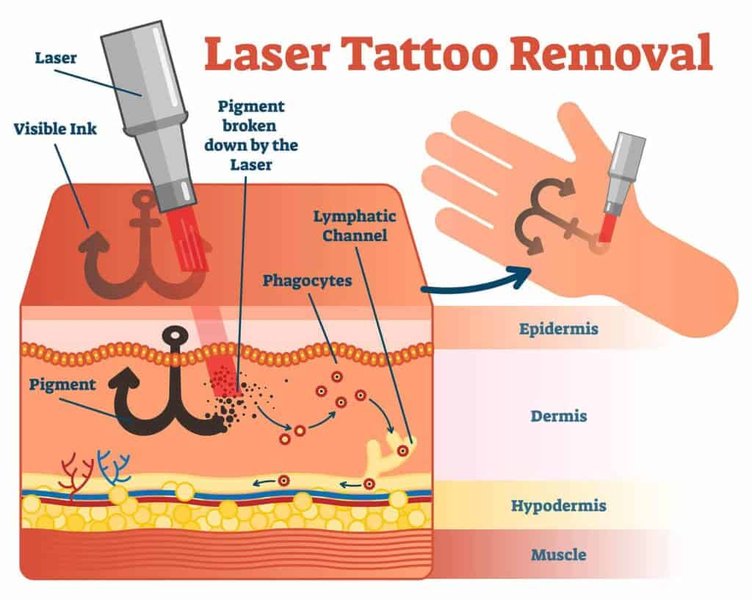
Visual representation of laser light penetrating the skin to shatter tattoo ink particles.
Mechanism: Selective Photothermolysis
The core principle behind laser tattoo removal is selective photothermolysis. High-intensity laser beams penetrate the epidermis (outer skin layer) to reach the dermis where tattoo pigment resides. These lasers emit specific wavelengths of light that are absorbed by the tattoo ink particles. This absorption causes the ink particles to heat up and shatter into much smaller fragments. Once fragmented, the body's natural immune and lymphatic systems recognize these particles as waste and gradually eliminate them over several weeks.
Types of Lasers and Color Targeting
Different laser types and wavelengths are used to target specific ink colors:
- Q-switched Lasers: These are the traditional workhorses in tattoo removal (e.g., Nd:YAG, Ruby, Alexandrite). They deliver very short, high-energy pulses.
- Nd:YAG lasers (1064nm wavelength) are effective for darker inks like black and dark blue. A frequency-doubled Nd:YAG (532nm) targets red, orange, and yellow inks.
- Ruby lasers (694nm) are good for blue, black, and green inks.
- Alexandrite lasers (755nm) can treat green, blue, and black inks.
- Pico Lasers (Picosecond Lasers): Newer technology (e.g., PicoWay, PicoSure) that delivers energy in even shorter pulses (picoseconds versus nanoseconds for Q-switched). This can lead to more efficient ink fragmentation, potentially fewer sessions, and better clearance of stubborn colors like blues and greens.
The Process and Number of Sessions
A typical laser tattoo removal session involves cleansing the area, applying a topical anesthetic (if desired), and then passing the laser handpiece over the tattoo. The number of sessions required varies significantly based on:
- Tattoo Size and Complexity: Larger, denser tattoos need more sessions.
- Ink Colors: Multi-colored tattoos often require different laser wavelengths and more treatments.
- Ink Type and Depth: Professional tattoos usually have deeper and more concentrated ink than amateur ones.
- Tattoo Age: Older tattoos may have already faded somewhat, potentially requiring fewer sessions.
- Skin Type: Darker skin tones may require more cautious treatment to avoid pigmentation changes.
- Individual's Immune Response: How efficiently the body clears the fragmented ink.
Pain, Healing, and Aftercare
Laser tattoo removal can be uncomfortable, often described as the sensation of a rubber band snapping against the skin or like getting the tattoo itself. Topical numbing creams or cooling devices can help manage discomfort. After a session, the treated area may experience redness, swelling, blistering, and pinpoint bleeding. This is a normal part of the healing process. Proper aftercare is crucial to prevent infection and minimize scarring:
- Keep the area clean by gently washing with soap and water.
- Apply an antibiotic ointment or a prescribed healing cream.
- Cover the area with a sterile dressing for a few days.
- Avoid sun exposure, hot tubs, and swimming pools until fully healed.
- Avoid picking at scabs or blisters.
Advantages and Potential Risks
Advantages: Highly effective for a wide range of inks, relatively low risk of scarring when performed by a qualified professional, non-invasive compared to surgical methods, and targets ink specifically.
Risks: Include temporary or permanent skin discoloration (hyperpigmentation or hypopigmentation), blistering, infection (if aftercare is poor), and, rarely, textural changes or scarring. The risk of side effects is higher with improper technique or inadequate aftercare.
2. Surgical Excision: Direct Removal
Surgical excision is an invasive method where the tattooed skin is physically cut out, and the remaining skin is stitched together. This method guarantees complete removal of the tattoo in one procedure, provided the tattoo is small enough.
Mechanism and Suitability
A healthcare professional administers local anesthesia to numb the area. The tattoo is then surgically removed using a scalpel. For smaller tattoos, the skin edges can be directly sutured. For larger tattoos, a skin graft (skin taken from another part of the body) might be necessary to cover the wound, which adds complexity and healing time. Surgical excision is best suited for small, linear tattoos or tattoos located in areas with enough skin laxity to allow for closure without excessive tension. It's often considered when laser removal is ineffective or not desired.
Effectiveness and Considerations
This method is 100% effective in removing the ink as the tattooed skin is entirely removed. However, it always results in a surgical scar, which may be more noticeable than the original tattoo. The size and appearance of the scar depend on the tattoo's size, location, and individual healing characteristics. It is generally more expensive than a single laser session but may be comparable to a full course of laser treatments for a very small tattoo.
3. Dermabrasion: Mechanical Exfoliation
Dermabrasion involves mechanically "sanding" down the top layers of skin to remove the tattoo ink. It's a less common method today due to the precision and lower scarring risk offered by lasers.
Mechanism and Process
After local anesthesia, a rapidly rotating abrasive medical grinding tool is used to remove the epidermis and superficial dermis, where the tattoo ink is located. This process aims to remove the ink-laden skin layers. Multiple sessions might be required. Healing involves an open wound that needs daily cleaning, antibiotic ointment, and dressing, similar to laser removal, but often with a longer recovery period (7-14 days or more).
Effectiveness and Risks
Dermabrasion can be moderately effective but is less precise than laser removal and may not completely remove all ink. It carries a higher risk of scarring, skin discoloration, and infection compared to laser treatments. Results can be uneven. This procedure should only be performed by physicians well-trained in the technique.
Comparative Overview of Main Tattoo Removal Methods
To help visualize the differences between the primary professional tattoo removal methods, the following table summarizes their key characteristics:
| Feature | Laser Removal | Surgical Excision | Dermabrasion |
|---|---|---|---|
| How it Works | Breaks ink into small particles for body to eliminate | Physically cuts out tattooed skin | Sands down skin layers containing ink |
| Effectiveness | High, can achieve full removal or significant fading | Complete removal in one session (for suitable tattoos) | Moderate, may leave remnants |
| Pain Level (During) | Moderate (snapping sensation); numbing helps | None during procedure (local anesthesia) | None during procedure (local anesthesia) |
| Recovery Time | 5-7 days initial healing per session; full recovery longer | Weeks for initial healing; scar maturation longer | 7-14+ days initial healing per session |
| Scarring Risk | Low with proper technique and aftercare | Guaranteed surgical scar | Higher risk of scarring and pigmentation changes |
| Typical Sessions | 5-15+ | 1 (for suitable tattoos) | Multiple may be needed |
| Primary Suitability | Most tattoos, various colors and sizes | Small tattoos, areas with skin laxity | Less common; historically used before advanced lasers |
Visualizing Method Attributes: A Comparative Analysis
The radar chart below offers a visual comparison of the three main tattoo removal methods across several key attributes. For this chart, higher scores (further from the center) indicate a more favorable outcome for that specific attribute (e.g., higher 'Effectiveness', higher 'Safety Profile', higher 'Affordability' meaning lower cost, etc.). Please note these are generalized comparisons and individual results can vary.
Understanding the Tattoo Removal Landscape
The mindmap below outlines the primary tattoo removal methods and the key factors to consider when deciding on a removal strategy. This visual tool can help you navigate the options and considerations involved in the process.
Low scarring risk
Targets specific colors"] Cons["Multiple sessions
Can be painful
Cost per session"] SurgicalExcision["Surgical Excision"] Mechanism["Cuts out tattooed skin"] Pros["Complete removal (small tattoos)
One session"] Cons["Guaranteed scar
Invasive
Longer recovery"] Dermabrasion["Dermabrasion"] Mechanism["Sands skin layers"] Pros["Can remove ink"] Cons["Higher scarring risk
Painful
Less precise"] OtherMethods["Other Methods (Less Common/Advised)"] ChemicalPeels["Chemical Peels (TCA)"] IPL["Intense Pulsed Light (IPL)"] Salabrasion["Salabrasion (High Risk)"] AtHome["At-Home Methods (Not Recommended)"] KeyConsiderations["Key Considerations"] TattooFactors["Tattoo Characteristics"] SizeColor["Size & Color"] AgeInkType["Age & Ink Type"] Location["Location on Body"] IndividualFactors["Individual Factors"] SkinType["Skin Type"] Health["Overall Health"] Budget["Budget"] ProcessFactors["Process Factors"] Consultation["Professional Consultation"] PainManagement["Pain Management"] Sessions["Number of Sessions"] Aftercare["Aftercare & Healing"] Risks["Potential Risks & Side Effects"]
Other Methods and Important Warnings
While laser, surgical excision, and dermabrasion are the main professionally recognized methods, other techniques exist, though they are generally less common or come with higher risks.
Less Common or Higher-Risk Methods
- Chemical Peels (e.g., Trichloroacetic Acid - TCA): Acids are applied to remove outer skin layers, potentially reaching the ink. TCA peels can cause burns, scarring, and may not fully remove deep ink. They are rarely a first-line choice for tattoo removal.
- Intense Pulsed Light (IPL) Therapy: Similar to lasers, IPL uses broad-spectrum light pulses. However, it's generally less effective and less targeted than Q-switched or pico lasers for tattoo ink, potentially causing more damage to surrounding skin and being more painful.
- Salabrasion: An older method involving rubbing salt or a saline solution vigorously into the tattooed skin to abrade it. This method is highly prone to causing significant scarring, infection, and pain, and is generally not recommended by medical professionals.
- Infrared Treatments: These were once popular but have been associated with side effects like burning, infections, and prolonged recovery.
A Critical Warning About At-Home Methods
At-home tattoo removal methods, including creams, gels, DIY laser pens, and home-based abrasion techniques, are strongly discouraged. These products are often ineffective because tattoo ink resides in the dermis, and topical creams cannot penetrate deeply enough to break it down. More alarmingly, they can be dangerous, leading to:
- Skin irritation and allergic reactions
- Chemical burns
- Permanent scarring
- Infection
- Hyperpigmentation (darkening of the skin) or hypopigmentation (lightening of the skin)
This video provides an engaging explanation of how laser tattoo removal, the most common method, works at a microscopic level.
Frequently Asked Questions (FAQ)
What is the most effective and safest tattoo removal method?
Laser tattoo removal is widely considered the most effective and safest method for most tattoos. It selectively targets ink particles while minimizing damage to the surrounding skin. When performed by a qualified and experienced professional, the risk of scarring is low. Surgical excision is also highly effective for small tattoos but will leave a surgical scar.
How many sessions are typically needed for tattoo removal?
The number of sessions varies greatly depending on factors like the tattoo's size, color, age, ink density, depth of ink, and your skin type and immune response. For laser removal, most people require between 5 to 15 sessions, spaced 4-8 weeks apart, to achieve significant fading or complete removal. Some tattoos may require more.
Is tattoo removal painful?
Most people experience some discomfort during laser tattoo removal, often described as a rubber band snapping against the skin or similar to getting the tattoo. Topical anesthetic creams or cooling devices can be used to minimize pain. Surgical excision is performed under local anesthesia, so there is no pain during the procedure itself, but there will be post-operative soreness. Dermabrasion is also performed with anesthesia but can have a painful recovery.
Will tattoo removal leave a scar?
Surgical excision will always leave a scar. With laser tattoo removal, the risk of scarring is low if performed by a qualified professional and proper aftercare instructions are followed. However, some individuals may be prone to scarring or experience textural changes or skin discoloration (hypopigmentation or hyperpigmentation). Dermabrasion has a higher risk of scarring compared to laser removal.
Are at-home tattoo removal kits or creams effective?
No, at-home tattoo removal creams, kits, or DIY methods are generally ineffective and can be dangerous. Tattoo ink is located in the dermis (deeper layer of skin), and these products typically cannot reach it. They can cause skin irritation, chemical burns, infections, and permanent scarring. Professional medical advice is essential for safe and effective tattoo removal.
Recommended Further Exploration
- What are the differences between Q-switched and Pico lasers for tattoo removal?
- How does skin type affect the tattoo removal process and outcomes?
- What is the typical cost range for complete tattoo removal using lasers?
- What are the most important aftercare steps following a laser tattoo removal session?
References
Last updated May 6, 2025