

- Slow Start: An aggressive exponential growth phase to rapidly discover available network bandwidth at the beginning of a TCP connection or after a serious congestion event.
- AIMD (Congestion Avoidance): A balanced approach of additive window increases and multiplicative decreases, ensuring network stability, fairness, and efficient throughput after initial probing.
- Fast Retransmit & Fast Recovery: Mechanisms to swiftly recover from isolated packet losses without a complete restart, preserving throughput and minimizing latency.
TCP (Transmission Control Protocol) congestion control is a fundamental set of algorithms designed to prevent network overload, ensuring efficient and reliable data transmission across the internet. It dynamically adjusts the rate at which data is sent, adapting to varying network conditions and preventing a collapse where the network becomes unusable. At its core, TCP employs a "congestion window" (CWND), which dictates the amount of unacknowledged data a sender can transmit. The interplay of several key techniques—Slow Start, Additive Increase/Multiplicative Decrease (AIMD), and Fast Retransmit/Fast Recovery—allows TCP to intelligently manage this window, probing for available capacity, reacting to congestion, and recovering from packet losses.
The Foundation of Flow: Understanding the Congestion Window and ssthresh
Before diving into the specific techniques, it's crucial to understand two pivotal concepts: the congestion window (CWND) and the slow-start threshold (ssthresh). The CWND is a sender-side limit on the number of unacknowledged bytes that can be in flight. It works in conjunction with the receiver's advertised window, with the effective sending window being the minimum of the two. The ssthresh, on the other hand, is a dynamic threshold that determines when TCP transitions from the aggressive Slow Start phase to the more conservative Congestion Avoidance phase.
Slow Start: Rapid Discovery of Network Capacity
Slow Start is the initial phase of TCP congestion control, designed for rapid discovery of available bandwidth at the beginning of a new connection or after a significant network event like a timeout. Its primary objective is to quickly increase the sending rate without overwhelming an unknown network path.
Exponential Growth: Probing for Bandwidth
During Slow Start, the CWND begins at a small value, typically one Maximum Segment Size (MSS). For every Acknowledgment (ACK) received, the CWND is increased. Critically, this increase is exponential: for each ACK received, the CWND grows by one MSS. Since multiple ACKs can arrive within a single Round-Trip Time (RTT), the effective result is that the CWND roughly doubles every RTT. This aggressive growth allows TCP to quickly ramp up its sending rate, effectively probing for the network's capacity.
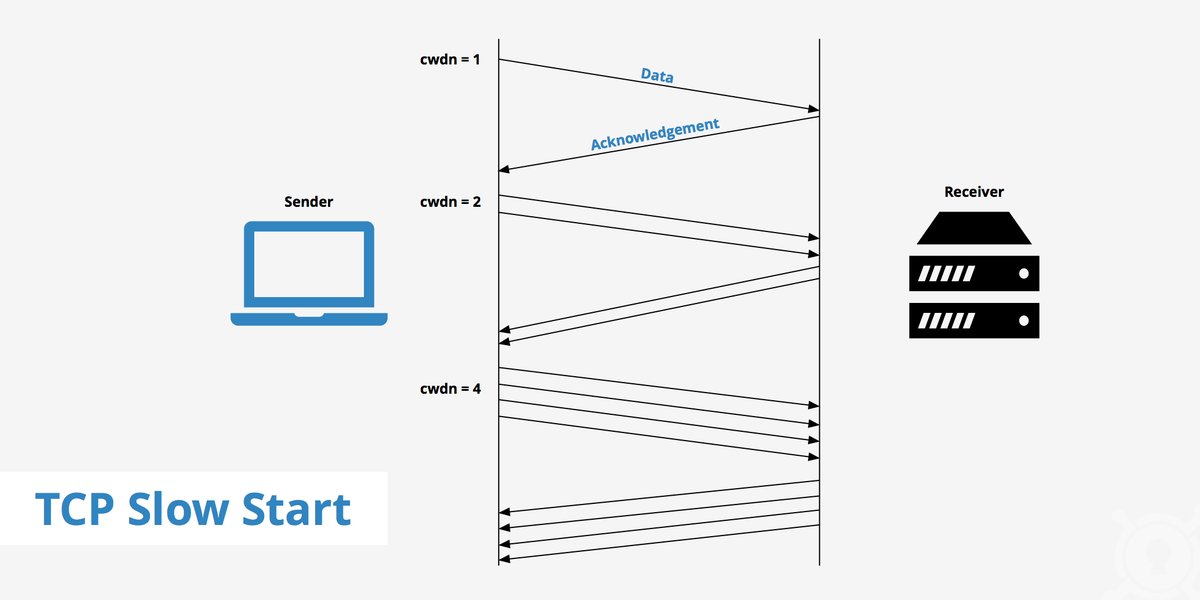
An illustration of the exponential growth of the congestion window during the Slow Start phase.
Transitioning Out of Slow Start
The Slow Start phase concludes under two main conditions:
- CWND reaches ssthresh: If the CWND grows to be greater than or equal to the ssthresh, TCP transitions into the Congestion Avoidance phase. The ssthresh is dynamically set, often to half of the CWND value at which congestion was last detected.
- Packet loss detection: If packet loss is detected (either through duplicate ACKs or a timeout) before ssthresh is reached, Slow Start will terminate. Depending on the type of loss detection, TCP may either re-enter Slow Start with a reset CWND or proceed to Fast Recovery.
AIMD (Additive Increase/Multiplicative Decrease): Sustaining Stable Throughput
Once TCP has rapidly estimated the network's capacity during Slow Start and the CWND has reached ssthresh, it enters the Congestion Avoidance phase, where the Additive Increase/Multiplicative Decrease (AIMD) algorithm governs the CWND adjustments. AIMD is designed to provide stable and fair sharing of bandwidth among competing flows, avoiding network congestion while maintaining good throughput.
Additive Increase: Gradual Probing
In Congestion Avoidance, the CWND increases much more cautiously compared to Slow Start. For each RTT, the CWND is typically increased by approximately one MSS. This linear increase is implemented by increasing the CWND by a fraction of an MSS for each incoming ACK, ensuring a slow and steady probe for additional bandwidth without aggressively overshooting capacity. This gradual approach minimizes the risk of causing new congestion.
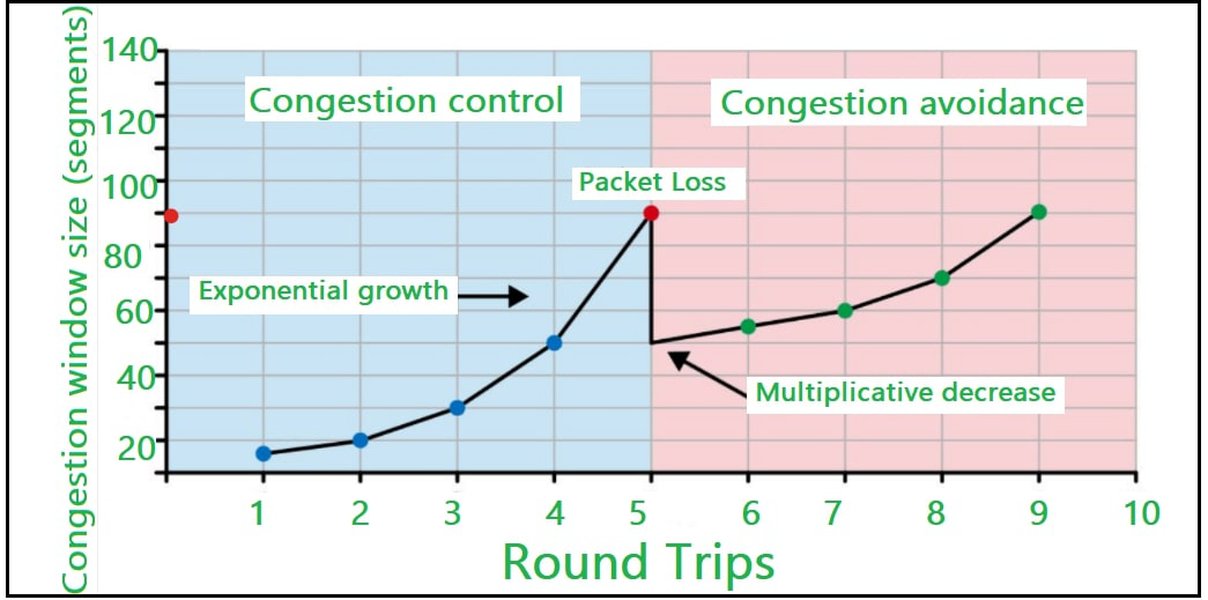
A visual representation of the sawtooth pattern characteristic of AIMD, showing additive increases and multiplicative decreases.
Multiplicative Decrease: Reacting to Congestion
When congestion is detected, TCP performs a multiplicative decrease. This typically means the CWND is halved (CWND := CWND / 2), and the ssthresh is often set to this new, reduced CWND value. This aggressive reduction in sending rate is critical for quickly alleviating congestion and preventing network collapse. The combination of additive increase and multiplicative decrease creates a characteristic "sawtooth" pattern in the CWND over time, as TCP continuously probes and then backs off in response to network conditions.
Fast Retransmit and Fast Recovery: Expedited Loss Repair
Fast Retransmit and Fast Recovery are advanced mechanisms designed to improve TCP's performance in environments with intermittent packet loss. Instead of waiting for a lengthy retransmission timeout (RTO), which can significantly impact throughput, these techniques allow TCP to recover more quickly from isolated packet losses.
Fast Retransmit: Detecting Loss Early
Fast Retransmit is triggered when the sender receives three duplicate ACKs for the same segment. Duplicate ACKs indicate that subsequent segments have arrived at the receiver, but a specific earlier segment is missing. Upon receiving the third duplicate ACK, the sender retransmits the missing segment immediately, without waiting for the RTO. This proactive retransmission significantly reduces the time taken to recover from a lost packet.
Fast Recovery: Maintaining Flow During Recovery
After initiating a Fast Retransmit, TCP enters the Fast Recovery phase. This phase is a crucial improvement over older TCP versions (like TCP Tahoe), which would reset the CWND to 1 MSS and re-enter Slow Start. In Fast Recovery (as implemented in TCP Reno and later variants):
- The ssthresh is set to half of the current CWND.
- The CWND is also reduced, typically to the new ssthresh value plus a small offset (e.g., 3 MSS, accounting for the duplicate ACKs).
- The sender continues to transmit new data, albeit at a reduced rate, based on the adjusted CWND. This "keeps the pipe full" and avoids the severe throughput drop associated with returning to Slow Start.
- For each additional duplicate ACK received during Fast Recovery, the CWND is temporarily increased by 1 MSS to reflect that another segment has left the network.
- When a new ACK arrives (acknowledging the retransmitted segment and possibly new data), the Fast Recovery phase ends, and the CWND is set to the ssthresh. TCP then transitions back to Congestion Avoidance.
This mechanism allows TCP to maintain a higher throughput during recovery from single packet losses, preventing unnecessary slowdowns and improving overall network efficiency. If, however, a timeout occurs, it is considered a more severe indication of congestion, and TCP typically reverts to the Slow Start phase with CWND reset to 1 MSS.
Interactions and Evolution of TCP Congestion Control
These three core techniques—Slow Start, AIMD, and Fast Retransmit/Fast Recovery—work in concert to form the robust congestion control strategy of TCP. The typical sequence of events is:
- Connection Start: Slow Start (exponential growth) until ssthresh is reached.
- Normal Operation: Congestion Avoidance (AIMD linear increase).
- Isolated Loss: Three duplicate ACKs trigger Fast Retransmit, followed by Fast Recovery to maintain flow.
- Severe Congestion/Timeout: CWND is reset to 1 MSS, ssthresh is halved, and TCP returns to Slow Start.
The continuous evolution of TCP has led to various congestion control algorithms beyond these fundamentals, such as NewReno, CUBIC, and BBR. These variants build upon the principles of Slow Start, AIMD, and Fast Recovery to optimize performance for specific network environments, like high-speed or long-distance networks, but the foundational concepts remain crucial for understanding TCP's resilience.
This mindmap provides a hierarchical overview of TCP congestion control, detailing the interconnections and functionalities of Slow Start, AIMD, and Fast Retransmit/Fast Recovery, along with supporting concepts and evolutionary aspects.
The Significance of TCP Congestion Control in Network Stability
The sophisticated mechanisms of TCP congestion control are paramount to the stability and efficiency of the internet. Without them, aggressive senders could easily flood network routers, leading to widespread packet loss, decreased throughput for all users, and ultimately, network collapse. By dynamically adjusting transmission rates based on perceived congestion, TCP ensures that the network resources are utilized effectively and fairly.
The video below offers a detailed explanation of TCP Congestion Control, including its phases and mechanisms. It delves into how the congestion window changes during Slow Start and Congestion Avoidance, and the role of Fast Retransmit and Fast Recovery in optimizing recovery from packet loss. This visual explanation complements the theoretical understanding by demonstrating the practical implications of these algorithms on network performance.
A comprehensive overview of TCP Congestion Control, covering slow start, congestion avoidance, and fast recovery.
Comparative Analysis of Congestion Control Phases
To further illustrate the distinct roles and behaviors of each TCP congestion control phase, the following table provides a comparative summary.
| Feature | Slow Start | AIMD (Congestion Avoidance) | Fast Retransmit & Fast Recovery |
|---|---|---|---|
| Primary Goal | Rapidly discover available bandwidth | Avoid congestion, achieve fair bandwidth sharing | Expedite recovery from isolated packet losses |
| CWND Growth | Exponential (doubles per RTT) | Additive (linear, approx. 1 MSS per RTT) | Temporarily adjusted (halved + offset), then gradual increase |
| CWND Initial State | Starts at 1 MSS | Starts when CWND reaches ssthresh | Triggered by 3 duplicate ACKs; CWND set to ssthresh + 3 MSS |
| Congestion Signal | Timeout or Duplicate ACKs (ends SS) | Timeout or Duplicate ACKs (multiplicative decrease) | 3 Duplicate ACKs |
| Response to Congestion | CWND reset to 1 MSS, ssthresh halved | CWND halved, ssthresh set to new CWND | Retransmit missing segment, CWND adjusted, continue sending |
| Efficiency | High for initial capacity discovery | Stable and fair, but slower to adapt to large capacity changes | High for minor losses, avoids full restart penalties |
Frequently Asked Questions
What is the primary purpose of TCP congestion control?
How does Slow Start differ from Congestion Avoidance?
What triggers Fast Retransmit and Fast Recovery?
Why is AIMD important for network fairness?
What is the role of the congestion window (CWND) and ssthresh?
Conclusion
TCP congestion control, through its intelligent combination of Slow Start, AIMD, and Fast Retransmit/Fast Recovery, forms the backbone of reliable data transmission over the internet. These mechanisms allow TCP to adapt dynamically to diverse network conditions, efficiently utilize available bandwidth, and rapidly recover from packet losses. While modern TCP variants continue to evolve these fundamental principles, understanding the core behavior of these three techniques is essential for comprehending how the internet maintains its stability and delivers data effectively. The continuous interplay of exponential growth, linear increase, and proactive recovery ensures that data flows smoothly, preventing congestion collapse and enabling the seamless exchange of information worldwide.
Recommended Further Exploration
- How do TCP variants like CUBIC and BBR optimize congestion control?
- What are the differences between TCP Tahoe, Reno, and NewReno congestion control?
- Explore the impact of network latency and packet loss on TCP throughput.
- How does explicit congestion notification (ECN) enhance TCP congestion control?