
Optimizing Team Structure: Leveraging Team Topologies for Stream Separation
A Comprehensive Guide to Breaking Down Teams into Value Streams
Key Insights into Team Topologies for Stream Alignment
- Team Topologies as a Framework: Team Topologies provides a practical, adaptive model for organizing business and technology teams to achieve a fast flow of value, moving beyond traditional functional silos.
- The Primacy of Stream-Aligned Teams: The core of Team Topologies revolves around "stream-aligned teams," which are cross-functional, end-to-end responsible teams focused on a single, continuous stream of work or value.
- Strategic Separation for Flow: Breaking a large team into separated streams using Team Topologies principles aims to reduce cognitive load, clarify responsibilities, minimize hand-offs, and accelerate the delivery of customer value.
In today's fast-paced technological landscape, organizations constantly seek ways to improve efficiency, accelerate delivery, and enhance responsiveness to customer needs. The concept of "Team Topologies," as articulated by Matthew Skelton and Manuel Pais, offers a powerful framework for achieving these goals by optimizing team structures and interactions. At its heart, Team Topologies advocates for organizing teams around the flow of value, rather than traditional functional hierarchies, to foster better collaboration and independent delivery.
Understanding Team Topologies: The Foundation for Separation
Team Topologies is not merely a set of rules but a dynamic approach to organizational design that helps reduce dependencies, clarify responsibilities, and empower teams to deliver value without being bogged down by organizational complexities. The framework introduces four fundamental team types and three core interaction modes, designed to create a healthy ecosystem for fast flow.
The Four Fundamental Team Types
The success of breaking a large team into separated streams relies heavily on understanding these four distinct team types:
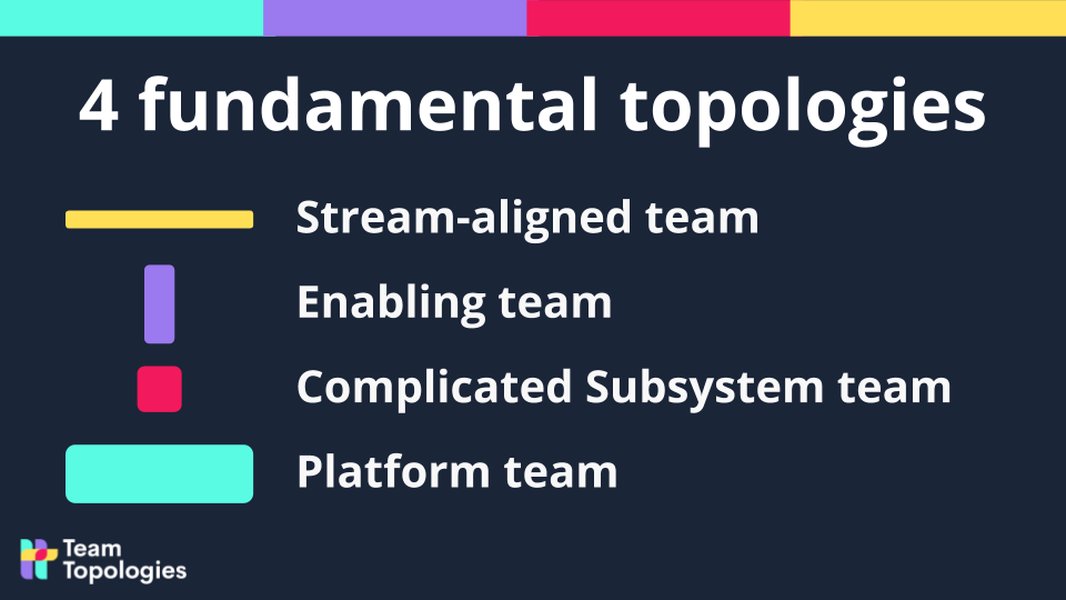 The foundational four team types in Team Topologies.
1. Stream-Aligned Teams
These are the primary teams in the Team Topologies model, responsible for delivering direct value to customers along a specific "value stream." A stream-aligned team is aligned to a single, valuable flow of work, such as a product, service, set of features, or a user journey. They are cross-functional and multidisciplinary, empowered to build, test, and deploy software independently, minimizing hand-offs. The goal is for these teams to own the entire slice of a business domain end-to-end, from development to operations ("You Built It, You Run It"). They should constitute the majority (60-80%) of teams within an organization.
2. Platform Teams
Platform teams provide and maintain internal products and services that accelerate delivery by stream-aligned teams. Their goal is to reduce the cognitive load on stream-aligned teams by offering a compelling internal product (e.g., infrastructure, tools, APIs) "as a Service." This enables stream-aligned teams to focus on delivering customer value without worrying about underlying complexities.
3. Enabling Teams
Enabling teams act as coaches, supporting stream-aligned teams by providing expertise in specialized areas like security, testing, or automation. They help stream-aligned teams overcome obstacles and detect missing capabilities, promoting a culture of continuous improvement. Their interaction mode is primarily "Facilitation," aiming to upskill other teams so they can maintain their independence.
4. Complicated Subsystem Teams
These teams are responsible for maintaining complex subsystems that require deep, specialized domain knowledge, such as sophisticated algorithms or niche technical components. They exist to reduce the cognitive load on stream-aligned teams by abstracting away the complexity of these highly specialized areas, typically interacting via an "X-as-a-Service" mode.
The Three Core Interaction Modes
Beyond team types, Team Topologies emphasizes explicit interaction modes to govern how teams collaborate:
- Collaboration: Teams work closely together for a defined, short period to discover new things (e.g., APIs, practices). This mode is for high adaptability or discovery needs.
- X-as-a-Service: One team provides a service (like a platform or complicated subsystem) that another team consumes. The consuming team uses the service without needing deep knowledge of its internal workings.
- Facilitation: One team (typically an enabling team) helps and mentors another team to build capabilities, aiming for the facilitated team to become self-sufficient.
Strategies for Breaking a Team into Separated Streams
The process of breaking a large, undifferentiated team into separated streams fundamentally involves aligning new, smaller teams with distinct value streams. This is about creating purposeful teams with clear responsibilities and minimal friction.
Identifying Value Streams
The first crucial step is to identify the inherent value streams within your organization. A value stream represents the end-to-end process that delivers value to a customer. This could be a specific product line, a customer segment, a key feature set, or a user journey. To do this, you might:
- Map Customer Journeys: Trace the steps a customer takes to receive a product or service. Each distinct journey can become a potential stream.
- Analyze Business Capabilities: Break down your business into its core capabilities. Each significant capability that delivers measurable business value can be a candidate for a stream-aligned team.
- Look for Natural Seams: Identify areas where work naturally separates into distinct flows, often corresponding to different domains or business concerns.
Re-aligning with Value Streams
Once value streams are identified, the existing large team needs to be re-evaluated. Instead of organizing around functions (e.g., "all backend developers," "all QA testers"), team members are grouped to form stream-aligned teams, each dedicated to an identified value stream. This means each stream-aligned team will be cross-functional, possessing all the necessary skills (development, testing, operations) to deliver their portion of the value stream independently.
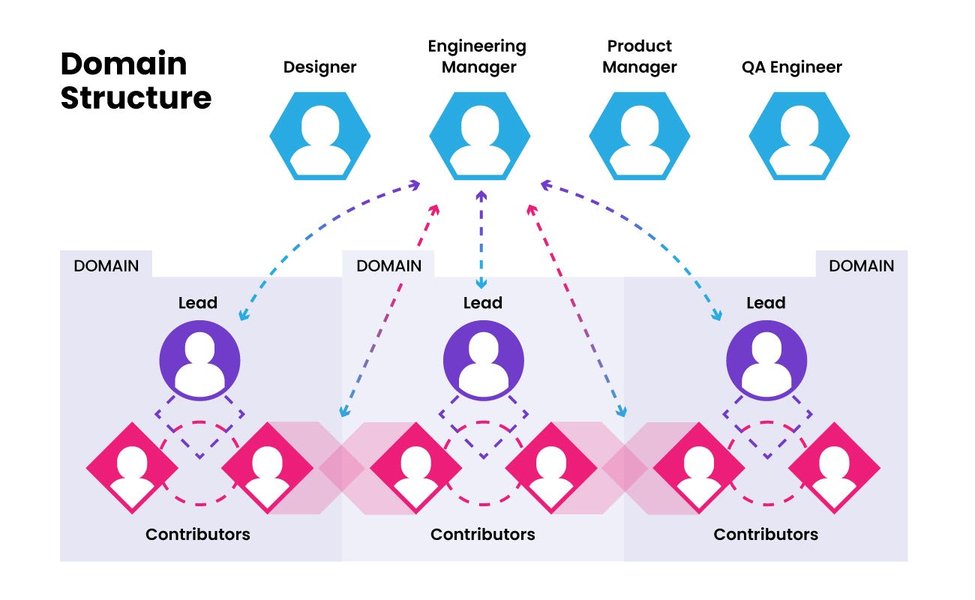 Visualizing a domain-based structure for software engineering teams.
Managing Cognitive Load
A key driver for breaking up teams is to reduce "cognitive load" – the amount of mental effort required to perform a task. Large, undifferentiated teams often suffer from excessive cognitive load due to broad responsibilities, constant context switching, and unclear boundaries. By aligning teams to narrow, well-defined value streams, their cognitive load is significantly reduced, allowing for deeper expertise and faster execution.
The book "Team Topologies" highlights that the primary benefit of a platform is to reduce the cognitive load on stream-aligned teams. Similarly, enabling teams and complicated subsystem teams also play a role in managing this load by providing specialized support or abstracting complexity.
Designing Team Interactions
With separated stream-aligned teams, it becomes critical to explicitly define how these new teams will interact. Avoid ad-hoc or undefined "long-lived collaboration dependencies" that can impede flow. Instead, encourage the three defined interaction modes:
- Stream-aligned teams and Platform teams: Primarily use X-as-a-Service mode, where the platform provides tools and services for the stream-aligned teams to consume.
- Stream-aligned teams and Enabling teams: Use Facilitation mode, with enabling teams coaching and mentoring stream-aligned teams on specific practices or technologies.
- Stream-aligned teams and Complicated Subsystem teams: Often use X-as-a-Service, but may use short bursts of Collaboration for integration or deep problem-solving.
Example of Team Reorganization
Consider a large software development team responsible for an entire product. If this product has distinct user segments or feature areas (e.g., user authentication, content management, payment processing), it might be beneficial to separate this into multiple stream-aligned teams. For instance:
- A "User Journey Team" focused on the entire authentication and onboarding experience.
- A "Content Delivery Team" responsible for features related to content creation, publication, and distribution.
- A "Monetization Team" handling subscriptions, payments, and billing.
Supporting these could be a "Cloud Infrastructure Platform Team" providing deployment environments and a "Security Enabling Team" offering guidance on best practices.
Benefits of Stream-Aligned Separation
Breaking teams into separated streams using Team Topologies yields several significant advantages:
- Faster Flow of Value: Reduces hand-offs and external dependencies, leading to quicker delivery of features and bug fixes.
- Increased Ownership and Responsibility: Teams feel a stronger sense of ownership over their specific value stream, fostering accountability.
- Reduced Cognitive Load: Teams can focus on a narrower domain, leading to deeper expertise and higher quality.
- Clearer Boundaries: Well-defined team responsibilities minimize confusion and duplication of effort.
- Improved Communication: Streamlined communication paths within and between teams.
- Better Adaptability: Smaller, focused teams can respond to changes and market demands more rapidly.
A Comparison of Team Characteristics Across Topologies
To further illustrate the distinct nature of each team type within the Team Topologies framework, the following table outlines their primary focus, key responsibilities, and typical interaction modes:
| Team Type | Primary Focus | Key Responsibilities | Typical Interaction Modes |
|---|---|---|---|
| Stream-Aligned Team | Delivering direct customer/user value along a single flow of work. | End-to-end delivery of a product, service, or feature set; owning business capability. | Consuming X-as-a-Service from Platform/Complicated Subsystem teams; Facilitated by Enabling teams; short-term Collaboration. |
| Platform Team | Providing internal products and services to accelerate stream-aligned teams. | Building and maintaining shared infrastructure, tools, APIs; focusing on developer experience. | Providing X-as-a-Service to Stream-aligned teams; short-term Collaboration with Stream-aligned teams for feedback. |
| Enabling Team | Helping other teams (primarily stream-aligned) overcome obstacles and adopt new practices. | Coaching, mentoring, sharing expertise in specialized areas (e.g., security, testing, new technologies). | Facilitation with Stream-aligned teams; short-term Collaboration for knowledge transfer. |
| Complicated Subsystem Team | Managing complex components requiring deep, specialized domain knowledge. | Developing and maintaining specific complex algorithms, payment systems, or other highly specialized subsystems. | Primarily providing X-as-a-Service; short-term Collaboration for integration or deep issue resolution. |
Visualizing Team Effectiveness Through Radar Chart Analysis
To better understand the potential impact of applying Team Topologies and breaking down a large team into separated streams, we can visualize the expected shifts in team effectiveness using a radar chart. This chart illustrates how adopting stream-aligned teams, supported by platform and enabling teams, can enhance various aspects crucial for fast flow and organizational agility.
The radar chart illustrates the expected shift in key performance indicators when an organization transitions from a monolithic, undifferentiated team structure to one aligned with Team Topologies principles. The "Pre-Team Topologies" dataset represents a scenario where a large team might struggle with high cognitive load, lower autonomy, and less clear ownership, impacting flow efficiency and responsiveness. In contrast, the "Post-Team Topologies" dataset shows significant improvement across all dimensions. By breaking a team into distinct, stream-aligned units, cognitive load is reduced, autonomy is boosted, and the teams become more adept at delivering value efficiently, owning their respective domains clearly, and adapting to changes rapidly. This visual comparison underscores the transformative potential of adopting Team Topologies for organizational design.
Considerations for Successful Implementation
Implementing Team Topologies and breaking apart existing teams requires careful planning and a deep understanding of organizational dynamics. It's not merely a categorization exercise but a fundamental shift in how work flows and teams interact.
Avoiding Common Pitfalls
- Don't just label teams: Simply renaming existing teams without addressing underlying work patterns and dependencies will not yield results. The shift requires changes in responsibilities, autonomy, and interaction models.
- Focus on flow, not just structure: The primary goal is to optimize the flow of value. Team structures are a means to that end, not an end in themselves.
- Beware of "anti-types": Recognize and actively work to avoid team structures that impede flow, such as "support teams" that act as hand-off points or "feature teams" that lack end-to-end ownership.
- Continuous evolution: Organizational design with Team Topologies is an adaptive model. Team boundaries and interaction modes may need to evolve over time as business needs change.
Role of Leadership
Leadership plays a critical role in this transformation. Leaders must:
- Communicate the "Why": Clearly articulate the rationale behind the re-organization and the benefits for both the organization and individual teams.
- Empower Teams: Grant stream-aligned teams the necessary autonomy and resources to truly own their value streams.
- Foster a Learning Culture: Encourage continuous learning and adaptation, especially for enabling teams that help upskill others.
- Manage Cognitive Load: Actively look for and address sources of excessive cognitive load on teams.
Deep Dive: The Stream of Teams Initiative
The creators of Team Topologies themselves engage in a "Stream of Teams" initiative, which is a livestream series discussing practical applications and insights related to the framework. This initiative exemplifies the continuous engagement and evolution of the Team Topologies concepts.
An introduction to the "Stream of Teams" livestream series, discussing the evolution of Team Topologies.The "Stream of Teams, Episode 0 | 5 years of Team Topologies" video introduces this ongoing livestream series, highlighting the continued relevance and practical application of the Team Topologies framework. It showcases how the principles are being used in real-world scenarios, from optimizing for AI/ML teams to transforming telecom organizations. This exemplifies that Team Topologies is not a static blueprint but a living framework that evolves with the industry, emphasizing the importance of ongoing discussion, shared experiences, and adaptation in achieving fast flow of value within complex organizational structures.
Frequently Asked Questions (FAQ)
What is a "stream" in Team Topologies?
Why is reducing cognitive load important for team separation?
Can a team change its topology type over time?
How does Team Topologies relate to DevOps?
Recommended Further Exploration
- How to apply Team Topologies principles in a real-world organizational restructure?
- What are effective strategies to manage cognitive load in software development teams?
- How can organizations effectively measure the flow of value in their software delivery pipelines?
- Explore the "Platform as a Product" approach and its benefits for accelerating software delivery.
References
 docs.aws.amazon.com
Last updated May 21, 2025