
Temperature Regulation and Negative Feedback
A Detailed Look into Receptors, Control Center, and Effectors
Key Takeaways
- Receptors: Specialized thermoreceptors in the skin and body’s core sense deviations from the set point.
- Control Center: The hypothalamus compares sensory input to the body's target temperature and orchestrates responses.
- Effectors: Effectors, including sweat glands, blood vessels, and muscles, enact changes to restore the optimal temperature.
Overview of Temperature Regulation
Homeostasis is a fundamental principle in physiology, ensuring that the internal environment remains stable despite external fluctuations. Temperature regulation is a classic example of a negative feedback mechanism in which the body continuously self-adjusts to maintain an optimal internal temperature, typically around 37°C (98.6°F). Through a well-organized system involving specific receptors, a control center, and effectors, the body detects changes in temperature and responds accordingly to restore balance.
The Negative Feedback Mechanism in Detail
Receptors: The Body’s Temperature Detectors
The first component in temperature regulation is the receptor. Thermoreceptors are specialized sensory nerve endings that monitor both external and internal temperatures. They are primarily located in two areas:
Peripheral Thermoreceptors
These receptors are found in the skin, where they are responsible for detecting changes in the external temperature. They play a critical role in initiating responses to either dissipate or conserve heat based on environmental conditions.
Central Thermoreceptors
Central thermoreceptors are located within the body's core, particularly in regions such as the hypothalamus, viscera, and even parts of the spinal cord. Their critical function is to continuously monitor the core temperature, ensuring that the body’s vital processes operate within a strict thermal range.
Control Center: The Hypothalamus as the Thermostat
Once the thermoreceptors detect changes in temperature, they send signals to the control center—the hypothalamus. Positioned deep within the brain, the hypothalamus acts like a thermostat. It receives input from the peripheral and central thermoreceptors and compares the current temperature to a pre-set value, usually around 37°C (98.6°F).
When the hypothalamus identifies a deviation from the set point, it initiates appropriate corrective responses. For instance, if the core temperature exceeds the optimal range, the hypothalamus triggers mechanisms to dissipate heat. Conversely, if the temperature falls below the set point, it initiates responses to generate and conserve heat.
Effectors: Implementing the Body’s Response
The effectors are the organs and tissues that execute the corrective measures as directed by the hypothalamus. The effectors involved in temperature regulation include:
Sweat Glands and Vasodilation
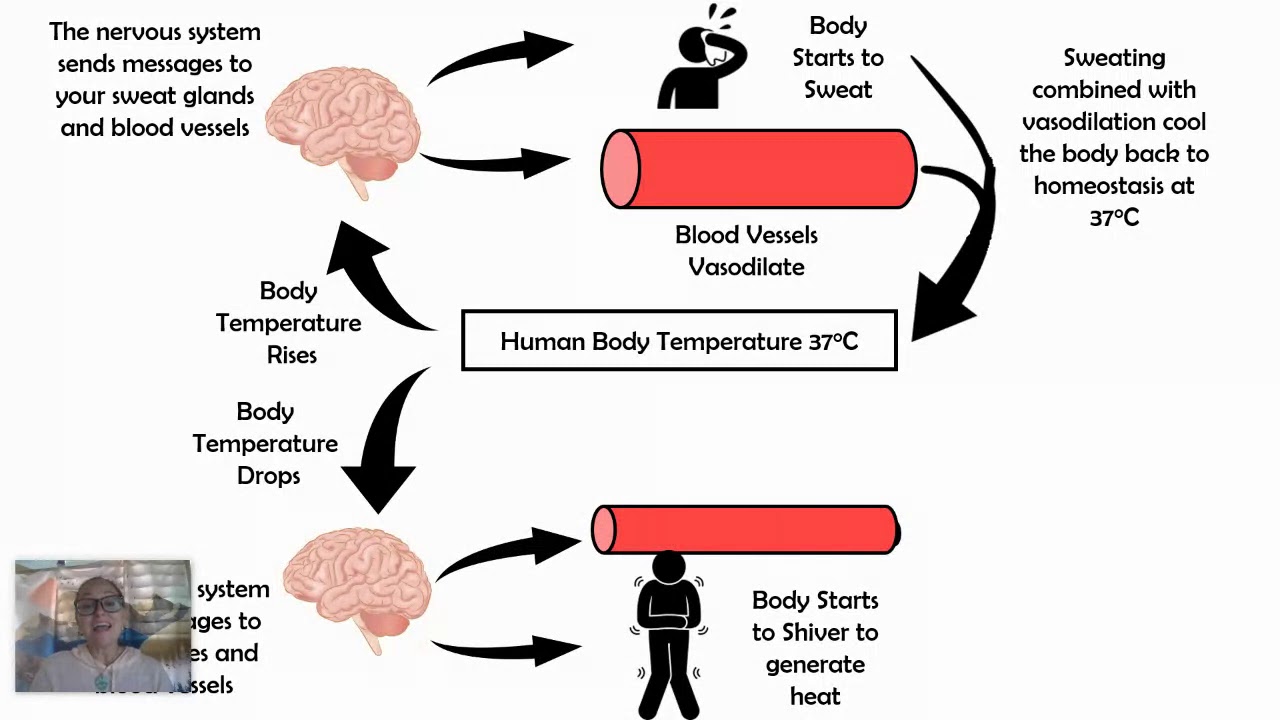
When body temperature is too high, the hypothalamus signals the sweat glands to produce sweat. As sweat evaporates, it removes excess heat from the skin—a process known as evaporative cooling. Additionally, vasodilation occurs, where blood vessels near the skin widen. This process increases blood flow to the surface, promoting heat loss.
Muscular Activity and Shivering
In response to a drop in body temperature, the hypothalamus signals the muscles to initiate shivering. Shivering is the rapid, involuntary contraction of muscles, and it generates heat through increased metabolic activity. This process is essential in raising the core body temperature back toward the set point.
Vascular Constriction
Vasoconstriction is another key response when the body is too cold. In this process, blood vessels constrict (narrow), thereby reducing blood flow to the skin. This reduces heat loss by keeping warm blood away from the external environment, allowing the body to retain heat.
Integration of the Negative Feedback Loop
The regulation of body temperature is achieved through a dynamic and continuous negative feedback loop. The loop operates as follows:
- Detection: Temperature deviations from the set point are detected by peripheral and central thermoreceptors.
- Signal Transmission: Thermoreceptors send real-time signals to the hypothalamus regarding the current temperature status.
- Comparison and Decision-Making: The hypothalamus compares the received temperature information with the body’s set point. Any significant deviation activates a compensatory response.
- Response Activation: Once the appropriate response has been determined, the hypothalamus transmits signals to the effectors. This triggers responses such as sweating, vasodilation, shivering, or vasoconstriction depending on whether the body needs to cool down or warm up.
- Restoration of Homeostasis: As effectors work to counteract the temperature deviation, the body temperature gradually returns to the set point. When the desired temperature is reached, the feedback loop reduces its activity, illustrating the classic negative feedback effect.
Physiological Scenarios of Temperature Regulation
The negative feedback mechanism governing temperature regulation plays a crucial role in various physiological scenarios:
Heat Exposure
When exposed to high ambient temperatures, the peripheral thermoreceptors detect the rise in skin temperature. The hypothalamus, upon receiving these signals, responds by initiating sweating and vasodilation. As sweat evaporates from the skin surface, heat is effectively removed. Additionally, dilated blood vessels allow for greater blood flow near the skin surface, further facilitating heat dissipation.
Cold Exposure
In contrast, when the environment is cold, central thermoreceptors in the hypothalamus may detect a fall in core temperature. The hypothalamus then directs effectors to generate heat. This response includes inducing shivering, which increases muscle activity and produces heat, and activating vasoconstriction to reduce heat loss by minimizing blood flow to the skin. These mechanisms are particularly important in cold climates or during sudden exposure to low temperatures.
Role in Fever and Hyperthermia
In instances such as infections, the thermoregulatory set point in the hypothalamus can be elevated, leading to a fever. The introduction of pyrogens (fever-inducing substances) causes the hypothalamus to modify its target temperature. As a result, even though the body might generate responses typical of a cold state (such as shivering), these actions actually serve to raise the body temperature to the new, higher set point. Conversely, hyperthermia represents an unregulated rise in body temperature where negative feedback is overwhelmed or disrupted.
Comparing Temperature Regulation Methods
Various methods exist for monitoring and understanding temperature regulation in clinical and physiological contexts. Below is a table summarizing key sites and methods used to measure core temperature, which, while not a direct part of the negative feedback loop itself, reflects the importance of precisely monitoring temperature in medical settings.
| Measurement Site | Instrument/Method | Advantages | Disadvantages |
|---|---|---|---|
| Pulmonary Artery | Swan-Ganz Catheter | Highly precise and repeatable | Invasive; restricted to ICU settings |
| Esophagus | Esophageal Thermistor | Quick reaction, widely available | High latency in rapid temperature changes |
| Tympanic Membrane | Infrared Ear Thermometer | Non-invasive; good indicator of core temperature | Risk of measurement error based on probe placement |
| Skin (Surface) | Surface Thermometer | Easy and widely available | Highly variable; affected by environmental factors |
This table is useful for understanding that accurate temperature monitoring is essential in assessing whether the body’s negative feedback mechanism is operating correctly. Errors in measurement could lead to misunderstanding of states such as fever, hypothermia, or hyperthermia.
Deep Dive into the Physiological Mechanisms
Signal Reception and Processing
The process begins when thermoreceptors send afferent signals to the hypothalamus. For example, when the external temperature increases above the optimal range, peripheral thermoreceptors in the skin detect the change and relay this information via sensory neurons. Similarly, differences in the core body temperature, detected by centrally located thermoreceptors, also contribute vital input. The hypothalamus integrates these signals, comparing the current temperature against an internally maintained set point.
Upon identifying any discrepancies, neuronal circuits within the hypothalamus activate autonomic processes. This initiation of a response is extremely rapid, ensuring that transient and potentially dangerous deviations in body temperature do not persist long enough to impair metabolic and enzymatic functions critical for survival.
Efferent Pathways and Overlapping Systems
The hypothalamus sends efferent signals through the autonomic nervous system to engage various effectors. In high-temperature conditions, signals propagate to sweat glands and the vascular smooth muscles, eliciting sweating and vasodilation. In low-temperature conditions, signals are delivered to skeletal muscles to induce shivering, and vasoconstrictor responses are mitigated through sympathetic neural pathways.
Notably, these responses are regulated in such a manner that they are mutually reinforcing. When sweating is activated, both evaporative cooling and enhanced peripheral blood flow combine to maximize heat loss. When shivering is initiated simultaneously with vasoconstriction, the conservation and generation of heat are optimized. This integrated response prevents excessive oscillations in body temperature.
Maintenance of Homeostasis Over Varying Conditions
The negative feedback system ensures that internal temperature is maintained across a range of conditions, from the extremes of environmental exposure to pathophysiologic states such as fever. For example, during a febrile episode, cytokines and other pyrogens can alter the hypothalamic set point, leading to behavioral responses—such as seeking warmth or cooling measures—that complement physiological adjustments. Meanwhile, patients with impaired thermoregulatory functions, such as those with specific autonomic dysfunctions, exhibit disturbances in this feedback loop, underscoring the importance of each component in preserving homeostasis.
Clinical Implications of Temperature Regulation
Pathophysiology and Disorders
Faults in the negative feedback loop of temperature regulation can result in significant clinical disorders. For instance, if thermoreceptors are damaged or if the hypothalamus fails to correctly interpret temperature signals, the resulting abnormalities could lead to hypothermia—or a dangerously low body temperature—or hyperthermia, where protective cooling mechanisms fail.
Furthermore, specific conditions such as fever represent a controlled and adaptive response to infection. Here, the body purposefully raises its temperature to create an environment less favorable for invading pathogens, while also enhancing the performance of immune cells. Alternatively, in malignant hyperthermia—a rare but life-threatening complication related to certain medications and anesthetics—the lack of proper regulation results in uncontrolled heat production by the muscles.
Age, Development, and Temperature Regulation
Age-related differences greatly influence the efficiency of thermoregulatory mechanisms. Newborns and premature infants, for example, have underdeveloped thermoregulatory responses. They rely on non-shivering thermogenesis involving brown adipose tissue (BAT) to generate heat, making them particularly vulnerable to hypothermia. On the other hand, elderly individuals often experience a decreased sensitivity of thermoreceptors and less efficient vasomotor responses, both of which can lead to a higher risk of temperature regulation disorders.
Conclusion and Final Thoughts
In summary, body temperature regulation is a prototypical example of negative feedback in physiology. This highly coordinated process relies on a triad of components: thermoreceptors act as sensors to detect deviations from the set point, the hypothalamus functions as the control center to compare and evaluate the current temperature, and effectors such as sweat glands, blood vessels, and muscles execute precise measures to restore balance. The seamless interaction of these elements ensures that the internal temperature remains stable, thereby facilitating optimal metabolic activity and overall homeostasis.
Understanding this mechanism not only provides crucial insights into normal physiology but also helps clinicians appreciate the pathophysiology underlying temperature-related disorders. The precise control exhibited by this negative feedback loop is essential for survival, and any disruption—whether due to environmental factors, disease states, or drug reactions—can have far-reaching consequences on human health.
References
https://en.wikipedia.org/wiki/Human_thermoregulation
https://www.medicalnewstoday.com/articles/thermoregulation
https://courses.lumenlearning.com/suny-ap1/chapter/homeostasis-and-feedback-loops/
https://www.khanacademy.org/science/ap-biology/cell-communication-and-cell-cycle/feedback/a/homeostasis
https://simplemed.co.uk/subjects/metabolism/temperature-regulation
https://www.ncbi.nlm.nih.gov/books/NBK507838/
https://www.rush.edu/news/how-body-regulates-heat
https://shiken.ai/biology/negative-feedback
Last updated February 17, 2025