
Unlocking the Low-Speed Potential of the Tesla Turbine: A Deep Dive into Torque Enhancement
Exploring groundbreaking research and design innovations to overcome the inherent low-torque challenge of Nikola Tesla's bladeless turbine.
Key Insights into Low-Speed Torque Enhancement
- Surface Modifications are Crucial: Roughening disc surfaces or incorporating specific textures significantly enhances viscous interaction, directly boosting torque at lower speeds.
- Optimal Disc Spacing and Geometry: Precise adjustments to the gap between discs and the overall rotor diameter are vital for maximizing fluid-to-disc momentum transfer and improving torque.
- Hybrid Designs and Auxiliary Mechanisms: Integrating features from other turbine types, such as Pelton-style cavities, or utilizing external gearing systems can effectively amplify torque output for practical applications.
The Core Principle of the Tesla Turbine: Boundary Layer Dynamics
At its heart, the Tesla turbine harnesses the boundary layer phenomenon. When a fluid flows over a surface, a thin layer, known as the boundary layer, adheres to the surface due to viscosity. The fluid within this layer slows down, transferring momentum to the surface. In the Tesla turbine, the working fluid (e.g., steam, air, gas) enters tangentially through nozzles, creating a spiral flow between parallel discs mounted on a shaft. As the fluid moves towards the central exhaust, the viscous drag from these boundary layers on the disc surfaces imparts rotational force, or torque, to the discs.
The total torque generated is a function of the shear stress exerted by the fluid on the disc's surface, multiplied by the contact area and the radial distance from the center. This mechanism is exceptionally efficient at high relative velocities between the fluid and the discs, which naturally leads to high rotational speeds and, conversely, lower torque when starting or operating at reduced RPMs.
Navigating the Low-Torque Challenge at Reduced Speeds
The inherent design of the original Tesla turbine leads to a fundamental challenge: its tendency to produce high rotational speeds with comparatively low torque. This characteristic restricts its direct use in applications that demand substantial starting torque or continuous high torque at lower RPMs, such as driving electrical generators, powering vehicles, or operating industrial machinery. When a load is applied, the turbine shaft slows, increasing the relative velocity between the fluid and the discs. While this can enhance drag and potentially increase torque at higher speeds, it becomes a limiting factor at very low speeds where the viscous forces alone are insufficient to overcome significant resistance.
Furthermore, under heavy load, the spiral flow path of the fluid can shorten, reducing the effective contact time and area between the fluid and the discs. This compromises the efficiency of momentum transfer, leading to diminished torque. Nikola Tesla himself recognized this limitation, leading to early design considerations that aimed to mitigate poor starting torque in his smooth-rotor-disk configurations.
Breakthroughs in Torque Enhancement: Design Innovations and Research
To address the low-torque limitation, particularly for low-speed applications, extensive research and innovative design modifications have been explored. These efforts aim to optimize the interaction between the fluid and the turbine's components, ensuring greater momentum transfer and improved torque output across a broader range of operating speeds.
Surface Modifications: Enhancing Fluid Adhesion
While Tesla's initial designs featured smooth rotor disks, later findings and modern research have demonstrated the profound impact of surface modifications on torque generation. Roughening the disc surfaces significantly enhances the frictional interaction between the fluid and the discs. This increased friction leads to a stronger boundary layer effect, allowing for greater momentum transfer and thus higher torque, even at lower fluid velocities.
For example, studies have shown that adding small washers or strategically patterning the disc surfaces can improve starting torque without unduly compromising efficiency. This approach counters the turbine's natural tendency for low torque, as the enhanced texture helps maintain fluid adhesion and energy transfer even when the discs are not spinning at very high RPMs. Practical implementation might involve etching the discs or applying specific coatings, which have been validated in experimental setups using various working fluids like compressed air.
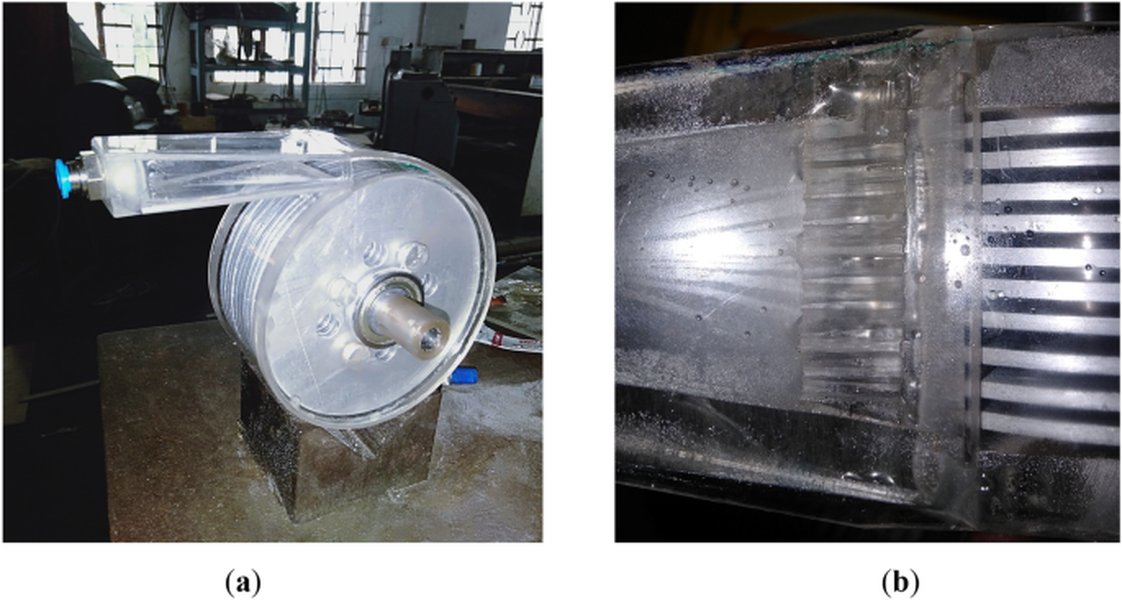
An illustration of a Tesla turbine design, potentially featuring optimized inlet geometry for enhanced fluid dynamics and torque generation.
Optimizing Disc Spacing and Rotor Geometry
The precise spacing between the rotor discs is a critical parameter influencing the turbine's performance. Research indicates that an optimal disc spacing exists to maximize torque and efficiency. If the spacing is too narrow, the boundary layers from adjacent discs can overlap, leading to increased fluid resistance and reduced effective frictional force. Conversely, if the spacing is too wide, a significant portion of the working fluid may flow outside the boundary layer without imparting sufficient energy to the discs. Nikola Tesla himself found that keeping the disks closer, approximately twice the boundary layer thickness, improved shear effects and increased torque. Modern studies suggest an optimal spacing around 0.4 mm to 1 mm, depending on the working fluid properties and operating conditions.
Furthermore, increasing the total number of discs or the effective contact area between the discs and the fluid can yield more torque. Tesla observed that adding more discs to his designs increased the overall surface area for fluid interaction, allowing for more fluid flow paths and mitigating the reduction in flow area caused by decreased disc spacing. Computational fluid dynamics (CFD) studies confirm that optimizing rotor diameter and disc thickness also enhances torque characteristics by improving the fluid's tangential velocity and extending the effective fluid spiral path.
Hybrid Designs and Auxiliary Mechanisms
One of the most innovative approaches to increasing low-speed torque involves developing hybrid turbine designs. A notable patent describes a Hybrid Tesla-Pelton wheel turbine, which replaces some or all of the smooth Tesla discs with "Pelton-type" discs featuring cavities. These cavities are designed to capture impulse forces from fluid jets, similar to a traditional Pelton wheel. This hybrid approach allows the turbine to generate more direct impulse torque, significantly boosting output at lower speeds and making it suitable for applications requiring higher torque, such as power generation.
Other auxiliary mechanisms include:
- Airfoil-shaped Spacers: Incorporating spacers with airfoil shapes near the perimeter of the discs can generate lift, applying additional torque to the spinning shaft.
- Gearing Systems: Attaching a gear system to the turbine output shaft can effectively convert the high-speed, low-torque output into lower-speed, higher-torque rotation. While this might introduce a slight reduction in overall efficiency, it makes the turbine more versatile for applications requiring higher torque at reduced RPMs.
- Compression Plates: Designs incorporating compression plates that vent fluid in a controlled manner can help maintain torque levels during low-speed operation, particularly relevant for dynamometers or low-RPM generators.
Fluid Dynamics and Flow Optimization
The torque generated is directly proportional to the tangential velocity gradient near the rotating disc walls. Therefore, efforts to maintain or increase this gradient, even at lower rotational speeds, are crucial for torque enhancement. Research has investigated the impact of inlet pressure and flow rate on stall torque and overall efficiency. Using multiple discrete inlet nozzles and channeling fluid through several multi-channel pathways can ensure more uniform fluid distribution, reducing flow losses and increasing torque generation at lower speeds. This also helps alleviate uneven fluid loading, which contributes to improved startup and low-speed performance.
For specific applications, such as waste heat recovery or compressed gas energy storage, modulating inlet pressure and flow rate can tune the turbine's response, improving startup torque while maintaining desired rotational speeds during operation. The use of water spray in some experimental setups has also shown promise in increasing mass flow and thus torque, preventing discs from running at excessively high RPMs unnecessarily.
Assessing Torque Performance: A Comparative Radar Analysis
To better understand the strengths and weaknesses of various Tesla turbine design approaches in terms of torque generation at low speeds, a comparative analysis can be visualized. The following radar chart provides an opinionated assessment of different design parameters and their estimated impact on key performance indicators for low-speed torque.
The radar chart illustrates the trade-offs involved in enhancing low-speed torque for Tesla turbines. While roughened surfaces and hybrid Pelton-Tesla designs show significant improvements in starting and operational torque, they may introduce complexities in manufacturing. Optimized disc spacing generally balances these factors, offering good low-speed performance and efficiency, albeit with potentially higher manufacturing precision requirements compared to standard smooth disc designs, which inherently excel in simplicity and fluid adaptability but fall short on torque.
Visualizing Key Torque Enhancement Strategies
The following mindmap outlines the primary strategies and contributing factors for increasing torque at low speeds in Tesla turbines, providing a structured overview of the multifaceted research efforts in this area.
Practical Applications and Viability of High-Torque Tesla Turbines
Despite historical perceptions of low torque, recent research and experimental findings underscore that Tesla turbines are indeed viable for practical power and torque generation, even at lower RPMs, when designed and optimized correctly. Engineers are now exploring their potential in diverse applications, extending beyond the high-speed niche they were initially perceived to occupy.
Emerging Application Areas
The enhanced torque capabilities open up new avenues for Tesla turbines:
- Low-Power Applications: Their compact design, smooth operation, and ability to handle various fluids make them attractive for scenarios requiring modest power output.
- Organic Rankine Cycle (ORC) Systems: The suitability of Tesla turbines for different working fluids and their relatively low manufacturing costs make them appealing for exploiting waste heat in small and micro-size ORC systems.
- Energy Generation: With optimized designs, particularly those incorporating larger rotor diameters, Tesla turbines are being considered for energy generators, including those that might operate at more moderate speeds (e.g., to feed into generators requiring 10,000-15,000 RPM).
- Waste Heat Recovery: Utilizing combustion gases, waste heat, and compressed air as working fluids for energy recovery is a promising area of investigation.
- Geothermal Energy: Nikola Tesla himself envisioned their use in capturing geothermal energy, a vision that is now more attainable with improved torque characteristics.
- Compressed Gas Energy Storage: Novel bladeless turbine designs derived from the Tesla turbine are being explored for their potential in compressed gas energy storage systems.
Demonstrating Practical Power Output
Recent tests and studies have provided compelling evidence of the Tesla turbine's ability to produce usable power and torque. The video below showcases a Tesla turbine undergoing a power load test, demonstrating its practical electrical output potential. Such experiments are crucial in validating theoretical improvements and showcasing the real-world viability of these innovative designs.
A practical demonstration of a Tesla Turbine undergoing a 600-watt power load test, illustrating its capability to produce usable electrical output.
This video highlights a 4.5-inch Tesla turbine being subjected to a significant electrical load, demonstrating its capacity to generate power. The ability to produce measurable and usable electrical output under load is a critical step in the commercialization and broader adoption of Tesla turbines. Early experimental setups with optimized parameters, such as those using compressed air at moderate pressures, have shown competitive performance in low-power scenarios, indicating that efficiency improvements are being made even at lower speeds. While challenges like maintaining efficiency and avoiding mechanical issues (e.g., disc rubbing) remain, ongoing research continues to refine these aspects, making the Tesla turbine a more practical and versatile power generation solution.
Summary of Torque Enhancement Strategies
The following table summarizes the key strategies for increasing torque at low speeds in Tesla turbines, along with their primary mechanisms and expected benefits.
| Strategy | Primary Mechanism | Benefits for Low-Speed Torque |
|---|---|---|
| Roughened Disc Surfaces | Increases frictional interaction and boundary layer adhesion. | Significantly boosts starting and operational torque, especially at lower speeds. |
| Optimal Disc Spacing (0.4-1mm) | Balances frictional forces and fluid flow, preventing boundary layer overlap or excessive slip. | Maximizes torque efficiency by optimizing viscous drag. |
| Hybrid Pelton-Tesla Discs | Combines viscous drag with impulse forces from fluid jets. | Delivers greater torque at reduced speeds, ideal for high-load applications. |
| Multi-Nozzle & Multi-Channel Inlets | Ensures uniform fluid distribution and longer effective fluid paths. | Reduces flow losses, increases fluid-to-disc contact, and improves startup torque. |
| Larger Rotor Diameter | Extends the fluid's path across the discs, allowing more time for momentum transfer. | Generates more rotational force at moderate speeds, suitable for specific design points. |
| Gearing Systems | Converts high-speed, low-torque output to lower-speed, higher-torque output. | Amplify torque for direct application to generators or machinery, albeit with minor efficiency loss. |
| Advanced Materials | Enables lighter, stronger discs for higher operational speeds and improved structural integrity. | Indirectly supports torque by allowing for more robust and efficient designs. |
Frequently Asked Questions (FAQ)
What is the main challenge of the original Tesla turbine design?
How does disc spacing affect torque generation in a Tesla turbine?
Can roughening the disc surfaces really increase torque?
What is a "Hybrid Tesla-Pelton wheel turbine"?
Are Tesla turbines practical for modern applications?
Conclusion
The Tesla turbine, a testament to Nikola Tesla's visionary engineering, continues to be a subject of intense research and innovation. While its original design excelled in achieving remarkable rotational speeds, the inherent challenge of low torque at lower RPMs has historically limited its widespread adoption. However, a confluence of modern research, including advanced computational fluid dynamics (CFD) studies, experimental validations, and pioneering design modifications, is effectively overcoming this limitation. Strategies such as optimizing disc surface geometry, meticulously tuning disc spacing, and introducing hybrid designs that integrate impulse-based features are fundamentally transforming the Tesla turbine's capabilities. These advancements are paving the way for the Tesla turbine to become a highly viable and efficient solution for a broader spectrum of applications, particularly those requiring substantial torque output at moderate or low speeds, thus fulfilling a long-standing promise of this ingenious bladeless machine.
Recommended Further Exploration
- Explore the role of advanced materials in enhancing Tesla turbine performance and durability.
- Investigate how CFD simulations are used to optimize Tesla turbine design for improved torque.
- Discover the potential and current applications of Tesla turbines in sustainable energy systems.
- Understand the comparative advantages and disadvantages of Tesla turbines against traditional bladed designs.