
Unveiling Tether's Financial Engine: How the Dominant Stablecoin Powers Its Operations and Profits
An in-depth look at USDT's revenue streams, reserve management, and the mechanisms ensuring its stability in the crypto world.
Tether (USDT) stands as a cornerstone in the cryptocurrency ecosystem, designed to maintain a stable value by pegging itself, most commonly, 1:1 to the US dollar. Understanding how Tether Limited, the company behind USDT, generates revenue and sustains its vast operations is crucial for anyone interacting with this widely used stablecoin. Its financial model is multifaceted, relying on prudent investment of its substantial reserves, various fees, and strategic participation in blockchain networks.
Key Insights: Tether's Financial Framework
- Interest on Reserves is Paramount: The primary revenue driver for Tether is the interest earned from investing its vast reserves, predominantly in low-risk assets like U.S. Treasury bills.
- Fees Augment Income: Transaction fees for issuing and redeeming USDT, especially for large institutional clients, as well as deposit and withdrawal fees, contribute significantly to its earnings.
- Operational Stability Through Robust Reserves: Tether maintains its operations and the USDT peg by ensuring that its issued tokens are fully backed by a combination of fiat currency, cash equivalents, and other qualified assets, subject to regular attestations.
Powering Profits: Tether's Diverse Revenue Streams
Tether has cultivated several income channels that leverage its unique position in the digital asset market. These streams not only fund its operational needs but have also led to substantial profitability.
Interest Income from Reserve Assets: The Financial Bedrock
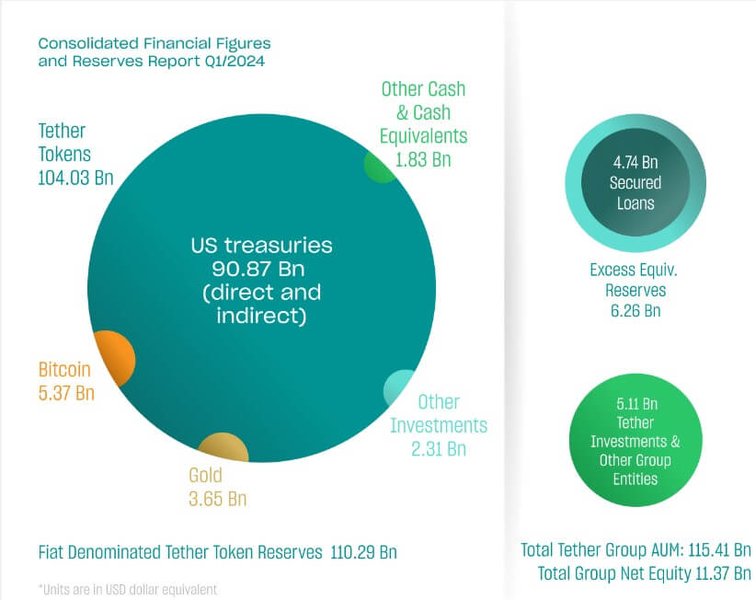
The most substantial portion of Tether's revenue comes from the interest generated by its massive reserve holdings. When users purchase USDT, they deposit fiat currency (like USD), which Tether then holds in reserve. Instead of letting these funds sit idle, Tether strategically invests them into a portfolio of assets. This portfolio is heavily weighted towards highly liquid, low-risk instruments.
Key Reserve Investments:
- U.S. Treasury Bills (T-bills): These form the cornerstone of Tether's reserve investments. Given the multi-billion dollar scale of USDT in circulation, even modest yields on T-bills translate into significant income. For example, Tether reported holding nearly $120 billion in U.S. Treasuries in early 2025, contributing to over $1 billion in operating profit in Q1 2025.
- Government Bonds: Similar to T-bills, other government-issued bonds offer stable returns.
- Cash and Cash Equivalents: A portion is held in highly liquid forms to ensure redemption capabilities. This includes bank deposits and money market funds.
- Other Investments: Tether has also disclosed investments in other areas, including corporate bonds, precious metals (like gold), and even digital tokens such as Bitcoin. These can offer higher returns but also come with increased risk.
The sheer volume of assets under management allows Tether to generate billions in profit. For instance, in the first half of 2024, Tether reported a record-breaking profit of $5.2 billion, largely attributed to its U.S. Treasury bill holdings. For the full year 2024, group-wide net profits reportedly exceeded $13 billion.
Tether's Q1 profit announcement highlighting the success of its investment strategy.
Transaction and Service Fees
While interest on reserves is primary, Tether also collects various fees that bolster its revenue:
Types of Fees:
- Issuance and Redemption Fees: When large entities, typically institutional clients, want to create new USDT (issuance) or convert USDT back to fiat (redemption), Tether may charge a fee.
- Deposit Fees: For new fiat deposits onto their platform, Tether charges a fee. For example, a common rate cited is 0.1% for minimum deposits of $100,000.
- Withdrawal Fees: Similarly, withdrawing fiat currency can incur a fee, such as a $1,000 charge for withdrawals exceeding $100,000.
- Transfer Fees: While many USDT transactions on public blockchains incur network fees paid to miners/validators, Tether itself might levy fees for certain direct services or transfers facilitated through its platform.
Though individual fees might seem small, the enormous daily trading volume of USDT means these charges accumulate into a significant revenue stream.
Lending Activities
Tether also engages in lending operations, providing secured loans to other institutions within the cryptocurrency ecosystem. These loans generate interest income for Tether, further diversifying its revenue. While specific details about these lending activities are less public, it represents another avenue for optimizing the yield on its capital.
Blockchain Network Participation
Tether actively participates in certain blockchain ecosystems. Notably, on the Tron network, Tether acts as a "Super Representative." In this capacity, under Tron's Delegated Proof of Stake (DPoS) consensus mechanism, Tether helps validate transactions and create new blocks. For these services, Tether earns block rewards and transaction fees native to the Tron blockchain, adding an ancillary income stream tied to blockchain infrastructure.
Comparative Significance of Tether's Revenue Streams
To visualize the relative importance of Tether's various income sources, the radar chart below provides an estimated breakdown. "Interest on Reserves" clearly dominates, reflecting its core business model of leveraging its vast asset base. Transaction fees provide a steady, volume-driven income, while lending and blockchain rewards offer supplementary revenue.
This chart illustrates that while diversified, Tether's financial health is overwhelmingly powered by its ability to generate returns on the fiat currencies backing USDT.
Maintaining Stability and Operations: The Pillars of USDT
Generating revenue is only one part of the equation. Tether must also meticulously manage its operations to ensure the stability of USDT's peg and maintain user trust, which are fundamental to its continued success and adoption.
Rigorous Reserve Management
The core principle of Tether's operational stability is the full backing of all circulating USDT with corresponding assets held in its reserves. This 1:1 backing (or near 1:1, with excess reserves often reported) is crucial for users to trust that their USDT can be redeemed for the pegged fiat currency.
Key Aspects of Reserve Management:
- Asset Composition: As mentioned, reserves primarily consist of U.S. Treasury bills, cash, cash equivalents, and other investments. Tether aims for a conservative allocation to minimize risk.
- Regular Attestations: To foster transparency, Tether publishes periodic attestation reports conducted by independent accounting firms. These reports aim to verify the adequacy of its reserves against the total amount of USDT in circulation. While not full audits in the traditional sense, these attestations provide a snapshot of Tether's financial position. As of August 2024, Tether reported holding $118.4 billion in reserves, including $5.3 billion in excess reserves.
- Liquidity Management: Ensuring sufficient liquidity is vital so that Tether can meet redemption requests promptly.
Issuance and Redemption Mechanism
Tether's supply is dynamic, expanding and contracting based on market demand. This is managed through a clear issuance and redemption process:
- Issuance: When authorized entities (usually large institutional clients or exchanges) want to acquire new USDT, they deposit the equivalent amount of fiat currency (e.g., USD) with Tether. Upon verification, Tether mints and issues the corresponding amount of USDT to the entity.
- Redemption: Conversely, when holders wish to convert their USDT back into fiat currency, they can request a redemption from Tether (typically subject to minimum amounts and fees). Tether then burns (destroys) the redeemed USDT and returns the equivalent fiat currency to the user.
This mechanism helps maintain the peg by ensuring that the supply of USDT in circulation is matched by underlying demand and backed by reserves.
Operational Costs and Technology
The revenue generated by Tether is used to cover various operational expenses, including:
- Platform Maintenance and Development: Ensuring the security and efficiency of its systems across multiple blockchains.
- Compliance and Legal: Adhering to regulatory requirements in various jurisdictions.
- Security: Protecting its assets and systems from cyber threats.
- Audits and Attestations: Costs associated with third-party verification of reserves.
- Staff and Infrastructure: General operational overheads.
Tether's Business Model: A Mindmap Overview
The following mindmap provides a visual representation of the key components of Tether's business model, illustrating how revenue generation, operational maintenance, and reserve management are interconnected to support the USDT stablecoin.
(Primary Source)"] id1a1["U.S. Treasury Bills"] id1a2["Government Bonds"] id1a3["Cash Equivalents"] id1a4["Other Investments
(Gold, Bitcoin, etc.)"] id1b["Transaction & Service Fees"] id1b1["Issuance Fees"] id1b2["Redemption Fees"] id1b3["Deposit/Withdrawal Fees"] id1c["Lending Activities"] id1c1["Secured Loans to Institutions"] id1d["Blockchain Participation"] id1d1["Validator Rewards (e.g., Tron SR)"] id2["Operational Maintenance"] id2a["Peg Stability (1:1 with Fiat)"] id2b["Issuance & Redemption Mechanism"] id2c["Platform & Technology Costs"] id2d["Compliance & Legal"] id2e["Security Measures"] id3["Reserve Management"] id3a["Full Asset Backing"] id3b["Asset Composition Strategy"] id3c["Liquidity Management"] id3d["Transparency & Attestations"] id3d1["Independent Reports"]
This mindmap highlights the cyclical nature of Tether's operations, where effective reserve management fuels revenue, which in turn supports the ongoing stability and utility of USDT.
Tether's Financials and Fee Structure: A Snapshot
The table below summarizes some key financial indicators and fee examples associated with Tether's operations, illustrating the scale and financial dynamics discussed.
| Aspect | Detail / Example | Significance |
|---|---|---|
| Reported Profit (H1 2024) | $5.2 billion | Demonstrates high profitability from reserve investments. |
| Reported Profit (Full Year 2024) | Over $13 billion | Indicates sustained strong performance. |
| U.S. Treasury Holdings (Early 2025) | Approaching $120 billion | Core component of reserve assets and income generation. |
| Total Reserves (August 2024) | $118.4 billion (including $5.3B excess) | Supports the circulating supply of USDT and user confidence. |
| Fiat Deposit Fee Example | 0.1% (min. deposit $100,000) | Revenue from onboarding large fiat sums. |
| Fiat Withdrawal Fee Example | $1,000 (min. withdrawal $100,000) | Revenue from fiat off-ramping services. |
| Market Share (Approx.) | Around 70% of stablecoin market | Dominant position amplifies fee revenue and investment scale. |
Exploring Tether's Success: A Video Perspective
The following video delves into the factors contributing to Tether's significant presence and financial success in the cryptocurrency market. It offers insights into how USDT generates substantial revenue and maintains its position as the leading stablecoin.
This video discusses how Tether (USDT) achieves its profitability, making it the largest stablecoin and a major cryptocurrency by market capitalization. It touches upon its revenue model, which is a central theme of our discussion here, providing a dynamic complement to the textual explanations.
Frequently Asked Questions (FAQ)
▶ How does Tether guarantee the 1:1 peg with the US dollar?
Tether aims to maintain the 1:1 peg by holding reserves that are intended to fully back each USDT token in circulation. These reserves consist primarily of cash, cash equivalents (like short-term government securities), and other assets. The ability for authorized participants to redeem USDT for USD (and vice-versa) at or near the pegged rate also helps maintain this stability through arbitrage. However, market dynamics can sometimes cause minor deviations.
▶ Is Tether's revenue solely from interest on U.S. Treasury bills?
No, while interest from U.S. Treasury bills and other similar low-risk assets forms the largest part of Tether's revenue, it's not the sole source. Tether also earns income from transaction fees (for issuance, redemption, deposits, and withdrawals), lending activities, and potentially from its other investments, which can include precious metals and digital tokens. They also earn rewards as a validator on networks like Tron.
▶ How transparent is Tether about its reserves?
Tether has increased its transparency efforts over time by publishing periodic attestation reports from independent accounting firms. These reports provide a breakdown of its reserve composition. While these are not full, detailed audits in the traditional banking sense, they offer insights into the assets backing USDT. The company has stated its commitment to further enhancing transparency.
▶ What are the main operational costs for Tether?
Tether's operational costs include expenses related to technology infrastructure and platform maintenance across multiple blockchains, security measures to protect assets and user data, legal and compliance efforts to navigate global regulations, costs associated with obtaining reserve attestations, and general administrative and personnel expenses.
Recommended Further Exploration
- What are the specific types of assets included in Tether's reserves beyond U.S. Treasury bills?
- How do Tether's reserve attestations compare to full financial audits of traditional institutions?
- What are the risks associated with holding and using USDT stablecoins?
- How does Tether's business model compare to other major stablecoin issuers like Circle (USDC)?
References
Last updated May 9, 2025