

Key Discoveries from Thomson's Experiment
- Identification of the Electron: Thomson definitively proved the existence of subatomic particles, which he initially called "corpuscles" and were later named electrons.
- Negative Charge: The experiments established that these particles carry a negative electrical charge.
- Universal Constituent of Matter: Thomson demonstrated that these negatively charged particles are fundamental components of all atoms, regardless of the material from which they originate.
- Charge-to-Mass Ratio Measurement: He successfully calculated the charge-to-mass ratio (e/m) of the electron, providing a crucial quantitative measure.
J.J. Thomson's cathode ray experiment, conducted in 1897, stands as a monumental achievement in the history of science. It challenged the long-held belief that atoms were indivisible, ushering in a new era of understanding atomic structure. Through a series of ingenious observations and measurements using a modified cathode ray tube, Thomson conclusively demonstrated the existence of the electron, a fundamental subatomic particle.
The Experimental Setup: A Glimpse into the Cathode Ray Tube
At the heart of Thomson's groundbreaking work was the cathode ray tube (CRT), a device that had been refined by predecessors like Sir William Crookes. This evacuated glass tube typically contained two electrodes: a cathode (negatively charged) and an anode (positively charged). When a high voltage was applied across these electrodes, a glowing beam, known as a cathode ray, would emanate from the cathode and travel towards the anode.
Thomson's modifications to the standard CRT were crucial for his experiments. He incorporated features that allowed him to manipulate and measure the deflection of these rays. These included:
- Electromagnetic Deflection Apparatus: Thomson utilized magnets to observe how the cathode rays responded to magnetic fields.
- Electric Field Plates: He strategically placed charged plates (one positive, one negative) within the tube to introduce an electric field perpendicular to the path of the cathode rays.
- Fluorescent Screen: A screen at the end of the tube would glow upon impact by the cathode rays, making their path visible and allowing for precise measurements of deflection.
The ability to create a high vacuum within the tube was essential. This minimized interactions between the cathode rays and gas molecules, ensuring that the observed deflections were primarily due to the applied electric and magnetic fields.
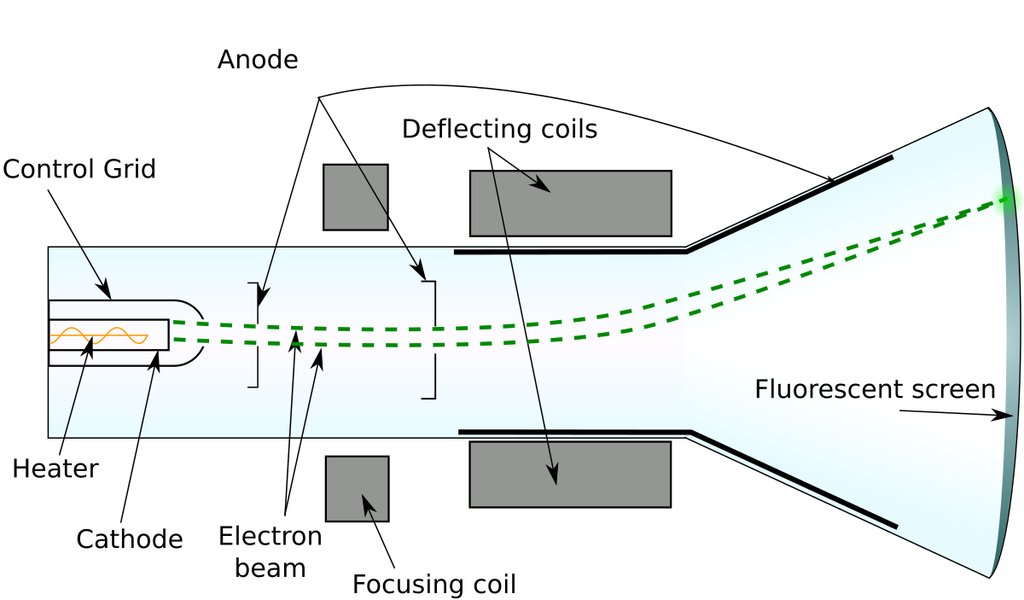
A typical diagram illustrating the components of a cathode ray tube used in Thomson's experiments.
The Process: Manipulating the Invisible Beam
Thomson's experimental procedure involved a meticulous series of observations and measurements. He systematically investigated how cathode rays behaved under the influence of both electric and magnetic fields.
Observing Electromagnetic Deflection
Early in his experiments, Thomson used magnets to deflect the cathode rays. He noted that the rays carried an electric charge, as their deflection was influenced by the magnetic field. This initial observation indicated that the rays were not simply a form of light or energy but were composed of something with intrinsic electrical properties.
Unveiling the Negative Charge with Electric Fields
A pivotal step involved applying an electric field using parallel plates. When the rays passed between a positively charged plate and a negatively charged plate, Thomson observed that the rays consistently bent towards the positive plate. This deflection provided conclusive evidence that the particles composing the cathode rays possessed a negative electrical charge, as opposite charges attract.
This video provides a clear explanation of J.J. Thomson's Cathode Ray Tube Experiment, detailing the setup, procedure, and the revolutionary discovery of the electron. It visually demonstrates how the rays were manipulated by electric and magnetic fields, making it an excellent resource for understanding the core principles of the experiment.
The Crucial Charge-to-Mass Ratio Measurement
Thomson's most significant contribution was his ability to quantitatively determine the charge-to-mass ratio (e/m) of these negatively charged particles. He achieved this by carefully balancing the effects of perpendicular electric and magnetic fields. By adjusting the strengths of these fields until the cathode ray traveled in a straight line, undeviated, he could equate the electric force to the magnetic force acting on the particles.
The electric force \( F_E \) is given by \( F_E = qE \), where \( q \) is the charge of the particle and \( E \) is the electric field strength. The magnetic force \( F_B \) is given by \( F_B = qvB \), where \( v \) is the velocity of the particle and \( B \) is the magnetic field strength. When these forces are balanced:
\[ qE = qvB \]This simplifies to:
\[ v = \frac{E}{B} \]Using the deflection in a purely electric field, Thomson could also relate the deflection distance to the charge, mass, velocity, and field strength. By combining these measurements, he derived a formula for the charge-to-mass ratio:
\[ \frac{e}{m} = \frac{E}{B^2 r} \quad \text{or, more generally, by considering energy and deflection geometry.} \]A common simplified formula used to calculate e/m when balancing fields is:
\[ \frac{e}{m} = \frac{E^2}{2 V B^2} \quad \text{(where V is accelerating voltage)} \]Thomson found that the e/m ratio was approximately \( 1.76 \times 10^{11} \text{ C/kg} \). This value was consistent regardless of the type of gas in the tube or the material of the electrodes, strongly suggesting that these particles were universal constituents of all matter.
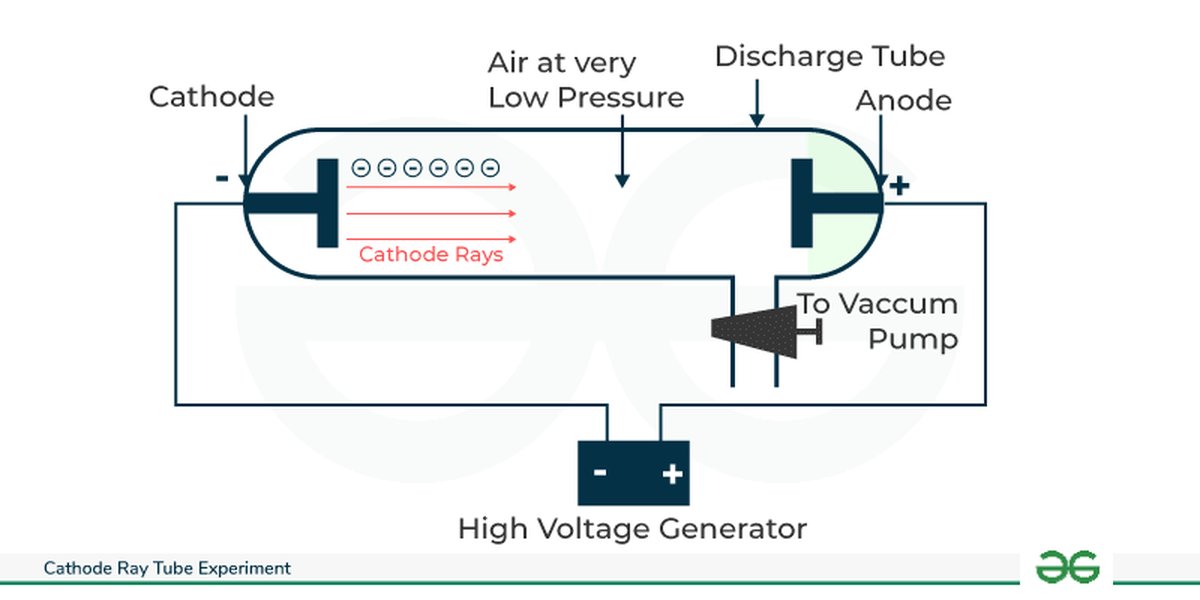
A diagram illustrating the experimental setup for Thomson's cathode ray experiment, showing the electric and magnetic plates.
Revolutionizing Atomic Theory: The Plum Pudding Model
Thomson's discovery was nothing short of revolutionary. Prior to his work, the atom was widely considered to be an indivisible, fundamental unit of matter, a concept championed by John Dalton. Thomson's experiments decisively proved that atoms contained smaller, negatively charged particles – the electrons (which he initially called "corpuscles").
To reconcile the existence of these negatively charged electrons within a neutral atom, Thomson proposed his famous "plum pudding" model of atomic structure in 1904. In this model, the atom was envisioned as a sphere of uniformly distributed positive charge, much like a pudding, with negatively charged electrons (the "plums") embedded within it. This model, while later superseded by Rutherford's nuclear model, was a critical stepping stone in the development of modern atomic theory.
Beyond the Electron: Immediate and Lasting Impact
The impact of Thomson's experiment extended far beyond the mere discovery of a new particle. It fundamentally altered the scientific understanding of matter and laid the groundwork for numerous future discoveries.
- Foundation for Millikan's Experiment: Thomson's e/m ratio paved the way for Robert Millikan's oil-drop experiment, which later measured the elementary charge of the electron (e) directly. With both 'e' and 'e/m' known, the mass of the electron could be accurately calculated.
- Development of Modern Physics: The electron's discovery opened up new avenues of research in quantum mechanics, solid-state physics, and countless other fields.
- Technological Advancements: The understanding of cathode rays and their properties was instrumental in the development of various technologies, most notably the cathode ray tube displays used in televisions and computer monitors for decades.
The Legacy in Detail
Thomson's work created a ripple effect, influencing not only theoretical physics but also practical applications. Understanding the electron was crucial for developing technologies ranging from advanced scientific instruments to everyday electronics.
This mindmap visually summarizes the multifaceted aspects of Thomson's cathode ray experiment, from its core discovery of the electron to its profound impact on atomic theory and subsequent scientific and technological advancements. It highlights the interconnectedness of his methodology, findings, and the lasting legacy.
Chronology of Discovery and Related Work
To further contextualize Thomson's achievements, it's useful to consider the timeline of related scientific efforts leading up to and following his experiment.
| Year | Scientist(s) | Contribution | Significance |
|---|---|---|---|
| Mid-1800s | Various (e.g., Geissler, Crookes) | Development of vacuum tubes and observation of cathode rays | Pioneered the apparatus crucial for later experiments. |
| 1895 | Wilhelm Röntgen | Discovery of X-rays using cathode ray tubes | Demonstrated unexpected phenomena originating from CRTs, fueling further research. |
| 1897 | J.J. Thomson | Discovery of the electron and measurement of its e/m ratio | Proved subatomic particles exist, shattering the indivisible atom model. |
| 1904 | J.J. Thomson | Proposed the "Plum Pudding" atomic model | First model incorporating subatomic electrons, despite later inaccuracies. |
| 1909 | Robert Millikan | Oil-drop experiment, measuring the elementary charge of the electron | Allowed for the precise calculation of the electron's mass. |
| 1911 | Ernest Rutherford | Gold foil experiment, leading to the nuclear model of the atom | Disproved the plum pudding model and established the atomic nucleus. |
This table illustrates how Thomson's experiment was a pivotal point, building on earlier technological advancements and providing the critical evidence needed for subsequent, more refined atomic models.
Frequently Asked Questions About Thomson's Experiment
What was the primary goal of J.J. Thomson's cathode ray experiment?
How did Thomson determine the charge of the cathode ray particles?
Why was the charge-to-mass ratio (e/m) so significant?
What was the "plum pudding" model, and why was it proposed?
How did Thomson's experiment challenge earlier atomic theories?
Conclusion: A Foundation for Modern Science
J.J. Thomson's cathode ray experiment was a watershed moment in scientific history. It not only led to the discovery of the electron, a fundamental particle of matter, but also shattered the prevailing notion of the indivisible atom. His meticulous experimental design, precise measurements of the charge-to-mass ratio, and insightful conclusions paved the way for all subsequent atomic models, from his own "plum pudding" model to Rutherford's nuclear model and the quantum mechanical descriptions of today. The legacy of Thomson's work is evident in every aspect of modern physics and chemistry, underscoring its profound and lasting impact on our understanding of the universe.
Recommended Further Exploration
- How did Millikan's oil drop experiment build on Thomson's work?
- What were the limitations of Thomson's plum pudding model?
- Explore the history and evolution of the cathode ray tube technology.
- Compare and contrast Dalton's atomic theory with Thomson's discoveries.