
Unlocking Thorium's Power: Navigating the Hurdles to a New Nuclear Era
Delving into the complex technical, economic, and regulatory obstacles hindering the widespread adoption of thorium-based nuclear reactors.
Thorium, a naturally abundant element, holds considerable promise as an alternative nuclear fuel, potentially offering enhanced safety, reduced long-lived radioactive waste, and greater fuel security compared to conventional uranium-based reactors. However, the path to harnessing thorium's energy on a commercial scale is fraught with a multitude of significant challenges. As of May 6, 2025, these obstacles span technical complexities in fuel science and reactor design, substantial economic barriers, evolving regulatory landscapes, and safety considerations including proliferation risks.
Highlights: Key Obstacles at a Glance
- Fertile, Not Fissile Nature: Thorium (specifically Thorium-232) is a fertile material, meaning it cannot directly sustain a nuclear chain reaction. It must first be converted, or "bred," into the fissile isotope Uranium-233 (U-233) within a reactor, introducing unique complexities to the fuel cycle.
- Advanced Material Science Demands: Many promising thorium reactor designs, particularly Molten Salt Reactors (MSRs), operate at high temperatures and involve highly corrosive fuel or coolant materials. This necessitates the development and qualification of novel, resilient materials capable of withstanding these extreme conditions over long operational lifetimes.
- Economic and Regulatory Gaps: The journey from concept to commercial reality for thorium reactors is characterized by high initial research and development costs, significant infrastructure investment, and competition with the well-established uranium fuel cycle. Furthermore, existing nuclear regulatory frameworks, largely designed for uranium reactors, require adaptation for novel thorium-based systems.
The Thorium Fuel Cycle: Inherent Complexities
The unique nuclear properties of thorium give rise to a distinct set of challenges associated with its fuel cycle, from its initial preparation to the management of its byproducts.
From Fertile to Fissile: The Breeding Imperative
Unlike Uranium-235, which is naturally fissile, Thorium-232 (the predominant isotope of thorium) is fertile. This means it cannot initiate or sustain a nuclear chain reaction on its own. To become a usable nuclear fuel, Thorium-232 must absorb a neutron to transform into Thorium-233. This isotope then undergoes two stages of beta decay: first into Protactinium-233 (Pa-233), and subsequently into the fissile Uranium-233. This breeding process necessitates an initial source of neutrons, typically provided by a fissile "driver" material such as Uranium-235 or Plutonium-239, or an external neutron source, adding complexity to reactor start-up and operation.
Managing Radioactive Byproducts: U-233 and U-232
The fissile Uranium-233 produced from thorium is highly radioactive and requires careful, often remote, handling and processing. A significant challenge arises from the concurrent production of Uranium-232 as an isotopic contaminant. U-232 has a relatively short half-life (around 69 years) but its decay chain includes Thallium-208, which emits highly energetic gamma radiation. This intense gamma radiation complicates fuel fabrication, reactor maintenance, spent fuel reprocessing, and transportation, necessitating more robust shielding and remote handling technologies. Paradoxically, the presence of U-232 also acts as a passive proliferation deterrent, as it makes the U-233 significantly more difficult and hazardous to handle for weaponization purposes.
The Protactinium Predicament (Pa-233)
Protactinium-233, the intermediate isotope in the breeding chain from Thorium-232 to Uranium-233, presents a notable challenge. Pa-233 has a relatively long half-life of about 27 days and a significant neutron absorption cross-section. If Pa-233 remains within the reactor core, it can absorb neutrons that would otherwise contribute to fission or further breeding of U-233, thereby reducing the reactor's neutron economy and breeding efficiency. Some advanced reactor designs, particularly certain Molten Salt Reactors, propose to chemically separate Pa-233 from the fuel salt and allow it to decay into U-233 outside the core before reintroducing the U-233. This separation process, while improving breeding, adds significant complexity and cost to the fuel processing system and introduces another stream of highly radioactive material to manage.
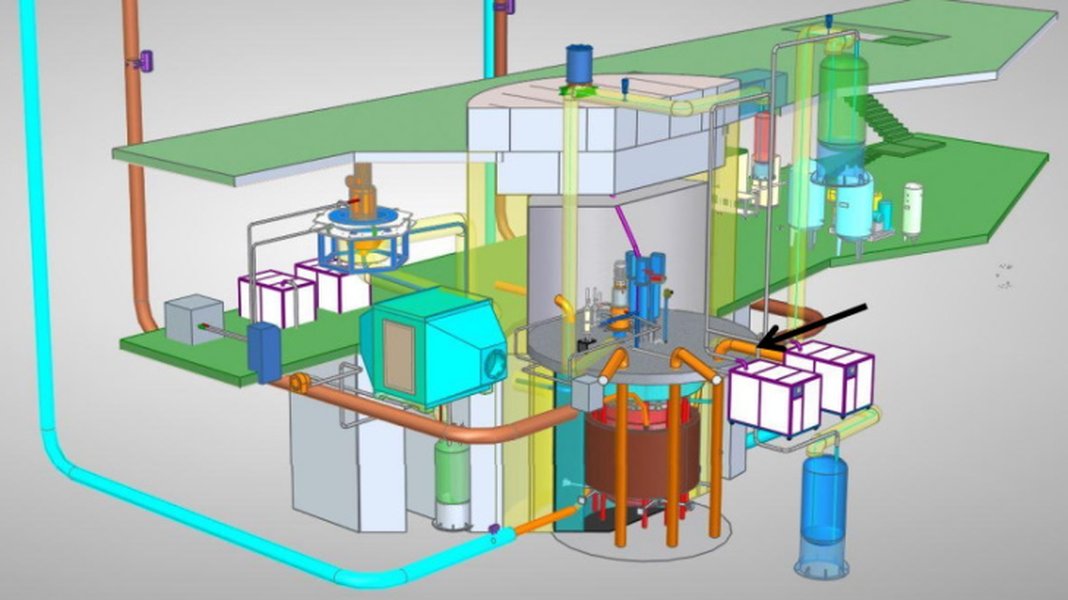
Cutaway view of an experimental Thorium Molten Salt Reactor (TMSR-LF1) design, illustrating the complexity of such systems.
Engineering and Material Science Hurdles
The development of practical and reliable thorium reactors hinges on overcoming substantial engineering and material science challenges, particularly for advanced designs aiming to maximize thorium's benefits.
The Quest for Resilient Materials
A critical hurdle, especially for Molten Salt Reactors (MSRs) which are often considered ideal for thorium fuel cycles, is material compatibility. MSRs typically use molten fluoride or chloride salts as a solvent for the thorium fuel and as a primary coolant. These salts, operating at high temperatures (often 600°C to over 700°C), are highly corrosive to conventional structural materials. Finding or developing alloys that can withstand this corrosive environment, along with intense radiation fields and high mechanical stresses for decades, is a major research and development focus. Historical MSR experiments, like the Molten Salt Reactor Experiment (MSRE) at Oak Ridge National Laboratory in the 1960s, encountered significant material degradation issues, and while progress has been made, robust, commercially viable solutions are still under development.
Reactor Design and Operational Challenges
The overall technological maturity of thorium reactor designs is considerably lower than that of established uranium-fueled reactors. Most thorium concepts are still in the experimental or demonstration phase. Specific challenges include:
- Molten Salt Reactor Specifics: Beyond corrosion, MSRs face challenges in designing reliable pumps for circulating highly radioactive molten salt, ensuring leak-tight primary coolant systems, developing effective shielding, managing the complex chemistry of the salt (including fission product removal), and preventing blockages due to salt freezing or precipitation.
- Neutron Economy: Thorium-based fuel cycles can sometimes yield fewer excess neutrons per fission event compared to uranium-plutonium cycles, particularly in thermal spectrum reactors. This demands very precise reactor core design and control systems to sustain the chain reaction efficiently and achieve effective breeding of U-233.
- Adapting Thorium for Existing Reactors: While thorium can theoretically be used in existing reactor types like Light Water Reactors (LWRs) or Pressurized Heavy Water Reactors (PHWRs), this often requires significant modifications to the reactor core, development of new fuel assembly designs (e.g., thorium-oxide pellets mixed with uranium or plutonium oxides), and adjustments to fuel management strategies. Such adaptations can be costly, introduce new licensing challenges, and may not fully leverage thorium's potential benefits without substantial redesign.
Charting the Challenges: A Comparative Overview
The development of thorium reactors involves navigating a multifaceted landscape of challenges. The radar chart below provides a qualitative visualization of the perceived relative intensity across several key challenge categories for thorium reactor development in general. These assessments are based on the current understanding and highlight areas requiring significant focus and innovation. The scale represents perceived difficulty/impact, with higher values indicating greater challenges.
This chart illustrates that material science demands and the initial economic viability, coupled with the inherent technical complexity of the thorium fuel cycle, are often perceived as the most significant hurdles. While waste management is considered a relative strength of thorium, developing and licensing appropriate solutions still presents challenges.
Economic Realities and Market Adoption Barriers
Beyond the scientific and engineering intricacies, the path to commercializing thorium reactors is heavily influenced by economic factors and market dynamics.
The High Cost of Innovation
The development of any new nuclear reactor technology entails substantial upfront investment. For thorium reactors, this includes extensive research and development (R&D), construction and operation of prototypes and demonstration plants, comprehensive testing and qualification of new materials and components, and the establishment of novel fuel fabrication and reprocessing facilities. These high initial costs can be a significant deterrent for both public and private sector investment, especially given the long timelines before any return on investment can be expected.
Competing with an Established Incumbent
The global nuclear industry is overwhelmingly based on the uranium fuel cycle. This established technology benefits from decades of operational experience, well-developed global supply chains for uranium fuel and components, extensive existing infrastructure, and mature regulatory frameworks. For thorium to gain significant market share, it must demonstrate clear and compelling economic advantages, or superior performance in safety and waste management, sufficient to overcome the inertia of the established uranium-based industry.
Investment Uncertainty and Development Timelines
The long development cycles, typically spanning decades from concept to commercial deployment for new nuclear technologies, contribute to investment uncertainty. The lack of fully commercial-scale thorium reactor prototypes in operation means that reliable data on construction costs, operational performance, and overall economic viability are still limited. This uncertainty can make it difficult to secure the sustained, long-term financial commitments necessary for successful development and deployment.
The following table summarizes key categories of challenges in thorium reactor development, providing specific examples and their broad implications:
| Challenge Category | Specific Issues | Primary Implications |
|---|---|---|
| Technical (Fuel Cycle) | Fertile nature of Th-232 (breeding required); Pa-233 management; U-232 contamination and U-233 handling; neutron economy. | Complex reactor physics and design; need for initial fissile material; specialized remote handling for fuel; potentially difficult fuel reprocessing. |
| Technical (Materials & Design) | High-temperature corrosion (especially in MSRs); radiation damage to materials; overall technology immaturity; challenges in adapting thorium to existing LWR designs. | Need for novel, highly resistant alloys; extensive material qualification programs; limited operational data and experience; potentially high redesign costs for existing reactor types. |
| Economic | High R&D and initial capital costs; lack of established thorium fuel cycle infrastructure; competition with mature uranium market; long development timelines. | Significant upfront financial investment required; slow market penetration; difficulty attracting investment without proven commercial viability. |
| Regulatory & Licensing | Existing regulatory frameworks primarily designed for uranium reactors; need for new safety assessment methodologies for novel designs (e.g., MSRs); licensing first-of-a-kind reactors. | Potentially lengthy and complex licensing processes; uncertainty in regulatory requirements; delays in deployment. |
| Safety & Proliferation | Proliferation potential of U-233 (though mitigated by U-232); safe handling of highly radioactive Pa-233 and U-233; management of thorium-specific waste streams. | Need for robust safeguards and non-proliferation measures; stringent safety protocols for fuel handling and processing; development of specific waste disposal solutions. |
| Public & Social Acceptance | General public perception of nuclear energy; concerns about new or unfamiliar nuclear technologies; need for transparent communication. | Potential for public opposition affecting project siting and development; importance of stakeholder engagement and education. |
Navigating the Regulatory and Safety Landscape
The successful deployment of thorium reactors also depends on establishing appropriate regulatory frameworks and addressing safety and proliferation concerns comprehensively.
Adapting Frameworks for a New Technology
Current nuclear regulatory frameworks in most countries have been developed over decades based on the experience with uranium-fueled Light Water Reactors (LWRs). Thorium reactors, particularly advanced designs like Molten Salt Reactors (MSRs) or Liquid Fluoride Thorium Reactors (LFTRs), possess unique characteristics and safety profiles that may not be adequately addressed by existing regulations. This necessitates the development of bespoke safety assessment methodologies, potential modifications to licensing requirements, and extensive dialogue between developers and regulatory bodies. This adaptation process can be time-consuming and add to the overall development timeline and cost.
Addressing Proliferation Concerns
While the thorium fuel cycle offers certain non-proliferation advantages, it is not entirely free from proliferation risks. Uranium-233, the fissile material bred from thorium, is a weapons-usable material. As mentioned, the presence of U-232 (and its highly gamma-emitting decay products) makes U-233 difficult to handle and weaponize, providing a degree of intrinsic proliferation resistance. However, concerns remain, particularly regarding the potential for clandestine separation of Protactinium-233. Pa-233 is the precursor to U-233 and is chemically distinct, making it potentially easier to separate from thorium than U-233 is from uranium in a mixed fuel. If Pa-233 were separated and allowed to decay, it could yield U-233 with lower U-232 contamination. Therefore, robust international safeguards, material accountancy, and physical protection measures are essential for any widespread deployment of thorium fuel cycle technologies.
Public Perception and Acceptance
As with any nuclear technology, public perception and acceptance are crucial for the successful development and deployment of thorium reactors. Past nuclear accidents and general concerns about radiation and radioactive waste can lead to public apprehension towards new nuclear projects. Proponents of thorium energy must engage in transparent communication, clearly articulating the potential benefits (e.g., reduced long-lived waste, enhanced safety features of certain designs) while also openly addressing the risks and challenges. Building public trust through demonstrated safety, responsible waste management strategies, and robust regulatory oversight will be key.
Visualizing the Web of Challenges
The development of thorium reactors is a complex endeavor, with interconnected challenges spanning multiple domains. This mindmap provides a visual overview of the primary obstacles that researchers, engineers, and policymakers are working to overcome to realize the potential of thorium energy.
Understanding the Broader Context: Why Thorium Isn't Mainstream Yet
The journey towards realizing thorium's potential is multifaceted, involving not just technical hurdles but also historical development paths, economic decisions, and policy priorities. The following video explores some of the overarching questions and debates surrounding why thorium energy, despite its long-recognized promise, hasn't yet become a mainstream reality, touching upon several of the challenges discussed in this overview.
Frequently Asked Questions (FAQ)
Why is thorium pursued despite needing to be "bred" into a usable fuel?
Thorium is pursued for several key reasons despite its fertile nature. Firstly, thorium is about three to four times more abundant in the Earth's crust than uranium, offering long-term fuel security. Secondly, its breeding process into Uranium-233 (U-233) can, in certain advanced reactor designs (breeder reactors), potentially create more fissile fuel than is consumed. Thirdly, thorium fuel cycles can produce significantly less transuranic waste (long-lived radioactive elements like plutonium and americium) compared to uranium fuel cycles, which simplifies long-term waste management. Finally, some thorium reactor designs, particularly Molten Salt Reactors, are believed to offer inherent safety advantages, such as operating at lower pressures and having passive decay heat removal capabilities.
Are Molten Salt Reactors (MSRs) the only option for thorium?
No, Molten Salt Reactors (MSRs) are not the only option for utilizing thorium, although they are often highlighted due to their potential for efficient thorium breeding, continuous fission product removal, and operation at high temperatures. Thorium can also be used as a fuel in other reactor types, including:
- Pressurized Heavy Water Reactors (PHWRs): These reactors, like the CANDU design, have excellent neutron economy and can utilize thorium in various fuel bundle configurations. India has a significant program focused on thorium in PHWRs.
- High-Temperature Gas-Cooled Reactors (HTGRs): Thorium can be incorporated into the TRISO fuel particles used in HTGRs, offering benefits of high thermal efficiency and safety.
- Light Water Reactors (LWRs): Thorium can be used in existing LWRs, typically as a mixed oxide (ThO2-UO2 or ThO2-PuO2) fuel. However, achieving efficient breeding in standard LWRs is challenging due to their neutron spectrum.
- Fast Breeder Reactors (FBRs): Thorium can also be used in the blanket of FBRs to breed U-233.
Each reactor type presents different advantages and challenges for thorium utilization, and the optimal choice depends on various technical and strategic factors.
How significant is the proliferation risk associated with thorium reactors?
The proliferation risk associated with thorium reactors is a complex issue with arguments on both sides. Uranium-233 (U-233), bred from thorium, is a fissile material suitable for nuclear weapons, similar to Uranium-235 or Plutonium-239. However, the thorium fuel cycle has an intrinsic feature that complicates the use of U-233 for weapons: the inevitable co-production of Uranium-232 (U-232). U-232 decays to Thallium-208, which emits very strong, penetrating gamma radiation. This makes the U-233 highly radioactive and difficult to handle, fabricate into a weapon, and conceal, thus providing a degree of "self-protection" or "proliferation resistance."
Nevertheless, concerns exist. If Protactinium-233 (the precursor to U-233, with a half-life of 27 days) is chemically separated from the irradiated thorium fuel before it decays into U-233, it could theoretically yield U-233 with significantly lower U-232 contamination, making it more attractive for proliferation. Therefore, while some thorium fuel cycles offer enhanced proliferation resistance compared to traditional uranium-plutonium cycles, they are not entirely proliferation-proof. Robust international safeguards, physical security measures, and careful fuel cycle design are crucial to mitigate these risks.
What is often cited as the single biggest hurdle for thorium reactor commercialization?
While there are many interconnected challenges, the combination of high initial development costs and the lack of a mature, established thorium fuel cycle infrastructure is frequently cited as a primary hurdle for commercialization. The existing nuclear industry is heavily invested in the uranium fuel cycle, which has a well-developed supply chain, decades of operational experience, and established regulatory frameworks. Overcoming the economic inertia of this established industry requires substantial, sustained investment in research, development, demonstration, and the creation of entirely new infrastructures for thorium fuel fabrication, reprocessing, and waste management. This economic barrier, coupled with long development timelines and the need to prove technological viability and safety to stringent regulatory standards, makes it difficult for thorium to compete economically in the short to medium term without strong, long-term government policy support and significant technological breakthroughs that demonstrate clear advantages.
Recommended Further Exploration
- What are the specific material science breakthroughs needed for Molten Salt Thorium Reactors?
- How does the waste profile of thorium reactors compare in detail to uranium reactors?
- What is the current status of major thorium reactor research projects worldwide as of 2025?
- Can thorium reactors be economically competitive with other low-carbon energy sources?
References
Last updated May 6, 2025