
Unlocking the Blueprint of Compelling Stories: What is the Three-Act Structure?
Discover the timeless narrative framework that shapes everything from ancient myths to modern blockbusters.
The three-act structure is arguably the most recognized and widely utilized narrative framework in storytelling. It provides a foundational model that divides a story into three distinct segments: a beginning (Act One: The Setup), a middle (Act Two: The Confrontation), and an end (Act Three: The Resolution). This structure isn't just a screenwriter's tool; it underpins novels, plays, television series, and even complex video game narratives, offering a reliable blueprint for crafting engaging and emotionally resonant stories.
Key Insights into the Three-Act Structure
- Universal Appeal: Its roots trace back to Aristotle's Poetics, highlighting a fundamental human preference for stories with a clear beginning, middle, and end. Modernized by figures like Syd Field, it remains dominant across various media.
- Dynamic Framework: Far from a rigid formula, it's a flexible guide. Each act serves a specific purpose—setup, confrontation, resolution—driven by key turning points (plot points) that escalate conflict and propel the narrative forward.
- Character-Centric Journey: The structure inherently supports character development, forcing protagonists to confront obstacles, grow, and change in response to escalating stakes, culminating in a climactic resolution.
Deconstructing the Narrative: The Three Acts Explained
Understanding each act's function and key components is crucial for appreciating how this structure builds momentum, tension, and ultimately, a satisfying story arc.
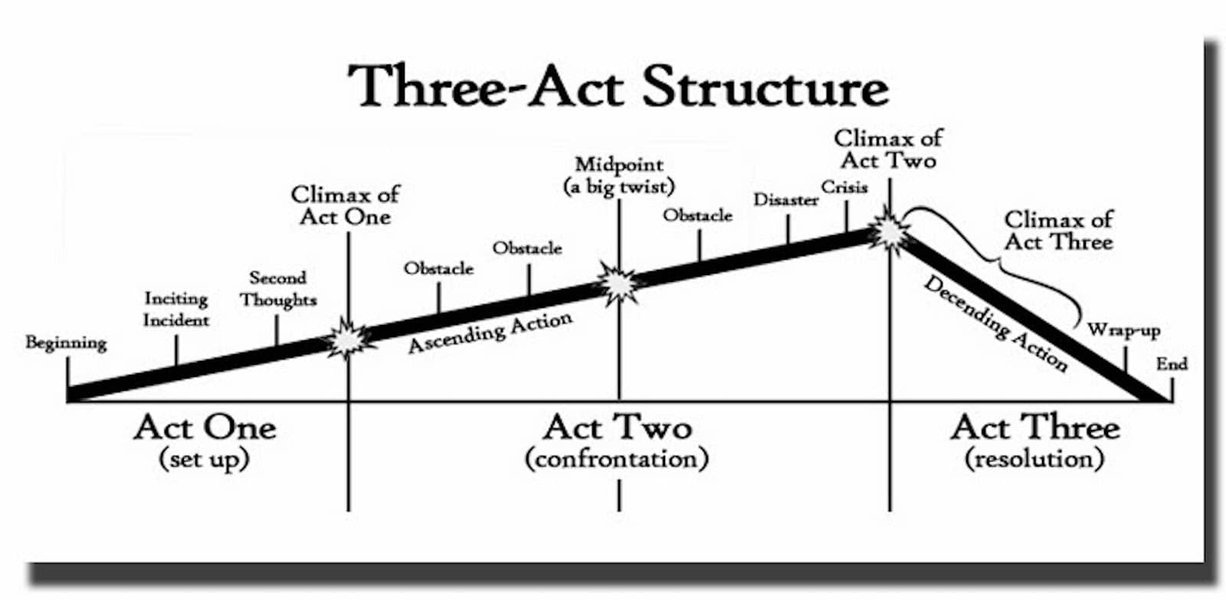
A visual representation of the typical plot progression within the three-act structure.
Act One: The Setup (Beginning)
Typically comprising the first 20-25% of the story, Act One lays the groundwork. Its primary goal is to orient the audience, introduce the core elements, and launch the central conflict.
Core Components of Act One
- Exposition & Introduction: Establishes the setting (time and place), introduces the protagonist in their 'ordinary world,' and familiarizes the audience with key supporting characters and the initial tone of the story.
- Inciting Incident: This is the catalyst—an event that disrupts the protagonist's normal life, introduces the central conflict or story question, and sets the narrative in motion. It's the hook that grabs the audience's attention.
- Establishing Stakes and Goals: The audience learns what the protagonist wants or needs to achieve and what they stand to lose if they fail.
- Plot Point One (The Turning Point): Occurring near the end of Act One, this is a crucial event or decision that locks the protagonist into the central conflict and propels them out of their ordinary world and into the main action of Act Two. There's often no turning back after this point.
Example: In Star Wars: A New Hope (1977), Act One introduces Luke Skywalker's mundane life on Tatooine, presents the inciting incident (R2-D2's message from Princess Leia), and culminates in Plot Point One: Luke's decision to leave Tatooine with Obi-Wan Kenobi after his aunt and uncle are killed, committing him to the Rebel cause.
Act Two: The Confrontation (Middle)
Act Two is the longest section, usually making up around 50% of the story. This is where the conflict unfolds in earnest, stakes are raised, and the protagonist undergoes significant development.
Core Components of Act Two
- Rising Action: A series of escalating challenges, obstacles, and complications confront the protagonist as they pursue their goal. Tension builds steadily.
- Subplots and Character Development: Relationships are tested, alliances are formed or broken, and secondary storylines often emerge, adding depth to the main plot and exploring themes. The protagonist learns, adapts, and grows (or fails to).
- The Midpoint: Occurring roughly halfway through Act Two (and the story overall), this is often a major turning point. It can be a significant victory or defeat, a crucial revelation, or a moment where the stakes are dramatically raised, changing the direction or intensity of the conflict.
- Obstacles and Setbacks: The protagonist faces increasing opposition, often leading to moments of despair, failure, or the "dark night of the soul" where hope seems lost.
- Plot Point Two (The Second Turning Point): Near the end of Act Two, this event pushes the protagonist towards the final confrontation. It's often the lowest point for the hero, involving a major setback, a loss, or a final piece of information that makes the climax inevitable. It transitions the story into Act Three.
Example: In The Matrix (1999), Act Two encompasses Neo's training, his encounters with Agents, the betrayal by Cypher, and his visit to the Oracle. The Midpoint could be the Oracle's ambiguous prophecy, raising the stakes of Neo's potential role. Plot Point Two occurs when Morpheus is captured, forcing Neo to commit fully to a dangerous rescue mission, leading into the final act.
Act Three: The Resolution (End)
Constituting the final 20-25% of the narrative, Act Three brings the conflict to its peak and provides closure.
Core Components of Act Three
- Pre-Climax (Build-Up): Events accelerate towards the final showdown. The protagonist often gathers allies, makes final preparations, or overcomes last-minute obstacles.
- Climax: The story's peak. This is the direct confrontation between the protagonist and the primary antagonist or antagonistic force. The central conflict is faced head-on, and the story's main dramatic question is answered.
- Falling Action: The immediate aftermath of the climax. Tension subsides as the consequences of the climax unfold.
- Resolution (Denouement): Loose ends are tied up, subplots are concluded, and the protagonist's journey finds its conclusion. The audience sees the 'new normal' – how the characters and the world have changed as a result of the story's events. The final thematic message is often reinforced here.
Example: In Jurassic Park (1993), Act Three involves the final desperate attempts to restore power and escape the island, culminating in the Climax where the T-Rex inadvertently saves the humans from the velociraptors. The Resolution shows the survivors escaping by helicopter, reflecting on the chaos unleashed by unchecked ambition.
Visualizing Narrative Flow: Act Focus Comparison
While all elements are present throughout, the emphasis shifts across the acts. This chart visualizes the relative focus on key narrative components within each act, based on typical storytelling patterns. A higher score indicates greater emphasis during that act.
As illustrated, Act One heavily emphasizes introductions and setup. Act Two is dominated by rising action, character development, and navigating obstacles, centered around the Midpoint. Act Three peaks with the Climax and focuses on providing a satisfying Resolution.
Mapping the Structure: A Mindmap Overview
This mindmap provides a simplified visual breakdown of the three-act structure and its core components, showing the linear progression and key elements within each phase.
(Protagonist, World, Tone)"] id1b["Inciting Incident
(Disruption, Conflict Begins)"] id1c["Establish Stakes & Goal"] id1d["Plot Point 1
(Commitment, Transition to Act 2)"] id2["Act Two: Confrontation"] id2a["Rising Action
(Obstacles, Complications)"] id2b["Character Development & Subplots"] id2c["Midpoint
(Major Turning Point, Revelation)"] id2d["Increased Stakes & Setbacks"] id2e["Plot Point 2
(Low Point, Transition to Act 3)"] id3["Act Three: Resolution"] id3a["Pre-Climax
(Build-up, Final Preparations)"] id3b["Climax
(Peak Confrontation, Conflict Resolved)"] id3c["Falling Action
(Immediate Consequences)"] id3d["Resolution / Denouement
(New Normal, Loose Ends Tied)"]
Key Narrative Turning Points
Certain moments within the three-act structure are pivotal for driving the story forward. Understanding these plot points is key to mastering the framework.
| Plot Point / Term | Act | Function | Description |
|---|---|---|---|
| Inciting Incident | Act One | Initiate Conflict | The event that disrupts the protagonist's ordinary life and launches the main storyline. |
| Plot Point One | End of Act One | Commitment / Transition | Marks the protagonist's commitment to the journey or conflict; propels the story into Act Two. Often a point of no return. |
| Midpoint | Middle of Act Two | Shift in Dynamics | A significant event (revelation, victory, failure) that changes the stakes, direction, or protagonist's understanding. |
| Plot Point Two | End of Act Two | Crisis / Transition | Often the protagonist's lowest point or a major setback that raises the stakes to their highest, leading directly into the final confrontation of Act Three. |
| Climax | Act Three | Peak Conflict | The ultimate confrontation where the central conflict is resolved and the main dramatic question is answered. |
| Resolution (Denouement) | End of Act Three | Closure | The aftermath of the climax, showing the new status quo and tying up remaining narrative threads. |
Why Does the Three-Act Structure Endure?
The longevity and prevalence of the three-act structure can be attributed to several factors:
- Psychological Resonance: It mirrors the natural rhythm of problem-solving and human experience—identifying a problem (Act 1), struggling with it (Act 2), and finding a resolution (Act 3). This makes stories feel intuitive and satisfying.
- Emotional Engagement: The structure is designed to build emotional investment. Act One creates curiosity and empathy, Act Two builds tension and suspense through conflict, and Act Three provides catharsis and emotional release through resolution.
- Pacing and Momentum: It provides a clear roadmap for managing narrative pacing, ensuring a balance between setup, development, and payoff, which helps maintain audience interest.
- Flexibility and Adaptability: While providing a clear structure, it's not overly prescriptive. Writers can adapt it to fit various genres, tones, and narrative complexities, from simple fables to intricate epics. Modern storytellers often play with or subvert elements while still adhering to the underlying principles.
See it in Action: Explaining the Structure
Visual explanations can often clarify complex concepts. This video provides a concise overview of the three-act structure, highlighting its key components and demonstrating its application in storytelling, particularly useful for visual learners and those interested in screenwriting.
The video effectively breaks down the progression through the acts, illustrating how tension typically rises and falls, and how pivotal moments like the inciting incident, midpoint, and climax function to shape the narrative journey. It reinforces the idea that this structure provides a powerful yet adaptable foundation for compelling storytelling.
Frequently Asked Questions (FAQ)
Is the three-act structure a strict formula?
No, it's best viewed as a flexible framework or blueprint rather than a rigid formula. While it outlines key stages (Setup, Confrontation, Resolution) and typical turning points, writers frequently adapt, modify, or even subvert elements to suit their specific story, genre, or artistic goals. Its strength lies in providing a solid foundation for narrative momentum and coherence.
Can the three-act structure be used for novels as well as screenplays?
Absolutely. While heavily associated with screenwriting (popularized by Syd Field), the three-act structure is widely used in novels, plays, and other forms of long-form storytelling. The core principles of setup, rising conflict, and resolution apply effectively across different mediums, providing a useful tool for plotting and pacing lengthy narratives.
What's the difference between the Inciting Incident and Plot Point One?
The Inciting Incident is the event that kicks off the story's main conflict and disrupts the protagonist's status quo (e.g., finding Leia's message in Star Wars). Plot Point One occurs later in Act One and represents the moment the protagonist actively commits to addressing the conflict or embarking on the journey, effectively locking them into the story of Act Two (e.g., Luke deciding to leave Tatooine).
Are there other common story structures besides the three-act structure?
Yes, while the three-act structure is dominant, other structures exist and are widely used. Examples include the Five-Act Structure (common in Shakespearean plays and some modern dramas, often dividing the middle act), the Hero's Journey (Joseph Campbell's monomyth, focusing on archetypal stages), Fichtean Curve (starting closer to the action), and various non-linear or episodic structures.
Recommended Reading
- Explore the nuances distinguishing the three-act structure from the five-act model.
- Investigate Syd Field's specific contributions to popularizing and defining the three-act structure for screenwriting.
- Discover notable films that play with or break the conventions of the three-act structure.
- Learn practical tips for adapting and utilizing the three-act structure specifically for novel writing.
References
Last updated April 29, 2025