
The Tiananmen Square Protests and Massacre of 1989
A pivotal moment in China's struggle for democracy and human rights
Key Takeaways
- Massive Pro-Democracy Movement: Initiated by students seeking political reform and anti-corruption measures.
- Violent Military Crackdown: The government's imposition of martial law led to a tragic loss of life.
- Enduring Impact and Censorship: The events significantly influenced China's political landscape and remain a sensitive topic.
Background and Origins of the Protests
Political and Social Context
In 1989, China was undergoing significant economic reforms under the leadership of Deng Xiaoping. These reforms had spurred rapid economic growth but also led to increased social inequality and widespread corruption within the Communist Party. The death of Hu Yaobang, a beloved and reform-minded Communist Party leader, on April 15, 1989, acted as a catalyst for the burgeoning pro-democracy movement. Hu was seen as a symbol of political openness, and his passing ignited a desire for similar reforms among the populace.
Demands for Political Reform
The initial gatherings in Tiananmen Square began as student-led mourning for Hu Yaobang. However, these gatherings quickly evolved into broader demands for political liberalization. The protesters articulated several key objectives:
-
Greater Democratic Freedoms: Advocating for more transparent and accountable government structures.
-
End to Government Corruption: A strong emphasis on combating the entrenched corruption within the Communist Party.
-
Freedom of Speech and Press: Demanding the lifting of restrictions on free expression and media.
-
Political Transparency: Seeking more transparent governance and reduced bureaucratic opacity.
Growth and Escalation of the Movement
Expansion of Participation
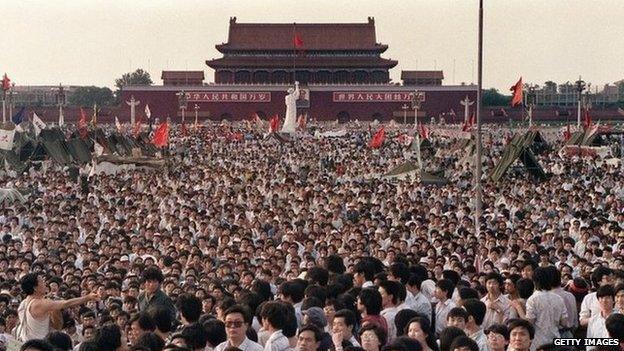
What began as a student-led movement rapidly attracted support from a diverse demographic, including intellectuals, workers, and citizens from various provinces. By mid-May 1989, the number of protesters in Tiananmen Square had swelled to hundreds of thousands, with participants also mobilizing in over 400 cities across China. This widespread participation underscored the deep-seated discontent and the yearning for change within Chinese society.
Symbolism and Strategies
The protesters employed various strategies to maintain visibility and gather support. Setting up permanent camps in Tiananmen Square, they organized marches, sit-ins, and hunger strikes to draw attention to their cause. The construction of the "Goddess of Democracy" statue became a powerful symbol representing the movement's aspirations for freedom, justice, and democratic governance. These symbolic acts played a crucial role in galvanizing national and international support.
Government Response and Martial Law
Declaration of Martial Law
On May 20, 1989, the Chinese government declared martial law in an attempt to suppress the growing protests. This move marked a significant escalation in the government's approach to handling the movement, signaling a willingness to employ force to maintain control.
Military Mobilization
Despite the official declaration, initial attempts to enforce martial law faced resistance from the protesters, who had established blockades around key government buildings and transportation hubs. This resistance prevented the immediate entry of the military into Beijing, prolonging the standoff and increasing international attention on the unfolding events.
The June 4th Massacre
Forcible Clearing of Tiananmen Square
In the early hours of June 4, 1989, the Chinese military initiated a decisive and violent crackdown to clear Tiananmen Square. Tanks and armored vehicles rolled into Beijing, supported by thousands of troops intent on dispersing the protesters by force.
Use of Force and Casualties
The military opened fire on unarmed civilians and protesters, leading to a tragic loss of life. The exact number of casualties remains uncertain due to government censorship and the suppression of information. Estimates from various sources suggest that the death toll ranges from several hundred to several thousand individuals. The brutality of the crackdown drew widespread international condemnation and highlighted the lengths to which the Chinese government would go to maintain its authority.
Iconic Moments
One of the most poignant images from the Tiananmen Square massacre is that of the "Tank Man," a lone individual who stood in front of a column of advancing tanks on June 5, 1989. This act of defiance became a global symbol of peaceful protest and individual bravery in the face of oppressive force, encapsulating the spirit of the movement.
Aftermath and Long-term Impact
Political and Social Repercussions
The Tiananmen Square massacre had profound implications for China's political trajectory. In the immediate aftermath, the government intensified its crackdown on political dissent, leading to widespread arrests and the imprisonment or exile of pro-democracy activists. The violent suppression of the protests effectively halted further political liberalization, reinforcing the authoritarian nature of the regime.
International Relations
Internationally, the massacre strained China's relations with Western countries. In response to the violent crackdown, several nations imposed economic sanctions and diplomatic condemnations. These sanctions had a lasting impact on China's international standing and economic engagements, contributing to a period of isolation from many Western institutions.
Legacy and Memory
Within China, the events of 1989 remain a highly sensitive and censored topic. The government has imposed strict controls over any discussion or remembrance of the Tiananmen Square protests, making it a symbol of the limitations on free expression and political dissent. Attempts to commemorate the events are often met with state suppression, ensuring that the official narrative remains one of stability and progress.
Globally, however, the Tiananmen Square massacre is remembered as a significant moment in the struggle for human rights and democratic freedoms. The "Tank Man" has become an enduring symbol of peaceful protest and individual courage against overwhelming odds, inspiring activists and movements around the world.
Timeline of Key Events
| Date | Event |
|---|---|
| April 15, 1989 | Death of Hu Yaobang sparks initial gatherings in Tiananmen Square. |
| Mid-April 1989 | Students begin mourning and calling for political reforms. |
| May 20, 1989 | Chinese government declares martial law in Beijing. |
| May 20 - June 3, 1989 | Protests swell to hundreds of thousands, spreading to over 400 cities. |
| June 3-4, 1989 | Military forcibly clears Tiananmen Square, leading to mass casualties. |
| June 5, 1989 | "Tank Man" incident captures global attention. |
Conclusion
The Tiananmen Square protests of 1989 represent a critical juncture in China's modern history, embodying the aspirations for political reform and the harsh realities of authoritarian governance. The violent crackdown not only quashed immediate demands for democracy but also left a lasting legacy on China's political landscape and its relationship with the global community. Despite the state's efforts to suppress memories of the events, the Tiananmen Square massacre remains a powerful symbol of the struggle for human rights and democratic freedoms worldwide.
References
Last updated February 12, 2025