
The Theoretical Possibility of Time Travel: A Deep Dive
Exploring the Science, Theories, and Paradoxes of Temporal Mechanics
Key Highlights on Time Travel
- Relativity's Role: Einstein's theories of relativity lay the groundwork for understanding how time can be relative, opening doors to theoretical time travel possibilities.
- Wormholes and Exotic Matter: Wormholes, hypothetical tunnels through spacetime, are often discussed as potential time machines, though their existence and the requirement for exotic matter pose significant challenges.
- Paradoxes and Timeline Consistency: The grandfather paradox and other logical inconsistencies raise questions about whether altering the past is possible, leading to theories like fixed timelines and self-healing timelines.
Is Time Travel Really Possible?
The question of whether time travel is theoretically possible has captivated scientists, philosophers, and science fiction enthusiasts alike for centuries. The answer, according to modern physics, is complex and multifaceted. While the concept remains largely in the realm of theoretical physics, certain aspects of time travel are considered plausible based on our current understanding of the universe.
Einstein's Relativity: The Foundation of Time Bending
Albert Einstein's theories of special and general relativity revolutionized our understanding of space and time. Special relativity, published in 1905, demonstrates that time is relative and depends on an observer's motion. The faster one travels, the slower time passes relative to a stationary observer. This phenomenon, known as time dilation, has been experimentally verified.
General relativity, introduced in 1915, further connects space and time, describing gravity as the curvature of spacetime caused by mass and energy. This theory suggests that extreme gravitational fields can also affect the passage of time. For example, time passes slightly slower near massive objects like black holes.
Time Dilation in Action
Time dilation isn't just a theoretical concept; it has practical implications. For instance, astronauts on the International Space Station (ISS) experience time slightly slower than people on Earth due to their high velocity and the weaker gravitational field. While the difference is minuscule, it's measurable and must be accounted for in precise calculations.
According to Einstein's theory of special relativity, time's flow depends on how fast you're moving. The quicker you travel, the slower seconds pass.
Theoretical Pathways to Time Travel
Several theoretical concepts have emerged from physics that propose potential pathways for time travel, each with its own set of challenges and possibilities.
Wormholes: Tunnels Through Spacetime
Wormholes, also known as Einstein-Rosen bridges, are hypothetical tunnels that connect two different points in spacetime. They are predicted by general relativity and could potentially allow for faster-than-light travel and even time travel. The concept involves warping spacetime to create a shortcut between distant locations or different points in time.

Conceptual depiction of a wormhole connecting two points in spacetime.
However, wormholes are purely theoretical, and their existence has not been confirmed. Furthermore, even if they exist, maintaining a stable wormhole would likely require exotic matter with negative mass-energy density, a substance that has never been observed.
Cosmic Strings and Black Holes
Other theoretical concepts involve the use of cosmic strings or rotating black holes. Cosmic strings are hypothetical one-dimensional topological defects with immense density. If two cosmic strings could be aligned in parallel, spacetime might be warped in a way that allows for time travel. However, the existence of cosmic strings is purely speculative.
Black holes, particularly Kerr black holes (rotating black holes), also present intriguing possibilities. By carefully navigating a spaceship around a rotating black hole, it might be possible to travel on a "closed time-like curve," a path through spacetime that loops back on itself, allowing for time travel. However, this would only allow travel to times after the black hole was created.
The Grandfather Paradox and Other Temporal Dilemmas
One of the most significant challenges to time travel is the potential for paradoxes, logical contradictions that could arise if someone were to alter the past. The most famous of these is the grandfather paradox, which asks what would happen if you traveled back in time and prevented your own grandparents from meeting. Would you still exist?
Fixed Timelines and Self-Healing History
Several theories attempt to resolve these paradoxes. The fixed timeline theory suggests that the past, present, and future are immutable. Any attempt to change the past would be part of the timeline all along, and your actions would inevitably lead to the events that you were trying to prevent. In essence, you can observe the past, but you cannot alter it.
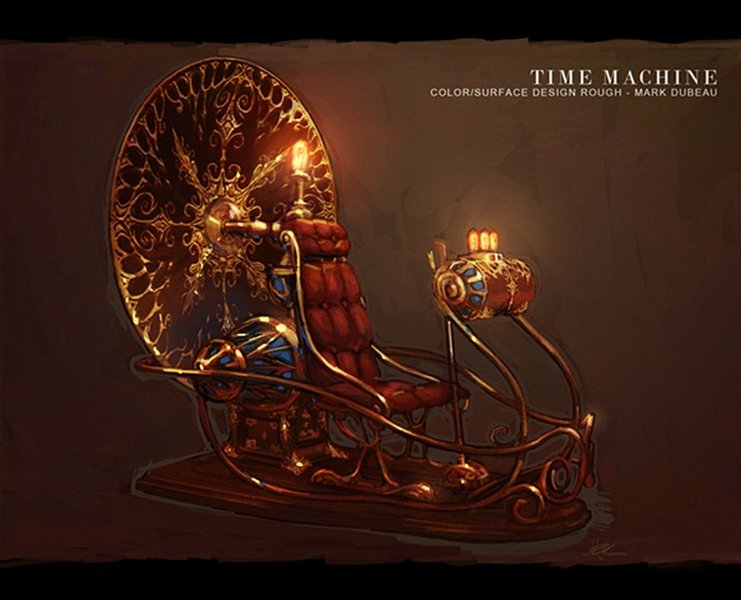
A concept of a time machine.
Another idea is that the timeline is self-healing. If you were to attempt to change the past, events would conspire to ensure that the original timeline remains intact. For example, if you tried to prevent your grandparents from meeting, some other factor would intervene to bring them together.
Multiple Timelines and Quantum Realities
The multiple timelines theory, often associated with quantum mechanics, proposes that every time you make a decision, the universe splits into multiple timelines, each representing a different outcome. If you travel back in time and change something, you would simply be creating a new timeline, distinct from your original one. This resolves the grandfather paradox because you wouldn't be altering your own past, but rather creating a new future in a different timeline.
The Chronology Protection Conjecture
The late Stephen Hawking proposed the chronology protection conjecture, suggesting that the laws of physics may conspire to prevent time travel. This conjecture posits that there might be an as-yet-unknown physical principle that forbids the formation of closed time-like curves and the possibility of time travel.
Time Travel in Pop Culture
Time travel is a popular concept in science fiction, with countless books, movies, and TV shows exploring its possibilities and paradoxes. These fictional depictions often take creative liberties with the science, but they can also raise thought-provoking questions about causality, free will, and the nature of time itself.
Famous Examples in Fiction
Examples of time travel in fiction include H.G. Wells' "The Time Machine," the "Back to the Future" trilogy, and the TV series "Doctor Who." Each of these works presents a unique take on time travel, with its own rules and consequences.
Theoretical physicists Brian Cox and Neil deGrasse Tyson discuss the science of time travel. The discussion covers the theoretical underpinnings, paradoxes, and potential pathways to time travel based on current scientific understanding.
Current Research and Future Prospects
Despite the many challenges, scientists continue to explore the theoretical possibilities of time travel. Research in quantum gravity, wormhole physics, and the nature of spacetime may one day reveal new insights into the fundamental laws of the universe and whether time travel is truly possible.
Experimental Verification
While traveling to the past might not be possible, traveling to the future has been proven to be possible. In 1971, Joseph Hafele and Richard Keating conducted an experiment where they flew atomic clocks around the world on commercial airplanes. When they compared the flown atomic clocks to the atomic clocks that remained stationary, the flown clocks were slightly slower, proving that time does indeed slow down as you move, even by a little bit.
Outstanding Questions
Many questions remain unanswered. Can wormholes exist, and can they be stabilized? Is exotic matter real, and can it be manipulated? Is there a chronology protection law that prevents time travel? These are just a few of the mysteries that continue to drive research in this fascinating field.
Implications of Time Travel
If time travel were possible, it would have profound implications for our understanding of causality, free will, and the nature of reality. It would also raise complex ethical and philosophical questions.
Causality and Free Will
The ability to alter the past would challenge our understanding of cause and effect. If you could go back in time and prevent an event from happening, would the consequences of that event still exist? Would you have the free will to make different choices in the past, or would your actions be predetermined?
Ethical Considerations
Time travel could also create ethical dilemmas. Could you use time travel to prevent disasters, correct mistakes, or gain an advantage? What would be the consequences of such actions, and who would be responsible for them? The potential for misuse and abuse would need to be carefully considered.
Time Travel Theories in a Nutshell
Here's a table summarizing some key time travel theories and concepts:
| Theory/Concept | Description | Challenges/Implications |
|---|---|---|
| Special Relativity | Time is relative and depends on an observer's motion. | Allows for time dilation, where time passes slower at high speeds. |
| General Relativity | Gravity is the curvature of spacetime caused by mass and energy. | Suggests that extreme gravitational fields can affect the passage of time. |
| Wormholes | Hypothetical tunnels connecting different points in spacetime. | Require exotic matter with negative mass-energy density; existence unconfirmed. |
| Cosmic Strings | Hypothetical one-dimensional topological defects with immense density. | Existence is purely speculative; requires specific alignment for time travel. |
| Kerr Black Holes | Rotating black holes that may allow for travel on closed time-like curves. | Only allows travel to times after the black hole was created. |
| Grandfather Paradox | Contradictions that could arise if someone were to alter the past. | Challenges the possibility of changing the past. |
| Fixed Timeline Theory | The past, present, and future are immutable. | Any attempt to change the past is part of the timeline all along. |
| Multiple Timelines Theory | Every decision creates new timelines, each representing a different outcome. | Changing the past creates a new timeline, distinct from the original. |
| Chronology Protection Conjecture | The laws of physics may conspire to prevent time travel. | Suggests there may be a physical principle that forbids the formation of closed time-like curves. |
FAQ: Frequently Asked Questions About Time Travel
Is time travel to the past possible according to current scientific theories?
While general relativity allows for solutions that theoretically permit backward time travel, these solutions often involve exotic conditions like wormholes or cosmic strings, which have not been observed and may require matter with negative energy density. The potential for paradoxes, like the grandfather paradox, also raises significant challenges.
What is time dilation, and how does it relate to time travel?
Time dilation is a phenomenon predicted by Einstein's theory of relativity, where time passes at different rates for observers in relative motion or in different gravitational fields. The faster you move or the stronger the gravitational field, the slower time passes for you relative to a stationary observer. This effect has been experimentally verified and is a real-world form of time travel, albeit only into the future.
What are wormholes, and how could they potentially be used for time travel?
Wormholes are hypothetical tunnels through spacetime that could connect distant points in the universe or even different points in time. They are predicted by general relativity but have not been observed. If wormholes exist and could be stabilized, they might allow for faster-than-light travel and time travel. However, maintaining a stable wormhole would likely require exotic matter with negative mass-energy density.
What is the grandfather paradox, and how do physicists attempt to resolve it?
The grandfather paradox is a thought experiment that asks what would happen if you traveled back in time and prevented your own grandparents from meeting. Would you still exist? This paradox raises questions about causality and the possibility of altering the past. Physicists have proposed various solutions, including the fixed timeline theory, the multiple timelines theory, and the self-healing timeline theory.
What is the chronology protection conjecture?
The chronology protection conjecture, proposed by Stephen Hawking, suggests that the laws of physics may conspire to prevent time travel. This conjecture posits that there might be an as-yet-unknown physical principle that forbids the formation of closed time-like curves and the possibility of time travel.
What is the Wheeler delayed choice experiment and how is it related to time travel?
The Wheeler delayed choice experiment is a quantum mechanical experiment that demonstrates that the act of observing a particle can affect its past behavior. This experiment is often cited in discussions of time travel because it challenges our classical understanding of time and causality, suggesting that the past may not be as fixed as we think it is.
References
 yestimetravelispossible.wordpress.com
Last updated April 15, 2025