
Unlocking TLS 1.3: Faster, Stronger, and More Private Secure Connections Explained
Dive deep into the latest standard for web security, understanding its core mechanics, advantages, and how it protects your data online.
Transport Layer Security (TLS) version 1.3 is the modern standard for securing communications over networks like the internet. Finalized in August 2018 and documented in RFC 8446, it represents a significant leap forward from its predecessors, primarily focusing on enhancing security, increasing performance, and improving user privacy. TLS is the foundational technology behind HTTPS, ensuring that your interactions with websites, email servers, and other online services are encrypted and authenticated.
Key Highlights of TLS 1.3
- Faster Connections: The handshake process required to establish a secure connection is significantly streamlined, typically requiring only one round-trip between client and server, compared to two or more in TLS 1.2.
- Enhanced Security: TLS 1.3 removes support for outdated and vulnerable cryptographic algorithms and features, mandating stronger encryption methods and perfect forward secrecy by default.
- Improved Privacy: More of the initial negotiation (handshake) messages are encrypted, shielding sensitive information like server certificates from eavesdroppers and making traffic analysis harder.
Core Concepts Driving TLS 1.3
Understanding TLS 1.3 involves grasping several fundamental concepts that differentiate it and contribute to its effectiveness:
Streamlined Handshake (1-RTT)
Reducing Latency
One of the most impactful changes is the reduction of the time needed to negotiate a secure connection. In most scenarios, TLS 1.3 completes the handshake in a single round-trip (1-RTT). The client sends its parameters and a guess for the key agreement algorithm in the first message (ClientHello), allowing the server to respond with everything needed to establish keys and finish its side of the handshake in its first flight of messages. This halves the handshake latency compared to TLS 1.2, leading to faster page load times and more responsive applications.
Zero Round-Trip Time (0-RTT) Resumption
Accelerating Repeat Connections
For clients reconnecting to a server they've previously established a TLS 1.3 session with, the protocol offers an optional 0-RTT mode. This allows the client to send encrypted application data (like an HTTP request) along with its very first message. While significantly boosting performance for returning visitors, this feature must be used carefully as it carries a potential risk of replay attacks if not implemented correctly by the server and application.
Mandatory Strong Cryptography
Eliminating Weaknesses
TLS 1.3 mandates the use of modern, secure cryptographic primitives. It exclusively uses Authenticated Encryption with Associated Data (AEAD) algorithms like AES-GCM and ChaCha20-Poly1305, which provide both confidentiality and integrity. Older, problematic algorithms and modes like RC4, SHA-1, MD5, CBC mode ciphers, and static RSA or static Diffie-Hellman key exchanges are completely removed from the protocol, eliminating entire classes of known vulnerabilities.
Perfect Forward Secrecy (PFS) by Default
Protecting Past Communications
Forward secrecy ensures that if the server's long-term private keys are compromised, past session keys cannot be derived, and thus past communications remain secure. TLS 1.3 enforces this by requiring ephemeral key exchange methods (like Elliptic Curve Diffie-Hellman - ECDHE) for every session. A unique session key is generated for each connection and discarded afterwards, decoupling session security from the server's long-term identity key.
Encrypted Handshake Messages
Enhancing Privacy
Unlike previous versions where many handshake details (like the server's certificate) were sent in plaintext, TLS 1.3 encrypts almost all handshake messages after the initial ClientHello and ServerHello. This significantly improves privacy by hiding sensitive negotiation details and metadata from passive network observers, making it harder to track user activity or profile servers.
Simplified Cipher Suites
Reducing Complexity
In TLS 1.2, cipher suites defined a combination of key exchange algorithm, authentication method, bulk encryption cipher, and message authentication code algorithm. TLS 1.3 simplifies this. The cipher suite now only specifies the AEAD algorithm for the record protection layer. The key exchange and authentication mechanisms are negotiated separately through extensions in the handshake messages, making the protocol logic cleaner and less prone to errors.
HKDF Key Derivation
Robust Key Generation
TLS 1.3 uses the HMAC-based Key Derivation Function (HKDF) described in RFC 5869. This standard function provides a cryptographically strong way to derive various necessary keys (for application data encryption, handshake message encryption, resumption secrets, etc.) from the initial shared secret established during the Diffie-Hellman exchange and the context of the handshake transcript.
TLS 1.3 vs. TLS 1.2: Key Differences
TLS 1.3 introduces substantial improvements over TLS 1.2. The following table highlights the most significant distinctions:
| Feature | TLS 1.2 (RFC 5246, 2008) | TLS 1.3 (RFC 8446, 2018) |
|---|---|---|
| Handshake Speed | Typically 2 full round-trips (2-RTT) | Typically 1 full round-trip (1-RTT); 0-RTT possible for resumption |
| Key Exchange | Supports static RSA & static DH (vulnerable); Ephemeral DH (optional) | Requires Ephemeral Diffie-Hellman (ECDHE/DHE); Static RSA/DH removed |
| Forward Secrecy | Optional (depends on cipher suite choice) | Mandatory (enforced by ephemeral key exchange) |
| Cipher Suites | Complex suites specify key exchange, auth, cipher, MAC (e.g., TLS_ECDHE_RSA_WITH_AES_128_GCM_SHA256) | Simplified suites specify only AEAD cipher (e.g., TLS_AES_128_GCM_SHA256); Key exchange/auth negotiated separately |
| Allowed Algorithms | Supported many older/weaker algorithms (RC4, 3DES, SHA-1, MD5, CBC modes) | Only strong AEAD ciphers (AES-GCM, ChaCha20-Poly1305), secure hashes (SHA-256/384); Weak algorithms removed |
| Handshake Encryption | Most handshake messages after ServerKeyExchange are plaintext (e.g., Server Certificate) | Most handshake messages after ServerHello are encrypted (including Certificate) |
| Session Resumption | Session IDs, Session Tickets (potential security issues) | Pre-Shared Key (PSK) mechanism; Enables 0-RTT (with replay risk considerations) |
| Renegotiation | Supported (complex, source of vulnerabilities) | Removed entirely |
| Compression | Supported (vulnerable to attacks like CRIME) | Removed entirely |
| Protocol Version Negotiation | Negotiated in plaintext | Includes protection against downgrade attacks |
This table summarizes the core advancements making TLS 1.3 faster, more secure, and simpler than its predecessor.
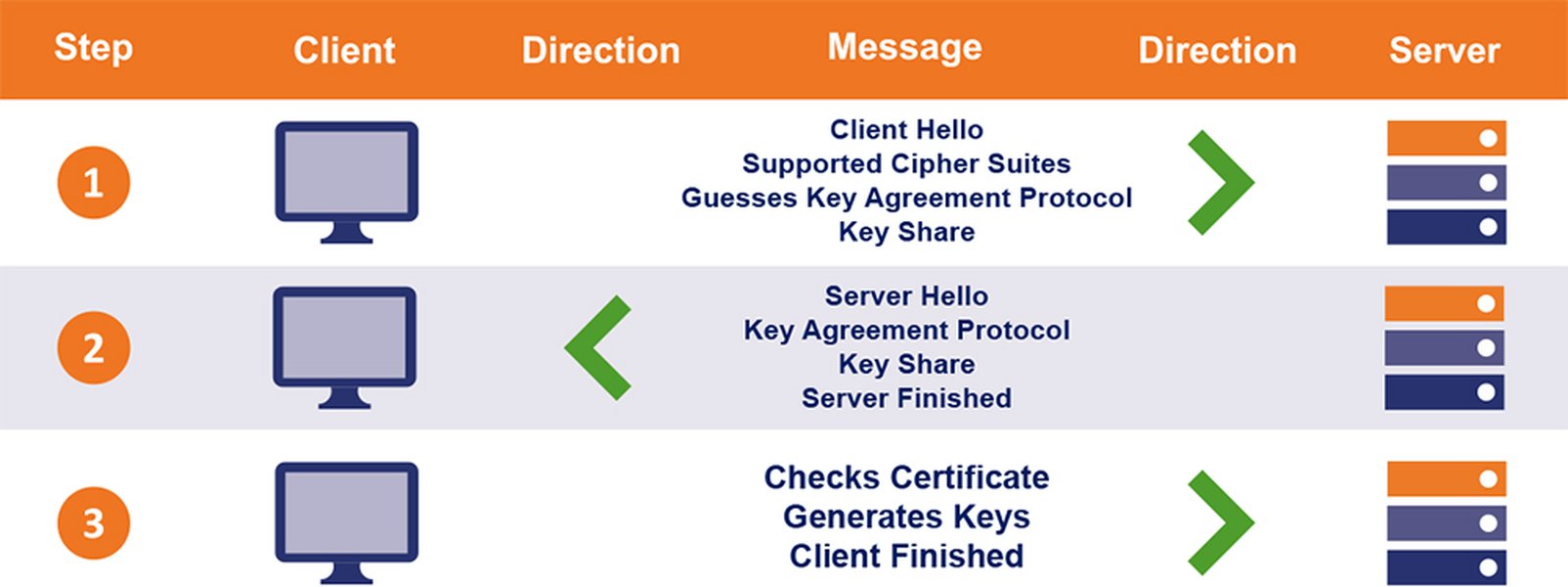
Visual comparison illustrating the reduced round trips in the TLS 1.3 handshake compared to TLS 1.2.
TLS 1.3 Protocol Architecture: Sub-Protocols
While often viewed as a single protocol, TLS logically consists of several interacting sub-protocols operating in layers. These components work together to establish and maintain a secure communication channel.
Layered Structure
TLS sub-protocols rely on each other. The Record Protocol forms the base layer, providing fundamental security services for messages generated by the higher-level protocols (Handshake, Alert, Application Data).
ClientHello
ServerHello
EncryptedExtensions
Certificate
CertificateVerify
Finished
NewSessionTicket
KeyUpdate"] alert["Alert Protocol"] alert_p["Purpose: Error Reporting, Connection Closure"] alert_m["Messages: Alert (Level: warning/fatal, Description: error code)"] app["Application Data Protocol"] app_p["Purpose: Transmit User Data Securely"] app_m["Messages: Encrypted Application Payload (e.g., HTTP)"] ccs["Change Cipher Spec Protocol"] ccs_p["Purpose: Signal Cipher Change (Primarily for Middlebox Compatibility in TLS 1.3)"] ccs_m["Messages: ChangeCipherSpec (Single message, minimal role)"]
This mindmap illustrates the main sub-protocols within TLS 1.3 and their primary functions and message types. The Handshake, Alert, and Application Data protocols rely on the Record Protocol for secure transport.
Detailed Sub-Protocol Descriptions
1. Record Protocol
This is the foundational layer responsible for securing all data transmitted over a TLS connection after the initial handshake setup.
- Purpose: Fragments outgoing data into manageable records, encrypts the payload using the negotiated AEAD cipher, adds an authentication tag to ensure integrity and authenticity, and reassembles/decrypts/verifies incoming records.
- Layering: Underpins all other protocols; messages from Handshake, Alert, and Application Data protocols are passed down to the Record Protocol to be secured before transmission.
- Message Contents: Each TLS record contains a header specifying the content type (handshake, alert, application_data), the protocol version, and the length of the encrypted payload. The payload itself is encrypted, followed by an authentication tag generated by the AEAD cipher.
2. Handshake Protocol
This protocol is responsible for the crucial initial negotiation phase where the client and server establish a secure session.
- Purpose: Authenticate the server (and optionally the client), negotiate the TLS version, select cryptographic algorithms (cipher suite, signature algorithm), and establish shared secret keys for the session.
- Layering: Operates above the Record Protocol. Its messages are encapsulated and protected by the Record Protocol (though initial messages like ClientHello and ServerHello components are necessarily in plaintext before keys are established, and subsequent handshake messages are encrypted using temporary handshake keys).
- Message Types & Contents:
ClientHello: Initiates the handshake. Contains client's random value, supported TLS versions, list of cipher suites, proposed key shares (e.g., for ECDHE), signature algorithms, and extensions (like SNI, ALPN, supported groups).ServerHello: Server's response. Contains server's random value, selected TLS version, chosen cipher suite, selected key share, and extensions.EncryptedExtensions: Contains extensions from the server that are not essential for establishing the cryptographic context (sent encrypted).Certificate: Contains the server's certificate chain (and optionally the client's if requested). Sent encrypted.CertificateVerify: A digital signature calculated over the entire handshake transcript up to this point, proving the sender possesses the private key corresponding to the public key in their certificate. Sent encrypted.Finished: An HMAC or MAC calculated over the handshake transcript using the derived session keys. Confirms that the key exchange and authentication were successful and that the handshake was not tampered with. Sent encrypted by both sides.NewSessionTicket: Sent by the server after the handshake to establish a Pre-Shared Key (PSK) for future session resumption (including 0-RTT). Sent encrypted.KeyUpdate: Allows peers to request an update of the keys used for record protection during a long-lived session without a full handshake.
3. Alert Protocol
Used to signal errors or warnings related to the TLS connection.
- Purpose: Communicate status changes or errors encountered during the session. Alerts can be warnings (connection may continue) or fatal (connection terminates immediately).
- Layering: Uses the Record Protocol for transmission. Alerts are encrypted once keys are established.
- Message Contents: An Alert message contains two fields: a level (warning or fatal) and a description (a code indicating the specific issue, e.g.,
handshake_failure,bad_record_mac,certificate_unknown,close_notifyfor graceful closure).
4. Change Cipher Spec (CCS) Protocol
In previous TLS versions, this protocol signaled the transition to newly negotiated keys. In TLS 1.3, its role is minimized.
- Purpose: Primarily maintained for compatibility with older systems and middleboxes. It serves as a notification that subsequent records will be protected under the newly negotiated keys (though TLS 1.3 transitions key usage implicitly based on Handshake messages).
- Layering: A simple protocol whose single message type is sent via the Record Protocol.
- Message Contents: A single message type,
ChangeCipherSpec, containing a fixed single-byte value. It doesn't carry substantial information in TLS 1.3 itself but helps coordinate the state transition.
5. Application Data Protocol
This isn't a distinct protocol in the same sense but represents the phase where actual application-level data (e.g., HTTP requests/responses, email content) is exchanged securely.
- Purpose: To transmit the user's application data over the secure channel established by the Handshake Protocol.
- Layering: Relies entirely on the Record Protocol to encrypt and integrity-protect the application data.
- Message Contents: The payload consists of the application data itself, encapsulated within TLS Record Protocol structures.
Typical TLS 1.3 Message Exchange Sequences
The sequence of messages varies depending on whether it's a new connection or a resumed one.
Full 1-RTT Handshake (New Connection)
This is the standard sequence when a client connects to a server for the first time or without a valid resumption ticket:
- Client → Server:
ClientHello- Sends random value, supported cipher suites, key shares (e.g., for P-256, x25519), signature algorithms, PSK proposals (if any), and other extensions (SNI, ALPN etc.).
- Server → Client:
ServerHello,EncryptedExtensions,Certificate*,CertificateVerify*,Finished- Server selects parameters (version, cipher suite), sends its random value, its chosen key share.
- Derives handshake keys based on shared secret from key shares.
- Sends encrypted extensions.
- Sends its encrypted Certificate chain (*if not using PSK authentication).
- Sends encrypted CertificateVerify message (signature over transcript) (*if sending Certificate).
- Sends its encrypted Finished message (MAC over transcript).
- Client → Server:
Certificate*,CertificateVerify*,Finished- Client processes server messages, verifies certificate and signature, derives keys.
- Sends its encrypted Certificate chain and CertificateVerify (*if client authentication requested).
- Sends its encrypted Finished message (MAC over transcript).
- Secure Application Data Exchange Begins: Both sides can now send encrypted application data. The server might also send a
NewSessionTicketmessage to enable future resumption.
(* indicates messages that might be omitted depending on authentication method or client authentication requirements)
0-RTT Handshake (Resumed Connection)
If the client possesses a valid PSK ticket from a previous session and the server supports 0-RTT:
- Client → Server:
ClientHello+ Early Application Data- Client includes the PSK identity from the ticket and sends encrypted "early data" (e.g., an HTTP GET request) along with the ClientHello.
- Server → Client:
ServerHello,EncryptedExtensions,Finished- Server validates the PSK, accepts 0-RTT (or rejects it and proceeds with 1-RTT), derives keys, sends its encrypted Finished message.
- Client → Server:
Finished(if needed, depending on mode) - Secure Application Data Exchange Continues: Normal data exchange proceeds. The server processes the early data received in step 1.
Visualizing the Handshake
The following video provides a detailed walkthrough of the messages exchanged during a TLS 1.3 handshake:
This video breaks down each message and record exchanged, offering a clear visual explanation of the process outlined above.
TLS 1.3 vs TLS 1.2: Performance & Security Radar
This chart provides a comparative visualization of TLS 1.3 and TLS 1.2 across key performance and security dimensions. Higher scores indicate better performance or stronger security attributes. Note that these scores represent a qualitative assessment based on the protocol designs.
As illustrated, TLS 1.3 significantly outperforms TLS 1.2 in handshake speed, cryptographic modernity, forward secrecy guarantees, privacy through handshake encryption, and downgrade resistance. It also simplifies the protocol design while introducing 0-RTT capabilities (though this requires careful implementation).
Frequently Asked Questions (FAQ) about TLS 1.3
Is TLS 1.3 backward compatible with TLS 1.2?
Is the 0-RTT feature always safe to enable?
Does TLS 1.3 only improve speed, or security too?
Are TLS 1.3 cipher suites the same as in TLS 1.2?
Does TLS 1.3 eliminate the handshake completely?
Is session resumption handled the same way as in TLS 1.2?
Recommended Reading
Explore related topics for a deeper understanding:
- How does TLS 1.3 achieve forward secrecy using ephemeral key exchange?
- What are the specific security vulnerabilities in TLS 1.2 that TLS 1.3 addresses?
- Explain the security risks of TLS 1.3 0-RTT and how to mitigate them.
- Compare the key derivation process (HKDF) in TLS 1.3 with key derivation in TLS 1.2.
References
Last updated May 1, 2025