
Unlock Seamless Construction: The Top 10 BIM Documents Your Project Can't Afford to Ignore
Navigate large-scale projects effectively by mastering these essential Building Information Modeling documents for optimal collaboration and delivery.
Building Information Modeling (BIM) is more than just software; it's a collaborative process transforming how large construction projects are planned, designed, built, and managed. Central to this transformation is a suite of critical documents that standardize workflows, ensure clarity, and facilitate communication among diverse teams. Understanding these documents is vital for architects, engineers, contractors, owners, and all stakeholders involved in delivering complex projects successfully. This guide details the ten most crucial BIM documents everyone on a large construction project needs to know as of Monday, 2025-05-05.
Essential Insights: Key BIM Documentation Takeaways
- BIM Execution Plan (BEP): This foundational document is the strategic roadmap, defining how BIM will be used, setting goals, roles, and protocols essential for project alignment.
- Information Requirements (EIR/PBR): These documents specify the what and why of information needed by the client or project, ensuring deliverables meet specific standards and purposes.
- Data-Rich Models & Drawings: BIM centralizes project information, generating coordinated 2D drawings and data-rich 3D models that form the basis for construction, analysis, and handover.
Decoding the Core BIM Documents for Large Projects
Effective BIM implementation hinges on clear, comprehensive documentation. These documents provide the framework for collaboration, define standards, manage information exchange, and ensure quality throughout the project lifecycle. Here are the ten essential BIM documents crucial for success on large construction projects:
1. BIM Execution Plan (BEP)
The Strategic Blueprint
The BEP is arguably the most critical BIM document. It serves as the master plan outlining the project's BIM strategy. Developed collaboratively, it defines the project's BIM goals, specific BIM uses (e.g., clash detection, visualization, quantity take-off), roles and responsibilities of team members, collaboration procedures, software platforms to be used (and versions), data exchange formats and protocols, and key milestones for model development. It establishes the rules of engagement for BIM on the project, ensuring everyone understands how information modeling will contribute to project outcomes and how they fit into the process. A well-defined BEP minimizes confusion and maximizes the benefits of BIM.
2. Employer's Information Requirements (EIR) / Project BIM Requirements (PBR)
Defining the 'What' and 'Why'
Often issued by the client or project owner, the EIR (common in UK/ISO 19650 contexts) or PBR (common in US contexts like NIBS) specifies the information requirements for the project. It details *what* information is needed, *when* it's needed, *in what format*, and *for what purpose* (linking back to BIM Uses). These requirements cover technical aspects (like Levels of Detail/Development - LOD), management processes (like security protocols), and commercial considerations. The EIR/PBR ensures that the project team delivers information that meets the client's specific operational, maintenance, or strategic asset management needs, guiding the entire BIM workflow towards defined deliverables.
3. Information Delivery Plan (IDP)
Scheduling Information Flow
Complementary to the EIR/PBR, the IDP outlines the schedule and responsibilities for information delivery. It details *who* is responsible for producing specific information, *when* each piece of information needs to be delivered (often tied to project milestones), and the specific format and content required for each deliverable. This plan often takes the form of a detailed schedule linking specific model elements, data attributes, and documentation to project phases and handover requirements. The IDP ensures timely and structured information exchange, crucial for decision-making and preventing delays.
4. Model Content, Construction Documents & 2D Drawings
The Core Deliverables
This category encompasses the primary outputs of the BIM process used for construction. It includes the information-rich 3D models containing geometric and non-geometric data (attributes) for building elements. Crucially, it also includes the 2D construction drawings (plans, sections, elevations, details) that are often derived directly from the BIM model. Specifications and schedules are also part of this set. Ensuring the accuracy, completeness, and coordination of these documents is paramount, as they form the basis for tendering, fabrication, installation, and regulatory approvals. BIM streamlines the creation and updating of these documents, as changes in the model can automatically propagate to linked drawings.
Below is an example visualization of BIM workflow elements.
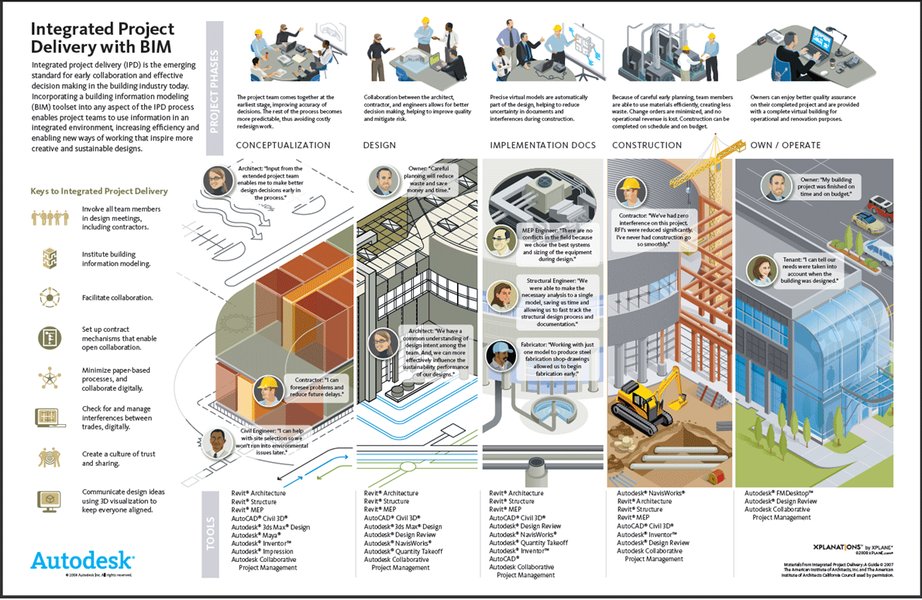
Visualizing BIM workflows helps understand the integration of different processes and deliverables.
5. Clash Detection Reports & Coordination Meeting Minutes
Ensuring Constructability
BIM enables the integration of models from different disciplines (architectural, structural, MEP - Mechanical, Electrical, Plumbing) into a federated model. Clash detection software analyzes this combined model to identify geometric conflicts (clashes) between elements (e.g., a pipe running through a beam). Clash Detection Reports document these clashes, including their location, severity, involved elements, and responsible parties. These reports are typically reviewed in coordination meetings, and the decisions, assigned actions, and resolutions are recorded in Coordination Meeting Minutes. Together, these documents provide a systematic process for identifying and resolving design conflicts before they cause costly delays and rework on site.
6. Shop Drawings
Detailing for Fabrication and Installation
Shop drawings are detailed drawings prepared by contractors, subcontractors, suppliers, or fabricators. They illustrate precisely how specific components (like structural steel connections, precast concrete panels, ductwork layouts, or curtain wall systems) will be fabricated and installed. While traditionally 2D, BIM facilitates the creation of more accurate and coordinated 3D shop drawings or fabrication models. These must be checked against the design intent models and coordinated with other trades' shop drawings, often using the federated BIM model as a reference, to ensure proper fit and assembly on site.
7. Quality Control (QC) / Quality Assurance (QA) Checklists & Reports
Maintaining Information Integrity
Ensuring the quality and reliability of BIM data is crucial. QA/QC checklists and procedures define the standards and verification steps required to validate model accuracy, completeness, and compliance with project standards (like those defined in the BEP and EIR/PBR). This includes checking for correct element classification, appropriate LOD, adherence to naming conventions, and resolution of clashes. QA/QC reports document the findings of these checks, highlighting any issues that need correction before models or data are issued or relied upon by other team members. These processes guarantee the trustworthiness of the BIM information.
8. As-Built Model & Handover Documentation
Documenting the Final Product
Upon project completion, the design models need to be updated to reflect the actual constructed conditions, incorporating any changes made during construction (e.g., due to site instructions or RFIs). This results in an As-Built BIM model. This model, along with associated documentation (like warranties, manuals, test certificates, and final inspection reports), forms the handover package delivered to the client or facility manager. This information is invaluable for efficient building operation, maintenance, and future renovation planning. The IDP typically specifies the requirements for this final handover.
9. BIM Standards & Naming Conventions Document
Ensuring Consistency and Interoperability
Consistency is key in large, multi-disciplinary projects. A BIM Standards document outlines the specific technical standards to be followed, often referencing international standards like ISO 19650. This includes guidelines for model organization, file naming conventions, layer/level naming, data classification systems (like Uniclass or OmniClass), coordinate systems, and template usage. It may also specify requirements for the Common Data Environment (CDE) – the shared digital space where project information is stored and managed. Adherence to these standards ensures interoperability between different software tools and makes data management across large teams more efficient and less error-prone.
10. RFI (Request for Information) & Submittal Management Process (within BIM)
Streamlining Communication and Approvals
While RFIs and submittals are standard construction processes, BIM workflows and platforms significantly enhance their management. An RFI is a formal query seeking clarification or missing information. A submittal involves providing documents, samples, or product data for approval. BIM platforms or integrated document management systems can link RFIs and submittals directly to specific elements in the model, providing context and visual clarity. Documenting the process for managing these communications within the BIM environment (often detailed in the BEP) ensures efficient tracking, response, and record-keeping, preventing information bottlenecks.
Visualizing BIM Document Interconnections
Understanding how these documents relate to each other and to the project lifecycle is crucial. The following mindmap illustrates the key relationships between essential BIM documents and project phases/stakeholders.
in Large Construction Projects"] id1["Project Planning & Setup"] id1a["BIM Execution Plan (BEP)
Overall Strategy, Roles, Goals"] id1b["Employer's Information Requirements (EIR/PBR)
Client Needs, Data Specs"] id1c["BIM Standards & Naming Conventions
Consistency, CDE Rules"] id1d["Information Delivery Plan (IDP)
Who Delivers What, When"] id2["Design & Coordination"] id2a["Model Content & Construction Docs
3D Models, 2D Drawings, Specs"] id2b["Clash Detection Reports
Identifying Conflicts"] id2c["Coordination Meeting Minutes
Tracking Resolutions"] id2d["QA/QC Checklists & Reports
Model Validation"] id3["Construction Phase"] id3a["Shop Drawings
Fabrication & Installation Details"] id3b["RFI Management Process
Clarifications & Queries"] id3c["Submittal Management Process
Material & Data Approvals"] id4["Project Closeout & Handover"] id4a["As-Built Model
Reflects Final Construction"] id4b["Handover Documentation
Manuals, Warranties, Data for FM"] id4c["Final QA/QC Reports"] id5["Stakeholders"] id5a["Client/Owner"] id5b["Design Team (Architects, Engineers)"] id5c["Contractors & Subcontractors"] id5d["Facility Managers"]
This mindmap shows how foundational documents like the BEP and EIR inform the entire process, leading to specific deliverables like models and drawings during design, refined through coordination and QA/QC. Construction relies on these outputs plus shop drawings and managed RFIs/submittals, culminating in the As-Built model and handover package for the client and facility managers.
Impact of Key BIM Documents Across Project Phases
Different BIM documents have varying levels of impact or importance during different phases of a large construction project. The radar chart below provides a conceptual representation of the relative impact of five key document types across typical project stages. The scoring is illustrative, representing perceived importance rather than quantitative data.
As illustrated, the BEP and EIR/PBR are highly impactful during the initial Planning & Setup phase, setting the foundation. Construction Documents and Clash Coordination documents peak in importance during Design Development, Coordination, and Construction. As-Built and Handover Documentation becomes critical towards the end of Construction and especially for Handover & Facility Management (FM). This visualization helps understand the lifecycle relevance of each document type.
Understanding BIM in Practice
Grasping the practical application of BIM and its associated documentation is key. The video below provides an overview of what BIM entails and how it is utilized in real-world construction scenarios, offering valuable context to the importance of the documents discussed.
This video explains the fundamentals of BIM and its practical application in the construction industry.
The video discusses how Building Information Modeling serves as a digital representation of the physical and functional characteristics of a facility. It highlights BIM's role in improving collaboration, enabling better visualization, facilitating clash detection, and providing valuable data throughout the project lifecycle, from design through construction to operations. Understanding this context reinforces why structured documentation like BEPs, EIRs, and clash reports are essential for harnessing BIM's full potential on complex projects.
Key Information Summary Table
The following table summarizes the primary purpose, key stakeholders involved, and the typical project phase where each of the top 10 BIM documents is most relevant or actively used.
| BIM Document/Process | Primary Purpose | Key Stakeholders | Typical Project Phase(s) |
|---|---|---|---|
| 1. BIM Execution Plan (BEP) | Define BIM strategy, goals, roles, processes | Client, Design Team, Contractor, BIM Manager | Planning, Design, Construction (Reference) |
| 2. EIR / PBR | Specify client/project information needs & standards | Client, Project Manager, Design Team | Planning, Design (Input), Handover (Verification) |
| 3. Information Delivery Plan (IDP) | Schedule information deliverables & responsibilities | BIM Manager, Design Team, Contractor | Planning, Design, Construction, Handover |
| 4. Model Content, Construction Docs & Drawings | Provide detailed design and construction information | Design Team, Contractor, Subcontractors, Suppliers | Design, Tender, Construction |
| 5. Clash Reports & Coordination Minutes | Identify and resolve inter-disciplinary conflicts | Design Team, Contractor, BIM Coordinator | Design, Coordination, Pre-construction |
| 6. Shop Drawings | Detail specific components for fabrication/installation | Contractor, Subcontractors, Fabricators, Design Team (Review) | Construction |
| 7. QA/QC Checklists & Reports | Ensure model quality, accuracy, and compliance | BIM Manager, Design Team, Modellers | Design, Construction, Handover |
| 8. As-Built Model & Handover Documentation | Record final constructed state; provide operational data | Contractor, Client, Facility Manager | Construction Completion, Handover, Operations |
| 9. BIM Standards & Naming Conventions | Ensure consistency, interoperability, data management | All Project Participants | Throughout Lifecycle (established in Planning) |
| 10. RFI & Submittal Management Process | Streamline clarification requests and approvals | Contractor, Design Team, Client, Subcontractors | Construction |
This table provides a quick reference guide, highlighting the distinct role each document plays and when it typically comes into focus during a large construction project's timeline.
Frequently Asked Questions (FAQ)
What is the single most important BIM document? +
While all listed documents are important, the BIM Execution Plan (BEP) is often considered the most critical foundational document. It sets the stage for how BIM will be used throughout the project, defining goals, roles, responsibilities, processes, and standards. A clear and comprehensive BEP is essential for aligning all stakeholders and ensuring the successful implementation of BIM.
Who is responsible for creating these BIM documents? +
Responsibility varies depending on the document and project structure. Typically:
- EIR/PBR: Client or Owner (often with consultant support).
- BEP: Lead Designer or Contractor's BIM Manager, developed collaboratively with key stakeholders.
- IDP: BIM Manager or Information Manager.
- Models/Drawings: Design Team (Architects, Engineers).
- Clash Reports: BIM Coordinator/Manager.
- Shop Drawings: Contractors/Subcontractors/Fabricators.
- As-Built Model: Contractor.
Collaboration is key for most documents, especially the BEP.
Are these documents legally binding? +
Some BIM documents, particularly the EIR/PBR and parts of the BEP, are often incorporated into contracts by reference, making them legally binding requirements. Construction documents (drawings and specifications derived from BIM) are typically part of the formal contract documents. The specific legal standing depends on how they are referenced within the project's contracts and agreements. It's crucial to clarify the contractual status of BIM deliverables and requirements early in the project.
How does ISO 19650 relate to these documents? +
ISO 19650 is an international standard for managing information over the whole life cycle of a built asset using BIM. Many of the documents listed, such as the EIR, BEP, IDP, and the concept of a Common Data Environment (CDE), are core components defined and structured by the ISO 19650 series. Adopting ISO 19650 provides a standardized framework and terminology for these documents and the information management processes they support, promoting better collaboration, especially on international projects.
Recommended Further Exploration
- How can one develop an effective BIM Execution Plan tailored for complex construction projects?
- What distinguishes Level of Detail (LOD) from Level of Information (LOI) within BIM documentation requirements?
- Explore the specific functions of a Common Data Environment (CDE) in managing and distributing BIM documents effectively.
- How does the ISO 19650 standard specifically aim to standardize BIM documentation and information management across international projects?
References
Last updated May 5, 2025