
The Fascinating World of Tree Swallow Nesting and Behavior
A Deep Dive into the Breeding Habits of These Agile Aerialists
Key Insights into Tree Swallow Nesting:
- Cavity Nesters: Tree Swallows are obligate secondary cavity nesters, meaning they cannot excavate their own nesting sites. They rely entirely on pre-existing cavities, whether natural tree holes or human-made nest boxes.
- Habitat Preference: These elegant birds typically breed in open fields, meadows, and wetlands, preferring areas near water bodies that provide an abundant supply of flying insects for food.
- Complex Social Dynamics: While often socially monogamous, Tree Swallows exhibit complex mating behaviors including extra-pair copulations and intense competition for desirable nesting sites, even among their own species.
Tree Swallows (Tachycineta bicolor) are captivating birds renowned for their iridescent blue-green backs, crisp white undersides, and remarkable aerial acrobatics. These agile flyers are a common sight across northern North America during the warmer months, as they migrate north from their wintering grounds in the southern United States, Mexico, and Central America to begin their breeding season. Understanding their nesting behavior is crucial for appreciating their ecological role and for aiding in their conservation efforts, especially as their populations have experienced some declines.
Habitat Selection: The Foundation of a Successful Nest
Ideal Environments for Tree Swallow Breeding
Tree Swallows are highly adaptable birds, but they show a clear preference for specific environments during their breeding season. They primarily breed in open, semi-open, and wooded areas, with a strong inclination for sites near water. This includes various wetlands such as marshes, swamps, beaver ponds, wet meadows, lakes, and shorelines. The presence of water is key because it supports the large populations of flying insects that form the bulk of their diet, particularly during the breeding season when they need ample food for their chicks.
While their name suggests a strong association with trees, Tree Swallows are not overly fond of dense forests, preferring open country where their agile flight is unimpeded. They utilize existing tree cavities—often old woodpecker holes in dead or live trees—as natural nesting sites. However, their readiness to occupy human-made nest boxes has allowed them to expand their breeding range, particularly into more open habitats where natural cavities might be scarce.
Importance of Nest Boxes
The availability of suitable nesting cavities is a limiting factor for Tree Swallow populations. The widespread provision of nest boxes has significantly benefited this species, leading to population increases in some areas. These birds will readily take to nest boxes, making them a popular species for backyard bird enthusiasts to attract. Placing nest boxes in appropriate habitats, such as open fields near water, can greatly encourage their presence. It's recommended to place these boxes well before the breeding season begins, typically from early to mid-spring, and to ensure they are equipped with predator guards to protect eggs and young.

Tree Swallows frequently utilize nest boxes for breeding, a practice that has significantly aided their populations.
Breeding Season and Mating Rituals
From Migration to Pair Formation
The Tree Swallow breeding season typically spans from May to September, though in the southern parts of their range, egg-laying can begin as early as mid-April. Males generally arrive at the breeding grounds a few days before females, scouting and establishing territories. This early arrival allows them to showcase potential nesting sites to prospecting females. Courtship involves the male performing "flutter flights" and bowing displays to impress the female with his "charm and nest-finding skills."
Tree Swallows are largely socially monogamous, meaning one male forms a breeding pair with one female. However, their mating system is more complex than simple monogamy. While they often choose new partners each year and do not mate for life, extra-pair copulations are common, with as many as 50% of nests potentially containing young not fathered by the resident male. Polygyny (one male mating with two females) can also occur in some instances. Despite being very social birds, they are territorial with their own species, especially when it comes to defending their chosen nest cavities.
Nest Site Competition
Competition for nest sites is intense, both among Tree Swallows themselves (intraspecific) and with other cavity-nesting birds such as bluebirds, house sparrows, and woodpeckers. Tree Swallows are known for their assertive behavior in defending their chosen boxes or cavities, engaging in displays, vocalizations, chases, and even physical fights to deter intruders. This competition underscores the critical importance of available nesting sites for their reproductive success.
Nest Construction and Parental Care
The Art of Building a Feathered Home
Once a pair forms and a nest site is chosen, nest building typically begins in late April or early May. The female largely takes on the responsibility of constructing the nest, shaping a cup-like structure within the cavity. This nest is primarily made of grasses, weeds, rootlets, moss, and pine needles. A distinctive feature of Tree Swallow nests is their lining: they incorporate a significant number of feathers from other bird species, especially waterfowl, gulls, and domestic fowl. Both male and female swallows may collect feathers, sometimes engaging in aerial chases to retrieve dropped ones.
This feather lining is believed to provide crucial insulation for the eggs and young, helping to protect them from cold and damp conditions. The female presses her body against the nest material to create a compact, well-insulated cup, typically 2-3 inches across and 1-2 inches deep. While nest construction can be completed in 4-8 days, some pairs may delay egg-laying for an extended period after the nest is built.
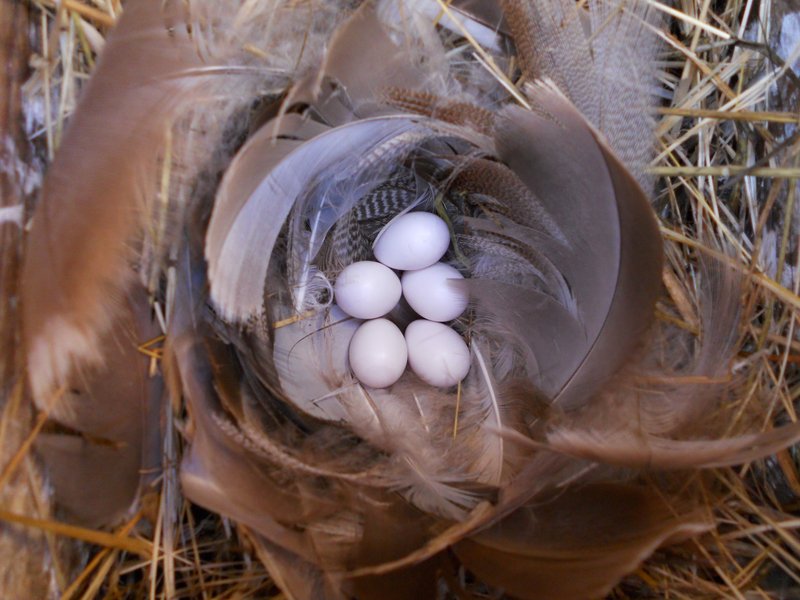
A typical Tree Swallow nest, characterized by its feather lining, providing insulation for the clutch.
Egg Laying and Incubation
Tree Swallows typically lay one brood per year, though in warmer, southern regions or if a first brood is lost, a second brood is sometimes attempted. A clutch usually consists of 3-5 white eggs. The female is primarily responsible for incubating the eggs, which typically takes 13-17 days. During this period, the male may help by bringing food or occasionally relieving the female for short periods.
Chick Rearing and Fledging
Once hatched, the chicks are altricial, meaning they are helpless and require extensive parental care. Both parents are actively involved in feeding the young, bringing them a continuous supply of flying insects. Tree Swallows have a diverse diet of insects, including dragonflies, mayflies, flies, bees, wasps, and beetles, along with spiders. During the breeding season, they also seek out calcium-rich items like fish bones, crayfish exoskeletons, and eggshells to supplement their diet, which is vital for the chicks' bone development.
The nestlings fledge, or leave the nest, at around 15-25 days old, typically between 18-22 days. They are capable of flight immediately after fledging, but the parents continue to feed them for at least three more days. After fledging, families may gather in large flocks near wetlands to build up energy reserves before their long southward migration. These staging areas offer abundant food and safe roosting sites.
Understanding Tree Swallow Behavior: A Radar Chart Analysis
To better visualize the multifaceted behaviors of Tree Swallows during their breeding season, I have created a radar chart. This chart represents key aspects of their behavior, reflecting their social interactions, territoriality, and adaptability.
This radar chart illustrates the Tree Swallow's behavioral profile across several key dimensions. "Social Cohesion" is moderately high, reflecting their tendency to form large flocks outside the breeding season, yet they exhibit significant "Territoriality" during nesting. Their "Mating Complexity" is noted for their socially monogamous but genetically promiscuous tendencies. "Parental Investment" is very high, with both parents diligently feeding their young. Finally, "Nesting Adaptability" highlights their ability to utilize both natural cavities and artificial nest boxes, a trait that has greatly contributed to their study and expansion.
Yearly Cycle and Migration
The Journey to and from Breeding Grounds
Tree Swallows are migratory birds, spending their winters in the southern United States, Mexico, and Central America. In early spring, large flocks break up into smaller groups as they embark on their northward journey. They are among the earliest swallow species to return to their breeding grounds, often arriving when it is still relatively cold, allowing them to stake out territories and nest sites before other competing cavity-nesting birds arrive.
After the breeding season, typically from late summer to early fall, Tree Swallows gather in massive flocks that can number in the hundreds of thousands. These impressive aggregations form dense "living tornadoes" above roost sites, such as cattail marshes or groves of small trees, where they spend about an hour before sunset swirling down to roost. These staging areas are critical for them to build up energy reserves for their long migration south. While they don't necessarily return to the exact same nest box each year, they often show strong fidelity to a general breeding site.
Behavioral Characteristics Beyond Nesting
Unique Traits and Interactions
Beyond their nesting habits, Tree Swallows exhibit several interesting behaviors. They are highly agile flyers, capable of acrobatic twists and turns as they chase flying insects mid-air. Unlike other swallows, they can supplement their insect diet with berries, particularly bayberries, which allows them to survive unexpected cold spells when insects are scarce. They also bathe on the wing, skimming the surface of water bodies.
One peculiar behavior observed in Tree Swallows is their "feather fetish." They avidly collect white feathers to line their nests, sometimes spending hours fighting over a single feather. This behavior is not just for nest insulation; they are also observed "playing" with feathers, dropping and re-catching them in flight, which adds a playful dimension to their character.
Communication and Vocalizations
Tree Swallows communicate through a cheerful series of liquid twitters. While not considered "musical" by human standards, their high-pitched, bubbly calls are distinctive. They use various calls for different purposes, including advertising their presence at nest sites and warning against predators. When faced with threats, they commonly swarm and dive-bomb predators while issuing alarm calls.
Comparing Swallows: Tree Swallows vs. Others
While this response focuses on Tree Swallows, it's helpful to understand how their nesting habits compare to other swallow species. The table below highlights key differences and similarities.
| Characteristic | Tree Swallow (Tachycineta bicolor) | Barn Swallow (Hirundo rustica) | Cliff Swallow (Petrochelidon pyrrhonota) |
|---|---|---|---|
| Primary Nest Site | Natural cavities (tree holes) and man-made nest boxes | Man-made structures (barns, eaves, bridges) | Cliffs, canyons, bridges, building eaves |
| Nest Construction Material | Grass, weeds, rootlets, moss, pine needles, lined extensively with feathers | Mud pellets, grass, feathers, hair, often cup-shaped on vertical surfaces | Mud pellets, often gourd-shaped with a tunnel entrance |
| Nesting Preference | Solitary or loose groups, dependent on pre-existing cavities | Solitary or small colonies | Colonial, often hundreds of nests in one location |
| Broods Per Year | Typically one, sometimes two in southern ranges | Often two | Often two |
| Diet | Primarily flying insects; supplements with berries (e.g., bayberries) | Exclusively flying insects | Exclusively flying insects |
| Feather Lining | Extensive feather lining is a defining characteristic | Uses feathers, but less extensively than Tree Swallows | Uses feathers as lining |
This table illustrates that while all swallows are aerial insectivores and skilled builders, their specific nesting preferences and materials vary significantly, reflecting their unique adaptations to different environments.
Observing Tree Swallows: A Visual Perspective
To further appreciate the behavior of Tree Swallows, particularly their interactions around nest boxes and their distinctive feather-gathering habits, the following video offers a compelling look into their lives.
This video provides an excellent overview of Tree Swallow behavior, including their nesting habits and the intriguing importance of white feathers in their nests. It highlights their aerial prowess and their interactions during the breeding season.
Frequently Asked Questions About Tree Swallows and Their Nesting
What do Tree Swallows use to build their nests?
How many times do Tree Swallows lay eggs in a year?
Do Tree Swallows reuse the same nest box every year?
What kind of habitat do Tree Swallows prefer for nesting?
Are Tree Swallows monogamous?
Conclusion
The Tree Swallow's nesting behavior is a testament to its remarkable adaptability and complex social dynamics. From their reliance on pre-existing cavities and readiness to embrace nest boxes to their unique feather-lined nests and diligent parental care, these birds offer a fascinating glimpse into avian life. Their preference for open, watery habitats, coupled with their competitive yet socially intricate breeding rituals, highlights the delicate balance of their ecosystem. Understanding these behaviors not only enriches our appreciation for Tree Swallows but also underscores the importance of conservation efforts, particularly in providing and maintaining suitable nesting sites.
Recommended Further Exploration
- Discover effective methods for attracting Tree Swallows to your property and establishing a successful nest box project.
- Learn more about the Tree Swallow's fascinating diet, including their unique ability to consume berries, and their aerial foraging techniques.
- Explore the dynamics of interspecies competition for nesting sites and strategies to mitigate conflicts between Tree Swallows and other cavity nesters.
- Delve into the incredible migratory journeys of Tree Swallows, including their wintering grounds and the routes they take to their northern breeding territories.
References
Last updated May 21, 2025