

Key Insights into Trigonometric Functions and Derivatives
- Foundation of Periodicity: Trigonometric functions are essential for modeling cyclic patterns seen in nature and engineering.
- Calculus Cornerstone: Their derivatives are crucial for understanding rates of change, slopes, and solving complex differential equations.
- Radians are Key: For calculus operations involving trigonometric functions, angles must be expressed in radians for the derivative formulas to hold true in their standard forms.
Trigonometric functions form a cornerstone of mathematics, bridging geometry, algebra, and calculus to describe relationships within triangles and the cyclical nature of many physical phenomena. These functions—sine (sin), cosine (cos), tangent (tan), cotangent (cot), secant (sec), and cosecant (csc)—are not merely abstract mathematical constructs; they are powerful tools for understanding and predicting everything from sound waves and light to planetary orbits and electrical currents. Their derivatives, the focus of calculus, reveal how these periodic behaviors change over time or with respect to other variables, providing insights into rates of motion, acceleration, and optimization in various scientific and engineering disciplines.
Defining the Six Pillars of Angular Relationships
At their core, trigonometric functions define ratios of sides in a right-angled triangle relative to its angles. This right-triangle definition serves as an intuitive starting point, but their true power emerges when extended to the unit circle. The unit circle, a circle with a radius of one centered at the origin of a coordinate plane, allows these functions to encompass all real numbers as angles, moving beyond the 0 to 90-degree confines of a right triangle.
Right-Triangle Definitions
For an acute angle \( \theta \) in a right-angled triangle:
- Sine (\(\sin \theta\)): Ratio of the length of the side opposite the angle to the length of the hypotenuse.
- Cosine (\(\cos \theta\)): Ratio of the length of the side adjacent to the angle to the length of the hypotenuse.
- Tangent (\(\tan \theta\)): Ratio of the length of the side opposite the angle to the length of the side adjacent to the angle. It can also be expressed as \( \frac{\sin \theta}{\cos \theta} \).
The remaining three functions are reciprocals of these fundamental three:
- Cosecant (\(\csc \theta\)): Reciprocal of sine, \( \frac{1}{\sin \theta} \).
- Secant (\(\sec \theta\)): Reciprocal of cosine, \( \frac{1}{\cos \theta} \).
- Cotangent (\(\cot \theta\)): Reciprocal of tangent, \( \frac{1}{\tan \theta} \), or \( \frac{\cos \theta}{\sin \theta} \).
The Unit Circle Extension
On the unit circle, for an angle \( \theta \) measured counter-clockwise from the positive x-axis, the coordinates of the point where the angle's terminal side intersects the circle are \( (\cos \theta, \sin \theta) \). This extension allows for angles beyond 90 degrees and negative angles, revealing the periodic nature of these functions. For instance, both sine and cosine functions repeat their values every \( 2\pi \) radians (360 degrees), while tangent and cotangent repeat every \( \pi \) radians (180 degrees).
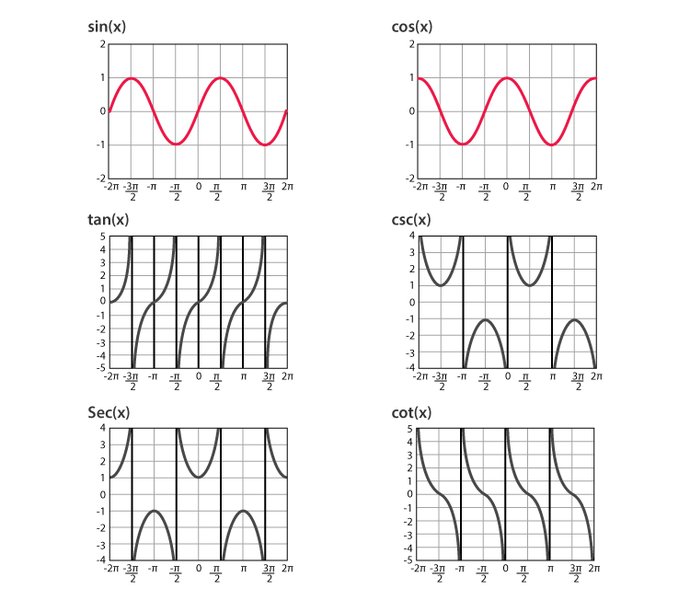
Visual representation of the graphs of fundamental trigonometric functions, illustrating their periodic behavior.
Practical Applications and Significance
Trigonometric functions are indispensable in numerous fields:
- Physics: Describing oscillations, wave motion (sound, light, water), and simple harmonic motion.
- Engineering: Analyzing forces, stresses, and vibrations in structures, electrical currents, and signal processing.
- Navigation and Surveying: Calculating distances and angles, mapping terrain, and guiding vehicles.
- Computer Graphics: Rendering 3D objects, rotations, and transformations.
Their ability to model cyclical phenomena makes them powerful tools for predictive analysis and system design.
Understanding Rates of Change in Periodic Systems
In calculus, the derivative of a function represents its instantaneous rate of change. For trigonometric functions, these derivatives reveal how rapidly the sine, cosine, tangent, and their reciprocals are changing at any given point. This understanding is fundamental to solving problems in physics, engineering, and other sciences that involve dynamic systems.
The Six Fundamental Derivatives
The derivatives of the six basic trigonometric functions, assuming the angle \( x \) is measured in radians, are:
- \[ \frac{d}{dx}(\sin x) = \cos x \]
- \[ \frac{d}{dx}(\cos x) = -\sin x \]
- \[ \frac{d}{dx}(\tan x) = \sec^2 x \]
- \[ \frac{d}{dx}(\cot x) = -\csc^2 x \]
- \[ \frac{d}{dx}(\sec x) = \sec x \tan x \]
- \[ \frac{d}{dx}(\csc x) = -\csc x \cot x \]
These formulas are derived using the definition of the derivative, alongside fundamental limit properties and trigonometric identities. For example, the derivative of \( \tan x \) can be found by expressing it as \( \frac{\sin x}{\cos x} \) and applying the quotient rule:
\[ \frac{d}{dx}(\tan x) = \frac{d}{dx}\left(\frac{\sin x}{\cos x}\right) = \frac{(\cos x)(\cos x) - (\sin x)(-\sin x)}{(\cos x)^2} = \frac{\cos^2 x + \sin^2 x}{\cos^2 x} = \frac{1}{\cos^2 x} = \sec^2 x \]The Pythagorean identity \( \sin^2 x + \cos^2 x = 1 \) is crucial in such derivations.
The Importance of Radians
It is vital that angles are measured in radians when calculating these derivatives. If degrees were used, a conversion factor of \( \frac{\pi}{180} \) would appear in the derivative formulas, making them more cumbersome. Radians simplify the mathematical expressions, making them cleaner and more intuitive for calculus operations.
Chain Rule Applications
When dealing with composite trigonometric functions, the chain rule becomes indispensable. For a function like \( \sin(u(x)) \), its derivative is \( \cos(u(x)) \cdot u'(x) \). For example:
- If \( y = \sin(3x) \), then \( \frac{dy}{dx} = \cos(3x) \cdot \frac{d}{dx}(3x) = 3\cos(3x) \).
- If \( y = \tan(x^2) \), then \( \frac{dy}{dx} = \sec^2(x^2) \cdot \frac{d}{dx}(x^2) = 2x\sec^2(x^2) \).
Connecting Graphs and Rates of Change
The graphs of trigonometric functions beautifully illustrate their periodic nature. When considering their derivatives, we are essentially looking at the slope of the tangent line at every point on these graphs. For instance, the slope of the sine wave is highest when sine is at its steepest upward incline, corresponding to the positive peaks of the cosine wave. Conversely, where the sine wave flattens out (its peaks and troughs), its slope is zero, which is where the cosine wave crosses the x-axis.
This video provides a comprehensive explanation of how to find the derivatives of trigonometric functions, detailing their proofs and applications. It is particularly relevant as it delves into the "why" behind the formulas, offering a deeper conceptual understanding for students and practitioners alike.
The video above further clarifies the process of finding derivatives for all six trigonometric functions, emphasizing the product and quotient rules. It helps solidify the understanding of these crucial calculus concepts.
The Web of Trigonometric Relationships
The derivatives of trigonometric functions are deeply interconnected. Notice that the derivatives of functions starting with "co" (cosine, cotangent, cosecant) all involve a negative sign. This is a common mnemonic for remembering these relationships.
This mindmap illustrates the comprehensive relationship between trigonometric functions and their derivatives, branching out from fundamental definitions to their applications and the crucial role of calculus. It helps organize the various concepts, highlighting how each component contributes to a holistic understanding.
A Consolidated View of Trigonometric Derivatives
For quick reference, the table below summarizes the six primary trigonometric functions and their corresponding derivatives, emphasizing their standard forms in calculus.
| Trigonometric Function | Derivative | Underlying Principle for Derivation (Example) |
|---|---|---|
| \( \sin x \) | \( \cos x \) | Limit definition of the derivative |
| \( \cos x \) | \( -\sin x \) | Limit definition of the derivative |
| \( \tan x \) | \( \sec^2 x \) | Quotient Rule on \( \frac{\sin x}{\cos x} \) |
| \( \cot x \) | \( -\csc^2 x \) | Quotient Rule on \( \frac{\cos x}{\sin x} \) |
| \( \sec x \) | \( \sec x \tan x \) | Chain Rule on \( (\cos x)^{-1} \) |
| \( \csc x \) | \( -\csc x \cot x \) | Chain Rule on \( (\sin x)^{-1} \) |
This table serves as a concise guide to the fundamental derivatives that are indispensable in calculus. Understanding the derivation principles listed in the third column reinforces the theoretical underpinnings of these formulas.
FAQ: Deepening Your Understanding
Why are radians preferred over degrees in calculus for trigonometric derivatives?
What is the significance of the negative sign in the derivatives of cosine, cotangent, and cosecant?
How are these derivatives used in real-world applications?
Can inverse trigonometric functions also be differentiated?
What if the argument of a trigonometric function is not just \( x \) but a more complex expression, like \( \sin(x^2 + 1) \)?
Conclusion: The Foundation of Dynamic Analysis
Trigonometric functions and their derivatives are fundamental tools in the mathematical landscape. From their geometric origins in right triangles and their elegant extension to the unit circle, these functions provide the language to describe and predict periodic behavior across diverse scientific and engineering domains. Their derivatives, derived through foundational calculus principles and dependent on radian measure, quantify the instantaneous rates of change within these cyclical patterns. Mastering these concepts not only enhances one's understanding of calculus but also unlocks the ability to analyze and model complex dynamic systems, making them indispensable for anyone pursuing advanced studies in mathematics, physics, engineering, or computer science.
Recommended Further Exploration
- Explore detailed derivations of each trigonometric derivative from first principles.
- Investigate real-world applications of trigonometric derivatives in physics, such as simple harmonic motion.
- Visualize the relationship between the graphs of trigonometric functions and their derivatives.
- Learn about the derivatives of inverse trigonometric functions and their unique properties.