
Unveiling Triputi Pratyaksha: The Mimamsa Perspective on Direct Perception
A Deep Dive into the Interconnectedness of Knower, Known, and Knowledge in Indian Philosophy
Key Insights into Triputi Pratyaksha
- Triputi refers to the "trio" of the knower (pramatr), the known (prameya), and the act of knowing (prama). It emphasizes their simultaneous revelation in the process of perception.
- Pratyaksha is direct perception, considered the primary and most reliable source of knowledge (pramana) in the Mimamsa school of Hindu philosophy.
- The Prabhakara school of Mimamsa is particularly known for advocating Triputi-pratyakṣavāda, which posits that the knower, the object, and the knowledge itself are all revealed simultaneously during an act of perception.
The Mimamsa school, one of the six orthodox (Astika) systems of Indian philosophy, primarily focuses on the interpretation of the Vedas and the proper performance of Vedic rituals. While its core concern is dharma, Mimamsa also offers a robust epistemology, detailing how valid knowledge (prama) is acquired. Central to this epistemology is the concept of Pratyaksha, or direct perception, and within Mimamsa, the Prabhakara sub-school further refines this with the doctrine of Triputi-pratyakṣavāda, emphasizing the inseparable trinity of the knower, the known, and the act of knowing.
Understanding Mimamsa: The Foundation of Vedic Inquiry
The "Critical Investigation" of Dharma
The Sanskrit word Mīmāṃsā translates to "reflection" or "critical investigation." This philosophical tradition delves deeply into the meanings of Vedic texts, particularly the Karma-kanda (ritualistic part) of the Vedas. It is also known as Pūrva-Mīmāṃsā ("Prior Study") or Karma-Mīmāṃsā ("Study of Actions") to distinguish it from Uttara Mimamsa, or Vedanta, which focuses on the Upanishads (the later, more philosophical sections of the Vedas).
The primary aim of Mimamsa, as established by Rishi Jaimini in his Mimamsa Sutras (ca. 300–200 BCE), is to provide rules for interpreting the Vedas and to philosophically justify Vedic rituals. Mimamsakas consider the Vedas to be eternal, authorless (apaurusheyatva), and absolutely infallible. For them, dharma—understood as a set of ritual obligations—cannot be known through mere perception or reasoning alone but must be derived from the authoritative revelation in the Vedas.
Mimamsa's Contribution to Epistemology
Despite its ritualistic focus, Mimamsa developed a sophisticated theory of knowledge, establishing rigorous criteria for discerning valid knowledge, known as pramanas. While other schools like Nyaya accept four pramanas (perception, inference, comparison, and verbal testimony), Mimamsa (especially certain sub-schools) recognizes six: Pratyaksha (perception), Anumāna (inference), Upamāṇa (comparison and analogy), Śabda (verbal testimony/scripture), Arthāpatti (postulation/presumption), and Anupalabdhi (non-perception or negation).
Decoding Pratyaksha: The Apex of Direct Knowledge
Perception as a Pramana
Pratyaksha, meaning "in front of the eyes" or "direct apprehension," is considered the most reliable source of knowledge in the Mimamsa tradition, especially when it is direct and unmediated. It is the knowledge that results from the immediate contact between an object and the sense organs. Generally, whatever is perceived directly by the senses is believed to be true because it offers immediate knowledge without requiring intermediary processes.
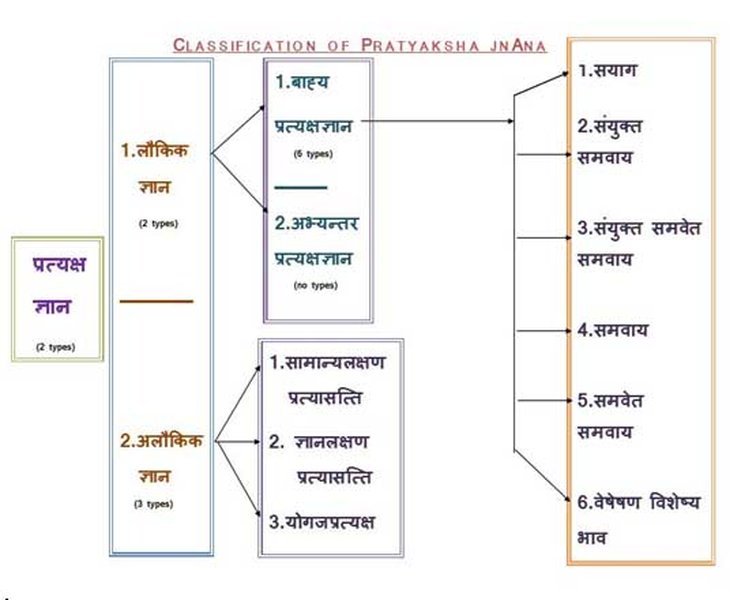
A diagram illustrating the classification of Pratyaksha Pramana in Indian philosophy.
Pratyaksha is broadly categorized into two types: direct perception (anubhava) and remembered perception (smriti). While direct perception is knowledge gained instantly through sensory organs, remembered perception involves knowledge accessed through memory. In the Mimamsa framework, specifically the Prabhakara school, perception is always regarded as direct and immediate cognition.
The Nuances of Perception
The process of Pratyaksha involves the interaction of the five sense organs (sight, sound, touch, taste, and smell) with their respective objects. When a sense organ interacts with an object, a firm knowledge is established. This source of firm knowledge, often the mind, is considered the Pratyaksha Pramana. However, Mimamsa also acknowledges that perceptions can sometimes be erroneous, leading to what is known as mithyā jñāna (misunderstanding) or samshaya jñāna (uncertain knowledge). The Mimamsa theory of error (Akhyati, for Prabhakara, and Viparyayakhyati for Kumarila) explains how these perceptions can sometimes be flawed, yet it maintains that knowledge is intrinsically valid unless proven otherwise.
Triputi Pratyaksha: The Doctrine of Triple Revelation
The Prabhakara School's Unique Insight
The term Triputi (त्रिपुटी) literally means "trio" or a "combination of three things." In the context of Pratyaksha, Triputi-pratyakṣavāda refers specifically to the Prabhakara sub-school's doctrine of "Triple Perception." This theory posits that in any act of valid direct perception, three distinct entities are simultaneously revealed: the knower (pramatr), the object that is known (prameya), and the knowledge itself (prama).
For Prabhakara, knowledge is inherently self-luminous, meaning it reveals itself, the subject (knower), and the object (known) simultaneously. This is a significant departure from other schools, such as the Nyaya, which consider the self to be unconscious but argue that knowledge, while not self-luminous, can be known through inference. The Prabhakara view highlights an indivisible and simultaneous apprehension of all three elements in a single cognitive event. It emphasizes that perception is not merely the apprehension of an external object, but an experience that necessarily involves the conscious self and the act of knowing itself, all at once.
The Interconnectedness of the Trio
The concept of Triputi Pratyaksha asserts that when one perceives something, there is no sequential process where the object is perceived first, then the knowledge of it, and finally the realization of oneself as the knower. Instead, all three facets emerge simultaneously. This simultaneous revelation ensures the directness and immediacy that Mimamsakas attribute to Pratyaksha as a valid means of knowledge. The strength of this doctrine lies in its assertion that the very act of knowing necessarily includes the conscious subject and the object of consciousness, making error less likely in the initial, unmediated apprehension.
This doctrine reinforces the Mimamsa belief in the intrinsic validity of knowledge (svatah pramanyavada), where knowledge is presumed to be true unless it is later contradicted. The simultaneous revelation of the knower, known, and knowledge in Triputi Pratyaksha contributes to this self-validating nature, as the elements required for validation are present within the perceptual act itself.
Contrasting Views on Knowledge and Self-Perception
The concept of the self's perception of itself was a significant debate in medieval Indian philosophy. While Prabhakara's school held that the self is revealed simultaneously with the object and knowledge, other Mimamsa thinkers like Kumarila Bhatta differed. Kumarila argued that cognitions are not amenable to direct perception but can be known by inference. He contended that consciousness itself is imperceptible. This highlights the intricate philosophical discussions within Mimamsa and broader Indian thought regarding the nature of self, consciousness, and the process of knowing.
The Components of Knowledge and Their Validation
A Framework for Understanding Epistemological Claims
To further illustrate the nuanced perspectives within Indian philosophy, particularly concerning the validity and nature of different knowledge sources, let's consider a comparative analysis. This radar chart will visually represent how various schools might hypothetically rate their emphasis on different aspects of knowledge acquisition and its self-validating nature, with a focus on the Mimamsa (Prabhakara) perspective on Triputi Pratyaksha.
The radar chart illustrates the differing epistemological priorities of three prominent Indian philosophical schools. Prabhakara Mimamsa (represented in yellow/gold) shows a strong emphasis on Direct Perception (Pratyaksha), the Self-Luminosity of Knowledge, and the simultaneous revelation inherent in Triputi, reflecting its core tenets. Its reliance on Vedic Testimony (Shabda) is also significant, given Mimamsa's focus on Vedic interpretation. The Nyaya school (in teal) places high value on Inference (Anumana) and Direct Perception but does not adhere to the self-luminous nature of knowledge or the Triputi concept in the same way as Prabhakara. Advaita Vedanta (in green) emphasizes Vedic Testimony (Shabda) as a primary source, especially for spiritual knowledge, and also posits the intrinsic validity of knowledge, though its view on the self's perception might differ from Mimamsa.
The Broader Context: Pramanas in Indian Philosophy
Diverse Paths to Valid Knowledge
The concept of pramana is fundamental across various schools of Indian philosophy, representing the reliable means by which true and valid knowledge (prama) can be acquired. While Mimamsa holds a prominent position, particularly with its detailed analysis of Pratyaksha and unique contributions like Arthapatti (postulation) and Anupalabdhi (non-perception), it's important to see it within the broader landscape of Indian epistemology.
An introductory video exploring the concept of Pramanas in Indian Epistemology, highlighting different means of valid knowledge.
This video provides an excellent overview of the various pramanas, including Pratyaksha, Anumana, and others. It helps contextualize the Mimamsa perspective by showing how different philosophical traditions approached the fundamental question of how humans attain correct knowledge about the world and reality. Understanding the shared framework of pramanas helps to appreciate the unique contributions and debates within each school, such as the Mimamsa's detailed elaboration of Triputi Pratyaksha.
Comparative Analysis of Pramanas Across Schools
The number and definition of accepted pramanas vary across different Indian philosophical schools. This table provides a comparative overview, highlighting the commonalities and distinctions, and positioning Mimamsa's approach within this diverse intellectual tradition.
| Pramana (Means of Knowledge) | Description | Mimamsa (Prabhakara) Acceptance | Nyaya Acceptance | Buddhism Acceptance | Carvaka Acceptance |
|---|---|---|---|---|---|
| Pratyaksha (Perception) | Direct, immediate knowledge through sense-object contact. | Primary source, includes Triputi-pratyakṣavāda. | Accepted (direct and remembered). | Accepted. | Only accepted pramana. |
| Anumāna (Inference) | Knowledge derived from logical reasoning or deduction. | Accepted, but secondary to Pratyaksha and Shabda. | Accepted. | Accepted. | Rejected. |
| Upamāṇa (Comparison/Analogy) | Knowledge gained through resemblance or analogy. | Accepted. | Accepted. | Rejected. | Rejected. |
| Śabda (Verbal Testimony) | Knowledge from reliable verbal authority or scripture (Vedas). | Accepted, highly authoritative, especially for Dharma. | Accepted. | Accepted (scriptures from "valid persons"). | Rejected. |
| Arthāpatti (Postulation/Presumption) | Postulating an unperceived cause to reconcile an observed effect. | Unique contribution, accepted. | Rejected (can be reduced to Anumana). | Rejected. | Rejected. |
| Anupalabdhi (Non-perception/Negation) | Knowledge of absence or non-existence through non-perception. | Accepted (by Kumarila, not Prabhakara). | Rejected (absence is known through Pratyaksha or Anumana). | Rejected. | Rejected. |
As the table illustrates, the Mimamsa school, particularly the Prabhakara branch, is distinctive in its embrace of a wide range of pramanas, emphasizing the reliability of direct perception while also recognizing the importance of verbal testimony (especially the Vedas) for knowledge beyond sensory reach, such as dharma.
The Legacy of Triputi Pratyaksha
Enduring Relevance in Indian Philosophical Thought
The concept of Triputi Pratyaksha, while specific to the Prabhakara school of Mimamsa, underscores a profound epistemological insight: the cognitive act is never isolated. It always involves a conscious subject experiencing an object, with the experience itself being an integral part of the process. This idea of simultaneous revelation provides a strong philosophical basis for the intrinsic validity of knowledge, a hallmark of Mimamsa epistemology.
Mimamsa's meticulous examination of perception, its robust criteria for valid knowledge, and its unique theories of error and truth have significantly shaped the intellectual landscape of Indian philosophy. Its detailed analysis of language, meaning, and the interpretation of sacred texts has left an indelible mark, influencing not only subsequent philosophical schools but also methodologies for textual analysis and legal reasoning in India. The emphasis on practical application, particularly through the correct performance of rituals, further solidified Mimamsa's role as a foundational system within Hindu thought.
Frequently Asked Questions
What does "Triputi" mean in Indian philosophy?
Which school of Mimamsa advocates Triputi-pratyakṣavāda?
How does Mimamsa view Pratyaksha (perception) as a source of knowledge?
What is the significance of the "intrinsic validity of knowledge" (svatah pramanyavada) in Mimamsa?
Conclusion
The concept of Triputi Pratyaksha from the Mimamsa school, particularly the Prabhakara branch, offers a profound understanding of direct perception. It posits that the knower, the known object, and the act of knowing are not separate, sequential occurrences but rather a simultaneously revealed trinity in every act of perception. This doctrine underscores the inherent immediacy and self-validating nature of perceptual knowledge within the Mimamsa framework, distinguishing it from other schools of thought in Indian philosophy. By rigorously analyzing the mechanisms of knowledge acquisition, Mimamsa not only provided a philosophical justification for Vedic rituals but also contributed significantly to the broader discourse on epistemology, truth, and the nature of reality in ancient India.
Recommended Further Reading
- Epistemological theories of Kumarila Bhatta vs Prabhakara Mimamsa
- Role of Shabda Pramana in Mimamsa philosophy
- Comparison of Pramanas in Nyaya and Mimamsa schools
- Mimamsa theory of error: Akhyati vs Viparyayakhyati
Search Results
 sudhanshushekhar.files.wordpress.com