
Unlocking the Labyrinth: Navigating the Traveling Salesman Problem with Heuristics
Explore a comprehensive guide to understanding and applying various heuristic algorithms to solve the Traveling Salesman Problem, enhancing efficiency in optimization.
Key Heuristic Approaches for TSP
- Nearest Neighbor: A simple, intuitive method that builds a tour by iteratively adding the nearest unvisited city.
- Convex Hull Insertion: Constructs a tour by starting with the convex hull of the cities and then inserting the remaining cities one by one.
- 2-opt Heuristic: An improvement heuristic that iteratively removes two edges and reconnects the tour in a different way to reduce the total distance.
Understanding the Traveling Salesman Problem (TSP)
The Traveling Salesman Problem (TSP) is a classic problem in computer science and operations research. It asks the following question: "Given a list of cities and the distances between each pair of cities, what is the shortest possible route that visits each city exactly once and returns to the origin city?" The TSP is an NP-hard problem, meaning that there is no known polynomial-time algorithm that can solve all instances of the problem. This makes heuristic algorithms particularly valuable for finding near-optimal solutions in a reasonable amount of time.
Why Heuristics are Essential for TSP
Due to the computational complexity of the TSP, exact algorithms are generally only feasible for small problem sizes. For larger instances, heuristic algorithms are used to provide solutions that are of high quality but not necessarily optimal. Heuristics offer a balance between speed and solution quality, making them suitable for real-world applications where finding an optimal solution is impractical.
Core Idea Behind Heuristic Algorithms
Heuristic algorithms for the TSP aim to find a good approximation of the optimal path within a reasonable amount of time. They often involve iteratively improving a tour until a satisfactory solution is found, or constructing a tour using a set of rules designed to produce a short path.
Construction Heuristics
Construction heuristics are algorithms that build a TSP tour from scratch. These methods typically start with a partial tour and iteratively add cities until a complete tour is formed.
Random Tour
The random tour heuristic generates a tour by randomly selecting the order in which to visit the cities. While simple, this method is unlikely to produce a good solution, but it can serve as a baseline for comparison with other heuristics.
Nearest Neighbor
The nearest neighbor heuristic starts at a random city and repeatedly visits the nearest unvisited city until all cities have been visited. It then returns to the starting city to complete the tour. This is a greedy algorithm, as it makes the locally optimal choice at each step.
Convex Hull Insertion
The convex hull insertion heuristic begins by computing the convex hull of the set of cities. The algorithm then iteratively inserts the remaining cities into the tour. Each city is inserted between two adjacent cities in the current tour to minimize the increase in the tour's total length. This method leverages the geometric properties of the problem to build a tour incrementally.
Cheapest Insertion
The cheapest insertion heuristic starts with a subtour, often just a single edge between two cities, and iteratively inserts cities into the tour such that the increase in the tour length is minimized. At each step, it selects the city and the insertion point that results in the smallest increase in the tour's total distance. This method tends to produce better results than nearest neighbor but is computationally more intensive.
Spanning Tree-Based Heuristics
Spanning tree-based heuristics construct a minimum spanning tree (MST) of the graph representing the TSP instance and then convert the MST into a TSP tour. These methods leverage the property that the cost of the MST is a lower bound on the cost of the optimal TSP tour.
Ring-Shaped Tree
The ring-shaped tree heuristic is not a standard term in TSP literature, but it likely refers to a method that combines aspects of spanning trees with the idea of forming a ring-like structure. The exact implementation can vary, but the general idea involves creating a spanning tree and then modifying it to form a tour that resembles a ring.
Bitonic Tour
A bitonic tour is a tour that increases in distance from the starting point to a certain point, then decreases back to the ending point. This type of tour is relevant in specific geometric instances of the TSP, particularly when cities are arranged in a plane. The bitonic tour approach typically works best when the cities have a natural ordering.
Clarke and Wright's Savings Algorithm
The Clarke and Wright's savings algorithm is a constructive heuristic that starts with each city being visited directly from the depot and then iteratively merges routes to reduce the total travel distance. The algorithm calculates "savings" for each pair of cities, representing the reduction in distance achieved by visiting them consecutively rather than returning to the depot separately.
Improvement Heuristics
Improvement heuristics start with an initial tour and iteratively improve it by making local changes. These methods continue until no further improvements can be found.
2-opt Heuristic
The 2-opt heuristic is a local search algorithm that iteratively improves a TSP tour by repeatedly replacing two edges in the tour with two different edges. This is done in such a way that the new tour is shorter than the original tour. The process continues until no further 2-opt improvements can be found. The 2-opt heuristic is relatively simple but can significantly improve the quality of a TSP tour.
Simulated Annealing
Simulated annealing is a metaheuristic algorithm inspired by the annealing process in metallurgy. It starts with an initial solution and iteratively makes small changes to the solution. Unlike local search algorithms, simulated annealing can accept moves that worsen the solution with a certain probability, allowing it to escape local optima. The probability of accepting a worsening move decreases as the algorithm progresses, gradually converging to a good solution.
Tabu Search
Tabu search is another metaheuristic algorithm that explores the solution space by iteratively moving from one solution to a neighboring solution. To avoid cycling back to previously visited solutions, tabu search maintains a tabu list of recently visited solutions or moves that are forbidden for a certain number of iterations. This allows the algorithm to explore a wider range of solutions and escape local optima.
Neural Network-Inspired Heuristics
Neural networks can be adapted to solve combinatorial optimization problems like the TSP. These approaches typically involve training a neural network to represent the TSP instance and then using the network to generate a tour.
Kohonen Map
The Kohonen map, also known as a self-organizing map (SOM), is a type of neural network that can be used to solve the TSP. The cities are presented to the network, and the network adjusts its weights such that the neurons become ordered in a way that reflects the arrangement of the cities. A tour can then be constructed by following the order of the neurons in the map.
Swarm Intelligence-Inspired Heuristics
Swarm intelligence algorithms are inspired by the collective behavior of social insects and other animal societies. These algorithms use a population of agents that cooperate to find a solution to the problem.
Ant Colony System
The ant colony system (ACS) is a metaheuristic algorithm inspired by the foraging behavior of ants. In ACS, a population of artificial ants explores the solution space, depositing pheromones on the edges of the graph. The pheromone trails guide the ants towards promising solutions. Over time, the pheromone trails evaporate, allowing the ants to explore new regions of the solution space. This collaborative approach can lead to good solutions for the TSP.
Bees Algorithm
The bees algorithm is a metaheuristic algorithm inspired by the foraging behavior of honeybees. The algorithm consists of a population of bees that search for food sources (solutions) in the solution space. Some bees are selected as "elite bees" and are assigned to search promising regions more intensively. Other bees are assigned to search randomly, exploring new regions of the solution space. This combination of exploitation and exploration can lead to good solutions for the TSP.
Evolutionary Algorithms
Evolutionary algorithms are a class of optimization algorithms inspired by biological evolution. These algorithms maintain a population of solutions and iteratively improve them using genetic operators such as selection, crossover, and mutation.
Genetic Algorithm
The genetic algorithm (GA) is a population-based metaheuristic algorithm that uses principles of evolution to find solutions to optimization problems. In the context of the TSP, a population of tours is maintained, and the algorithm iteratively improves the population by selecting good tours, combining them to create new tours (crossover), and randomly modifying tours (mutation). The GA can be effective for finding good solutions to the TSP, but it can be computationally intensive.
Black Hole Algorithm
The black hole algorithm is a more recent optimization algorithm inspired by the phenomenon of black holes in space. In this algorithm, solutions (stars) are attracted to a black hole (the best solution). The positions of the stars are updated based on their distance from the black hole. The black hole algorithm is relatively new and has shown promise in solving various optimization problems, including the TSP.
Enhancing TSP Solutions with Visuals
Visual representations of TSP solutions and the algorithms used to find them can greatly aid in understanding and optimization. Here's a curated collection of visualizations and real-world applications to provide a deeper insight into the TSP.
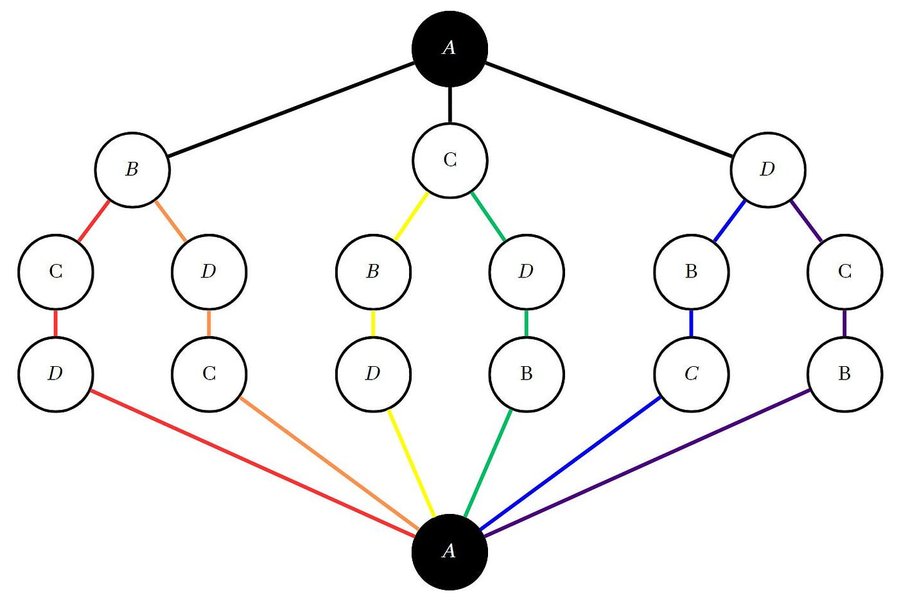
Visualizing the TSP can take many forms, from simple plots of city locations and tour paths to more complex animated demonstrations of algorithms in action. These visuals serve to:
-
Illustrate Algorithm Mechanics: Animations show how algorithms like Nearest Neighbor, 2-opt, and simulated annealing iteratively improve solutions.
-
Highlight Solution Quality: Visual comparison of different algorithms on the same problem instance allows for easy assessment of performance.
-
Provide Intuition: Seeing the problem and its solutions helps build intuition about the nature of the TSP and the challenges it presents.
Algorithmic Strategies for TSP
Different algorithmic strategies for solving the Traveling Salesman Problem (TSP) offer varying degrees of efficiency and solution accuracy. Exact algorithms, while guaranteeing optimal solutions, are often impractical for large problem instances due to their exponential time complexity. Heuristic and approximation algorithms provide a balance between computational speed and solution quality, making them suitable for real-world applications.
| Algorithm Type | Description | Advantages | Disadvantages | Example |
|---|---|---|---|---|
| Exact Algorithms | Guarantee the optimal solution by exhaustively searching the solution space. | Optimal solution guaranteed. | Computationally expensive; impractical for large instances. | Branch and Bound, Cutting Plane Method |
| Heuristic Algorithms | Provide good, but not necessarily optimal, solutions in a reasonable amount of time. | Faster than exact algorithms; suitable for large instances. | Do not guarantee optimal solutions. | Nearest Neighbor, 2-opt, Simulated Annealing |
| Approximation Algorithms | Guarantee a solution within a specific percentage of the optimal solution. | Offer a balance between speed and solution quality. | May not always find the best possible solution. | Christofides Algorithm |
| Metaheuristic Algorithms | Employ strategies to escape local optima and explore the solution space more effectively. | Can find high-quality solutions for complex problems. | May require careful tuning of parameters; no guarantee of optimality. | Genetic Algorithm, Ant Colony Optimization, Tabu Search |
TSP Approximation Algorithms Explained
This YouTube video, "TSP Approximation Algorithms | Solving the Traveling Salesman Problem," offers a concise explanation of the Traveling Salesman Problem (TSP) and delves into two approximation algorithms designed to find solutions within polynomial time. The video serves as an excellent educational resource for those seeking to understand how to tackle the TSP with algorithms that balance efficiency and solution quality.
The presenter elucidates the core concepts of TSP, emphasizing its inherent complexity as an NP-hard problem. They effectively communicate the rationale behind using approximation algorithms, which provide a practical means of obtaining near-optimal solutions when an exact solution is computationally infeasible due to time constraints. By breaking down complex topics into digestible segments, the video enhances the viewer's understanding of the nuances of TSP and its algorithmic solutions.
Frequently Asked Questions (FAQ)
References
Last updated April 10, 2025