
Beyond the Headlines: Unpacking the Enduring Legacy of Tupac Shakur
An in-depth look at the rapper, actor, poet, and activist whose voice continues to echo decades after his death.
Highlights
- Multifaceted Icon: Tupac Shakur was more than a rapper; he was a gifted actor, poet, and potent activist whose work addressed deep societal issues.
- Profound Impact: Selling over 75 million records worldwide, his music, characterized by raw honesty and social commentary, cemented his place as one of hip-hop's most influential figures.
- Tragic End & Enduring Mystery: His life was cut short at age 25 in a still-debated drive-by shooting, adding layers of complexity to his already powerful legacy.
The Formative Years: Roots in Revolution
From Black Panthers to Baltimore School for the Arts
Tupac Shakur's story begins not just with his birth but with the revolutionary fervor of his family. Born Lesane Parish Crooks on June 16, 1971, in East Harlem, New York City, his identity was deeply intertwined with the Black Panther Party from the outset. His mother, Afeni Shakur, a prominent member of the Panthers, was acquitted of conspiracy charges just weeks before his birth. His father was Billy Garland. At age one, his mother renamed him Tupac Amaru Shakur, honoring Túpac Amaru II, an 18th-century Peruvian revolutionary who led an indigenous uprising against Spanish rule. This name, chosen to instill a sense of global culture and resistance, foreshadowed the powerful voice he would become.
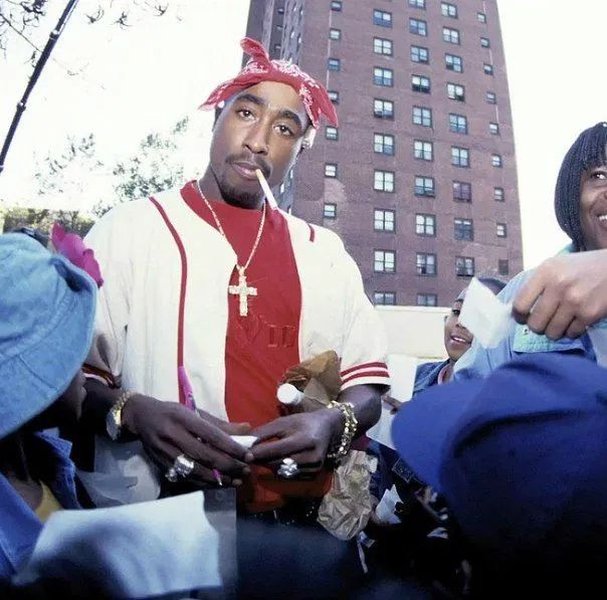
Tupac Shakur in Harlem, New York, 1994.
A Childhood Shaped by Instability and Art
Tupac's early life was marked by poverty, frequent moves, and his family's ongoing struggles with the law, stemming from their activism. This instability led him from Harlem to Baltimore in 1984. It was in Baltimore that a crucial aspect of his artistic identity began to form. He enrolled at the Baltimore School for the Arts, where he studied acting, poetry, jazz, and ballet. This formal training honed his natural talents and exposed him to a wider range of artistic expression, including Shakespeare, influences that subtly permeated his later work. Here, he developed close friendships, including one with Jada Pinkett (later Pinkett Smith), and began writing his first raps.
West Coast Bound: Marin City
In 1988, the family moved again, this time to Marin City, California, a community near San Francisco. This transition exposed him more directly to the harsh realities of inner-city life, including gang culture and economic hardship. These experiences would profoundly shape the themes and narratives present in his music, lending an authenticity and raw edge to his lyrical explorations of urban struggle.
Ascension: From Digital Underground to Global Stardom
Forging a Path in Music and Film
Tupac's professional journey began not as a frontman, but behind the scenes. In 1990, he joined the alternative hip-hop group Digital Underground, initially as a roadie and backup dancer. His charisma and talent quickly became apparent, leading to his first feature on their 1991 song "Same Song," which also appeared in the film *Nothing but Trouble*. This exposure served as a launching pad for his solo career.

Tupac Shakur performing live, showcasing his stage presence.
The Solo Breakthrough: 2Pacalypse Now
Signing with Interscope Records, Tupac released his debut album, *2Pacalypse Now*, in late 1991. The album was a raw, politically charged statement, tackling issues like police brutality ("Trapped"), poverty, and teenage pregnancy ("Brenda's Got a Baby") with unflinching honesty. While critically acclaimed for its depth and social commentary, it also generated controversy, notably drawing criticism from then-Vice President Dan Quayle, who claimed it had no place in society. Tupac defended his work as a reflection of the realities faced by Black youth in America.
Building Momentum: Albums and Acting
His sophomore album, *Strictly 4 My N.I.G.G.A.Z.* (1993), continued his exploration of social issues while showcasing a more aggressive sound and achieving greater commercial success. Simultaneously, Tupac launched a promising acting career. His debut role as the volatile Bishop in *Juice* (1992) earned him critical praise for his intense performance. He followed this with starring roles opposite Janet Jackson in *Poetic Justice* (1993) and in the basketball drama *Above the Rim* (1994), demonstrating his versatility as a performer.
Peak and Turmoil: Me Against the World and All Eyez on Me
While incarcerated on sexual abuse charges in 1995 (charges he vehemently denied), Tupac released *Me Against the World*. Recorded largely before his prison sentence, the album is considered one of his most introspective and critically lauded works, debuting at number one on the Billboard 200. It showcased his vulnerability alongside his defiance, with tracks like "Dear Mama" becoming timeless anthems.
Upon his release from prison, facilitated by a deal with Marion "Suge" Knight's Death Row Records, Tupac immediately returned to the studio. In February 1996, he released *All Eyez on Me*, hip-hop's first major double album. A sprawling, ambitious project, it became a massive commercial success, certified Diamond by the RIAA, and featured hit singles like "California Love" and "How Do U Want It." This period marked the zenith of his fame but also deepened his involvement in the escalating East Coast-West Coast hip-hop rivalry, particularly with Bad Boy Records and The Notorious B.I.G.
The Voice of a Generation: Themes and Activism
Artistry Rooted in Social Consciousness
Tupac's music was more than entertainment; it was a platform for potent social commentary and activism. Drawing from his upbringing and experiences, his lyrics consistently addressed the harsh realities of systemic racism, poverty, police brutality, gang violence, and the struggles of navigating life in marginalized communities. He gave voice to the voiceless, articulating the anger, frustration, hope, and resilience of a generation.
A Complex Persona
He presented a complex, often contradictory, persona. He could be the thoughtful poet exploring themes of love, loss, and motherhood ("Dear Mama," "Keep Ya Head Up") and the militant activist demanding justice ("Changes"). At the same time, he embraced the "Thug Life" ethos (an acronym for "The Hate U Give Little Infants Fucks Everybody"), reflecting the harshness of his environment and embodying defiance against societal oppression. This duality – vulnerability mixed with aggression, intellectualism paired with street sensibility – made him a relatable and compelling figure.
Beyond Music: Poetry and Advocacy
His artistic expression extended beyond rapping. His poetry, often written during his youth and later published posthumously in collections like *The Rose That Grew from Concrete*, revealed a sensitive and insightful mind grappling with complex emotions and societal observations. He used interviews and public appearances to advocate for social change, speaking candidly about the failures of the system and the need for empowerment within the Black community.
Visualizing Tupac's Multifaceted Impact
A Radar Chart Analysis
Tupac Shakur's influence spanned multiple domains, from lyrical prowess to cultural impact. The radar chart below provides a visual representation of his strengths across key areas, reflecting his complex legacy. This chart synthesizes subjective assessments based on critical reception, sales data, cultural analysis, and the enduring relevance of his work.
This chart highlights Tupac's exceptional strength in lyrical depth, social commentary, and cultural influence, positioning him as a towering figure in music history. His commercial success was immense, and his voice as an activist resonated deeply. While his acting career was shorter, it showcased significant talent. The score for emotional vulnerability reflects his capacity to blend toughness with heartfelt introspection, a key element of his enduring appeal.
Mapping the Journey: A Mindmap Overview
Key Facets of Tupac's Life and Career
To better understand the interconnected elements of Tupac Shakur's influential life, the following mindmap provides a visual summary of the major themes and milestones discussed.
(1971-1996)"] id1["Early Life & Influences"] id1a["Born Lesane Parish Crooks (NYC)"] id1b["Renamed Tupac Amaru Shakur"] id1c["Parents: Afeni Shakur & Billy Garland (Black Panthers)"] id1d["Upbringing: Poverty, Activism, Instability"] id1e["Baltimore School for the Arts (Acting, Poetry)"] id1f["Move to Marin City, CA"] id2["Music Career"] id2a["Digital Underground (Dancer/Roadie)"] id2b["Solo Debut: *2Pacalypse Now* (1991)"] id2c["Key Albums:
*Strictly 4 My N.I.G.G.A.Z.* (1993)
*Me Against the World* (1995)
*All Eyez on Me* (1996)"] id2d["Stage Names: 2Pac, Makaveli"] id2e["Themes: Social Issues, Racism, Poverty, Violence, Resilience"] id2f["Group: Thug Life"] id2g["Record Labels: Interscope, Death Row"] id3["Acting Career"] id3a["*Juice* (1992)"] id3b["*Poetic Justice* (1993)"] id3c["*Above the Rim* (1994)"] id3d["Praised for Authenticity"] id4["Activism & Social Impact"] id4a["Voice for Marginalized Communities"] id4b["Addressed Systemic Injustice"] id4c["'Thug Life' Philosophy"] id4d["Poetry (*The Rose That Grew from Concrete*)"] id4e["Controversy & Criticism (e.g., Dan Quayle)"] id5["Personal Life & Controversies"] id5a["Legal Troubles & Imprisonment (1995)"] id5b["East Coast vs. West Coast Rivalry"] id5c["Association with Death Row Records"] id6["Death & Unsolved Murder"] id6a["Shot in Las Vegas (Sept 7, 1996)"] id6b["Died Sept 13, 1996 (Age 25)"] id6c["Murder Remained Unsolved for Decades"] id6d["Duane 'Keffe D' Davis Indicted (2023)"] id7["Legacy & Enduring Influence"] id7a["Over 75 Million Records Sold Worldwide"] id7b["Considered One of the Greatest Rappers"] id7c["Cultural Icon & Symbol of Resistance"] id7d["Posthumous Releases (e.g., *The Don Killuminati*)"] id7e["Rock & Roll Hall of Fame Inductee (2017)"] id7f["Influence on Subsequent Generations"] id7g["Authorized Biography by Staci Robinson (2023)"]
This mindmap connects Tupac's revolutionary roots, his multifaceted artistic career in music and film, his role as an activist, the controversies that marked his life, his tragic death, and his lasting legacy as a global icon.
Milestones: Key Works
A Selection of Albums and Films
Tupac Shakur's career, though brief, was incredibly prolific. The table below highlights some of his most significant albums and films, showcasing the breadth of his artistic output.
| Category | Title | Year | Significance |
|---|---|---|---|
| Album | 2Pacalypse Now | 1991 | Debut solo album; known for raw social commentary. |
| Film | Juice | 1992 | Critically acclaimed acting debut as Bishop. |
| Album | Strictly 4 My N.I.G.G.A.Z. | 1993 | Achieved platinum status; continued social themes with a harder edge. |
| Film | Poetic Justice | 1993 | Starred opposite Janet Jackson; showcased romantic lead potential. |
| Album | Thug Life: Volume 1 (with Thug Life) | 1994 | Group project further exploring the "Thug Life" concept. |
| Film | Above the Rim | 1994 | Played Birdie, a complex antagonist role. |
| Album | Me Against the World | 1995 | Released while incarcerated; highly introspective, debuted at #1. |
| Album | All Eyez on Me | 1996 | Landmark double album; massive commercial success (Diamond certified). |
| Album (Posthumous) | The Don Killuminati: The 7 Day Theory (as Makaveli) | 1996 | Released shortly after his death; darker themes, fueled speculation. |
This selection represents key moments in Tupac's artistic journey, demonstrating his evolution as both a musician and actor, and highlighting works that cemented his legacy.
Untimely Death and Lingering Questions
The Las Vegas Shooting and Its Aftermath
Tupac Shakur's life was tragically cut short on September 7, 1996. After attending the Bruce Seldon vs. Mike Tyson boxing match in Las Vegas with Suge Knight, Tupac was riding in the passenger seat of Knight's BMW. While stopped at a red light near the Las Vegas Strip, a white Cadillac pulled alongside them, and an occupant opened fire, striking Tupac multiple times. He was rushed to the University Medical Center of Southern Nevada, where he fought for his life for six days before succumbing to his injuries on September 13, 1996. He was only 25 years old.

A portrait reflecting the intensity and charisma of Tupac Shakur.
An Enduring Mystery
For nearly three decades, Tupac's murder remained officially unsolved, fueling countless theories, speculation, and public fascination. The circumstances surrounding the shooting, including his altercation with Orlando "Baby Lane" Anderson in the MGM Grand lobby hours earlier and the backdrop of the East Coast-West Coast rap feud, added layers of complexity.
A Breakthrough in the Case
In September 2023, a significant development occurred when Duane Keith "Keffe D" Davis was arrested and indicted by a Clark County grand jury for the murder of Tupac Shakur. Davis, a known associate of Anderson (who died in 1998) and a self-proclaimed witness who has spoken publicly about being in the Cadillac during the shooting, was charged with murder with use of a deadly weapon with a gang enhancement. This indictment marked a major step in a case that has haunted hip-hop culture for decades, though the legal proceedings are ongoing.
Tupac Shakur Mini Biography
A Visual Overview of His Life and Career
This short video provides a concise yet compelling overview of Tupac Shakur's journey, highlighting his roles as a rapper, poet, actor, and his undeniable status as a hip-hop legend. It touches upon his background, rise to fame, artistic contributions, and lasting impact, offering a visual summary of the key aspects of his life discussed here.
Enduring Legacy: More Than Music
Why Tupac Still Matters
Decades after his death, Tupac Shakur remains one of the most iconic and influential figures in popular culture. His global sales exceed 75 million records, making him one of the best-selling music artists of all time. But his legacy extends far beyond sales figures.
Cultural and Artistic Influence
Tupac is revered for his exceptional lyrical skill, his raw emotional honesty, and his fearless engagement with controversial social and political themes. He broke ground by bringing complex narratives about Black life in America to a mainstream audience. His ability to blend vulnerability with defiance, and intellect with street wisdom, created a unique artistic voice that continues to resonate. Artists like Kendrick Lamar, Eminem, J. Cole, and countless others cite him as a major inspiration. His induction into the Rock & Roll Hall of Fame in 2017 solidified his status as a transcendent cultural force.

Tupac's electrifying presence during a live performance.
Symbol of Resistance and Resilience
Tupac embodies resilience in the face of adversity. His life story—marked by struggle, incarceration, and ultimately, tragedy—parallels many of the themes he explored in his music. He remains a potent symbol of resistance against systemic oppression and a voice for marginalized communities. His work continues to be studied in academic settings, analyzed in documentaries, and celebrated through posthumous releases and biographies, such as Staci Robinson's 2023 authorized account, ensuring his message endures.
Frequently Asked Questions (FAQ)
What is the meaning behind Tupac's name?
Tupac Amaru Shakur was named after Túpac Amaru II, an 18th-century Peruvian revolutionary who led an indigenous revolt against Spanish colonial rule. His mother, Afeni Shakur, chose the name to connect him to a legacy of resistance and world culture.
What were some of Tupac's biggest hit songs?
Some of Tupac's most famous and commercially successful songs include "California Love," "Dear Mama," "Changes," "Keep Ya Head Up," "I Get Around," "How Do U Want It," and "Hit 'Em Up." His catalog features numerous influential tracks addressing both social issues and personal experiences.
Was Tupac only a rapper?
No, Tupac was a multifaceted artist. In addition to being a highly successful rapper, he was a critically acclaimed actor (starring in films like *Juice* and *Poetic Justice*), a published poet (*The Rose That Grew from Concrete*), and a vocal activist.
Has Tupac's murder been solved?
For decades, the murder remained officially unsolved. However, in September 2023, Duane Keith "Keffe D" Davis was arrested and indicted for the murder. The case is currently progressing through the legal system.
What is "Thug Life"?
"Thug Life" was both the name of a group Tupac founded and a philosophy he promoted. He stated it was an acronym for "The Hate U Give Little Infants Fucks Everybody," intended as a commentary on how systemic neglect and racism negatively impact society as a whole. He also proposed a "Code of Thug Life" to reduce street violence.
Recommended
- What are the main themes in Tupac Shakur's poetry?
- Explore the East Coast vs West Coast hip-hop rivalry involving Tupac.
- Analyze Tupac's album Me Against the World.
- What was Tupac Shakur's relationship with the Black Panther Party?
References
 amazon.com
Last updated May 5, 2025