
TV Tropes: Entertaining Resource or Factual Minefield? Unpacking Its Reliability
Navigating the world of narrative devices, and when to trust this popular wiki.
TV Tropes is a widely known website that catalogs the myriad devices, conventions, and archetypes—collectively known as "tropes"—found across all forms of creative media, from television and film to literature and video games. Launched in 2004, it has become a go-to resource for many. But when it comes to factual accuracy and reliability, the picture is more complex.
Key Insights: The Dual Nature of TV Tropes
- Not a Source for Facts: The consensus is that TV Tropes is generally unreliable for factual information about specific media, characters, or real-world subjects due to its open, unverified editing model.
- Valuable for Understanding Tropes: It excels as a resource for identifying, understanding, and exploring storytelling patterns and narrative conventions, making it useful for writers and creators.
- Use with Caution: Information found on TV Tropes, especially regarding specific details or interpretations, should always be cross-referenced with more authoritative sources before being accepted as fact.
What is TV Tropes?
An Encyclopedia of Storytelling Conventions
TV Tropes functions as a community-driven wiki. Its primary aim is to identify, categorize, and provide examples of tropes used in creative works. Initially focused on "Buffy the Vampire Slayer," its scope rapidly expanded to cover virtually all media, and even some non-media topics. Users, often referred to as "Tropers," contribute and edit content, building a vast, interlinked database of narrative patterns. This collaborative nature allows for extensive coverage but also introduces significant challenges regarding reliability.
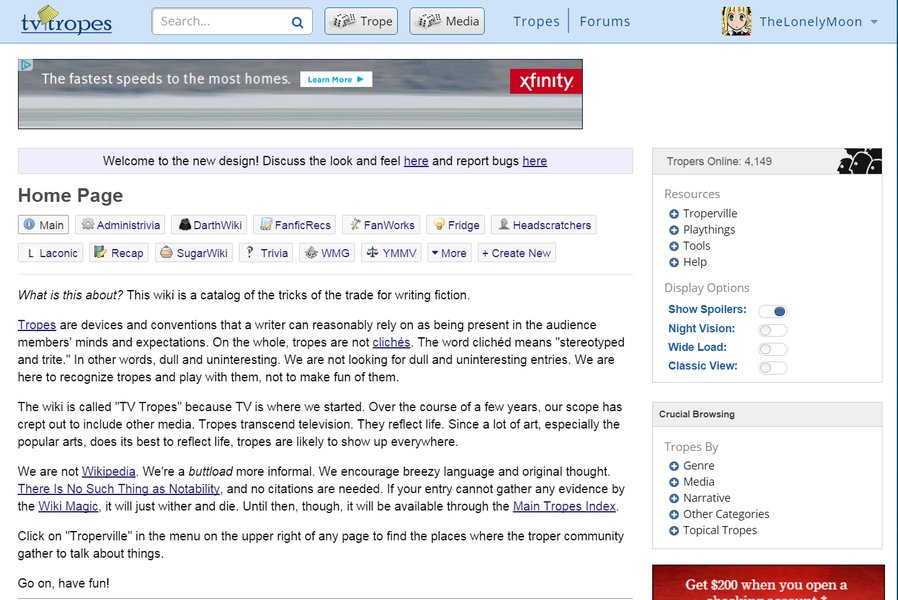
A glimpse of the TV Tropes website, showcasing its characteristic interlinked format.
The Core Issue: Why Factual Reliability is Limited
Understanding the Weaknesses of an Open Wiki
The primary reason TV Tropes is considered unreliable for factual information stems directly from its operational model. Several factors contribute to this assessment:
Open Editability and Lack of Rigorous Verification
Perhaps the most significant factor is that anyone can edit TV Tropes pages without needing to provide citations, verifiable sources, or possess specific expertise. Unlike more formally moderated wikis or academic resources, TV Tropes does not typically enforce stringent fact-checking or source verification processes. This openness allows for rapid content generation but means inaccuracies, personal interpretations, and unsubstantiated claims can easily be introduced and perpetuated.
Prevalence of "Headcanons" and Subjectivity
"Headcanons," or personal fan theories and interpretations presented as established fact, are a common issue. The site's conversational and often humorous tone can blur the lines between objective analysis and subjective opinion or speculation. While engaging, this makes it difficult to distinguish verified information from enthusiastic fan contributions.
Lack of Accountability
The anonymous or pseudonymous nature of contributions, coupled with the absence of a robust peer-review system, means there's little accountability for the accuracy of the information presented. This contrasts sharply with academic publications or even more rigorously curated encyclopedias like Wikipedia, which, despite its own challenges, has stricter sourcing policies.
Focus on Entertainment over Factual Precision
TV Tropes primarily serves as a platform for pop-culture commentary and entertainment. While it can be incredibly insightful for understanding *how* stories work, its priority is not necessarily to be a definitive repository of factual details about those stories or the real-world subjects they might touch upon.
Where TV Tropes Shines: Its Strengths and Appropriate Uses
Leveraging TV Tropes Effectively
Despite its limitations in factual reliability, TV Tropes offers considerable value in specific contexts:
Identifying and Understanding Storytelling Patterns
This is the site's core strength. It is an unparalleled resource for learning about the vast array of tropes, their common applications, variations, subversions, and deconstructions. For anyone interested in narrative structure, character archetypes, and plot devices, TV Tropes provides a rich, if informal, education.
Creative Writing and Worldbuilding Aid
Writers, game designers, and other creators often find TV Tropes invaluable. It can be used to:
- Brainstorm ideas for plots, characters, and settings.
- Understand common conventions within a genre to either utilize, avoid, or subvert them.
- Explore how particular tropes have been received or perceived by audiences.
- Gain inspiration by seeing how tropes are used across diverse media.
Pop-Culture Exploration and Casual Reference
For fans and casual readers, TV Tropes can be an engaging and entertaining way to explore the mechanics of their favorite shows, movies, books, and games. It facilitates a deeper appreciation for the craft of storytelling by highlighting recurring patterns and creative choices.
A Starting Point for Deeper Inquiry
While not a reliable end-source for facts, TV Tropes can sometimes serve as a starting point for research. If a particular claim or trope example piques interest, users can then seek out primary sources or more authoritative secondary sources to verify the information.
Visualizing TV Tropes' Utility
A Comparative Look at its Strengths and Weaknesses
To better understand the specific areas where TV Tropes excels and where it falls short, particularly in comparison to more formal resources, the following chart provides a visual representation. The scores are based on a consensus from user experiences and critical evaluations, rated on a scale where higher values indicate greater strength in that aspect.
This chart highlights that while TV Tropes scores very low on 'Factual Accuracy' and 'Academic Reliability,' it ranks highly for 'Entertainment Value,' 'Creative Inspiration,' and especially for 'Understanding Tropes.' 'Content Neutrality' is moderate, reflecting the potential for subjective interpretations and "headcanons" to influence content. This contrasts with a typical peer-reviewed journal, which would score highly on accuracy and academic reliability but lower on entertainment or direct creative inspiration for fiction.
The TV Tropes Landscape: A Mindmap Overview
Key Characteristics and Considerations
The following mindmap provides a conceptual overview of TV Tropes, summarizing its main attributes, areas of concern regarding reliability, and its notable strengths. This visual aid helps to quickly grasp the multifaceted nature of the website.
This mindmap illustrates the balance: while the "Concerns" branch highlights significant issues with factual reliability rooted in its open structure, the "Strengths" branch shows its considerable utility for creative and analytical purposes related to storytelling itself. The "Nature of Content" and "External Assessments" provide further context on how TV Tropes operates and is perceived.
Expert Perspectives and User Experiences
What Critics and the Community Say
Media Bias/Fact Check rates TV Tropes as "Least Biased" concerning political content, largely because it rarely engages in political reporting. However, the same source gives it a "Mixed" rating for factual reporting, citing the lack of consistent sourcing and the prevalence of subjective opinions. This distinction is crucial: low political bias does not equate to high factual accuracy.
Academics and critical analysts sometimes caution that while TV Tropes can be insightful, its tendency to break down complex narratives into lists of tropes can sometimes lead to oversimplification or a reductionist view of art, potentially stripping stories of their unique context and nuanced meanings. Nevertheless, many acknowledge its value as a unique "archaeology of storytelling."
User communities on platforms like Reddit and Quora generally echo this sentiment. Discussions often highlight that while TV Tropes is a fun and useful tool for understanding tropes or finding examples, it should not be trusted for specific plot details, character information, or any factual data without independent verification. Many users share anecdotes of encountering inaccuracies or unsourced "fan theories" presented as canonical information.
Guidance for Using TV Tropes
Best Practices for Navigation
The table below summarizes the reliability of TV Tropes for different use cases and provides recommendations for how to approach the site depending on your needs.
| Use Case | Reliability Level | Recommendation |
|---|---|---|
| Academic Research / Citations | Very Low | Avoid using as a primary or secondary source. Information should be independently verified from scholarly sources. TV Tropes itself often describes itself as a tertiary source. |
| Verifying Factual Details (e.g., plot points, character specifics) | Low to Mixed | Highly unreliable. Always cross-reference with primary media or reputable secondary sources. Prone to errors and headcanons. |
| Creative Writing & Brainstorming (e.g., for authors, game developers) | High | Excellent resource for understanding narrative conventions, finding inspiration, and exploring how tropes are used, subverted, or combined. |
| Understanding General Storytelling Patterns & Tropes | Very High | Its primary strength. Ideal for exploring the catalog of common narrative devices and archetypes across various media. |
| Casual Browsing & Entertainment for Media Enthusiasts | High | Very engaging and often humorous for those interested in pop culture and the mechanics of storytelling. A "wiki walk" through TV Tropes can be very entertaining. |
| Discovering New Media | Moderate | Can lead to discovering new works through examples of tropes, but be aware that descriptions may not always be accurate or complete. |
Insights from Creators on TV Tropes
How Writers View and Use Narrative Conventions
The discussion around tropes is not just academic; it's highly relevant to creators. This video features two professional writers discussing TV Tropes and how understanding these narrative conventions can impact writing and creativity. It offers a perspective on how awareness of tropes can be a tool for writers, aligning with one of the key positive uses of the TV Tropes website.
Professional writers discuss the role and utility of TV Tropes in the creative process.
This perspective underscores that while TV Tropes might not be a bastion of factual accuracy, its compilation of narrative devices serves as a significant resource for those actively involved in crafting stories. Understanding these patterns can help writers make more conscious decisions in their work, whether by adhering to established conventions, subverting them for effect, or finding fresh ways to combine them.
Frequently Asked Questions (FAQ)
Is TV Tropes completely useless for information?
No, not completely. While it's unreliable for specific factual details about media or real-world topics, it's highly valuable for understanding and identifying storytelling tropes, narrative patterns, and character archetypes. It's a great tool for creative inspiration and pop culture analysis, provided you don't take every assertion as verified fact.
Why is TV Tropes considered "Least Biased" by some if it's unreliable?
The "Least Biased" rating, for example from Media Bias/Fact Check, typically refers to political bias. TV Tropes primarily deals with fiction and storytelling conventions and rarely covers political news. Therefore, it exhibits minimal overt political leaning. This rating does not reflect its factual accuracy or neutrality in presenting information about media, which can be subjective and unverified.
What are "headcanons" and why are they an issue on TV Tropes?
"Headcanon" refers to a fan's personal interpretation, belief, or theory about a fictional universe that is not explicitly confirmed by the original source material. On TV Tropes, these personal interpretations can sometimes be written into articles as if they are established facts or widely accepted analyses. This contributes to the site's unreliability for factual information, as it blurs the line between canonical content and fan speculation.
Can I cite TV Tropes in academic papers?
Generally, no. TV Tropes is considered a tertiary source at best and lacks the rigorous editorial oversight, peer review, and verifiable sourcing required for academic citation. Most academic institutions and style guides would not accept TV Tropes as a credible scholarly source. Information should always be traced back to primary or reputable secondary sources for academic work.
How does TV Tropes compare to Wikipedia in terms of reliability?
While both are wikis, Wikipedia generally has stricter policies regarding sourcing and verifiability (e.g., "reliable sources" policies, notability guidelines). TV Tropes has a more informal approach, with less emphasis on citations for individual claims within media analysis. Consequently, while Wikipedia itself is not always considered a primary academic source, it often maintains higher standards for factual accuracy and verifiability compared to TV Tropes, especially for non-media topics. TV Tropes is more specialized in its focus on narrative conventions and often prioritizes comprehensive cataloging of tropes over strict factual validation of every example or interpretation.
Recommended Further Exploration
Delve Deeper into Related Topics
- How can writers effectively use TV Tropes for storytelling?
- What are the main differences in reliability between TV Tropes and Wikipedia?
- Explore examples of common storytelling tropes and their impact on narratives.
- What are the best alternative resources for reliable media analysis and criticism?
References
Sources Used for This Analysis
Last updated May 10, 2025