
Unveiling the Invisible: A Deep Dive into Ultraviolet Radiation's Wavelengths and Types
Explore the fascinating world of UV light, from its atmospheric dance to its profound impact on life and technology.
Key Insights into Ultraviolet Radiation
- Electromagnetic Spectrum Positioning: Ultraviolet (UV) radiation occupies a unique segment of the electromagnetic spectrum, characterized by wavelengths shorter than visible light but longer than X-rays, typically ranging from 10 to 400 nanometers (nm).
- Tripartite Classification: UV radiation is primarily categorized into three distinct types—UVA, UVB, and UVC—each defined by specific wavelength ranges, energy levels, and penetration capabilities, influencing their biological effects and atmospheric interactions.
- Diverse Sources and Applications: While the Sun is the primary natural source of UV radiation, human-made sources such as germicidal lamps and tanning beds leverage specific UV types for applications ranging from sterilization and medical treatments to industrial curing, underscoring both their utility and potential risks.
Ultraviolet (UV) radiation is an invisible form of electromagnetic radiation, residing just beyond the violet end of the visible light spectrum. It is a critical component of the energy emitted by the Sun and has a wide array of applications and effects, depending on its specific wavelength. The complete UV spectrum spans a broad range, generally considered to be from 10 nanometers (nm) to 400 nm. Within this range, UV radiation is further categorized into distinct types, primarily based on their wavelengths, which dictate their energy, penetration depth, and biological impact.
Decoding the Ultraviolet Spectrum: Wavelengths and Energy
The UV spectrum is a fascinating area of physics, where subtle differences in wavelength lead to significant variations in energy and interaction with matter. The relationship between wavelength and energy is inverse: shorter wavelengths correspond to higher energy photons, which are generally more damaging to biological systems. This principle underpins the classification of UV radiation into its main types.
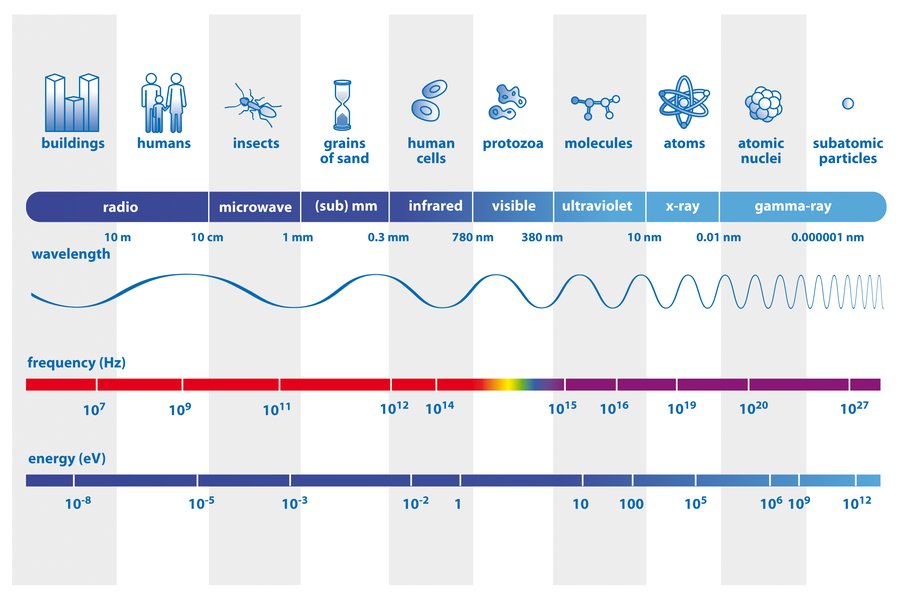
An illustration of the electromagnetic spectrum, highlighting the position of ultraviolet radiation relative to visible light and X-rays.
The entire electromagnetic spectrum, including UV, is characterized by waves that travel at the speed of light. The wavelength (\(\lambda\)) of UV radiation, measured in nanometers (nm), determines its frequency (\(\nu\)) and photon energy (\(E\)). The fundamental relationship is given by:
\[E = h\nu = \frac{hc}{\lambda}\]Where:
- \(E\) is the photon energy.
- \(h\) is Planck's constant (\(6.626 \times 10^{-34}\) J·s).
- \(c\) is the speed of light in a vacuum (\(3.00 \times 10^8\) m/s).
- \(\lambda\) is the wavelength in meters.
- \(\nu\) is the frequency in Hertz.
This formula demonstrates why shorter wavelengths, like those found in UVC, carry significantly more energy per photon, explaining their greater biological impact compared to longer UV wavelengths.
The Triad of UV: UVA, UVB, and UVC
The most common and impactful classification divides UV radiation into three primary categories: UVA, UVB, and UVC. Each category possesses distinct wavelength ranges, atmospheric behavior, and effects on living organisms and materials.
UVA: The Silent Penetrator (315-400 nm)
Characteristics and Atmospheric Behavior
UVA radiation has the longest wavelengths within the UV spectrum, typically ranging from 315 nm to 400 nm. This longer wavelength means it carries the least energy among the three UV types. A crucial characteristic of UVA is its ability to penetrate deeper into the skin layers compared to UVB. Importantly, nearly all UVA radiation from the Sun reaches the Earth's surface, as it is not significantly absorbed by the ozone layer or other atmospheric components. This makes UVA exposure relatively constant throughout the year, capable of penetrating clouds and even glass.
Biological and Material Effects
UVA is primarily responsible for the immediate tanning effect of sun exposure. However, its deeper penetration leads to significant contributions to premature skin aging, characterized by wrinkles, loss of skin elasticity, and the appearance of "liver spots." It can also damage collagen and elastin fibers in the skin. While less directly associated with sunburn than UVB, UVA still plays a role in the development of skin cancer, particularly basal- and squamous-cell carcinomas, and contributes to melanoma risk. In artificial applications, UVA is used in tanning beds and for curing certain resins and inks.
UVB: The Sunburn Inducer (280-315 nm)
Characteristics and Atmospheric Behavior
UVB radiation has shorter wavelengths than UVA, generally ranging from 280 nm to 315 nm, meaning it carries more energy. Unlike UVA, a substantial portion of UVB radiation is absorbed by the Earth's atmosphere, particularly by the ozone layer, water vapor, and carbon dioxide. Despite this absorption, enough UVB reaches the surface to cause noticeable biological effects. The intensity of UVB exposure varies significantly with factors such as time of day, season, altitude, and geographic location.
Biological and Material Effects
UVB rays are the primary culprits behind sunburn and delayed tanning. They are highly biologically active and primarily affect the superficial layers of the skin, causing direct DNA damage. This makes UVB a major contributor to the development of all types of skin cancers, including melanoma. On a positive note, UVB is essential for the natural synthesis of vitamin D in the skin, which is vital for bone health and calcium absorption. Artificial sources of UVB include certain germicidal lamps and phototherapy lamps used to treat skin conditions like psoriasis.
The radar chart above visually represents the comparative characteristics of UVA, UVB, and UVC radiation, highlighting their distinct roles and impacts. This chart provides an intuitive understanding of how each UV type ranks across key parameters such as penetration depth, energy level, atmospheric absorption, germicidal efficacy, and contribution to skin aging and cancer risk. Notice how UVC, with its high energy and almost complete atmospheric absorption, contrasts sharply with UVA, which readily penetrates the atmosphere and skin despite having lower energy per photon.
UVC: The Germicidal Guardian (100-280 nm)
Characteristics and Atmospheric Behavior
UVC radiation possesses the shortest wavelengths and the highest energy within the UV spectrum, ranging from 100 nm to 280 nm. Due to its extreme energy, UVC is exceptionally dangerous to living organisms. However, virtually all UVC radiation from the Sun is completely absorbed by the Earth's ozone layer and atmosphere before it can reach the planet's surface. This natural filtration mechanism is crucial for life on Earth.
Biological and Material Effects
While natural UVC doesn't pose a threat at ground level, artificial UVC sources are highly significant. UVC is known for its potent germicidal properties, meaning it can effectively inactivate bacteria, viruses, and other microorganisms by damaging their DNA and RNA, preventing them from reproducing. This makes artificial UVC lamps invaluable for sterilization and disinfection in various settings, such as water purification systems, air filtration in HVAC units, and surface disinfection in hospitals. Direct exposure to artificial UVC can cause severe burns to the skin and serious eye injuries, underscoring the necessity for strict safety precautions when using such sources.
Beyond the ABCs: Other UV Classifications and Applications
Beyond the primary UVA, UVB, and UVC categories, scientific and industrial applications often necessitate further subdivisions of the UV spectrum.
Specialized UV Ranges
- Near Ultraviolet (NUV): Typically ranges from 300 nm to 400 nm, largely overlapping with UVA.
- Middle Ultraviolet (MUV): Ranges from 200 nm to 300 nm, encompassing UVB and part of UVC.
- Far Ultraviolet (FUV): Ranges from 10 nm to 200 nm, overlapping significantly with UVC and extending into the Vacuum Ultraviolet. This range is particularly noted for strong germicidal effects, especially between 207-222 nm.
- Vacuum Ultraviolet (VUV): Generally defined as wavelengths between 10 nm and 200 nm. VUV is strongly absorbed by air, hence requiring vacuum conditions for study or application.
- Extreme Ultraviolet (EUV): Spans from approximately 10 nm to 121 nm (or even shorter, down to a few nanometers), bordering the X-ray spectrum. EUV has very high energy and is used in advanced applications like semiconductor lithography.
The Multifaceted Applications of UV Radiation
UV radiation, despite its potential hazards, is a powerful tool across numerous fields:
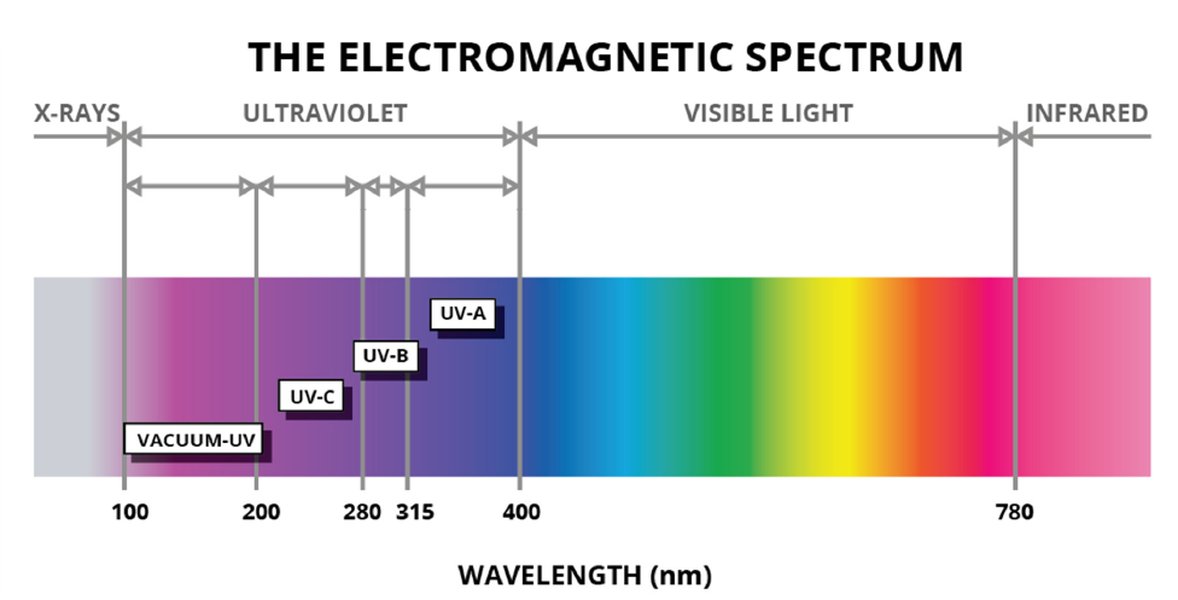
A visual representation of the UV spectrum with associated common applications.
For a deeper understanding of the various applications of UV light, consider the following visual explanation:
This video, titled "UV, What is Ultraviolet?", provides an excellent overview of the practical applications of UV lights in everyday life. It explains how UV technology is integrated into various sectors, from health and safety to industrial processes, offering a dynamic perspective on its real-world utility.
- Sterilization and Disinfection: UVC's germicidal properties are exploited in water purification, air disinfection systems, and surface sterilization in medical and food industries.
- Medical and Dental Treatments: UVB phototherapy is used for skin conditions like psoriasis. UVA is employed in dental curing lights and specialized medical diagnostics.
- Industrial Curing: UV light rapidly cures inks, coatings, and adhesives in manufacturing processes, offering efficiency and environmental benefits.
- Forensics and Authentication: UVA lamps are used to detect counterfeit currency, analyze bodily fluids at crime scenes, and verify documents, due to their ability to induce fluorescence in certain materials.
- Scientific Research: UV spectroscopy is a fundamental analytical technique in chemistry and biology, used to identify substances and study molecular structures.
Comparative Overview of UV Types
To summarize the key distinctions and characteristics of the primary UV types, the following table provides a comprehensive overview of their wavelength ranges, typical sources, atmospheric interaction, and significant effects.
| UV Type | Wavelength Range (nm) | Primary Sources | Atmospheric Absorption | Key Effects & Uses |
|---|---|---|---|---|
| UVA | 315 – 400 | Sunlight, tanning beds, blacklights | Almost none; reaches Earth's surface entirely | Skin aging (photoaging), wrinkles, tanning, contributes to skin cancer; used in curing and forensics. |
| UVB | 280 – 315 | Sunlight, some germicidal lamps | Partially absorbed by ozone layer; some reaches surface | Sunburn, DNA damage, major cause of skin cancer; essential for Vitamin D synthesis; used in phototherapy. |
| UVC | 100 – 280 | Artificial germicidal lamps, welding torches | Completely absorbed by ozone layer and atmosphere | Extremely harmful to life; strong germicidal properties (sterilization, disinfection); does not reach Earth naturally. |
Understanding UV Interaction: A Mindmap
The mindmap below illustrates the interconnected concepts surrounding UV radiation, from its fundamental classification to its diverse effects and applications. It provides a structured visual representation of how different aspects of UV radiation relate to one another, offering a holistic perspective on the topic.
Frequently Asked Questions (FAQ)
What is the overall wavelength range of ultraviolet radiation?
How does the ozone layer affect different types of UV radiation?
Are there any beneficial effects of UV radiation?
Why is UVC dangerous if it doesn't reach the Earth's surface naturally?
Conclusion
Ultraviolet radiation, an invisible force within the electromagnetic spectrum, profoundly impacts our world. Its classification into UVA, UVB, and UVC, alongside more specialized categories, is not merely an academic exercise but a critical framework for understanding its diverse effects. From the skin-aging properties of UVA to the vitamin D-producing and sunburn-inducing power of UVB, and the potent germicidal capabilities of artificial UVC, each type plays a distinct role. While sunlight remains the primary natural source, human ingenuity has harnessed UV for myriad applications in medicine, industry, and public health. This comprehensive understanding of UV wavelengths and types is essential for both leveraging its benefits and mitigating its risks, fostering a more informed and protected interaction with this powerful form of energy.
Recommended Further Exploration
- How does UV radiation affect human health?
- What are the industrial applications of UV light?
- The role of the ozone layer in filtering UV radiation
- Technologies for UV radiation detection and measurement