
Unlock the Mystery: What Time Is It *Really* Around the World?
Discover why asking "What time is it?" is more complex than it seems and how to find the precise time anywhere.
Understanding the current time isn't always straightforward. It depends heavily on where you are in the world due to the system of time zones and adjustments like Daylight Saving Time (DST). While I can't provide the *exact* real-time second for your specific location without knowing it, I can guide you through how time is determined globally and point you to resources for the most accurate information.
Key Insights into Global Timekeeping
- Time is Location-Dependent: The primary factor determining the current time is your geographical location, specifically your time zone.
- Atomic Clocks Ensure Accuracy: The most reliable time sources are synchronized with atomic clocks, the world's most precise timekeeping devices.
- Daylight Saving Time Matters: Many regions adjust their clocks seasonally for Daylight Saving Time (DST), impacting the local time and its offset from Coordinated Universal Time (UTC).
Why Does Time Vary Across the Globe?
The Earth rotates on its axis, meaning different parts of the planet experience sunrise, noon, and sunset at different moments. To standardize timekeeping across regions, the world is divided into time zones.
The Role of Time Zones
Time zones are geographical regions that observe a uniform standard time for legal, commercial, and social purposes. They generally follow the boundaries of countries or their subdivisions.
Understanding UTC
Most time zones are defined by their offset from Coordinated Universal Time (UTC), the primary time standard by which the world regulates clocks and time. UTC is based on International Atomic Time (TAI), a highly precise atomic timescale. It doesn't observe Daylight Saving Time.
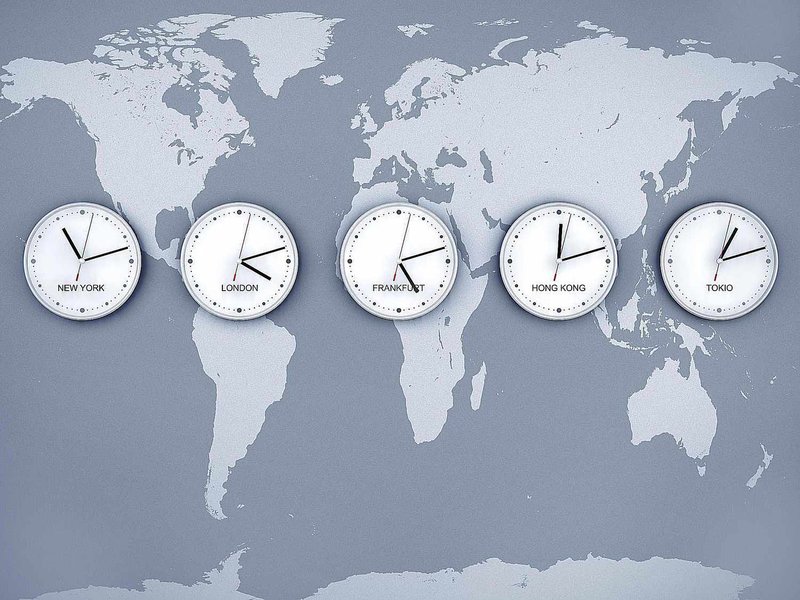
A world map illustrating the different standard time zones across the globe.
Daylight Saving Time (DST) Explained
Daylight Saving Time is the practice of advancing clocks (typically by one hour) during warmer months so that darkness falls at a later clock time. This shifts the standard time offset from UTC.
DST Example
For instance, the Eastern Time Zone in the United States observes Eastern Standard Time (EST), which is UTC-5. However, during DST (from spring to autumn), it observes Eastern Daylight Time (EDT), which is UTC-4. As of today, May 5, 2025, many regions in the Northern Hemisphere, including parts of the US and Europe, are currently observing DST.
Clocks are adjusted forward for Daylight Saving Time in many regions.
Visualizing Time Concepts
To better grasp the interconnected ideas around timekeeping, here's a mindmap illustrating the key concepts:
This mindmap shows how concepts like Time Zones, UTC, Atomic Clocks, and DST all relate to determining the Local Time somewhere in the world.
Comparing Timekeeping Resources
Various online services provide current time information. They differ slightly in features, accuracy presentation, and global coverage. The radar chart below compares key aspects of leading timekeeping websites based on general features often found on such platforms.
This chart highlights that while most reputable sites offer high accuracy and DST information, they may vary in global reach, ease of use, and additional tools like time zone converters or meeting planners.
Finding the Exact Time Right Now
Since the time constantly changes and depends on your location, the best way to know the precise current time is to use a reliable online source synchronized with atomic clocks. Here's a table showing *example* times in major world cities based on a hypothetical moment on May 5, 2025, to illustrate the differences:
| City | Time Zone Abbreviation | UTC Offset | Example Time (Illustrative) | Notes |
|---|---|---|---|---|
| New York, USA | EDT | UTC-4 | 04:00 PM | Currently observing Daylight Saving Time. |
| Los Angeles, USA | PDT | UTC-7 | 01:00 PM | Currently observing Daylight Saving Time. |
| Chicago, USA | CDT | UTC-5 | 03:00 PM | Currently observing Daylight Saving Time. |
| London, UK | BST | UTC+1 | 09:00 PM | Currently observing British Summer Time (DST). |
| Paris, France | CEST | UTC+2 | 10:00 PM | Currently observing Central European Summer Time (DST). |
| Tokyo, Japan | JST | UTC+9 | 05:00 AM (May 6th) | Does not observe Daylight Saving Time. |
| Beijing, China | CST | UTC+8 | 04:00 AM (May 6th) | China uses a single time zone. |
Note: The times listed above are purely illustrative examples for May 5, 2025, and do not represent the live current time.
Recommended Timekeeping Websites
For the exact, up-to-the-second time in your location or any other place worldwide, please consult one of these reliable resources:
- Time.is: Provides highly accurate atomic clock time for over 7 million locations worldwide.
- TimeandDate.com: Offers current local times, time zone information, DST details, calendars, and astronomical data.
- Time.gov: The official U.S. time provided by the National Institute of Standards and Technology (NIST) and U.S. Naval Observatory (USNO).
- WorldTimeBuddy.com: A convenient tool for comparing multiple time zones, often used for scheduling international meetings.
- TheTimeNow.com: Displays real-time local times for cities across the globe.
- RapidTables Current Time Tool: A simple interface for getting the current time in selected locations.
- vClock.com: Shows the exact time in your region and allows customization for major cities.
Frequently Asked Questions (FAQ)
Why can't you tell me the exact current time?
As an AI, I don't have built-in access to a real-time clock synchronized to the exact second for every possible location. Time is dynamic and location-specific. The best approach is to use one of the recommended timekeeping websites, which are designed specifically for providing precise, real-time information based on atomic clocks and your location or chosen city.
What is UTC?
UTC stands for Coordinated Universal Time. It's the global time standard derived from atomic clocks. Time zones around the world are expressed as positive or negative offsets from UTC (e.g., UTC-5, UTC+2). It is the successor to Greenwich Mean Time (GMT), although the terms are often used interchangeably in casual contexts. UTC itself does not change with Daylight Saving Time.
How does Daylight Saving Time (DST) affect the time?
During Daylight Saving Time, clocks in participating regions are typically set forward by one hour from their standard time. This changes the local time relative to UTC. For example, a location normally at UTC-5 would shift to UTC-4 during DST. Not all countries or regions observe DST, and those that do start and end it on different dates.
What are atomic clocks?
Atomic clocks are the most accurate timekeeping devices in the world. They measure time based on the vibrations (resonant frequency) of atoms, typically cesium or rubidium. Official time standards like UTC are based on a weighted average of signals from atomic clocks located in laboratories around the globe. Reputable time websites synchronize their displayed time with these highly stable atomic clocks.
Recommended Further Exploration
- Explore the history and methods behind how time zones were established across the world.
- Find out which countries currently practice Daylight Saving Time and their specific start/end dates.
- Learn about the subtle technical differences between Coordinated Universal Time (UTC) and Greenwich Mean Time (GMT).
- Delve into the physics and technology that make atomic clocks the most precise timekeepers available.
References

Last updated May 5, 2025