
Understanding E1 Converters: Bridging Networks and Technologies
Exploring the Functionality, Benefits, and Applications of E1 Converters in Modern Networking
Key Highlights of E1 Converters
- Seamless Bridging: E1 converters facilitate communication between E1 lines and Ethernet networks, ensuring smooth data transmission.
- Extended Distances: By utilizing fiber optic cables, E1 converters significantly extend transmission distances compared to traditional copper wiring.
- Versatile Applications: E1 converters find use in diverse scenarios, including connecting LANs, video monitoring, and integrating legacy telecom equipment with modern IP networks.
What Exactly is an E1 Converter?
An E1 converter is a device designed to bridge the gap between E1 (European standard for digital transmission) lines and Ethernet networks. E1 lines are typically used in digital telecommunications for carrying voice and data, especially in Time Division Multiplexing (TDM) systems. As Ethernet networks have become the dominant technology for local area networks (LANs) and wide area networks (WANs), the need to integrate E1 lines with Ethernet infrastructure has grown.
The E1 converter functions by translating the data from the E1 frame format into Ethernet packets, allowing it to be transmitted over an IP network. Conversely, it can also convert Ethernet packets back into the E1 frame format for transmission over E1 lines. This capability ensures seamless communication between different network types.
Why Use E1 to Ethernet Converters?
E1 to Ethernet converters bridge traditional E1 lines with modern Ethernet networks, enabling seamless communication. Here's a detailed look at the purposes and benefits:
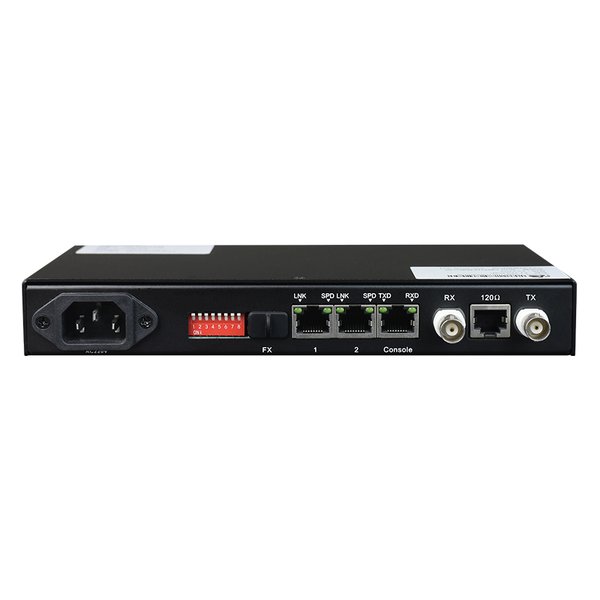
E1 to Ethernet Converter.
Bridging Legacy and Modern Networks
E1 converters allow older telecommunications equipment that relies on E1 lines to communicate with modern Ethernet-based networks. This is particularly useful for organizations that want to upgrade their networks without replacing their entire infrastructure. For example, SFP VoIP E1 converters can be used to reconstruct and upgrade legacy PBX (Private Branch Exchange) systems.
Extending Network Distances
E1 lines have distance limitations due to the nature of copper cabling. By converting E1 signals to fiber optic signals, the transmission distance can be significantly extended. Traditional E1 cabling is limited to 1.46 km, but with fiber optic converters, distances can reach up to 2 km using multimode optics and up to 20 km using single-mode optics.
Efficient Bandwidth Use
E1 converters enable the efficient use of available bandwidth by allowing Ethernet data to be transmitted over existing E1 lines. This is particularly useful for telecom operators who want to utilize their existing TDM network to transport Ethernet data with minimal investment. An E1 line provides a 2.048 Mbps capacity, which can be split into multiple 64 Kbps channels.
Electrical Isolation
E1 to fiber converters provide complete electrical isolation for E1 communications. This is especially beneficial in environments with high electrical noise, ensuring reliable data transmission.
Applications in Wireless Networks
E1 converters play a crucial role in wireless network solutions by converting Ethernet data into the E1 frame format for transmission over existing TDM (E1) links. The data is then converted back to Ethernet at the receiving end.
Different Types of E1 Converters
E1 converters come in various types, each designed to meet specific needs. Here are some common types:
- E1 to Ethernet Converters: These are the most common type, designed to convert Ethernet packets to E1 frames and vice versa. They facilitate LAN-to-WAN connectivity, enabling high-speed data transmission.
- E1 to Fiber Converters: These converters extend the transmission distance of E1 signals by converting them to optical signals. They are ideal for connecting distant networks.
- E1 to V.35 Converters: These converters provide conversion between the ITU-T G.703 standard E1 interface and the standard V.35 interface, which is used for connecting to routers, DDNs, and multiplexers.
- E1 TDM over IP Converters: These are used to transmit E1 signals over an IP network, employing TDM over IP (TDMoIP) technology.
Key Features and Functionality
Modern E1 converters come equipped with a range of features to ensure optimal performance and ease of use. Some of the key features include:
- Framed and Unframed Support: E1 converters support both framed and unframed E1 modes, providing flexibility for different applications.
- Data Rate: They support an E1 data rate of 2.048 Mbps.
- Impedance Options: E1 interfaces support both 75ohm & 120ohm impedance. Some converters support adaptive impedance, eliminating the need for manual configuration.
- Multiple Ethernet Ports: Some converters come with multiple Ethernet ports and support port isolation and VLANs via GUI NMS (Network Management System).
- Management Interfaces: E1 converters often provide both console (CLI) and web management interfaces, making them easy to install and manage.
- Built-in Loop Test Function: This feature provides convenience for project commissioning and routine maintenance.
Applications of E1 Converters
E1 converters are used in a variety of applications across different industries. Here are some notable examples:
- Connecting LANs over E1 Links: E1 converters can bridge two Ethernet LANs over existing E1-based telecom networks. This allows organizations to utilize their existing infrastructure for data transmission.
- PBX Systems: E1 converters are used in the reconstruction and upgrade of legacy PBX systems, enabling them to support modern VoIP (Voice over IP) technology.
- Video Monitoring: E1 to V.35 converters are used in video monitoring systems, connecting video equipment over wide area networks (WANs).
- Internet Access and LAN-to-LAN Services: E1 to Ethernet converters are an excellent choice for providing internet access and LAN-to-LAN services.
- Extending Demarcation Points: T1/E1 media converters extend the demarcation point between service providers and networking equipment, providing a cost-effective solution for extending telecom services.
- Digital Radio Linking: E1 converters facilitate digital radio linking over T1/E1 networks, enabling reliable communication in various scenarios.
Technical Specifications
When selecting an E1 converter, it's important to consider the technical specifications to ensure it meets your requirements. Here's a table outlining some common specifications:
| Feature | Specification |
|---|---|
| E1 Data Rate | 2.048 Mbps |
| Ethernet Interface | 10/100Base-T |
| E1 Impedance | 75 Ohm / 120 Ohm (Adaptive options available) |
| E1 Standards Compliance | ITU-T G.703 |
| Management | CLI, Web Interface |
| Power Supply | AC 220V / DC -48V |
| Operating Temperature | -10°C to 50°C |
E1 to Fiber Conversion
Converting E1 signals to fiber optic cables offers several advantages, especially for extending network distances and ensuring signal integrity.
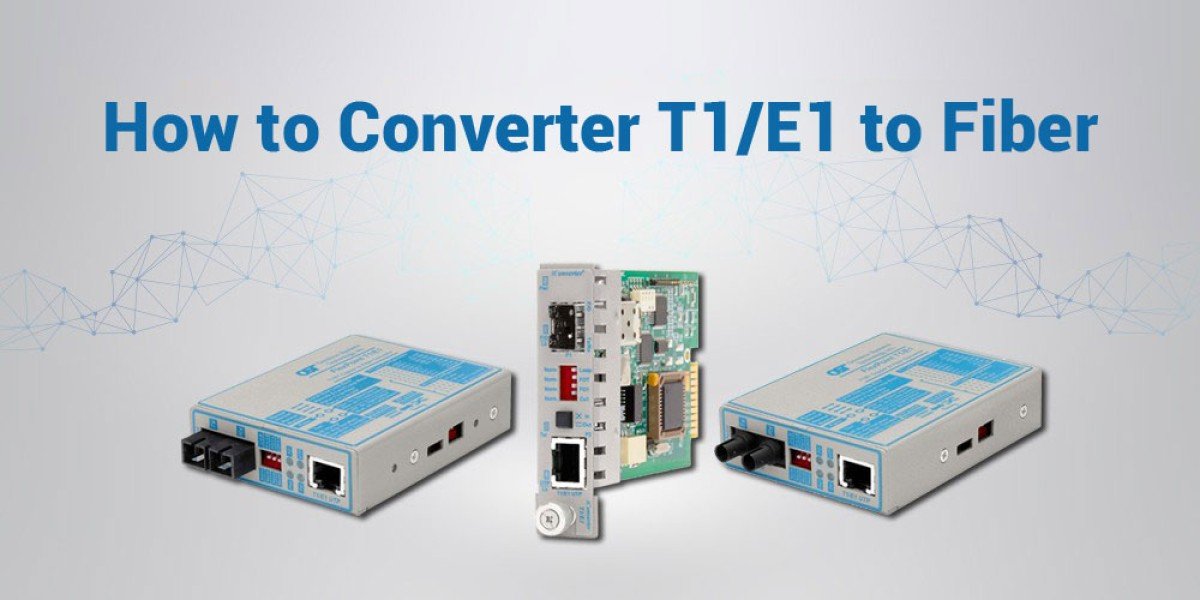
E1 to Fiber Conversion.
Benefits of Fiber Optic Conversion
- Extended Distance: Fiber optic cables allow for much longer transmission distances compared to copper cables. Multimode fiber can extend the distance to 2km, while single-mode fiber can extend it to 20km or more.
- Electrical Isolation: Fiber optic cables provide complete electrical isolation, protecting equipment from electrical noise and interference.
- High Bandwidth: Fiber optic cables support higher bandwidth, ensuring reliable data transmission even over long distances.
Components Used in E1 to Fiber Conversion
-
E1 to Fiber Converter: This device converts the electrical E1 signal into an optical signal for transmission over fiber.
-
Fiber Optic Cables: These cables transmit the optical signal over long distances.
-
SFP Modules: Small Form-factor Pluggable (SFP) modules provide flexibility in selecting the appropriate type of fiber connection (singlemode, multimode, BiDi, CWDM).
E1 Converter in Action: Video Demonstration
Here's a video demonstrating an E1 to Ethernet Converter, highlighting its support for both unframed and framed modes. This video provides a visual understanding of how these converters function and their practical applications.
E1 to Ethernet Converter - Ethernet over E1 - AN-E1-ETH Unframed / Framed Support.
FAQ Section
What is the primary function of an E1 to Ethernet converter?
The primary function of an E1 to Ethernet converter is to translate data between E1 lines and Ethernet networks, enabling seamless communication between devices using different communication standards.
What are the benefits of using fiber optic cables with E1 converters?
Using fiber optic cables extends transmission distances, provides electrical isolation, and supports higher bandwidth compared to traditional copper cables.
Can E1 converters be used in wireless networks?
Yes, E1 converters can be used in wireless networks to convert Ethernet data into E1 frame format for transmission over TDM links.
What is TDM over IP (TDMoIP) and how does it relate to E1 converters?
TDMoIP is a technology used to transmit TDM signals, such as E1, over an IP network. E1 converters that support TDMoIP encapsulate E1 data into IP packets for transmission over Ethernet networks.
What are some common applications of E1 converters?
Common applications include connecting LANs over E1 links, upgrading legacy PBX systems, video monitoring, and providing internet access and LAN-to-LAN services.
References
Last updated April 14, 2025