
Unlocking Your Inner World: The Transformative Principles of the Enneagram
Embark on a journey of self-discovery and harness the Enneagram's wisdom for profound personal growth and enhanced relationships.
Key Insights: Understanding Enneagram Principles
- Core Motivations Unveiled: The Enneagram helps identify the fundamental desires and fears that subconsciously drive your thoughts, feelings, and actions, offering a path to greater self-awareness.
- Pathways to Growth: By understanding your Enneagram type, its wings, and its connections to other types under stress or in growth, you gain a roadmap for personal development and breaking free from habitual patterns.
- Empathy and Connection: Learning about all nine types fosters deeper compassion and understanding for others, leading to more harmonious and authentic relationships.
Delving into the Enneagram: A Journey of Self-Discovery
What is the Enneagram?
The Enneagram is a dynamic and profound system of personality typology that describes nine distinct, interconnected personality types. Far more than a simple categorization, it serves as a powerful tool for self-discovery, personal development, and spiritual growth. The term "Enneagram" comes from the Greek words "ennea" (nine) and "grammos" (something written or drawn), referring to the nine-pointed geometric figure that symbolizes the system. This symbol illustrates the relationships between the types and their paths for growth and stress.
Following the principles of the Enneagram means engaging with this system to understand your core motivations, underlying fears, and the habitual patterns of thinking, feeling, and behaving that shape your experience of the world. It's about recognizing these often unconscious drivers to cultivate greater self-awareness, make more conscious choices, and unlock your potential for transformation.
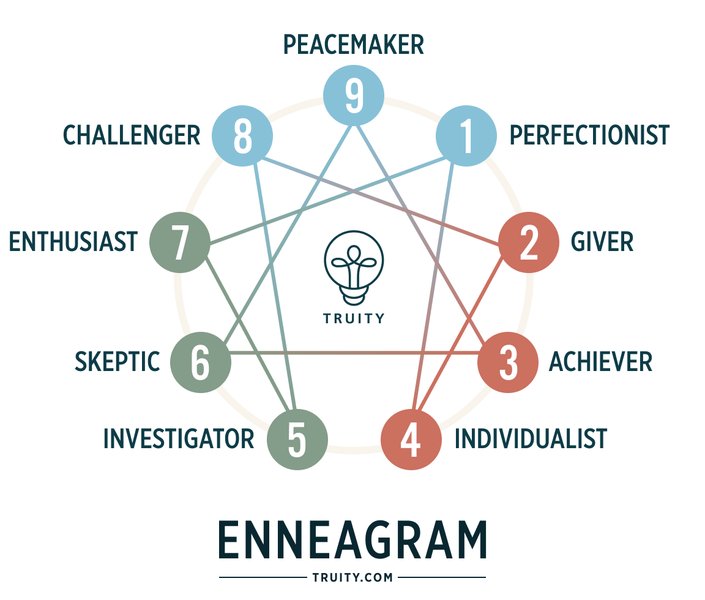
The Enneagram diagram, illustrating the nine types and their connections.
The Guiding Philosophy: Core Motivations and Fears
At the heart of the Enneagram lies the principle that each of the nine types is driven by a specific core emotional motivation (a fundamental desire) and a corresponding core fear. These deep-seated drivers profoundly influence how individuals perceive reality, interact with others, and respond to life's challenges. For instance, one type might be motivated by a need for security, while another is driven by a desire for appreciation. Understanding these core motivations and fears is crucial, as they often operate beneath the surface of conscious awareness, dictating reactions and life choices.
The Nine Pillars: Understanding the Personality Types
The Enneagram delineates nine fundamental personality archetypes. While everyone possesses traits from all nine types, one type is typically dominant, representing an individual's primary lens for viewing the world. Below is a brief overview of each type:
Type 1: The Reformer (or Perfectionist)
Principled, purposeful, self-controlled, and perfectionistic. Ones are motivated by the need to be good, to live up to their high ideals, and to improve themselves and the world around them. Their core fear is being corrupt, evil, or defective. They strive for justice and integrity but can struggle with criticism and rigidity.
Type 2: The Helper (or Giver)
Caring, interpersonal, generous, and people-pleasing. Twos are motivated by the need to be loved and appreciated, expressing this by tending to the needs of others. Their core fear is being unwanted or unworthy of love. They are empathetic and supportive but may struggle with acknowledging their own needs.
Type 3: The Achiever (or Performer)
Success-oriented, adaptable, excelling, and image-conscious. Threes are motivated by the need to be validated and to succeed, distinguishing themselves through accomplishments. Their core fear is being worthless or without inherent value. They are driven and competent but can struggle with workaholism and authenticity.
Type 4: The Individualist (or Romantic)
Expressive, dramatic, self-absorbed, and temperamental. Fours are motivated by the need to express their uniqueness and to experience deep, authentic emotions. Their core fear is having no identity or personal significance. They are creative and introspective but can struggle with melancholy and envy.
Type 5: The Investigator (or Observer)
Analytical, private, insightful, and innovative. Fives are motivated by the need to be capable and competent, seeking knowledge and understanding. Their core fear is being helpless, useless, or incapable. They are perceptive and visionary but can struggle with isolation and emotional detachment.
Type 6: The Loyalist (or Skeptic)
Engaging, responsible, anxious, and suspicious. Sixes are motivated by the need for security and support, often anticipating potential problems and seeking reassurance. Their core fear is being without support or guidance. They are committed and prepared but can struggle with anxiety and self-doubt.
Type 7: The Enthusiast (or Epicure)
Spontaneous, versatile, optimistic, and acquisitive. Sevens are motivated by the need to be happy and satisfied, seeking new experiences and avoiding pain. Their core fear is being deprived or trapped in pain. They are fun-loving and imaginative but can struggle with impulsivity and commitment.
Type 8: The Challenger (or Protector)
Self-confident, decisive, willful, and confrontational. Eights are motivated by the need to protect themselves and control their environment, asserting their strength and resisting vulnerability. Their core fear is being harmed or controlled by others. They are powerful and assertive but can struggle with intensity and insensitivity.
Type 9: The Peacemaker (or Mediator)
Receptive, reassuring, agreeable, and complacent. Nines are motivated by the need to maintain inner peace and external harmony, avoiding conflict and tension. Their core fear is loss of connection or fragmentation. They are easygoing and supportive but can struggle with passivity and neglecting their own priorities.
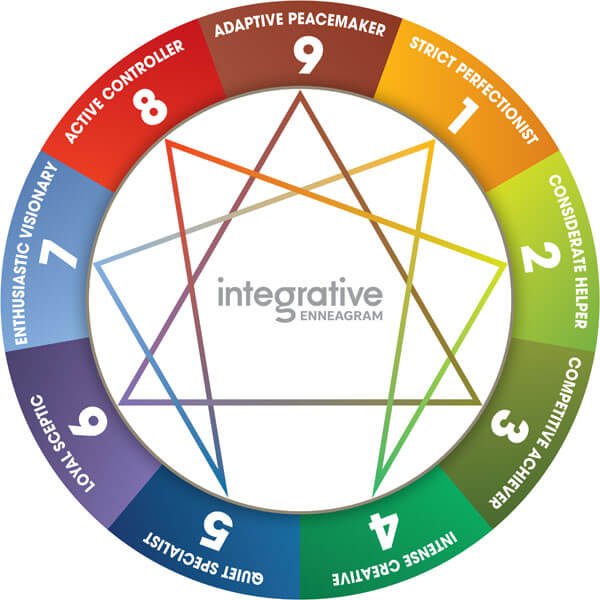
Each Enneagram type offers unique strengths and perspectives.
The Architecture of Personality: Triads, Wings, and Dynamic Paths
The Enneagram's depth extends beyond the nine basic types through several structural elements that reveal further layers of personality and interconnections.
The Centers of Intelligence: The Triads
The nine types are organized into three triads, each associated with a primary center of intelligence and a core emotion:
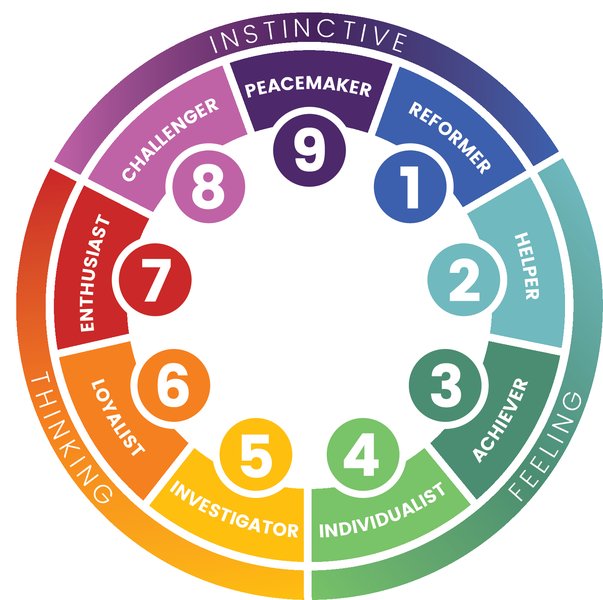
The Enneagram types grouped into Body, Heart, and Head Centers.
The Body Triad (Instinctive Center): Types 8, 9, and 1
These types primarily process the world through instinct and gut feelings. Their core emotion is anger (or rage), which Type 8 expresses outwardly, Type 9 denies or merges, and Type 1 represses or internalizes as resentment. They are concerned with issues of control, autonomy, and right action.The Heart Triad (Feeling Center): Types 2, 3, and 4
These types primarily relate to the world through their emotions and their image. Their core emotion is shame, which Type 2 addresses by focusing on others' needs, Type 3 by achieving success and admiration, and Type 4 by cultivating a unique identity. They are concerned with self-worth, connection, and recognition.The Head Triad (Thinking Center): Types 5, 6, and 7
These types primarily engage with the world through their thoughts and mental processes. Their core emotion is fear, which Type 5 manages by withdrawing and acquiring knowledge, Type 6 by anticipating threats and seeking security, and Type 7 by pursuing positive experiences and avoiding pain. They are concerned with safety, guidance, and future possibilities.
The Nuance of Wings
Each Enneagram type is influenced by the two adjacent types on the circle, known as "wings." While an individual's core type remains dominant, one or both wings can add distinct flavors, nuances, and complexities to their personality. For example, a Type 9 might have an 8-wing (9w8), making them more assertive and action-oriented, or a 1-wing (9w1), making them more principled and orderly. Understanding your wings provides a more personalized and richer picture of your type.
Navigating Growth and Stress: Lines of Connection
The lines within the Enneagram symbol are not arbitrary; they indicate dynamic paths of movement for each type.
- Direction of Integration (Growth): When individuals feel secure and are growing, they tend to take on some of the healthier qualities of the type connected by the arrow pointing *away* from their core type in a specific sequence (1→7→5→8→2→4→1 and 9→3→6→9). For example, a Type 1 moving towards health can integrate the joyful, spontaneous qualities of a healthy Type 7.
- Direction of Disintegration (Stress): Under stress or pressure, individuals may exhibit some of the less healthy characteristics of the type connected by the arrow pointing *towards* their core type (following the reverse sequence of integration). For example, a stressed Type 1 might disintegrate towards the moody, withdrawn aspects of an unhealthy Type 4.
Comparative Enneagram Type Characteristics
To illustrate the diverse approaches of different Enneagram types, the radar chart below compares four selected types across several key personality dimensions. This is a conceptual representation rather than precise data, designed to highlight how core motivations manifest in varied tendencies. For instance, a Type 1 (The Reformer) might score high on 'Desire for Order', while a Type 7 (The Enthusiast) might score higher on 'Spontaneity'. This visualization helps in appreciating the distinct profiles each type presents.
This chart visually represents how different Enneagram types might score on these conceptual dimensions, emphasizing their unique approaches and priorities. Remember, individual expressions of each type can vary greatly.
Visualizing Enneagram Concepts: A Mindmap
The Enneagram is a multifaceted system. This mindmap provides a visual overview of its core components and how they interrelate, offering a bird's-eye view of the principles that guide self-understanding through this framework. It illustrates the central role of the nine types, branching out to key concepts like Triads, Wings, and the dynamic paths of growth and stress.
Core: Anger"] id3_1_2["Heart/Feeling (2,3,4)
Core: Shame"] id3_1_3["Head/Thinking (5,6,7)
Core: Fear"] id3_2["Wings (Adjacent Influences)"] id3_3["Lines of Connection"] id3_3_1["Integration (Growth Path)"] id3_3_2["Disintegration (Stress Path)"] id4["Applications & Goals"] id4_1["Self-Awareness"] id4_2["Personal Growth"] id4_3["Improved Relationships"] id4_4["Emotional Intelligence"] id4_5["Understanding Defense Mechanisms"]
This mindmap encapsulates the journey of "following the principle of Enneagram": starting with identifying a core type, understanding its underlying dynamics, exploring its structural relations within the system, and ultimately applying these insights for personal and interpersonal development.
Practical Application: Living the Enneagram Principles
Understanding the Enneagram is not merely an intellectual exercise; its true value lies in applying its principles to everyday life. This involves:
- Self-Reflection and Awareness: Regularly observe your thoughts, feelings, and behaviors. Try to identify your core Enneagram type by exploring your deepest motivations, fears, and habitual responses. This awareness is the first step toward recognizing unconscious patterns.
- Emotional Intelligence and Regulation: Notice how your Enneagram type influences your emotional reactions and worldview. Understanding your type's emotional habits can help you manage difficult emotions more effectively and respond to situations with greater balance.
- Fostering Personal Growth: Intentionally work toward healthier expressions of your type. Embrace the qualities of your integration point (growth path) and become mindful of triggers that lead to your disintegration point (stress path). This conscious effort can lead to significant personal development.
- Enhancing Interpersonal Relationships: Use your knowledge of the Enneagram to understand the motivations and perspectives of others. This fosters empathy, improves communication, and helps in resolving conflicts more constructively by appreciating different worldviews.
- Understanding Defense Mechanisms: Each type has characteristic defense mechanisms used to cope with anxiety and protect the ego. Recognizing these in yourself allows you to see when you're operating on autopilot and to choose more conscious, healthier responses.
- Mindfulness Practice: Cultivating mindfulness can help you observe your type's automatic reactions without judgment. This creates a space between stimulus and response, allowing for more intentional choices rather than habitual ones.
By integrating these practices, the Enneagram becomes a living tool for transformation, helping individuals move toward greater authenticity, compassion, and wholeness.
Enneagram Types at a Glance: Core Characteristics
The following table provides a concise summary of key characteristics for each of the nine Enneagram types. This can serve as a quick reference to understand the fundamental driving forces, fears, and virtues associated with each type, as well as their placement within the Centers of Intelligence.
| Type Number & Name | Core Desire | Core Fear | Basic Virtue | Basic Vice / Passion | Center of Intelligence |
|---|---|---|---|---|---|
| 1: The Reformer | To be good, to have integrity, to be balanced | Being corrupt, evil, defective | Serenity | Resentment/Anger | Body/Instinctive |
| 2: The Helper | To be loved, to be needed and appreciated | Being unwanted, unworthy of being loved | Humility | Pride | Heart/Feeling |
| 3: The Achiever | To be valuable, to be admired and successful | Being worthless, a failure | Veracity/Authenticity | Deceit | Heart/Feeling |
| 4: The Individualist | To be unique, to find themselves and their significance | Having no identity, being insignificant | Equanimity | Envy | Heart/Feeling |
| 5: The Investigator | To be capable and competent | Being helpless, useless, incapable | Non-Attachment | Avarice | Head/Thinking |
| 6: The Loyalist | To have security and support | Being without support or guidance, unable to survive on their own | Courage | Fear/Anxiety | Head/Thinking |
| 7: The Enthusiast | To be satisfied and content, to have their needs fulfilled | Being deprived, trapped in pain and suffering | Sobriety | Gluttony | Head/Thinking |
| 8: The Challenger | To protect themselves, to determine their own course in life | Being harmed or controlled by others, violation | Innocence | Lust/Excess | Body/Instinctive |
| 9: The Peacemaker | To have inner stability and peace of mind | Loss and separation, fragmentation, conflict | Action | Sloth/Indolence | Body/Instinctive |
This table offers a snapshot, but deeper exploration of each type reveals much more nuance and complexity. It highlights how each type's core desire and fear shape their worldview and behaviors, and how their central vice can be transformed into a virtue through self-awareness and growth.
Visual Introduction: The 9 Enneagram Types Explained
For a dynamic and engaging overview of the Enneagram types, the following video featuring Ian Cron, a well-known Enneagram teacher, provides clear explanations of each of the nine personalities. This visual guide can help solidify understanding of the core characteristics, motivations, and common behaviors associated with each type, making the system more accessible and relatable.
This presentation helps illustrate the distinct worldviews and driving forces behind each Enneagram type. Watching how experts describe these types can offer new perspectives and deepen your appreciation for the diversity of human personality as mapped by the Enneagram.
Frequently Asked Questions (FAQ)
How do I discover my Enneagram type?
Discovering your Enneagram type is a process of self-exploration. While online tests can be a starting point, they are not definitive. The most reliable way is through deep self-reflection, reading detailed descriptions of the types (especially their core motivations and fears), observing your habitual patterns of thought and behavior, and perhaps discussing with trusted individuals or an Enneagram coach. Focus on the "why" behind your actions, not just the actions themselves.
Can my Enneagram type change over time?
Most Enneagram teachers believe that your core Enneagram type is established early in life and does not change. However, how you express your type can change dramatically. Through personal growth and self-awareness, individuals can move towards healthier expressions of their type, integrate positive qualities from their growth point, and become less reactive under stress. So, while the core type remains, your behavior and level of consciousness can evolve significantly.
Is one Enneagram type better or worse than another?
Absolutely not. Each Enneagram type has its own unique set of strengths, talents, potential challenges, and blind spots. No type is inherently better or worse than any other. The Enneagram aims to promote understanding and compassion, recognizing that each type offers a valuable perspective and contributes uniquely to the world. The goal is self-mastery and growth within one's own type, not to become a different type.
How does knowing my Enneagram type help in daily life?
Understanding your Enneagram type can bring profound benefits. It can help you:
- Recognize your automatic reactions and make more conscious choices.
- Understand your core motivations and how they drive your behavior.
- Identify your strengths and leverage them more effectively.
- Become aware of your blind spots and areas for growth.
- Improve communication and empathy in relationships by understanding different perspectives.
- Manage stress more effectively by recognizing your type's stress triggers and patterns.
- Cultivate greater self-compassion and acceptance.
Recommended Explorations
To deepen your understanding of Enneagram principles, consider exploring these related queries:
- How do Enneagram wings influence personality types?
- What are the Enneagram levels of development for each type?
- Exploring Enneagram compatibility in relationships.
- Practical exercises for Enneagram type growth.
References

Last updated May 11, 2025