
Understanding Experimental Error and Its Types
Delving into Systematic, Random, and Gross Errors in Scientific Measurement
In the realm of scientific experimentation and measurement, obtaining perfectly accurate results is an ideal that is rarely, if ever, achieved. The difference between the measured value and the true value is known as experimental error. It's not about making mistakes in the conventional sense, but rather acknowledging the inherent uncertainty in any measurement process. Understanding the different types of experimental errors is crucial for designing better experiments, minimizing inaccuracies, and interpreting results with appropriate confidence.
Key Highlights of Experimental Errors
- Systematic errors are consistent and predictable, leading to measurements that are consistently too high or too low. They affect the accuracy of results.
- Random errors are unpredictable fluctuations that cause measurements to vary randomly around the true value. They affect the precision of results.
- Gross errors (or blunders) are significant mistakes, often due to human oversight or equipment malfunction, leading to large deviations from the true value.
Defining Experimental Error
Experimental error, also known as measurement error or observational error, is the deviation between a measured value and its true or actual value. No measurement is perfect, and some level of error is always present due to various factors. Recognizing and quantifying these errors is a fundamental aspect of scientific practice, allowing researchers to assess the reliability and validity of their findings.
Primary Types of Experimental Errors
Experimental errors are broadly categorized into three main types: systematic errors, random errors, and gross errors. While random and systematic errors are inherent to the measurement process, gross errors are typically avoidable with careful execution and attention to detail.
Systematic Errors
Systematic errors are consistent errors that occur in the same direction each time a measurement is taken. This means that repeated measurements will be consistently higher or lower than the true value, resulting in a predictable bias. Systematic errors directly impact the accuracy of a measurement, which refers to how close the measured value is to the true value. These errors are often difficult to detect by simply repeating the experiment in the same way, as the bias will persist.
Think of a systematic error like a faulty weighing scale that consistently reads 1 kilogram higher than the actual weight. Every item you weigh will appear heavier by the same amount.
Characteristics of Systematic Errors:
- Consistent bias in one direction (always positive or always negative).
- Affects the accuracy of measurements.
- Often arise from identifiable sources.
- Can, in principle, be corrected or minimized once the source is identified.
Identifying and addressing systematic errors is crucial for improving the accuracy of experimental results.
Random Errors
Random errors are unpredictable fluctuations that cause measurements to vary randomly around the true value. Unlike systematic errors, random errors do not have a consistent direction of bias. Repeated measurements will yield slightly different results, scattered around the true value. Random errors primarily impact the precision of a measurement, which refers to the reproducibility of the results. Higher precision means that repeated measurements are in close agreement with each other.
An example of random error could be slight variations in reading a measuring instrument due to small, unpredictable changes in environmental conditions or the observer's position.
Characteristics of Random Errors:
- Unpredictable variations in measurements.
- Measurements are scattered around the true value.
- Affects the precision of measurements.
- Cannot be entirely eliminated but can be reduced by taking multiple measurements and using statistical analysis (like averaging).
Gross Errors (Blunders)
Gross errors, also referred to as blunders or personal errors, are significant mistakes made during an experiment that lead to large deviations from the true value. These are often due to human error, such as misreading an instrument, incorrect calculations, improper experimental setup, or recording data incorrectly. Gross errors are usually easily identifiable as they result in values that are significantly different from other measurements or expected results.
A classic example of a gross error would be spilling part of the sample being weighed or accidentally recording a temperature reading incorrectly.
Characteristics of Gross Errors:
- Large, unpredictable deviations from the true value.
- Usually caused by mistakes or malfunctions.
- Can significantly skew results if not identified and addressed.
- Often avoidable with careful procedures and attention to detail.
While random and systematic errors are inherent to the measurement process, gross errors can and should be minimized through careful experimental technique.
Detailed Exploration of Systematic Error Sources
Systematic errors can arise from various sources within an experiment. Understanding these specific sources is essential for designing experiments that minimize their impact. Systematic errors are often categorized further based on their origin:
Instrumental Errors
Instrumental errors originate from the measuring instruments themselves. These errors are inherent to the design, calibration, or condition of the equipment used in the experiment. If an instrument is not properly calibrated or has a defect, it will consistently provide inaccurate readings.
Sources of instrumental errors include:
- Faulty Calibration: The instrument does not read zero when the quantity being measured is zero (zero error), or the scale factor is incorrect, leading to proportional errors. For example, a thermometer that consistently reads a few degrees higher than the actual temperature.
- Instrument Drift: The instrument's reading changes over time, even when the measured quantity remains constant. This can be due to changes in temperature, voltage supply, or the aging of components.
- Imperfect Instrument Design: Limitations in the instrument's construction can lead to inaccuracies. For instance, friction in mechanical parts or non-linearity in electronic sensors.
Regular calibration and maintenance of instruments are crucial to minimize instrumental errors.
Methodic Errors
Methodic errors, also known as procedural errors or errors in the method, arise from flaws or limitations in the experimental procedure or design. If the method used to conduct the experiment is not appropriate or contains inherent assumptions that are not fully met, it can lead to systematic inaccuracies.
Sources of methodic errors include:
- Simplified Models: Using a theoretical model that does not fully account for all factors influencing the measurement.
- Incomplete Reactions: In chemical experiments, if a reaction does not go to completion, the measured yield or concentration will be systematically lower than the true value.
- Environmental Interference: The experimental environment affects the measurement in a consistent way. For example, air currents affecting sensitive weighing scales or external magnetic fields interfering with electrical measurements.
- Assumptions in the Procedure: The experimental method relies on assumptions that may not be entirely valid under the experimental conditions.
Careful design and validation of the experimental method are essential to reduce methodic errors.
Operational Errors
Operational errors, sometimes referred to as personal errors in some classifications, arise from the limitations or biases of the observer or experimenter. These are consistent errors introduced by the person performing the experiment.
Sources of operational errors include:
- Observational Bias: The experimenter consistently reads an instrument incorrectly due to parallax (viewing the scale from an angle) or a consistent tendency to anticipate a signal.
- Lack of Skill or Experience: An inexperienced experimenter may not handle equipment correctly or follow the procedure precisely, leading to consistent errors.
- Personal Habits: Consistent personal habits, such as consistently reading a burette to the nearest 0.1 mL instead of 0.05 mL, can introduce a systematic error.
Training, attention to detail, and using standardized procedures can help minimize operational errors.
Distinguishing Between Error Types
Understanding the difference between systematic and random errors is fundamental to proper error analysis. The table below summarizes the key distinctions:
| Error Type | Effect on Measurement | Impact on Accuracy/Precision | Nature of Variation | Sources | How to Minimize |
|---|---|---|---|---|---|
| Systematic Error | Consistent deviation in one direction | Affects Accuracy | Predictable bias | Faulty instruments, flawed methods, observer bias | Calibration, method refinement, standardized procedures |
| Random Error | Random fluctuations around the true value | Affects Precision | Unpredictable variation | Environmental fluctuations, limitations of instrument resolution, random variations in observation | Repeated measurements, statistical analysis (averaging) |
| Gross Error | Large, unpredictable deviation | Affects both Accuracy and Precision significantly | Due to mistakes or malfunctions | Human mistakes, equipment failure | Careful procedure, attention to detail, proper equipment maintenance |
It's important to note that in many experiments, both systematic and random errors are present. A well-designed experiment aims to minimize both types of errors as much as possible.
Visualizing Error
Visual representations can help in understanding the difference between accuracy and precision, and how systematic and random errors affect them. Imagine a target:
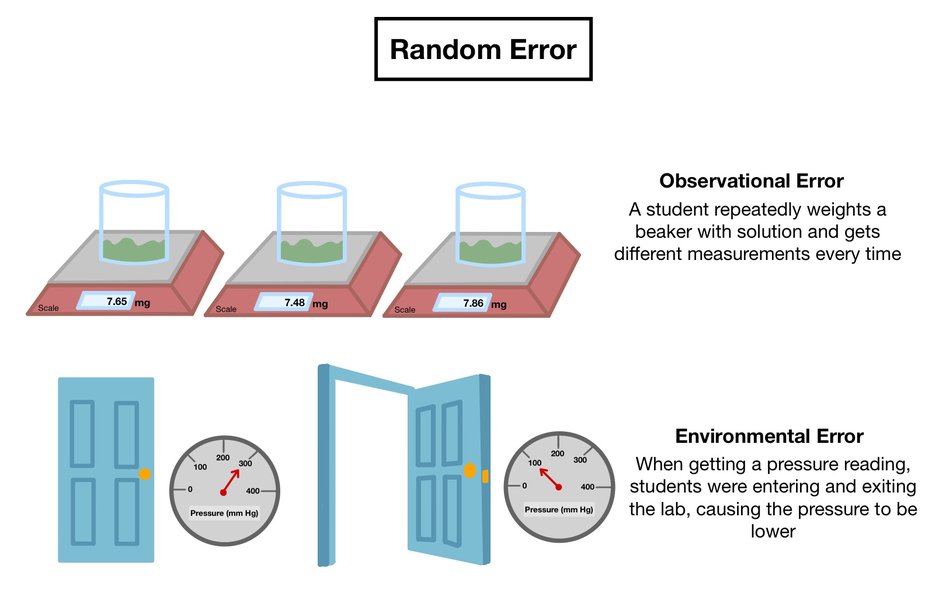
Illustration of Random Error: Shots are scattered around the target center, showing low precision but potentially centered around the true value (good accuracy if averaged).

Illustration of Systematic Error: Shots are clustered together (good precision) but consistently off-center (poor accuracy).

Illustration of Gross Error: Shots are widely scattered, with one or more shots significantly far from the target, indicating significant mistakes.
A good experiment strives for both accuracy (measurements close to the true value, minimizing systematic errors) and precision (measurements close to each other, minimizing random errors).
Practical Examples of Error Sources
Let's consider a simple experiment: measuring the length of an object with a ruler. Potential error sources include:
- Instrumental Error: The ruler's markings are not perfectly accurate or the end of the ruler is worn down, leading to a consistent offset.
- Methodic Error: The object is not perfectly straight, and the procedure doesn't specify exactly where to measure the length, leading to variations depending on where the measurement is taken.
- Operational Error: The observer consistently reads the ruler from an angle, introducing parallax error.
- Random Error: Slight variations in pressure applied to the ruler or the object, or minor fluctuations in the observer's eye position with each measurement.
- Gross Error: Misreading the scale entirely (e.g., reading 15 cm as 51 cm) or starting the measurement from the wrong point on the ruler.
Mitigating Experimental Errors
While completely eliminating experimental errors is impossible, their impact can be significantly reduced through various strategies:
-
Calibration: Regularly calibrate instruments against known standards to minimize instrumental systematic errors.
-
Refining the Method: Carefully design and test the experimental procedure to identify and minimize methodic errors. Use appropriate controls and standards.
-
Training and Standardization: Ensure experimenters are properly trained and follow standardized procedures to reduce operational errors.
-
Repeated Measurements: Take multiple measurements of the same quantity and calculate the average. This helps to reduce the impact of random errors. Statistical analysis can be used to quantify the uncertainty due to random errors.
-
Awareness and Vigilance: Be aware of potential sources of error in the experiment and take steps to minimize them. Double-check readings and procedures to avoid gross errors.
By understanding the different types and sources of experimental errors, scientists can design more robust experiments, obtain more reliable data, and draw more accurate conclusions.
Frequently Asked Questions about Experimental Errors
What is the main difference between systematic and random error?
The main difference lies in their predictability and direction. Systematic errors are consistent and predictable, always biasing measurements in the same direction, affecting accuracy. Random errors are unpredictable fluctuations that cause measurements to vary randomly around the true value, affecting precision.
Can an experiment have both systematic and random errors?
Yes, it is very common for experiments to have both systematic and random errors simultaneously. Every measurement has some inherent randomness, and the instruments and methods used may also introduce systematic biases.
How can I identify systematic errors?
Identifying systematic errors can be challenging. Look for consistent deviations from expected results, compare your results with those obtained using different methods or instruments, or use known standards to check the accuracy of your measurements.
Are gross errors considered a type of experimental error in the same way as systematic and random errors?
Gross errors are often discussed alongside systematic and random errors, but they are fundamentally different. While systematic and random errors are inherent to the measurement process and cannot be fully eliminated, gross errors are typically due to avoidable mistakes or malfunctions. They are more akin to blunders than inherent uncertainties.
References
Last updated May 5, 2025