
Understanding Functions and Multivariable Expressions
Delving into the Notation s(x, y) where x ∈ ℝ and (x, y) ∈ ℝ²
The notation \(s(x, y) : x \in \mathbb{R}, (x, y) \in \mathbb{R}^2\) followed by a vertical arrangement of 'x' and 'y' is a concise way of representing a function and its domain, particularly in the context of multivariable calculus. Let's break down the components to understand its full meaning.
Key Highlights
- Functions establish relationships: A function defines a relationship between an input (or inputs) and a unique output.
- Multivariable functions take multiple inputs: Functions like s(x, y) take more than one independent variable as input, in this case, x and y.
- Domain specifies valid inputs: The conditions \(x \in \mathbb{R}\) and \((x, y) \in \mathbb{R}^2\) define the set of all possible input pairs (x, y) for which the function is defined.
What is a Function?
At its core, a function in mathematics is a rule that assigns to each element in its domain exactly one element in its codomain. Think of it as a process that takes an input (or inputs) and produces a single, specific output. This relationship is often expressed using function notation, such as \(f(x)\) for a function of one variable, or \(s(x, y)\) for a function of two variables.
The Role of Notation
Function notation like \(f(x)\) or \(s(x, y)\) is a powerful tool because it not only names the function (in this case, 's') but also explicitly shows the independent variable(s) it depends on. The notation \(y = f(x)\) means that the value of y is determined by the value of x through the rule defined by the function f. Similarly, \(z = s(x, y)\) would indicate that the value of z depends on the values of both x and y.
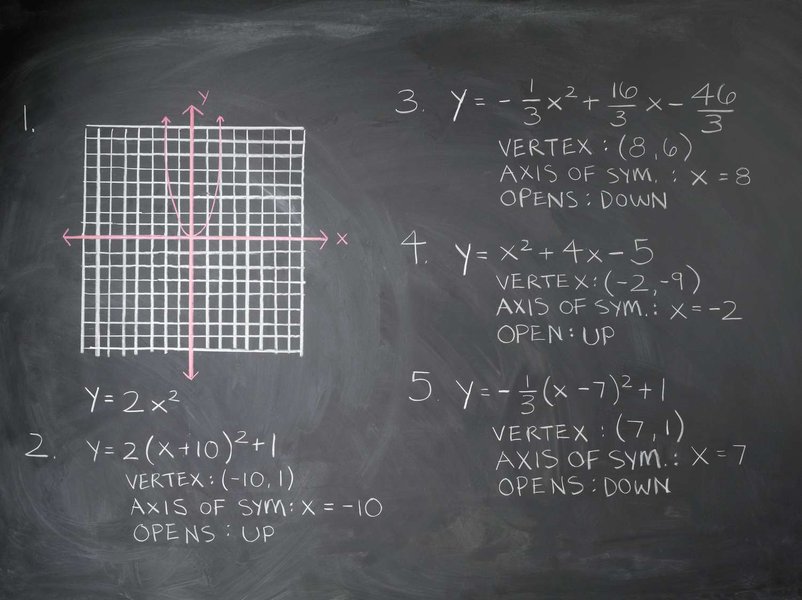
Understanding function notation is fundamental to mathematics.
Functions as Relationships
A function establishes a clear relationship between variables. For a function of one variable, say \(y = f(x)\), for every valid input value of x, there is only one corresponding output value of y. This is often visualized using the vertical line test on a graph: if any vertical line intersects the graph of the relation at more than one point, it is not a function.
Understanding Multivariable Functions
The notation \(s(x, y)\) signifies a multivariable function, specifically a function of two variables, x and y. Unlike functions of a single variable that map a value from ℝ to ℝ (e.g., \(f: \mathbb{R} \to \mathbb{R}\)), multivariable functions can take multiple inputs and map them to an output. In the case of \(s(x, y)\), the input is an ordered pair \((x, y)\) from a specified domain, and the output is a single value.
Functions from ℝ² to ℝ
A common type of multivariable function is one that maps from ℝ² to ℝ, denoted as \(f: \mathbb{R}^2 \to \mathbb{R}\). This means the function takes an ordered pair \((x, y)\) as input, where both x and y are real numbers, and produces a single real number as output. The notation \(s(x, y)\) in the user's query is an example of such a function, although the specific rule for how \(s(x, y)\) is calculated is not provided.
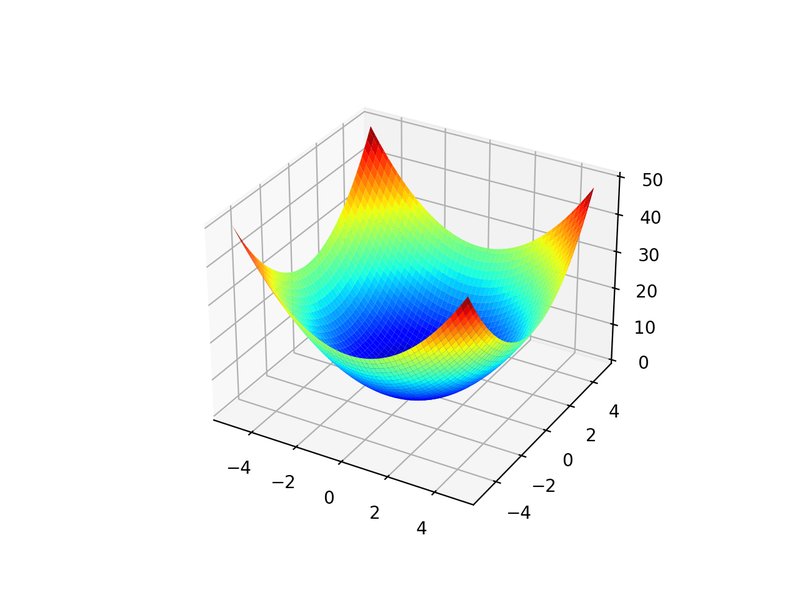
Multivariable functions can be visualized as surfaces in three-dimensional space.
Visualizing Multivariable Functions
While a function of one variable can be graphed on a two-dimensional plane, a function of two variables, \(z = f(x, y)\), is typically visualized as a surface in three-dimensional space. The input pair \((x, y)\) is located on the xy-plane (the domain), and the output value z is the height of the surface above or below that point.
Examples of Multivariable Functions
Examples of multivariable functions are abundant in various fields. For instance, the area of a rectangle is a function of its width and length, \(A(w, l) = w \cdot l\). The volume of a cylinder depends on its radius and height, \(V(r, h) = \pi r^2 h\). In physics, temperature in a room might be a function of three spatial coordinates and time, \(T(x, y, z, t)\).
Deconstructing the Domain Notation: \(x \in \mathbb{R}, (x, y) \in \mathbb{R}^2\)
The part of the notation specifying the domain, \(x \in \mathbb{R}, (x, y) \in \mathbb{R}^2\), provides crucial information about the valid inputs for the function \(s(x, y)\).
Understanding the Components
- \(x \in \mathbb{R}\): This part indicates that the variable 'x' belongs to the set of real numbers (\(\mathbb{R}\)). This is a fundamental concept in calculus and real analysis, signifying that x can be any value on the number line.
- \((x, y) \in \mathbb{R}^2\): This part indicates that the ordered pair \((x, y)\) belongs to the set \(\mathbb{R}^2\). The set \(\mathbb{R}^2\) represents the Cartesian plane, which is the set of all possible ordered pairs of real numbers. Each point on this plane corresponds to a unique pair of (x, y) coordinates.
Combining the Conditions
When these two conditions are presented together in the context of the domain for \(s(x, y)\), they are somewhat redundant but emphasize different aspects. The condition \((x, y) \in \mathbb{R}^2\) inherently means that both x and y are real numbers. Therefore, \(x \in \mathbb{R}\) is implied by \((x, y) \in \mathbb{R}^2\).
However, explicitly stating \(x \in \mathbb{R}\) might serve to highlight the nature of the individual variable x, while \((x, y) \in \mathbb{R}^2\) emphasizes that the input to the function is the combined pair of values representing a point in a two-dimensional space.
The Significance of the Vertical Arrangement of x and y
The vertical arrangement of 'x' above 'y' following the colon in the notation \(s(x, y) : x \in \mathbb{R}, (x, y) \in \mathbb{R}^2\) is not standard mathematical notation for defining the function's output or rule. In typical function notation, the rule for calculating the output would be provided after the colon or an equals sign. For example, \(f(x, y) = x^2 + y^2\) clearly defines the output for any given input \((x, y)\).
Interpreting the Vertical Arrangement
Given the context of defining the function's domain, the vertical arrangement of 'x' and 'y' most likely serves to visually represent the input to the function as a column vector or a point's coordinates. It's a way of saying that the function 's' takes an input which can be thought of as having two components, x and y.
While not a formal mathematical operation or definition of the function's value, this presentation reinforces the idea that the input is an ordered pair \((x, y)\) from \(\mathbb{R}^2\). It could be interpreted as a visual cue for the structure of the input data.
Alternative Representations of Input
The input to a multivariable function can be represented in several ways, including:
- As an ordered pair: \((x, y)\)
- As a vector: \(\begin{pmatrix} x \ y \end{pmatrix}\) or \(\langle x, y \rangle\)
The vertical arrangement aligns visually with the column vector representation, emphasizing the distinct components of the input.
Putting It All Together
Combining all the elements of the notation \(s(x, y) : x \in \mathbb{R}, (x, y) \in \mathbb{R}^2\) with the vertical arrangement of x and y, we can infer the following:
- We are defining a function named 's'.
- This function is a multivariable function that takes two independent variables, x and y, as input, represented together as an ordered pair \((x, y)\).
- The domain of this function is the entire Cartesian plane, \(\mathbb{R}^2\), meaning that any pair of real numbers \((x, y)\) is a valid input for the function. The condition \(x \in \mathbb{R}\) is implicitly included in \((x, y) \in \mathbb{R}^2\).
- The vertical arrangement of x and y is a visual representation of the input structure, likely emphasizing the two components of the ordered pair.
The notation, however, does not specify the rule that defines the output of the function \(s(x, y)\). To fully understand the function, this rule would need to be provided, for example, as \(s(x, y) = x^2 - y^2\) or \(s(x, y) = \sin(xy)\).
Contextualizing the Notation in Mathematics
This type of notation is commonly encountered in areas of mathematics that deal with functions of multiple variables, such as:
- Multivariable Calculus: Where concepts like partial derivatives, multiple integrals, and vector fields are studied. Functions mapping from \(\mathbb{R}^n\) to \(\mathbb{R}\) or \(\mathbb{R}^m\) are central to this field.
- Linear Algebra: Where vectors and transformations are represented and manipulated, and functions can map vectors to scalars or other vectors.
- Real Analysis: Which provides a rigorous foundation for calculus, including the study of functions of several real variables.
Video explaining the fundamental concept of a function in mathematics.
The provided YouTube video offers a general introduction to the concept of a function, which is foundational to understanding multivariable functions. It explains what a function is and why it's important in mathematics, particularly in algebra. While it focuses on single-variable functions, the core idea of an input-output relationship with a unique output for each input is extended to multivariable functions.
Functions in Different Mathematical Contexts
The way functions are defined and used can vary slightly depending on the specific branch of mathematics. However, the fundamental principle of a unique output for a given input remains consistent.
| Concept | Single-Variable Function (\(f: \mathbb{R} \to \mathbb{R}\)) | Multivariable Function (\(s: \mathbb{R}^2 \to \mathbb{R}\)) |
|---|---|---|
| Input | Single real number (x) | Ordered pair of real numbers \((x, y)\) |
| Output | Single real number (y or f(x)) | Single real number (z or s(x, y)) |
| Domain (typical) | A subset of ℝ (an interval or union of intervals) | A subset of ℝ² (a region in the xy-plane) |
| Visualization (typical) | A curve on a 2D plane | A surface in 3D space or contour plots in 2D |
The notation \(s(x, y) : x \in \mathbb{R}, (x, y) \in \mathbb{R}^2\) clearly places the function 's' in the realm of multivariable functions operating on a two-dimensional domain.
Beyond the Notation: What the Function Represents
Without a specific rule defining \(s(x, y)\), we can only discuss the general properties of a function with this domain and input structure. The function could represent a variety of real-world phenomena or mathematical constructs where an outcome depends on two varying quantities. The vertical arrangement of x and y might subtly hint at the inputs being treated as components of a position or a state.
Possible Interpretations of the Function's Purpose
The function \(s(x, y)\) could represent:
-
A scalar field, where a single value (like temperature, pressure, or elevation) is associated with each point \((x, y)\) in a region.
-
An objective function to be optimized, where the goal is to find the input pair \((x, y)\) that minimizes or maximizes the output \(s(x, y)\).
-
A probability density function, where \(s(x, y)\) gives the likelihood of a random event occurring at a specific point \((x, y)\).
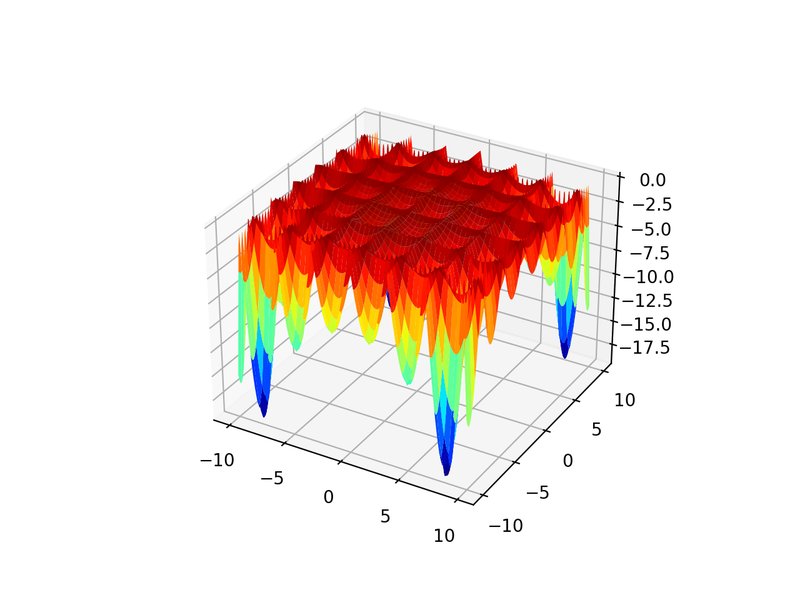
Complex multivariable functions can have intricate surface plots with multiple extrema.
The specific meaning and behavior of \(s(x, y)\) are entirely dependent on the rule that defines how the input \((x, y)\) is transformed into the output value.
Frequently Asked Questions (FAQ)
What is the difference between a function of one variable and a function of several variables?
A function of one variable takes a single input value from its domain and produces a single output value. A function of several variables takes multiple input values (often as an ordered tuple or vector) from its domain and produces a single output value (for scalar-valued functions) or multiple output values (for vector-valued functions).
What does ℝ² represent?
ℝ² represents the set of all ordered pairs of real numbers \((x, y)\). Geometrically, it corresponds to the two-dimensional Cartesian plane.
Why is the domain of a function important?
The domain of a function is crucial because it specifies the set of all valid inputs for which the function is defined. Attempting to evaluate a function outside of its domain can lead to undefined results.
Can all functions of two variables be graphed as a surface in 3D?
Scalar-valued functions of two variables (\(f: \mathbb{R}^2 \to \mathbb{R}\)) can typically be visualized as a surface in 3D space. However, vector-valued functions of two variables (\(f: \mathbb{R}^2 \to \mathbb{R}^m\) where \(m > 1\)) cannot be easily graphed as a single surface in 3D.
What is the codomain of the function s(x, y)?
Based on the typical usage of such notation in calculus, the function \(s(x, y)\) is likely a real-valued function, meaning its outputs are real numbers. If this is the case, the codomain would be ℝ.
References
Last updated May 2, 2025