
Unlocking Potential Returns: A Deep Dive into Range Accrual Notes
Explore how these sophisticated financial instruments operate, offering unique opportunities tied to market stability.
Highlights of Range Accrual Notes
- Conditional Returns: Investors earn interest or coupons primarily when an underlying asset, such as an interest rate, currency exchange rate, or stock index, remains within a predefined price or value range during specified observation periods.
- Enhanced Yield Potential: These notes are structured to potentially offer higher returns compared to traditional fixed-income products, particularly in market environments characterized by low volatility or sideways price movements.
- Customizable but Complex: Range accrual notes can often be tailored to specific investor market views and risk appetites, with various forms like callable or dual-range notes. However, they are sophisticated instruments that come with a unique set of risks that require careful consideration.
What is a Range Accrual Note?
A Range Accrual Note (RAN) is a type of structured financial product, a sophisticated derivative instrument, that offers investors returns based on the performance of an underlying asset or index. The defining characteristic of a RAN is that it accrues interest or pays a coupon only on the days or for the periods when the value of the underlying asset or reference rate is observed to be within a predetermined range. These instruments gained significant popularity, especially between 2004 and 2007, with an estimated over US$160 billion of interest-rate-indexed range accruals sold during that period, marking them as one of the more popular non-vanilla financial derivatives.
The Core Concept: Betting on Stability
Investors in range accrual notes are essentially taking a view that the underlying asset will exhibit low volatility and remain within a specified price or value corridor. Instead of betting on the direction of price movement (up or down), they are betting on the lack of significant movement outside defined boundaries. The note's structure is designed to reward this expectation of stability. Conceptually, a range accrual can be viewed as a series of binary options, where the investor receives a payoff (the coupon accrual) if the underlying is within the range on an observation date, and no payoff if it's outside.
Underlying Mechanics: How Payments Accrue
The mechanics involve linking coupon payments to an underlying reference. On specified observation dates throughout the life of the note, the level of the underlying asset is checked. If it falls within the pre-agreed range, a coupon accrues for that period (e.g., for that day). If it falls outside the range, no coupon accrues. The total interest paid over the life of the note, or at specific payment dates, is the sum of these accrued amounts. Some notes may offer a minimum coupon payment even if the index occasionally falls outside the predefined range, though this is a specific feature and not standard for all RANs.
Key Characteristics and Components
Understanding range accrual notes requires familiarity with their fundamental components:
Underlying Assets or Reference Rates
The performance of a range accrual note is tethered to an underlying asset or reference rate. This can vary widely and may include:
- Interest Rates: Such as LIBOR (historically), SOFR (Secured Overnight Financing Rate), or other benchmark interbank rates.
- Currency Exchange Rates: For example, EUR/USD, USD/JPY.
- Equity Indices: Like the FTSE 100, S&P 500, or Nikkei 225.
- Commodity Prices: Such as oil or gold prices.
- Individual Stock Prices.
The Accrual Range (The "Corridor")
This is the crucial element. It's a pre-defined upper and lower boundary for the underlying asset's value. For instance, a note linked to the FTSE 100 might specify a range of 7,000 to 7,500 points. The width of this range significantly impacts the risk and reward profile of the note.
Coupon Calculation and Payment
The coupon payment is variable and directly tied to the number of observation days the underlying asset spends "in-range." The calculation typically involves:
Coupon for a period = (Nominal Amount × Annual Coupon Rate × Number of Days In-Range) / (Total Days in Year)
Or, more generally, the return is a function of the proportion of time the underlying stays within the range:
Total Accrued Coupon = Stated Coupon Rate × (Number of Qualifying Observation Days / Total Observation Days)
Coupons can be paid periodically (e.g., quarterly, semi-annually) or accumulated and paid at the note's maturity. The investor does not know the total amount of coupon payments they will receive throughout the life of the note at the outset.
Observation Periods and Frequency
The underlying asset's value is checked against the range on specific observation dates. This can be daily (most common), weekly, monthly, or at other defined intervals. The frequency of observation affects the sensitivity of the note to short-term fluctuations in the underlying asset.
Market Expectation
Investors typically purchase range accrual notes when they anticipate a period of market stability or sideways movement for the underlying asset. They are not expecting strong directional trends, either bullish or bearish, that would take the asset outside the specified range for extended periods.
Mapping the World of Range Accrual Notes
To better visualize the interconnected concepts of Range Accrual Notes, the mindmap below outlines their definition, core features, common types, and the balance of benefits versus risks. It serves as a quick reference to understand the multifaceted nature of these structured products.
paying conditional coupons"] id2["Key Features"] id2_1["Underlying Asset (e.g., Interest Rate, FX, Index)"] id2_2["Predefined Range (Corridor)"] id2_3["Conditional Coupon Accrual"] id2_4["Observation Periods (Daily, Weekly)"] id2_5["Market View: Stability/Low Volatility"] id3["Types of RANs"] id3_1["Standard RAN"] id3_2["Callable RAN (Issuer can redeem early)"] id3_3["Dual Range RAN (Two underlyings)"] id3_4["Range Accrual Swaps"] id4["Benefits"] id4_1["Enhanced Yield Potential (in stable markets)"] id4_2["Principal Protection (Often, but not guaranteed)"] id4_3["Customization"] id4_4["Income Generation"] id5["Risks"] id5_1["Range Risk (Underlying moves out of range)"] id5_2["Liquidity Risk (Hard to sell)"] id5_3["Reinvestment Risk (Callable notes)"] id5_4["Market & Model Risk"] id5_5["Credit Risk (Issuer default)"]
Variations of Range Accrual Notes
Range accrual notes are not a one-size-fits-all product. They come in several variations, catering to different risk appetites and market outlooks:
Standard Range Accrual Note
This is the most basic form, where the coupon is linked to a single underlying reference rate or asset staying within a single predefined range. The terms are straightforward as described in the general mechanics.
Callable Range Accrual Notes
These notes include an embedded call option, granting the issuer the right (but not the obligation) to redeem the note at par value on specified dates before its scheduled maturity. Issuers might exercise this option if, for example, interest rates fall significantly (making their funding costs for the note too high) or if the note is consistently paying high coupons due to the underlying staying in range. To compensate investors for this reinvestment risk (the risk of having the note called away and needing to find a new investment, potentially at lower prevailing rates), callable RANs typically offer a higher initial coupon rate than comparable non-callable notes.
Dual Range Accrual Notes
More complex, these notes link coupon accrual to the performance of two (or more) underlying assets or reference rates. For a coupon to accrue, both underlyings might need to be within their respective, individually defined ranges. Alternatively, the condition might involve a relationship between the two (e.g., their spread). These notes require a more sophisticated understanding and are suited for investors with very specific, multi-asset views.
Other Related Structures
The range accrual concept also appears in other financial instruments, such as:
- Range Accrual Swaps: These function like interest rate swaps, but one leg of the swap pays based on a reference rate staying within a range.
- Corridor Bonds/Notes: These are essentially synonymous with range accrual notes.
- Index Range Notes: Specifically link to market indices, paying coupons if the index value stays within a defined band (e.g., 80% to 120% of its initial value on observation dates).
Illustrative Example
Imagine an investor purchases a 1-year Range Accrual Note with a nominal value of $100,000. The note is linked to the 3-month SOFR (Secured Overnight Financing Rate) and offers a potential annual coupon of 6%.
- Underlying: 3-month SOFR
- Predetermined Range: SOFR must be between 2.00% and 3.50%.
- Observation: Daily.
- Potential Annual Coupon: 6.00%.
Over the year (assume 252 business/observation days):
- If SOFR stays within the 2.00% - 3.50% range on all 252 observation days, the investor receives the full 6% coupon: $100,000 * 6% = $6,000.
- If SOFR is within the range for only 189 days (75% of the observation days), the investor receives 75% of the potential coupon: $6,000 * 0.75 = $4,500.
- If SOFR is within the range for only 63 days (25% of the observation days), the investor receives 25% of the potential coupon: $6,000 * 0.25 = $1,500.
- If SOFR is never within the range, the investor might receive no coupon at all (unless the note has a minimum guaranteed coupon feature).
At maturity, assuming no issuer default, the investor also receives back their principal amount of $100,000.
Benefits for Investors
Range accrual notes can offer several advantages under the right circumstances:
- Enhanced Returns in Stable Markets: They are designed to provide potentially higher yields than traditional fixed-rate deposits or bonds if the underlying asset or reference rate behaves as expected (i.e., stays within the range). This makes them attractive in low-volatility or sideways-trending market environments.
- Principal Protection (Often): Many range accrual notes are structured to return 100% of the principal investment at maturity, provided the issuer does not default. However, this is not universal, and some structures might expose principal to risk, so it's crucial to check the terms.
- Customization: These notes can be tailored to an investor's specific market views regarding the range boundaries, underlying asset, maturity, and coupon potential, allowing for targeted investment strategies.
- Income Generation: In periods of low prevailing interest rates, RANs can offer an alternative source of income, especially for institutional investors or high-net-worth individuals seeking yield.
Associated Risks and Considerations
Despite their potential benefits, range accrual notes carry significant risks that investors must carefully evaluate:
- Range Risk / Market Volatility Risk: This is the primary risk. If the underlying asset or reference rate frequently moves outside the specified range, coupon payments will be reduced or could even be zero. Unexpected market volatility can lead to significantly lower returns than anticipated. There have been historical instances where high volatility led to substantial underperformance of these notes.
- Liquidity Risk: Range accrual notes are often bespoke, over-the-counter (OTC) products. They may not have an active secondary market, making them difficult to sell before maturity if the investor needs to access their capital. If a sale is possible, it might be at a significant discount.
- Reinvestment Risk (for Callable Notes): If the issuer calls the note early (typically when it's advantageous for them, e.g., falling interest rates), the investor receives their principal back but then faces the challenge of reinvesting those funds, potentially at less favorable rates than the original note offered.
- Interest Rate Risk: For notes linked to interest rates, or even for others, general changes in the interest rate environment can affect the note's market value if one attempts to sell it before maturity.
- Credit Risk (Issuer Risk): The return of principal and payment of coupons depend on the financial stability of the issuing institution. If the issuer defaults, the investor could lose their entire investment, including principal.
- Complexity and Model Risk: These are complex instruments. Their pricing and behavior can be difficult to understand fully without specialized knowledge. The models used to price and hedge these notes by issuers also carry their own risks.
Summary: Range Accrual Notes at a Glance
The following table provides a concise overview of the main aspects of Range Accrual Notes, highlighting their defining characteristics, potential advantages, and inherent risks. This can help in quickly comparing them against other investment options.
| Aspect | Description |
|---|---|
| Primary Mechanism | Coupon accrues only when the underlying asset/index stays within a predefined range. |
| Typical Underlying Assets | Interest rates (e.g., SOFR), currency exchange rates (e.g., EUR/USD), equity indices (e.g., FTSE 100). |
| Investor's Market View | Expectation of low volatility and market stability for the underlying asset. |
| Potential Benefits | Enhanced yield compared to traditional fixed income in stable markets; principal protection (often, not always); customization. |
| Key Risks | Range Risk: Underlying moves out of range, reducing/eliminating coupons. Liquidity Risk: Difficult to sell before maturity. Reinvestment Risk: For callable notes, early redemption by issuer. Issuer Credit Risk: Risk of issuer default. Complexity: Sophisticated instrument requiring careful understanding. |
| Common Variations | Standard, Callable (issuer can redeem early), Dual-Range (linked to two underlyings). |
| Observation Frequency | Typically daily, but can be weekly or monthly. |
Comparative Profile: Range Accrual Notes vs. Traditional Bonds
To understand the unique positioning of Range Accrual Notes, it's helpful to compare them against more conventional investments like traditional fixed-rate bonds. The radar chart below illustrates this comparison across several key financial attributes. The scores are on a scale of 1 (Low) to 10 (High), representing a general assessment rather than precise figures.
This chart highlights that while Range Accrual Notes may offer higher yield potential and customization, they typically come with increased risk, complexity, and lower liquidity compared to traditional bonds, which excel in predictability of income and liquidity.
Understanding Structured Notes
Range Accrual Notes are a specific type of structured note. Structured notes, in general, are complex financial instruments whose returns are linked to an underlying asset, index, or strategy. The video below provides an introduction to structured notes with contingent coupons, which shares conceptual similarities with how range accrual notes operate, particularly the conditional nature of their payouts.
This video explains general concepts of structured notes and contingent coupons, relevant to understanding the framework within which Range Accrual Notes exist.
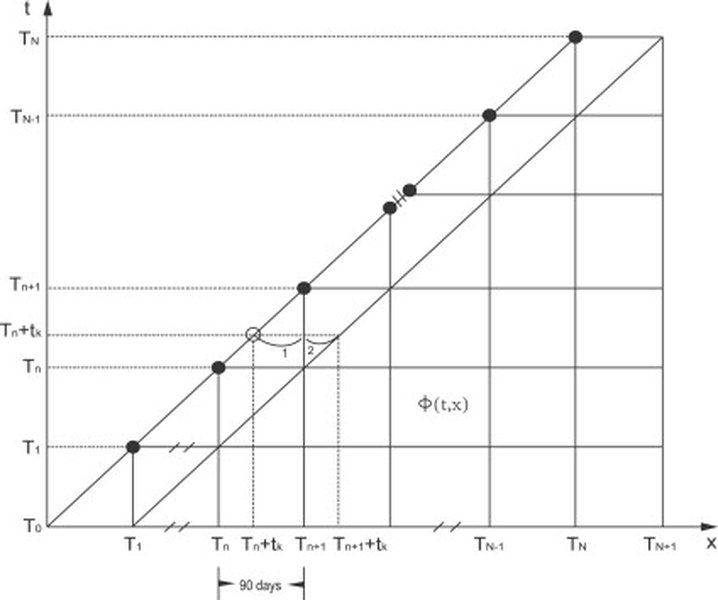
Illustrative payoff structure of a range accrual instrument, showing returns conditional on the underlying asset staying within bounds. (Source: ScienceDirect)
Frequently Asked Questions (FAQ)
What is the primary goal of investing in a range accrual note?
The primary goal for investors in range accrual notes is typically to achieve enhanced yields or returns compared to conventional fixed-income investments. This is pursued by taking a specific market view that an underlying asset (like an interest rate, currency, or index) will remain within a predetermined range for a significant portion of the note's life. They are essentially betting on market stability or low volatility for that specific asset.
How is the coupon of a range accrual note determined?
The coupon is determined by observing the underlying asset's value on specified dates (e.g., daily). If, on an observation day, the asset's value falls within the predefined range (the "corridor"), a portion of the potential coupon accrues for that day or period. The total coupon paid is the sum of these accruals, effectively proportional to the number of days the asset stayed "in-range" relative to the total observation days.
Are range accrual notes suitable for all investors?
No, range accrual notes are sophisticated financial instruments and are generally not suitable for all investors. They involve complex risk-reward profiles, including the risk of receiving little to no coupon payments if the market moves unexpectedly. They are typically more appropriate for experienced or institutional investors who understand the risks, have a specific market view aligning with the note's strategy, and can tolerate potential illiquidity.
What happens if the underlying asset goes outside the specified range?
If the underlying asset's value moves outside the specified range on an observation day, no coupon accrues for that particular day or period. If this happens frequently, the total coupon received by the investor will be significantly lower than the maximum potential coupon. In extreme cases, if the asset consistently stays outside the range, the investor might receive no coupon payments at all during the life of the note (though the principal is often protected at maturity, subject to issuer credit risk).
Can a range accrual note be redeemed before maturity?
Some range accrual notes are "callable," meaning the issuer has the option to redeem the note at par value before its scheduled maturity date. This usually happens if market conditions become favorable for the issuer (e.g., falling interest rates make the note's coupon expensive for them). If a note is not callable, then early redemption by the issuer is not a feature. Investors should always check the terms sheet for call provisions, as this introduces reinvestment risk for the investor.
Recommended Further Exploration
- How are callable range accrual notes different from standard ones?
- What are the specific risks of investing in dual range accrual notes?
- How is the fair value of a range accrual note determined by financial institutions?
- What market conditions make range accrual notes most attractive to investors?
References
Last updated May 8, 2025