
Understanding Research: A Comprehensive Overview
Delving into the systematic pursuit of knowledge with practical and simple examples.
Key Takeaways
- Research is a structured process aimed at expanding knowledge or solving specific problems.
- There are various types of research, including basic, applied, exploratory, descriptive, and explanatory.
- Research involves distinct steps and methodologies such as hypothesis formulation, data collection, and analysis.
What is Research?
Research is a systematic and methodical process of investigating a topic, question, or problem to expand knowledge, understand phenomena, or solve challenges. It involves several key characteristics that ensure the accuracy, reliability, and validity of the findings. Fundamentally, research seeks to inform, describe, explain, predict, or control observed phenomena through a structured approach.
Key Components of Research
1. Research Question
The foundation of any research project is a well-defined research question. This question identifies the specific issue or topic that the research aims to address, guiding the direction and scope of the study.
2. Hypothesis
A hypothesis is an educated guess or prediction that the research seeks to test. It provides a tentative explanation or assumption that the study will validate or refute based on the collected data.
3. Methodology
The methodology outlines the systematic approach used to collect and analyze data. It encompasses the research design, data collection methods, and analytical techniques employed to ensure the study's reliability and validity.
4. Data Collection and Analysis
Data collection involves gathering relevant information through various methods such as surveys, experiments, observations, or interviews. Once collected, the data is analyzed to identify patterns, relationships, and insights that address the research question.
5. Conclusion
The conclusion synthesizes the findings from the data analysis, drawing informed interpretations that answer the research question. It may also suggest implications, recommendations, or areas for further study.
Types of Research
Research can be categorized based on its purpose, methods, and the nature of the data it utilizes. Understanding these types helps in selecting the appropriate approach for a given study.
1. Basic (Fundamental) Research
Basic research aims to expand knowledge without immediate practical application. It focuses on understanding fundamental principles and theories.
2. Applied Research
Applied research seeks to solve specific, practical problems by applying scientific methods. It often has immediate real-world applications.
3. Exploratory Research
Exploratory research is conducted to explore new areas or questions that haven't been studied before. It helps in identifying potential avenues for further investigation.
4. Descriptive Research
Descriptive research aims to describe the characteristics of a population or phenomenon. It provides a detailed account without focusing on cause-and-effect relationships.
5. Explanatory Research
Explanatory research seeks to explain why something happens. It explores the relationships between variables to understand underlying causes.
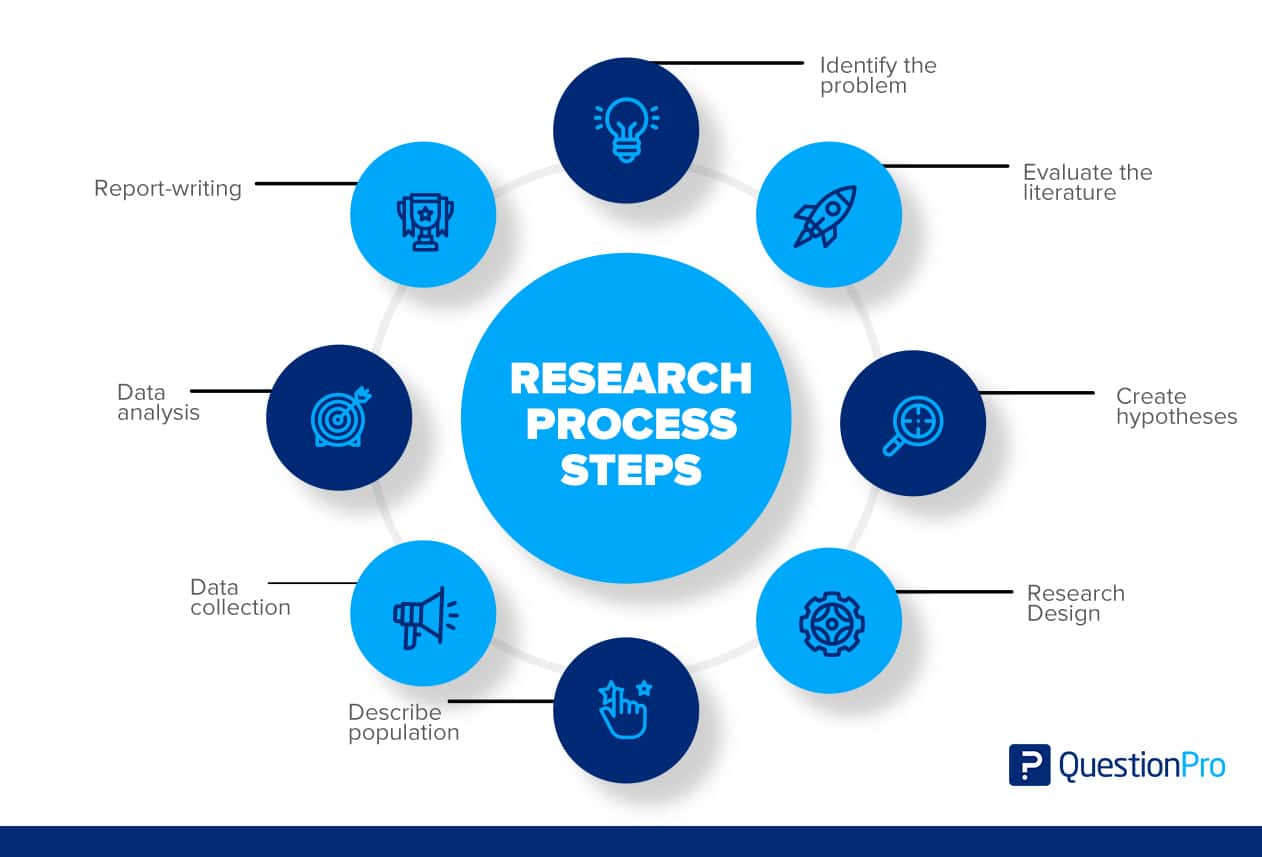
Research Process Steps
Conducting research involves a series of systematic steps designed to ensure thorough investigation and credible results.
1. Identify a Research Question
Formulating a clear and focused research question is the first step. It defines the scope and direction of the study.
2. Review Existing Literature
Conducting a literature review involves examining existing studies and sources related to the research question. It helps in understanding the current state of knowledge and identifying gaps.
3. Develop a Hypothesis
Based on the literature review, researchers formulate a hypothesis that predicts the relationship between variables.
4. Collect Data
Data collection can be quantitative or qualitative, depending on the research design. Methods include surveys, experiments, observations, and interviews.
5. Analyze Findings
Analyzing data involves using statistical tools or qualitative methods to interpret the information gathered, identifying patterns, and testing the hypothesis.
6. Draw Conclusions
Based on the analysis, researchers draw conclusions that answer the research question and discuss the implications of the findings.
7. Share Results
The final step involves disseminating the research findings through reports, publications, presentations, or other mediums to inform and influence others.
Simple Examples of Research
Understanding research is easier with practical examples that illustrate its application across various contexts.
1. School Project on Water Cycle
A student tasked with a homework assignment about the water cycle may engage in research by reading textbooks, accessing online resources, and compiling information on evaporation, condensation, and precipitation. The student organizes the findings into a comprehensive project presentation, effectively demonstrating the research process.
2. Science Experiment on Soil Types and Plant Growth
To determine which type of soil is best for plant growth, a researcher conducts an experiment by planting seeds in pots containing different soil varieties. Over a set period, the growth of the plants is measured and compared, providing data that answers the specific research question.
3. Improving a Cooking Recipe
When attempting to enhance a cooking recipe, one might experiment with various ingredients or cooking techniques. By systematically testing each modification and evaluating the results, the individual conducts research to identify the best method for improving the dish's flavor.
4. Survey on Favorite Foods Among College Students
A researcher interested in understanding dietary preferences among college students conducts a survey, collecting data on their favorite foods. Analyzing the survey results reveals the most popular food choices, providing insights into student preferences.
5. Observation of Bird Behavior in Different Environments
A biologist studying bird behavior observes how birds react to various environmental conditions, such as changes in temperature or habitat. By systematically recording and analyzing these observations, the researcher gains a deeper understanding of avian behavior patterns.
Research Methods
Different research methods are employed based on the study's objectives, nature of data, and the discipline involved.
1. Interviews
Interviews involve direct, often qualitative, interactions with participants to gather in-depth information about their experiences, opinions, or behaviors.
2. Questionnaires
Questionnaires are structured sets of questions distributed to a sample population to collect quantitative data on specific topics.
3. Observation
Observational methods entail systematically watching and recording behaviors or phenomena as they occur naturally, providing qualitative insights.
4. Experiments
Experiments involve manipulating one or more variables to determine their effect on another variable, establishing cause-and-effect relationships.
5. Case Studies
Case studies provide an in-depth analysis of a single individual, group, event, or situation, offering detailed qualitative information.
Types of Research Explained with Examples
| Type of Research | Description | Example |
|---|---|---|
| Basic Research | Expands fundamental knowledge without immediate practical application. | Studying the properties of neutrinos in physics. |
| Applied Research | Solves specific, practical problems using scientific methods. | Investigating how employee training impacts workplace productivity. |
| Exploratory Research | Explores new areas or questions that haven't been studied before. | Exploring the effects of virtual reality on learning experiences. |
| Descriptive Research | Describes characteristics of a population or phenomenon. | Surveying grocery store customers about their shopping habits. |
| Explanatory Research | Explains why something happens by exploring relationships between variables. | Studying how stress levels affect student academic performance. |
The Importance of Research
Research plays a pivotal role in various aspects of society, driving innovation, informing policy decisions, and contributing to personal and professional growth. It enables individuals and organizations to make informed decisions, solve complex problems, and advance knowledge across diverse fields.
1. Enhancing Understanding
Through systematic inquiry, research deepens our understanding of the world, uncovering new insights and expanding the boundaries of knowledge.
2. Driving Innovation
Research fuels innovation by exploring novel ideas, developing new technologies, and improving existing processes, thereby fostering progress in various industries.
3. Informing Policy and Practice
By providing evidence-based findings, research informs policy-making and best practices in fields such as education, healthcare, and business, ensuring that decisions are grounded in reliable data.
4. Solving Problems
Applied research focuses on addressing specific challenges, offering practical solutions that enhance efficiency, effectiveness, and overall quality of life.
5. Personal and Professional Growth
Engaging in research cultivates critical thinking, analytical skills, and a deeper appreciation for continuous learning, contributing to personal and professional development.
Conclusion
Research is an essential component of intellectual and practical advancement. By systematically investigating questions and problems, it contributes to the expansion of knowledge, the development of innovative solutions, and the improvement of various aspects of society. Whether through basic or applied research, the process involves careful planning, data collection, analysis, and interpretation to ensure meaningful and reliable outcomes. Understanding the different types and methodologies of research empowers individuals to conduct effective studies, make informed decisions, and contribute positively to their respective fields.
References
Last updated February 16, 2025