
The Genesis of Everything: Exploring the Universe's Origin
Unraveling the Mysteries of the Big Bang and Beyond
Key Highlights of the Universe's Origin
- The Big Bang Theory: The prevailing cosmological model posits that the universe originated from an extremely hot, dense state about 13.8 billion years ago and has been expanding ever since.
- Cosmic Microwave Background (CMB): The CMB radiation provides crucial evidence supporting the Big Bang theory, representing the afterglow of the early universe.
- Alternative Theories: While the Big Bang is widely accepted, alternative theories like the Steady State theory and Ekpyrotic model offer different perspectives on the universe's origin.
The Big Bang Theory: The Dominant Explanation
The most widely accepted scientific explanation for how the universe began is the Big Bang Theory. According to this theory, the universe emerged from an incredibly hot and dense single point approximately 13.8 billion years ago. This point rapidly expanded and cooled, leading to the formation of the cosmos as we know it today. The Big Bang wasn't an explosion in pre-existing space but rather an explosion *of* space itself.

An illustration of the Big Bang Theory, showing the expansion of the universe from an initial singularity.
The Initial Singularity
At the very beginning, all the energy and matter in the universe were concentrated in an infinitely small space, an event often referred to as a singularity. The conditions within this singularity were beyond anything we can currently replicate or fully comprehend. The Big Bang theory describes the evolution of the universe from this initial state of high density and temperature.
Expansion and Cooling
Immediately after the Big Bang, the universe underwent a period of rapid expansion known as cosmic inflation. During this expansion, the universe cooled, allowing for the formation of subatomic particles. As the universe continued to cool, these particles combined to form atoms, primarily hydrogen and helium.
Timeline of the Early Universe
The early universe went through several distinct epochs. Here's a simplified timeline:
- Planck Epoch: The earliest known period, where the four fundamental forces (gravity, electromagnetism, strong nuclear force, and weak nuclear force) are theorized to have been unified.
- Inflationary Epoch: An extremely rapid expansion of space that smoothed out the universe and set the stage for later structure formation.
- Lepton Epoch: Leptons and anti-leptons dominated the mass of the universe.
- Photon Epoch: Photons dominated after most leptons and anti-leptons were annihilated.
- Nucleosynthesis: Protons and neutrons combined to form the first atomic nuclei, primarily hydrogen and helium.
Evidence Supporting the Big Bang
Several key observations support the Big Bang theory:
- Cosmic Microwave Background Radiation (CMB): The CMB is the afterglow of the Big Bang, a faint thermal radiation that fills the universe. Its discovery in the 1960s provided strong evidence for a hot, dense early universe.
- Abundance of Light Elements: The observed abundance of light elements like hydrogen and helium in the universe matches predictions made by the Big Bang theory.
- Redshift and Expansion: Edwin Hubble's observations in the 1920s showed that galaxies are moving away from us, and the farther away they are, the faster they are receding. This supports the idea of an expanding universe that originated from a single point.
Alternative Theories to the Big Bang
While the Big Bang theory is the most accepted model, several alternative theories attempt to explain the origin of the universe. These include:
Steady State Theory
The Steady State theory, popular in the mid-20th century, proposed that the universe has always existed and will continue to exist in a similar state. This theory suggests that as the universe expands, new matter is continuously created to maintain a constant density. However, the discovery of the CMB and other evidence has largely discredited the Steady State theory.
Ekpyrotic Model
The Ekpyrotic model suggests that the universe began from a collision between two "branes" in a higher-dimensional space. This collision released energy and triggered the expansion and cooling that led to the formation of our universe.
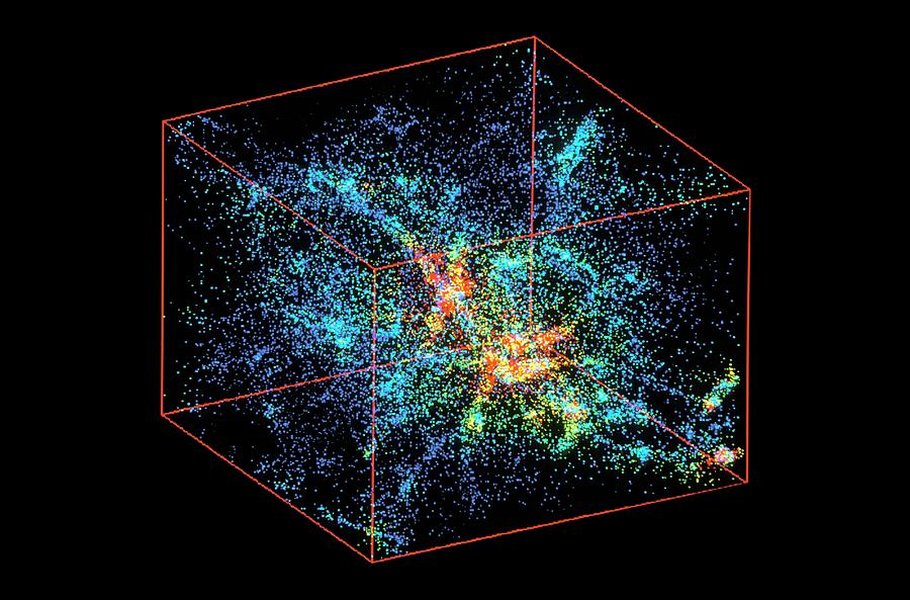
A simulation showing the formation of the universe, illustrating the complex processes involved in its evolution.
Cyclic Models
Cyclic models propose that the universe undergoes repeated cycles of expansion and contraction, with each cycle beginning with a "Big Bang" and ending with a "Big Crunch," which then leads to another Big Bang. These models suggest that the universe has no beginning or end but rather exists in an eternal cycle.
Eternal Inflation
This theory suggests that cosmic inflation never entirely stopped. Instead, it continues in some regions of space, giving rise to new "bubble universes." Our universe would be just one of many such bubbles in a vast multiverse.
The Composition of the Universe
Understanding the origin of the universe also requires understanding what makes up the universe. The universe is composed of:
- Normal Matter: This includes all the matter we can see and interact with, such as stars, planets, and galaxies. However, normal matter only makes up a small fraction of the universe's total mass-energy density.
- Dark Matter: Dark matter is a mysterious substance that does not interact with light, making it invisible to telescopes. However, its presence can be inferred through its gravitational effects on visible matter. Dark matter is estimated to make up about 27% of the universe.
- Dark Energy: Dark energy is an even more mysterious force that is thought to be responsible for the accelerating expansion of the universe. It makes up about 68% of the universe's total mass-energy density.
Key Figures in the Development of the Big Bang Theory
Several scientists made significant contributions to the development of the Big Bang theory:
| Scientist | Contribution |
|---|---|
| Georges Lemaître | Proposed the idea that the universe began from a "primeval atom." |
| Edwin Hubble | Observed that galaxies are moving away from us, providing evidence for an expanding universe. |
| Alexander Friedmann | Derived the Friedmann equations, showing that the universe might be expanding. |
| Arno Penzias and Robert Wilson | Discovered the cosmic microwave background radiation. |
| Fred Hoyle | Coined the term "Big Bang" (though he was a proponent of the Steady State theory). |
Remaining Mysteries and Future Research
Despite the success of the Big Bang theory, many mysteries remain. Some of the key questions that scientists are still trying to answer include:
-
What caused the Big Bang? What was the state of the universe before the Big Bang, and what triggered its rapid expansion?
-
What is dark matter and dark energy? What are these mysterious substances that make up most of the universe, and how do they affect its evolution?
-
What is the ultimate fate of the universe? Will the universe continue to expand forever, or will it eventually collapse in a "Big Crunch?"
Future research, including observations from advanced telescopes like the James Webb Space Telescope, will help to shed light on these mysteries and further refine our understanding of the universe's origin and evolution.
FAQ
What is the Big Bang Theory in simple terms?
The Big Bang Theory says that the universe started as a tiny, hot, and dense point about 13.8 billion years ago. This point rapidly expanded and cooled, forming the universe we see today.
What is the evidence for the Big Bang Theory?
The main evidence includes the cosmic microwave background radiation, the abundance of light elements, and the observed expansion of the universe.
Are there any alternative theories to the Big Bang?
Yes, alternative theories include the Steady State theory, the Ekpyrotic model, cyclic models, and eternal inflation.
What is dark matter and dark energy?
Dark matter is a mysterious substance that does not interact with light but has gravitational effects. Dark energy is a mysterious force that is causing the expansion of the universe to accelerate.
How old is the universe?
The universe is estimated to be about 13.8 billion years old.
This video by National Geographic provides a great introduction to the origins of the universe, covering the Big Bang theory and how the universe has evolved over billions of years. It explains complex concepts in an accessible manner, making it easier to understand the timeline and key events in the universe's history.
References
Last updated April 17, 2025