
How Did the Universe Begin?
Exploring the Origins of Everything: Theories and Evidence
Key Takeaways
- The Big Bang Theory is the leading explanation for the universe's origin, supported by multiple lines of evidence.
- Cosmic inflation played a crucial role in the early expansion and uniformity of the universe.
- Despite strong support for the Big Bang, alternative theories and unanswered questions continue to inspire scientific inquiry.
Introduction
The origin of the universe is one of the most profound and captivating questions in science. It delves into the very fabric of existence, seeking to understand how everything—from the tiniest subatomic particles to the vast cosmic structures—came into being. The predominant scientific explanation for the universe's inception is the Big Bang Theory, which posits that the universe began approximately 13.8 billion years ago from an extremely hot and dense state and has been expanding ever since. This comprehensive theory is supported by a wealth of observational evidence and has undergone rigorous testing and refinement over decades.
The Big Bang Theory
Initial Singularity
The Big Bang Theory suggests that the universe originated from an initial singularity, a point of infinite density and temperature where all matter, energy, space, and time were compressed into an infinitely small point. This concept aligns with the principles of general relativity, which describe how mass and energy shape the curvature of spacetime.
Rapid Expansion and Cosmic Inflation
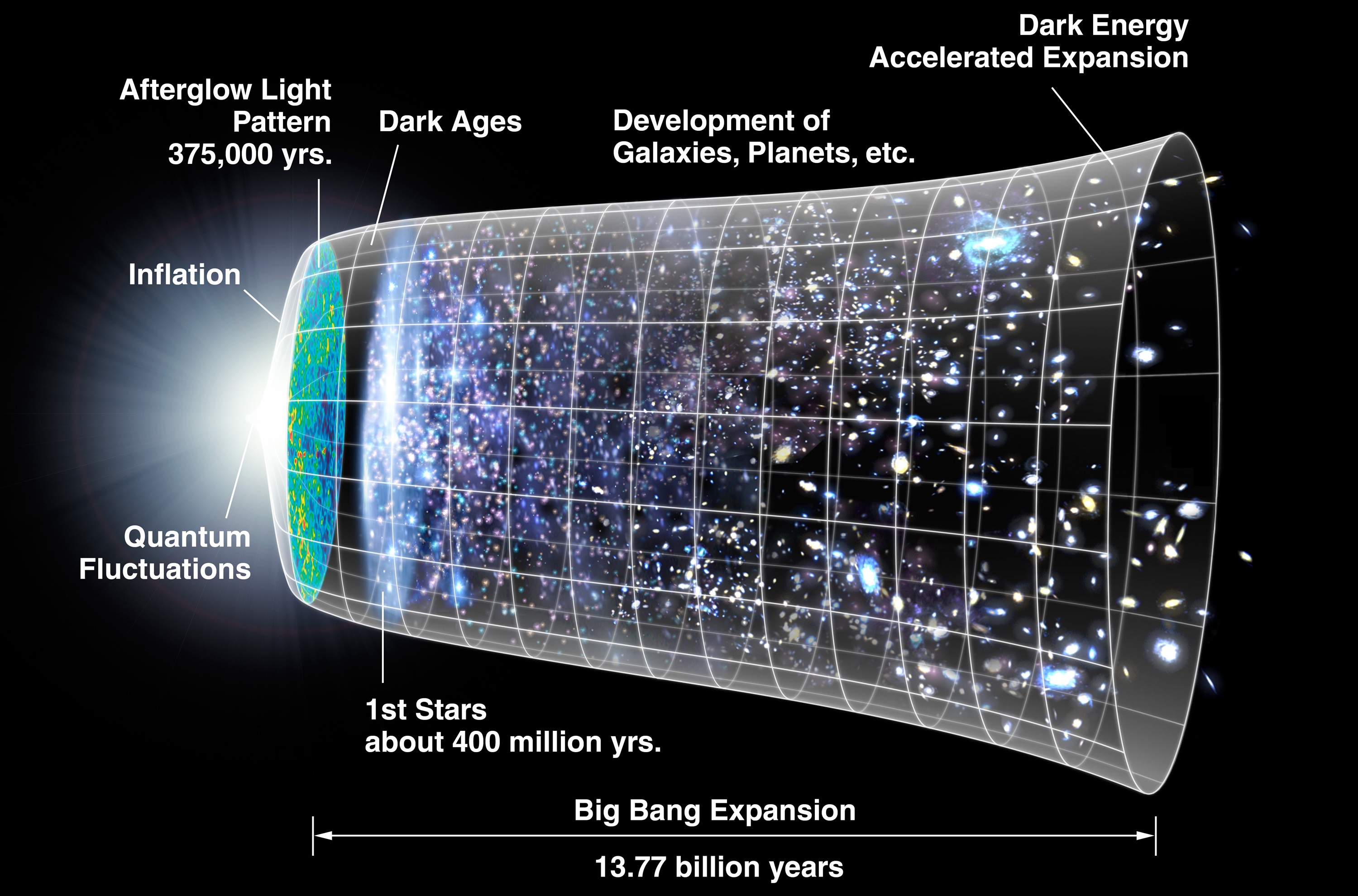
Following the initial singularity, the universe underwent a phase of rapid expansion known as cosmic inflation. Occurring within the first fraction of a second (approximately 10-32 seconds) after the Big Bang, inflation caused the universe to expand exponentially, growing faster than the speed of light. This expansion smoothed out any initial irregularities and led to the large-scale uniformity observed in the cosmos today.
Cooling and Formation of Fundamental Particles
As the universe expanded, it began to cool, allowing energy to convert into various fundamental particles. Within the first few seconds, protons and neutrons formed through processes governed by the strong and weak nuclear forces. These particles later combined to create the nuclei of simple elements like hydrogen and helium during a process known as nucleosynthesis.
Recombination and the Cosmic Microwave Background
Around 380,000 years after the Big Bang, the universe had cooled sufficiently for electrons to combine with nuclei, forming neutral atoms in a process called recombination. This decoupling of matter and radiation allowed photons to travel freely, resulting in the emission of the cosmic microwave background (CMB) radiation. The CMB serves as a critical piece of evidence for the Big Bang Theory, providing a snapshot of the universe at that early stage.
Formation of Stars and Galaxies
Over the subsequent hundreds of millions of years, gravitational forces caused matter to coalesce into the first stars and galaxies. These early stars ignited fusion processes, creating heavier elements that were disseminated throughout the universe via supernova explosions. The formation and evolution of galaxies continue to shape the large-scale structure of the cosmos.
Supporting Evidence for the Big Bang Theory
Cosmic Microwave Background (CMB) Radiation
Discovered in 1965 by Arno Penzias and Robert Wilson, the CMB is the afterglow of the Big Bang, providing a direct window into the universe's infancy. The CMB exhibits a nearly uniform temperature with slight anisotropies, which correspond to the seeds of future galaxy formation. Its uniformity and spectrum closely match the predictions of the Big Bang Theory, making it one of the most compelling pieces of evidence supporting the theory.
Hubble's Law and the Expanding Universe
Edwin Hubble's observations in the 1920s revealed that galaxies are moving away from us, with their velocities proportional to their distances—a relationship now known as Hubble's Law. This observation provided strong evidence for an expanding universe, a cornerstone of the Big Bang Theory. The extrapolation of this expansion suggests that the universe was once concentrated in a much smaller, denser state.
Abundance of Light Elements
The observed proportions of light elements, such as hydrogen, helium, and lithium, align remarkably well with predictions from Big Bang nucleosynthesis. According to the theory, these elements formed within the first few minutes after the Big Bang, and their relative abundances serve as a critical test for the theory's validity.
Large-Scale Structure of the Universe
Observations of the large-scale distribution of galaxies and galaxy clusters reveal patterns that are consistent with the initial density fluctuations predicted by the Big Bang Theory. The growth of these structures over billions of years under the influence of gravity further corroborates the theory's framework.
Alternative Theories on the Universe's Origin
Steady State Theory
The Steady State Theory posits that the universe has always existed in a constant state, with new matter continuously created to maintain a steady density despite its expansion. Proposed as an alternative to the Big Bang Theory, it was largely discredited due to the discovery of the CMB and other observational evidence supporting the Big Bang.
Cyclic Models
Cyclic models suggest that the universe undergoes endless cycles of expansion and contraction—alternating between Big Bangs and eventual Big Crunches. While intriguing, these models remain speculative and lack the empirical support that robustly backs the Big Bang Theory.
Multiverse Theories
Multiverse theories propose that our universe is just one of many within a larger multiverse. These theories attempt to explain certain fine-tuning aspects of our universe by suggesting that a multitude of universes exist with varying physical constants. While conceptually fascinating, multiverse theories face significant challenges in terms of testability and empirical validation.
Quantum Fluctuation Theories
Theories involving quantum fluctuations suggest that the universe could have emerged from fluctuations in a quantum vacuum. These ideas aim to reconcile quantum mechanics with cosmological models but remain an area of active research with many unresolved questions.
Unanswered Questions and Ongoing Research
The Origin of the Singularity
One of the most profound questions remains: What caused the initial singularity? Current physics, governed by general relativity, cannot fully describe the conditions at the singularity. This gap highlights the need for a unified theory of quantum gravity that can seamlessly integrate quantum mechanics with gravitational forces.
Dark Matter and Dark Energy
Despite comprising approximately 95% of the universe's total mass-energy content, dark matter and dark energy remain enigmatic. Dark matter interacts gravitationally but does not emit, absorb, or reflect light, making it invisible through electromagnetic observations. Dark energy, on the other hand, is hypothesized to drive the accelerated expansion of the universe. Understanding these components is crucial for a complete picture of the universe's origin and evolution.
Reconciliation of Quantum Mechanics and General Relativity
At the moment of the Big Bang, the universe was under conditions where both quantum mechanics and general relativity are significant. However, these two foundational theories of physics are currently incompatible in such extreme environments. Developing a theory of quantum gravity is essential to fully comprehend the universe's birth and the behavior of matter and energy at the smallest and largest scales simultaneously.
Advanced Theoretical Concepts
String Theory
String theory proposes that the fundamental constituents of reality are not point-like particles but rather one-dimensional "strings" vibrating at different frequencies. This theory aims to unify all fundamental forces, including gravity, into a single theoretical framework. While promising, string theory remains largely theoretical, with experimental evidence yet to support its predictions.
Loop Quantum Cosmology
Loop quantum cosmology is an application of loop quantum gravity principles to cosmological models. It suggests that the universe's expansion is quantized, potentially resolving the singularity problem by proposing a "Big Bounce" instead of a singular beginning. This model offers intriguing possibilities but requires further development and empirical validation.
Mathematical Foundations
Hubble's Law
Hubble's Law establishes a relationship between the distance of galaxies and their recession velocity, described by the equation:
$$v = H_0 \times d$$
Where:
- v is the recession velocity of a galaxy.
- H₀ is the Hubble constant, representing the rate of expansion of the universe.
- d is the distance to the galaxy.
This linear relationship supports the notion of an expanding universe, indicating that galaxies are moving away from each other over time.
Cosmic Inflation Equation
The concept of cosmic inflation is often modeled using the exponential growth equation:
$$a(t) = a_0 \cdot e^{Ht}$$
Where:
-
a(t) is the scale factor of the universe at time t.
-
a₀ is the initial scale factor.
-
H is the Hubble parameter during inflation.
This equation describes how the scale factor grows exponentially during the inflationary period, leading to a rapid expansion of space.
Timeline of the Universe
| Era | Time After Big Bang | Key Events |
|---|---|---|
| Planck Epoch | 0 to 10-43 seconds | All fundamental forces are unified; quantum gravity effects dominate. |
| Grand Unification Epoch | 10-43 to 10-36 seconds | Separation of the strong nuclear force from the electroweak force. |
| Inflationary Epoch | 10-36 to 10-32 seconds | Exponential expansion of the universe, smoothing out initial irregularities. |
| Quark Epoch | 10-12 seconds | Formation of quarks, gluons, and other fundamental particles. |
| Hadron Epoch | 10-6 seconds | Quarks combine to form hadrons, such as protons and neutrons. |
| Lepton Epoch | 1 second to 10 seconds | Formation of leptons, including electrons. |
| Photon Epoch | 10 seconds to 380,000 years | Universe becomes transparent as electrons combine with nuclei to form neutral atoms. |
| Recombination | Approximately 380,000 years | Decoupling of matter and radiation, leading to the release of CMB. |
| Dark Ages | 380,000 years to ~150 million years | Universe filled with neutral hydrogen gas, no stars or galaxies yet. |
| Reionization and Era of Structure Formation | ~150 million years onwards | Formation of first stars and galaxies; reionization of the universe. |
| Present Day | 13.8 billion years | Universe continues to expand, galaxies evolve, dark energy drives accelerated expansion. |
Current Research and Future Directions
Probing the Early Universe with Advanced Telescopes
Upcoming and existing telescopes, such as the James Webb Space Telescope (JWST) and the Extremely Large Telescope (ELT), are poised to provide unprecedented insights into the early universe. By observing distant galaxies and the CMB with higher precision, scientists aim to refine our understanding of cosmic inflation, dark matter, and the formation of large-scale structures.
Gravitational Waves and Cosmic Events
The detection of gravitational waves offers a new avenue for exploring cosmic events that are otherwise difficult to observe. Missions like LIGO and Virgo have already detected waves from merging black holes and neutron stars. Future detectors may uncover gravitational waves from the early universe, potentially providing direct evidence of inflation or other primordial phenomena.
Advancements in Particle Physics
Particle accelerators, such as the Large Hadron Collider (LHC), continue to probe the fundamental particles and forces that govern the universe. Discoveries in particle physics can have profound implications for cosmology, offering potential explanations for dark matter and insights into the conditions that prevailed during the universe's infancy.
Quantum Gravity and Theoretical Physics
Research in quantum gravity seeks to reconcile general relativity with quantum mechanics, aiming to provide a unified framework that can describe the universe at all scales. Theoretical models, including string theory and loop quantum gravity, are at the forefront of this quest, promising deeper understanding of spacetime, black holes, and the universe's origin.
Conclusion
The quest to understand how the universe began has led to some of the most significant scientific theories and discoveries in human history. The Big Bang Theory stands as the foremost explanation, offering a coherent narrative supported by extensive observational evidence, including the cosmic microwave background, Hubble's Law, and the abundance of light elements. However, the journey is far from complete. Alternative theories, such as the Steady State Theory and various multiverse hypotheses, continue to challenge and refine our understanding, pushing the boundaries of scientific inquiry.
Unanswered questions about the initial singularity, the nature of dark matter and dark energy, and the reconciliation of quantum mechanics with general relativity underscore the complexity and depth of cosmological research. As technology advances and new observational tools become available, our comprehension of the universe's origin will undoubtedly evolve, revealing new layers of complexity and beauty in the vast cosmic tapestry.
References
Last updated January 22, 2025