
Mastering اسم علم کی اقسام: A Complete Guide to Types of Proper Nouns in Urdu
Discover the rich cultural layers behind Urdu proper nouns and how they reflect identity, heritage, and literary tradition
Key Insights About Ism e Alam
- Ism e Alam encompasses five distinct categories - Khitab (خطاب), Laqab (لقب), Urf (عرف), Kunniyat (کنیت), and Takhallus (تخلص) - each serving unique cultural and linguistic functions
- These proper noun types are deeply rooted in cultural practices - reflecting social status, family relationships, personal achievements, and literary traditions in Urdu-speaking societies
- Understanding Ism e Alam is fundamental to mastering Urdu grammar - enabling students to distinguish between common nouns (Ism e Nakarah) and properly employ different types of proper nouns
Understanding Ism e Alam: The Foundation
Ism e Alam (اسم علم) is a crucial concept in Urdu grammar that refers to proper nouns - names that identify specific individuals, places, or entities. Unlike common nouns (Ism e Nakarah), which refer to general categories, Ism e Alam points to particular entities and typically begins with capital letters in written Urdu. Mastering the different types of Ism e Alam is essential for students learning Urdu, as these categories reflect the rich cultural and social dimensions of the language.
Proper nouns in Urdu are not merely grammatical constructs but windows into history, social relationships, and cultural practices. The system of titles, honorifics, pen names, and patronymics used in Urdu reflects the language's Persian and Arabic influences as well as its unique South Asian cultural context.
Definition and Importance
اسم علم وہ اسم ہے جو کسی خاص شخص، جگہ، یا چیز کا نام بتائے (Ism e Alam is a noun that names a specific person, place, or thing). These proper nouns help us distinguish between general categories and specific entities, making communication more precise and contextual.
Understanding the various types of Ism e Alam is not just a grammatical exercise but also provides insight into social structures, literary traditions, and cultural practices in Urdu-speaking societies.
The Five Types of Ism e Alam
Urdu proper nouns are categorized into five main types, each with distinct characteristics and cultural significance. Let's explore each type in detail:
1. Khitab (خطاب) - Title
Khitab refers to titles or honorifics that precede a person's name, indicating their profession, academic achievements, or social status.
Examples of Khitab
- سر سید احمد خان (Sir Syed Ahmad Khan) - Where "Sir" is the Khitab
- ڈاکٹر علامہ محمد اقبال (Dr. Allama Muhammad Iqbal) - Where "Doctor" and "Allama" are Khitab
- پروفیسر فاطمہ (Professor Fatima) - Where "Professor" is the Khitab
2. Laqab (لقب) - Epithet
Laqab refers to epithets or honorary surnames that describe a person's characteristics, achievements, or status. These often follow a person's name and highlight their notable qualities.
Examples of Laqab
- محمد علی جناح قائد اعظم (Muhammad Ali Jinnah Quaid-e-Azam) - Where "Quaid-e-Azam" (Great Leader) is the Laqab
- ابو بکر صدیق (Abu Bakr Siddiq) - Where "Siddiq" (Truthful) is the Laqab
- حسن بصری (Hassan Basri) - Where "Basri" (from Basra) is the Laqab
3. Urf (عرف) - Common Name
Urf refers to familiar names or nicknames used in everyday conversation, often shorter or more casual versions of formal names.
Examples of Urf
- امجد عرف گدو (Amjad known as Guddu) - Where "Guddu" is the Urf
- شاہد عرف شادو (Shahid known as Shadu) - Where "Shadu" is the Urf
- منیرہ عرف منی (Muneera known as Munni) - Where "Munni" is the Urf
4. Kunniyat (کنیت) - Patronymic
Kunniyat refers to names derived from familial relationships, typically using prefixes like "Abu" (father of) or "Umm" (mother of) followed by the name of a child, usually the firstborn.
Examples of Kunniyat
- ابو بکر (Abu Bakr) - Father of Bakr
- ام کلثوم (Umm Kulthum) - Mother of Kulthum
- ابن سعد (Ibn Saad) - Son of Saad
- بنت فاطمہ (Bint Fatima) - Daughter of Fatima
5. Takhallus (تخلص) - Pen Name
Takhallus refers to pen names or literary pseudonyms adopted by poets and writers, often used in their literary works and becoming an integral part of their identity.
Examples of Takhallus
- اسد اللہ خان غالب (Asadullah Khan Ghalib) - Where "Ghalib" is the Takhallus
- فیض احمد فیض (Faiz Ahmad Faiz) - Where "Faiz" is the Takhallus
- جوش ملیح آبادی (Josh Malihabadi) - Where "Josh" is the Takhallus
Comparative Analysis of Ism e Alam Types
The different types of Ism e Alam can be analyzed and compared across various dimensions, including their cultural significance, usage contexts, historical importance, and grammatical function. The following radar chart illustrates how these types compare across different attributes:
The radar chart illustrates that Khitab has high formal usage and social status indication, while Takhallus excels in literary value and historical significance. Kunniyat is particularly strong in religious contexts, and Urf has the highest contemporary relevance in everyday conversation.
Conceptual Relationships: Ism e Alam Mindmap
The following mindmap illustrates the relationship between Ism e Alam and its various types, along with their key characteristics and examples:
Official titles & honorifics"] Honorifics["Academic & Professional
سر (Sir), ڈاکٹر (Doctor)"] Religious["Religious Titles
علامہ (Allama), مولانا (Maulana)"] لقب["لقب (Laqab)
Epithets & descriptive titles"] Achievement["Achievement-based
قائد اعظم (Quaid-e-Azam)"] Character["Character traits
صدیق (Siddiq - Truthful)"] عرف["عرف (Urf)
Nicknames & familiar names"] Endearment["Terms of endearment
گدو (Guddu), منی (Munni)"] Shortened["Shortened forms
شادو (Shadu)"] کنیت["کنیت (Kunniyat)
Relational names"] Paternal["Paternal relation
ابو بکر (Abu Bakr)"] Maternal["Maternal relation
ام کلثوم (Umm Kulthum)"] Lineage["Lineage indicators
ابن سعد (Ibn Saad)"] تخلص["تخلص (Takhallus)
Pen names & literary pseudonyms"] Classical["Classical poets
غالب (Ghalib), حالی (Hali)"] Modern["Modern writers
فیض (Faiz), جوش (Josh)"]
This mindmap shows how the different types of Ism e Alam are categorized and their relationship to the main concept. It helps visualize the hierarchical structure and provides examples for each category.
Comprehensive Lesson Plan: Ism e Alam ki Iqsam
Lesson Details
| Element | Details |
|---|---|
| Grade Level | Middle School (Classes 6-8) |
| Subject | Urdu Grammar |
| Duration | 2 sessions of 45 minutes each |
| Learning Objectives |
1. Define and explain Ism e Alam 2. Identify and describe the five types of Ism e Alam 3. Distinguish between different types using examples 4. Apply knowledge by creating sentences using various types 5. Differentiate between Ism e Alam and Ism e Nakarah |
| Materials Required |
- Whiteboard and markers - Handouts with examples - Projector for visual aids - Chart paper for group activities - Example cards with names - Assessment worksheets |
Lesson Structure: Day 1
Introduction (10 minutes)
- Begin with a warm-up activity: Ask students to write their full names and any nicknames they have.
- Introduce the concept of Ism e Alam by contrasting proper nouns with common nouns.
- Explain that in Urdu culture, names often carry additional information about status, profession, or relationships.
Presentation (20 minutes)
- Provide a clear definition of Ism e Alam with everyday examples.
- Introduce the five types of Ism e Alam using the prepared chart.
- For each type, provide multiple examples and explain their cultural context.
- Use pictures of famous personalities to illustrate different name types.
Guided Practice (15 minutes)
- Divide students into pairs and distribute handouts with examples of each type.
- Ask students to identify which type of Ism e Alam is represented in each example.
- Review answers as a class, clarifying any misconceptions.
Lesson Structure: Day 2
Review (10 minutes)
- Briefly review the five types of Ism e Alam discussed in the previous session.
- Ask students to share one example for each type from memory.
Group Activity (20 minutes)
- Divide students into five groups, each assigned one type of Ism e Alam.
- Provide each group with chart paper and art supplies.
- Task: Create a creative poster that explains their assigned type with examples and illustrations.
- Groups should find at least five examples not mentioned in class.
Presentations (10 minutes)
- Each group presents their poster to the class, explaining the examples they chose.
- Encourage questions and discussions from other students.
Assessment (5 minutes)
- Distribute individual worksheets with mixed examples of Ism e Alam.
- Students must identify the type of each example and create one original sentence using each type.
Differentiation Strategies
- For advanced learners: Research the historical origins of titles and pen names in Urdu literature.
- For struggling learners: Provide a simplified chart with fewer examples and more visual cues.
- For visual learners: Incorporate more images and color-coding in the materials.
Assessment Criteria
- Ability to correctly identify the five types of Ism e Alam
- Accuracy in classifying examples under the correct categories
- Quality of original sentences created using different types
- Participation in group activities and discussions
- Creativity and accuracy in poster creation
Visual Resources for Teaching
Here are some visual resources to enhance the learning experience when teaching about Ism e Alam ki Iqsam:
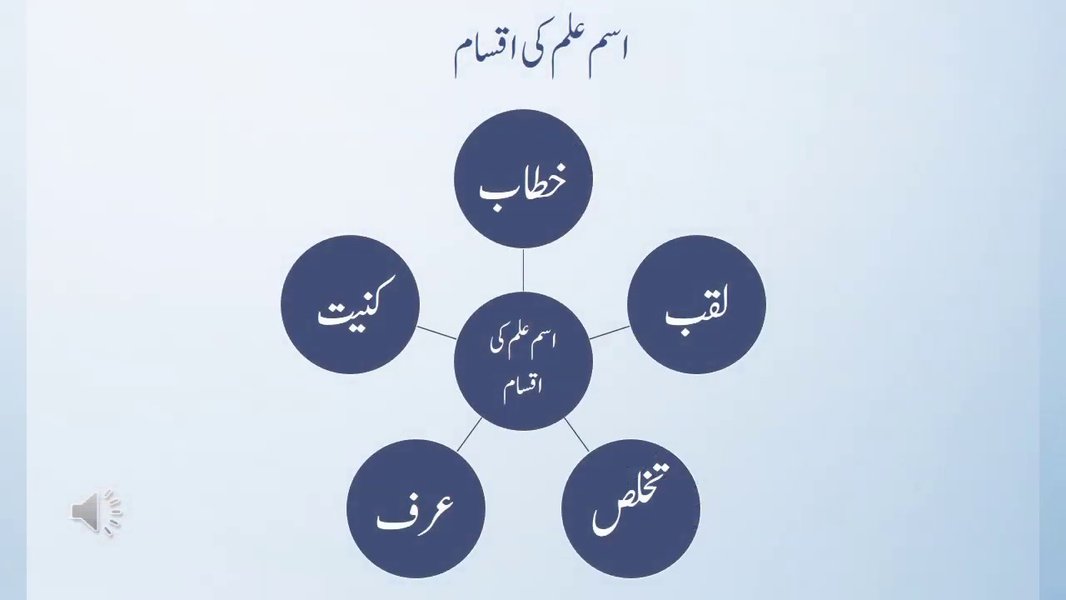
A comprehensive chart showing the types of Ism e Alam with examples
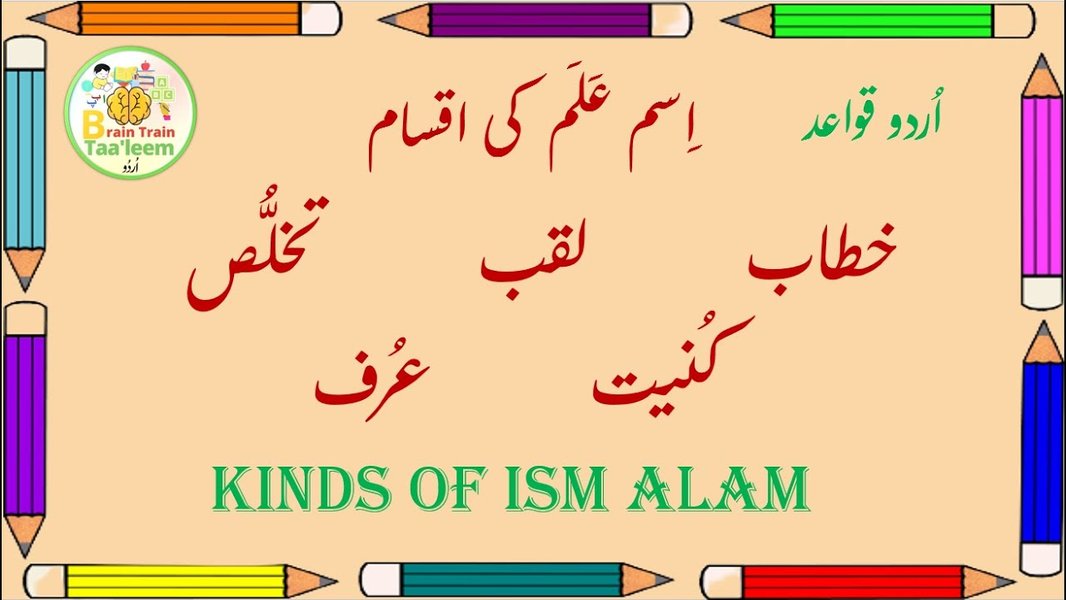
Visual representation of different types of Ism e Alam with examples
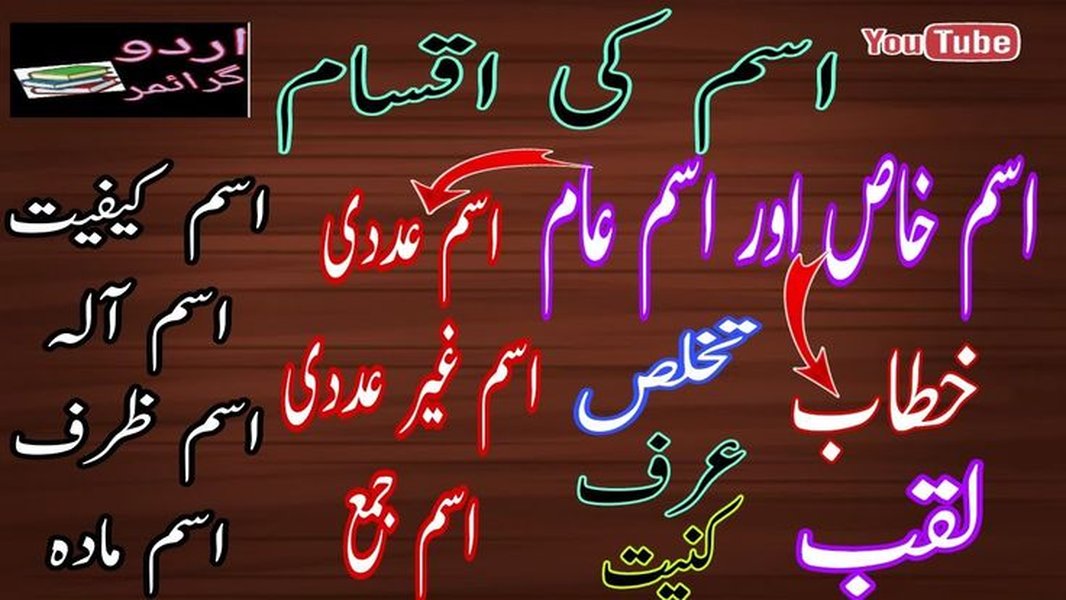
Educational chart showing broader categories of Ism (nouns) in Urdu grammar
Video Explanation
This educational video provides a clear explanation of the different types of Ism e Alam in Urdu with numerous examples. It can be used as supplementary material during the lesson or as a reference for students who need additional review.
The video explains each type of Ism e Alam with multiple examples and provides context for how these proper nouns are used in everyday language and literature. It's particularly helpful for students who benefit from audio-visual learning approaches.
Frequently Asked Questions
References
- Ism Alam ki Iqsam in Urdu - Urdu Notes
- Ism Alam Ki Kitni Kisme Hai - Urdu Notes
- Ism-E-Ilm || اسم معرفہ (خاص) کی ایک قسم اسم علم - Unacademy
- Urdu Grammar Rules: The Ultimate Guide - Ling App
- Urdu Grammar Online: اسم علم کی اقسام
- اسم علم کی تعریف | اسم علم کی اقسام - Prem Nath Bismil
Recommended Explorations
 urduassigment.blogspot.com
 urdugrammaronline.blogspot.com
 bsislamicstudies.wordpress.com
Last updated April 6, 2025