
Unveiling the 27 Pillars of American Democracy: A Concise Guide to U.S. Constitutional Amendments
Explore the evolution of American rights and governance through one-sentence summaries of each constitutional amendment.
The United States Constitution, the bedrock of American law and governance, was established on March 4, 1789. It is a living document, designed to adapt to the changing needs and values of the nation. This adaptability is achieved through amendments, formal changes to the Constitution's text. Over more than two centuries, twenty-seven amendments have been ratified, each reflecting a significant shift or clarification in American society, law, or governmental structure. The process for amending the Constitution, outlined in Article V, is rigorous, requiring proposal by a two-thirds majority in both houses of Congress or by a national convention called for by two-thirds of state legislatures, followed by ratification by three-fourths of the states. This intricate process ensures that only amendments with broad support become part of the nation's foundational law.
Key Insights into the Amendments
- The Bill of Rights: The first ten amendments, collectively known as the Bill of Rights, were ratified in 1791 to guarantee fundamental individual liberties and limit government power.
- Evolution of Rights and Governance: Subsequent amendments have addressed critical issues such as the abolition of slavery, the expansion of voting rights, changes in governmental procedures, and the establishment of federal income tax.
- A Living Document: The 27 amendments demonstrate the Constitution's capacity to evolve, reflecting societal progress and addressing historical injustices and new challenges faced by the nation.
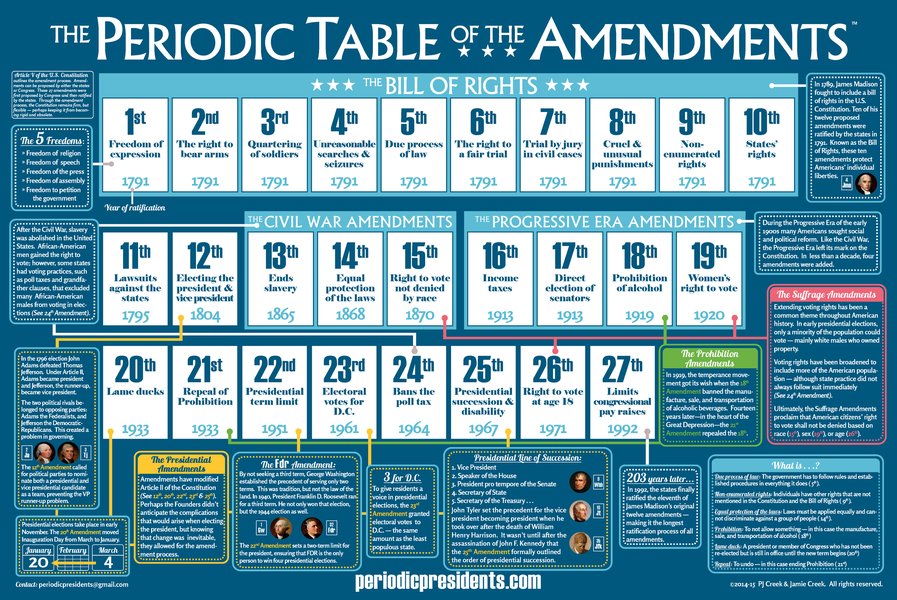
A visual representation conceptualizing the amendments, highlighting their organized structure within the Constitution.
Summaries of the 27 Amendments
Each amendment to the U.S. Constitution represents a pivotal moment in American history, shaping the rights of citizens and the framework of the government. Below is a concise one-sentence summary for each of these 27 amendments.
The Bill of Rights (Amendments 1-10)
Ratified in 1791, the Bill of Rights outlines fundamental freedoms and protections for individuals against government overreach. These first ten amendments were introduced to address concerns of early American leaders about safeguarding individual liberties.
An image symbolizing the foundational importance of the Bill of Rights in protecting citizen liberties.
1. First Amendment
Guarantees freedoms concerning religion, speech, the press, assembly, and the right to petition the government.
2. Second Amendment
Protects the right of the people to keep and bear arms, in the context of a well-regulated militia.
3. Third Amendment
Prohibits the quartering of soldiers in private homes without the owner's consent during peacetime or as prescribed by law in wartime.
4. Fourth Amendment
Protects individuals from unreasonable searches and seizures and requires warrants to be judicially sanctioned and supported by probable cause.
5. Fifth Amendment
Guarantees due process of law, protects against self-incrimination and double jeopardy, and ensures just compensation for private property taken for public use.
6. Sixth Amendment
Guarantees the rights to a speedy and public trial by an impartial jury, to be informed of charges, to confront witnesses, to compel favorable witnesses, and to have the assistance of counsel.
7. Seventh Amendment
Preserves the right to a jury trial in certain civil cases according to common law.
8. Eighth Amendment
Prohibits excessive bail, excessive fines, and cruel and unusual punishments.
9. Ninth Amendment
Enshrines that the enumeration of specific rights in the Constitution does not mean other rights not listed are denied to the people.
10. Tenth Amendment
Reinforces federalism by reserving powers not delegated to the United States by the Constitution, nor prohibited by it to the States, to the States respectively, or to the people.
Subsequent Amendments (Amendments 11-27)
These amendments reflect the nation's growth and evolving understanding of justice, equality, and governance, addressing issues from state sovereignty to presidential succession and voting rights.
11. Eleventh Amendment (1795)
Restricts the ability of individuals to sue states in federal court, affirming state sovereign immunity.
12. Twelfth Amendment (1804)
Modifies the procedure for electing the President and Vice President by the Electoral College, requiring separate ballots for each office.
13. Thirteenth Amendment (1865)
Formally abolishes slavery and involuntary servitude, except as punishment for a crime.
14. Fourteenth Amendment (1868)
Defines citizenship, guarantees all citizens "equal protection of the laws," and extends due process rights to apply to the states.
15. Fifteenth Amendment (1870)
Prohibits the denial of the right to vote based on race, color, or previous condition of servitude.
16. Sixteenth Amendment (1913)
Authorizes Congress to levy an income tax without apportioning it among the states or basing it on Census results.
17. Seventeenth Amendment (1913)
Establishes the direct election of United States senators by popular vote in each state.
18. Eighteenth Amendment (1919)
Prohibited the manufacturing, sale, or transportation of intoxicating liquors for beverage purposes (Prohibition).
19. Nineteenth Amendment (1920)
Guarantees women the right to vote by prohibiting denial of suffrage on the basis of sex.
20. Twentieth Amendment (1933)
Changes the dates when presidential, vice-presidential, and congressional terms begin and end (January 20th for President/VP, January 3rd for Congress), and addresses presidential succession details, often called the "lame duck" amendment.
21. Twenty-First Amendment (1933)
Repeals the Eighteenth Amendment, ending the national prohibition of alcohol, but allows states to regulate it.
22. Twenty-Second Amendment (1951)
Limits presidents to a maximum of two elected terms in office, or one term if they served more than two years of another president's term.
23. Twenty-Third Amendment (1961)
Grants residents of the District of Columbia the right to vote for the President by allocating it electoral votes as if it were a state, but no more than the least populous state.
24. Twenty-Fourth Amendment (1964)
Prohibits conditioning the right to vote in federal elections (for President, Vice President, or members of Congress) on payment of a poll tax or other types of tax.
25. Twenty-Fifth Amendment (1967)
Establishes procedures for presidential succession, disability, and filling a vacancy in the office of the Vice President.
26. Twenty-Sixth Amendment (1971)
Lowers the national minimum voting age from 21 to 18 for all federal and state elections.
27. Twenty-Seventh Amendment (1992)
Prohibits any law increasing or decreasing the salary of members of Congress from taking effect until the start of the next term of office (after an intervening election of Representatives).
Thematic Overview of Amendments
The amendments to the Constitution can be grouped by their primary impact and scope. The following chart offers a conceptual visualization of how different sets of amendments have influenced key areas of American life and governance. The scores (on a scale of 1 to 10) represent a qualitative assessment of the general impact or focus within each category, not a precise quantitative measurement.
This radar chart helps to illustrate the multifaceted nature of constitutional amendments, showing how different historical periods brought forth changes focused on varying aspects of American democracy.
Categorizing the Amendments
To better understand the broad themes addressed by the 27 amendments, they can be organized into several key categories. The mindmap below provides a visual representation of these groupings, helping to highlight the interconnectedness and distinct focuses of various amendments.
(1st Am.)"] id1b["Rights of the Accused
(4th, 5th, 6th, 8th Am.)"] id1c["Limits on Government &
Other Protections
(2nd, 3rd, 7th, 9th, 10th Am.)"] id2["Post-Civil War /
Reconstruction (13-15)"] id2a["Abolition of Slavery (13th Am.)"] id2b["Citizenship & Equal Protection
(14th Am.)"] id2c["Voting Rights (Race-Based)
(15th Am.)"] id3["Progressive Era (16-19)"] id3a["Income Tax (16th Am.)"] id3b["Direct Election of Senators
(17th Am.)"] id3c["Prohibition of Alcohol
(18th Am.)"] id3d["Women's Suffrage (19th Am.)"] id4["Governmental Operations &
Procedures (11, 12, 20, 22, 25, 27)"] id4a["State Sovereign Immunity
(11th Am.)"] id4b["Electoral College Revision
(12th Am.)"] id4c["Presidential Terms/Succession
(20th, 22nd, 25th Am.)"] id4d["Congressional Pay
(27th Am.)"] id5["Expansion of Suffrage &
Civil Rights (23, 24, 26)"] id5a["D.C. Presidential Vote
(23rd Am.)"] id5b["Abolition of Poll Tax
(24th Am.)"] id5c["Voting Age to 18 (26th Am.)"] id6["Unique Amendment (21)"] id6a["Repeal of Prohibition (21st Am.)"]
This mindmap illustrates how amendments often cluster around significant historical periods or address overarching themes such as individual rights, governmental reform, or the expansion of democracy.
Amendments at a Glance: Key Details
The following table provides a quick reference for each amendment, including its year of ratification, a very brief summary of its core provision, and a general category it falls into. This allows for an easy comparison of when and why each amendment was added to the Constitution.
| Amendment | Year Ratified | Primary Focus | Category |
|---|---|---|---|
| 1st | 1791 | Freedoms of religion, speech, press, assembly, petition | Individual Rights |
| 2nd | 1791 | Right to bear arms | Individual Rights |
| 3rd | 1791 | No quartering of soldiers | Individual Rights |
| 4th | 1791 | Protection from unreasonable search and seizure | Individual Rights |
| 5th | 1791 | Due process, no self-incrimination, double jeopardy | Individual Rights |
| 6th | 1791 | Rights of accused in criminal prosecutions | Individual Rights |
| 7th | 1791 | Jury trial in civil cases | Judicial Process |
| 8th | 1791 | No excessive bail or cruel/unusual punishment | Individual Rights |
| 9th | 1791 | Unenumerated rights retained by people | Individual Rights |
| 10th | 1791 | Powers reserved to states or people | Governmental Structure |
| 11th | 1795 | Suits against states | Governmental Structure |
| 12th | 1804 | Election of President and Vice President | Electoral Process |
| 13th | 1865 | Abolition of slavery | Civil Rights |
| 14th | 1868 | Citizenship, due process, equal protection | Civil Rights |
| 15th | 1870 | Right to vote regardless of race | Suffrage/Civil Rights |
| 16th | 1913 | Federal income tax | Economic |
| 17th | 1913 | Direct election of senators | Governmental Structure |
| 18th | 1919 | Prohibition of alcohol | Social Regulation |
| 19th | 1920 | Women's suffrage | Suffrage/Civil Rights |
| 20th | 1933 | Presidential term start; "lame duck" sessions | Governmental Structure |
| 21st | 1933 | Repeal of Prohibition (18th Amendment) | Social Regulation |
| 22nd | 1951 | Presidential term limits | Governmental Structure |
| 23rd | 1961 | Presidential electors for D.C. | Suffrage/Electoral Process |
| 24th | 1964 | Abolition of poll taxes in federal elections | Suffrage/Civil Rights |
| 25th | 1967 | Presidential disability and succession | Governmental Structure |
| 26th | 1971 | Right to vote at age 18 | Suffrage/Civil Rights |
| 27th | 1992 | Congressional pay raises | Governmental Structure |
Understanding the Amendments: A Deeper Dive
For those interested in a more detailed explanation of the amendments and the process of their ratification, the following video from the National Constitution Center provides an excellent overview. It walks through each of the 27 amendments, offering context and insights into their significance in shaping American constitutional law.
This video, "27 Amendments Walkthrough | Constitution 101," features Jeffrey Rosen, president and CEO of the National Constitution Center. It explores how new amendments are ratified and discusses the impact of these changes on the Constitution and American society. Watching this can provide a richer understanding beyond the one-sentence summaries provided here.
Frequently Asked Questions (FAQ)
What are the Bill of Rights?
How many amendments are there to the U.S. Constitution?
How is the U.S. Constitution amended?
Which constitutional amendment has been repealed?
Why is the 27th Amendment unique?
Conclusion
The 27 amendments to the U.S. Constitution are a testament to the nation's enduring commitment to adapting its foundational laws to meet the evolving demands of justice, equality, and effective governance. From the fundamental freedoms enshrined in the Bill of Rights to the expansions of suffrage and clarifications of governmental processes in later amendments, each change reflects a chapter in the American story. Understanding these amendments provides crucial insight into the rights and responsibilities of citizens and the structure of American democracy, highlighting the Constitution's role as a dynamic and living document.
Recommended Further Exploration
- What was the historical context behind the Bill of Rights?
- How did the Reconstruction Amendments (13th, 14th, 15th) change American society?
- Explore the impact of the 19th Amendment on women's rights and American politics.
- What are some proposed constitutional amendments that were never ratified?
References
Last updated May 21, 2025