
Understanding the US Electoral College: Is it Fair?
Exploring the system for electing the American president and the ongoing debate surrounding its fairness.
Key Highlights
- The Electoral College is the system used in the United States to elect the president and vice president, where electors cast votes based on the popular vote in their state.
- The system is designed to balance the power of more populous states with that of less populated states, ensuring representation for smaller regions.
- A major point of contention is that a candidate can win the presidency without winning the nationwide popular vote, which has occurred in several US elections.
What is the Electoral College and How Does it Work?
The Electoral College is a unique aspect of the United States presidential election process. Instead of directly electing the president through a nationwide popular vote, citizens cast ballots for a slate of electors who are pledged to a particular presidential candidate. These electors then cast the official votes, known as electoral votes, to determine the winner of the presidency.
Each state is allocated a number of electors equal to its total number of representatives in Congress (its two senators plus its number of representatives in the House of Representatives). There are a total of 538 electoral votes, and a candidate needs a majority of 270 electoral votes to win the presidency.
In almost all states (48 states and the District of Columbia), the candidate who wins the popular vote in that state receives all of that state's electoral votes. This is known as the "winner-takes-all" system. Maine and Nebraska are the only exceptions, using a district system where electoral votes can be split based on the popular vote in each congressional district and the statewide winner.
The Historical Context and Purpose
The Electoral College was established by the Founding Fathers during the Constitutional Convention. There was debate among the founders about how the president should be elected, with some favoring a popular vote and others preferring that Congress choose the president. The Electoral College was a compromise between these two approaches.
One of the key motivations behind the Electoral College was to balance the power between more populous states and less populated states. The founders were concerned that a direct popular vote would give undue influence to states with larger populations, potentially overshadowing the concerns of smaller states. The Electoral College aimed to ensure that candidates would need to build broad support across different states and regions, rather than just focusing on densely populated areas.
Another consideration was the belief that electors, who were intended to be knowledgeable and informed individuals, would make a more considered decision than the general public in an era when information dissemination was limited.
The Debate: Is the Electoral College Fair?
The fairness of the Electoral College has been a subject of continuous debate throughout US history. The primary argument against the system is that it can result in a candidate winning the presidency without winning the national popular vote. This has happened in several elections, including those in 2000 and 2016, where the candidate with fewer popular votes won the electoral vote and thus the presidency.
Critics argue that this outcome is undemocratic, as it goes against the principle of majority rule. They contend that every vote should carry equal weight, regardless of the voter's location, and that the person with the most individual votes nationwide should win the election. The winner-takes-all system in most states is particularly criticized for potentially ignoring the votes of those who supported the losing candidate in that state.
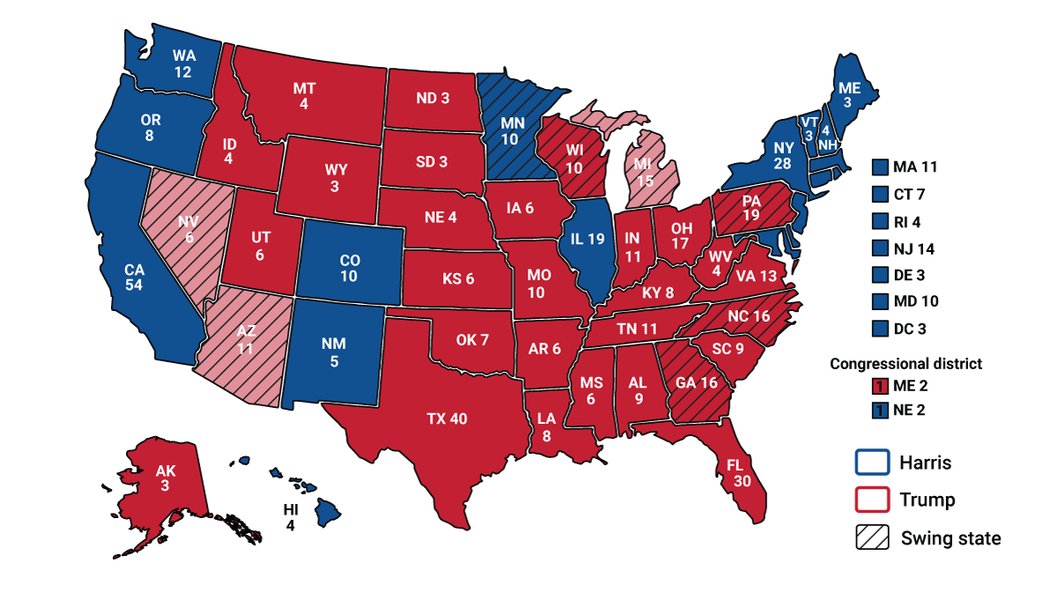
An example of an Electoral College map showing state allocations.
Supporters of the Electoral College argue that it remains a fair system that upholds the principles of federalism. They emphasize that the US is a republic of states, and the Electoral College ensures that all states, including those with smaller populations, have a voice in the presidential election. They argue that a direct popular vote would lead candidates to focus their campaigns only on heavily populated urban areas, neglecting the concerns of rural and less populated regions.
Proponents also suggest that the Electoral College promotes national unity by requiring candidates to build coalitions across diverse states and interests. They argue that it prevents a situation where a candidate could win the presidency with narrow regional support, forcing candidates to appeal to a broader range of voters.
Arguments for and Against the Electoral College
Here's a summary of the main arguments surrounding the Electoral College:
| Arguments For the Electoral College | Arguments Against the Electoral College |
|---|---|
| Protects the interests of less populous states. | Allows a candidate to win the presidency without the national popular vote. |
| Promotes national unity by requiring broad support across states. | Diminishes the value of individual votes, especially for those on the losing side in a state. |
| Encourages candidates to campaign in a variety of states. | Focuses campaign attention on a few "swing states." |
| Reflects the federal nature of the United States. | Is considered outdated and not truly democratic by some. |
| Prevents a "tyranny of the majority" where a few large cities could decide the election. | Can depress voter turnout in states considered "safe" for one party. |
Alternatives and Potential Reforms
Given the ongoing debate, various alternatives and reforms to the Electoral College have been proposed. One prominent alternative is a national popular vote, where the candidate with the most individual votes across the country wins the presidency. This would ensure that the winner always has the support of the majority of individual voters.
Another proposed reform is the National Popular Vote Interstate Compact, an agreement among states to award their electoral votes to the candidate who wins the national popular vote, regardless of the statewide outcome. This compact would go into effect once enough states join to reach the 270 electoral votes needed to win the presidency.
Other suggested changes include the proportional allocation of electoral votes within each state, rather than the winner-takes-all system. This would award electoral votes based on the percentage of the popular vote each candidate receives in a state.
Public Opinion on the Electoral College
Public opinion on the Electoral College has varied over time. Recent polls have shown that a majority of Americans favor changing the system to a national popular vote. For example, a Pew Research Center survey in 2024 found that 63% of US adults believe the president should be elected by the popular vote nationwide, while 35% prefer keeping the Electoral College.
Frequently Asked Questions
How are electors chosen?
Each political party with a presidential candidate on the ballot in a state typically nominates a slate of electors. The specific method for choosing electors varies by state and political party, but it often involves state party conventions or committees.
Do electors have to vote for the candidate who won their state's popular vote?
While electors are generally pledged to vote for the candidate who won their state's popular vote, there is no federal law requiring them to do so. These are sometimes referred to as "faithless electors." However, some states have laws that bind electors to the popular vote outcome, and faithless electors have rarely affected the outcome of a presidential election.
What happens if no candidate receives 270 electoral votes?
If no candidate receives a majority of the electoral votes (270 out of 538), the decision goes to the House of Representatives. In this scenario, each state delegation in the House gets one vote, and they choose among the top three presidential candidates. The Vice President is then chosen by the Senate.
References
Last updated May 7, 2025