

Key Insights into Volume Calculation
- Understanding the Region: The volume is defined by the intersection of a downward-opening paraboloid \(z = 2 - x^2 - y^2\) and a horizontal plane \(z = 1\), restricted to the first octant (\(x \ge 0, y \ge 0, z \ge 0\)).
- Projection onto the XY-Plane: The critical step for setting up integral bounds is identifying the projection of the intersection onto the XY-plane, which is a quarter-circle of radius 1, defined by \(x^2 + y^2 \le 1\) in the first quadrant.
- Coordinate System Advantages: While Cartesian coordinates provide a direct approach, cylindrical coordinates often simplify integration for regions with circular symmetry due to the inherent radial component.
Visualizing the Bounded Region: A Geometric Perspective
To accurately set up the triple integrals, it is crucial to first visualize the three-dimensional region whose volume we intend to calculate. This region is defined by the interplay of two surfaces and the constraint of the first octant.
The Paraboloid: Our Upper Bound
The surface \(z = 2 - x^2 - y^2\) represents a paraboloid that opens downwards. Its vertex is located at the point \((0, 0, 2)\) on the z-axis. As \(x\) and \(y\) increase, the value of \(z\) decreases, forming a bowl-like shape. We are interested in the portion of this paraboloid that serves as the upper boundary of our region.
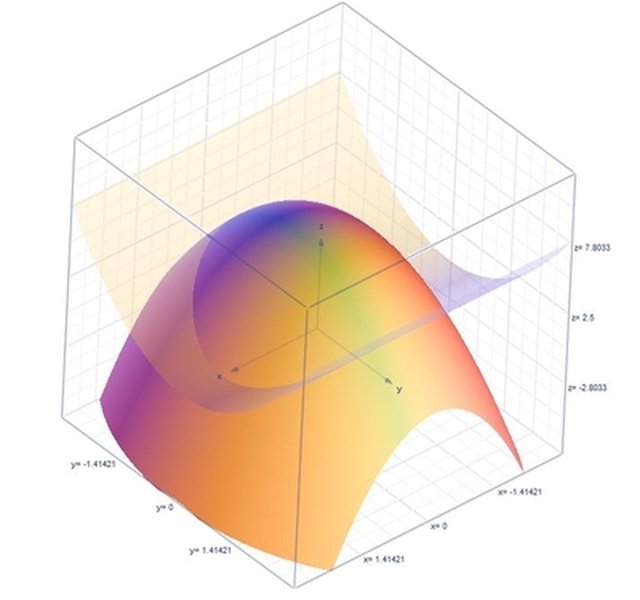
A visual representation of a paraboloid, illustrating its downward curvature from its vertex.
The Plane: Our Lower Bound
The surface \(z = 1\) is a horizontal plane parallel to the XY-plane. It acts as the lower boundary for the volume we are considering. This plane effectively "cuts" through the paraboloid, creating a bounded region above it.
The First Octant Constraint
The "first octant" condition means that we are only considering the part of the region where \(x \ge 0\), \(y \ge 0\), and \(z \ge 0\). This significantly restricts the domain of integration to one-eighth of the entire space, ensuring that our calculated volume is positive and geometrically meaningful.
Determining the Region of Intersection and Projection
The critical step in defining the integral limits is understanding where the paraboloid and the plane intersect. Setting their \(z\) values equal:
\[ 1 = 2 - x^2 - y^2 \]
Rearranging this equation gives:
\[ x^2 + y^2 = 1 \]
This equation describes a circle of radius 1 centered at the origin in the XY-plane. Since our region is confined to the first octant, the projection of the volume onto the XY-plane is a quarter-circle of radius 1, located in the first quadrant where \(x \ge 0\) and \(y \ge 0\).
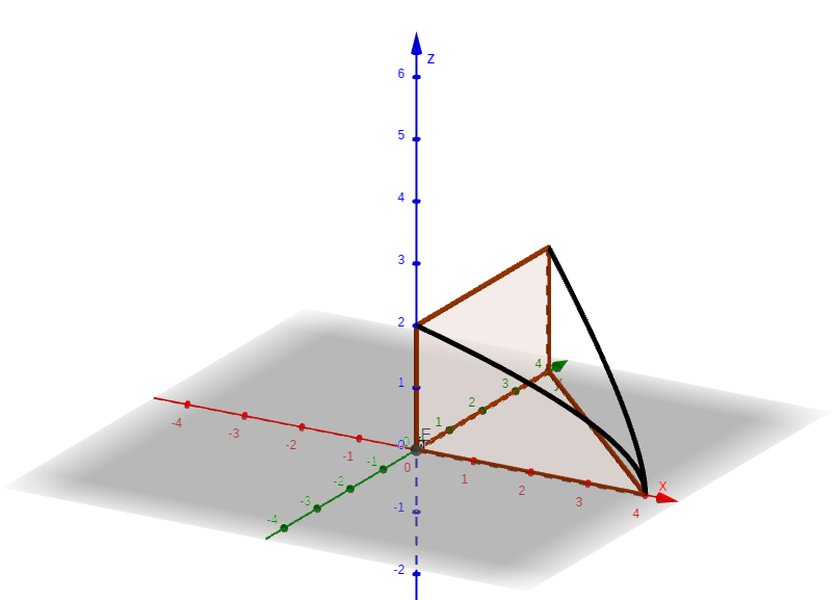
The quarter-circle projection in the XY-plane, crucial for defining integration limits.
Setting Up Triple Integrals in Cartesian Coordinates
For Cartesian coordinates, we need to define the bounds for \(z\), \(y\), and \(x\) in that specific order: \(dV = dz\, dy\, dx\). This approach involves slicing the volume into infinitesimally small rectangular prisms.
Bounds for z
For any given point \((x, y)\) within the projected region on the XY-plane, \(z\) varies from the lower bounding plane to the upper bounding paraboloid. Therefore, the limits for \(z\) are:
\[ 1 \leq z \leq 2 - x^2 - y^2 \]
Bounds for y
Considering the projection onto the XY-plane, which is a quarter-circle of radius 1, \(y\) ranges from the x-axis (\(y=0\)) up to the curve of the circle. From \(x^2 + y^2 = 1\), we get \(y = \sqrt{1 - x^2}\). Thus, for a fixed \(x\), the limits for \(y\) are:
\[ 0 \leq y \leq \sqrt{1 - x^2} \]
Bounds for x
Finally, \(x\) spans the entire extent of the quarter-circle in the first quadrant, starting from the origin and extending to the edge of the circle. The limits for \(x\) are:
\[ 0 \leq x \leq 1 \]
The Cartesian Triple Integral
Combining these bounds, the triple integral for the volume in Cartesian coordinates is:
\[ \boxed{ \int_{x=0}^{1} \int_{y=0}^{\sqrt{1 - x^2}} \int_{z=1}^{2 - x^2 - y^2} dz\, dy\, dx } \]
Setting Up Triple Integrals in Cylindrical Coordinates
Cylindrical coordinates are often preferred when dealing with regions that possess circular symmetry, as is the case with our paraboloid and its circular intersection. The conversion involves substituting \(x = r \cos \theta\), \(y = r \sin \theta\), and \(x^2 + y^2 = r^2\). The differential volume element \(dV\) becomes \(r\, dz\, dr\, d\theta\).
This video provides a comprehensive tutorial on understanding and applying triple integrals in cylindrical coordinates, covering how to conceptualize and read these coordinates, which is directly relevant to setting up part (b) of the problem.
Converting the Surfaces
The paraboloid \(z = 2 - x^2 - y^2\) transforms to \(z = 2 - r^2\) in cylindrical coordinates. The plane \(z = 1\) remains \(z = 1\).
Bounds for z
Similar to Cartesian coordinates, \(z\) is bounded by the plane below and the paraboloid above:
\[ 1 \leq z \leq 2 - r^2 \]
Bounds for r
The projection onto the XY-plane is a quarter-circle of radius 1. In cylindrical coordinates, the radius \(r\) extends from the origin to the boundary of this quarter-circle. The intersection \(x^2 + y^2 = 1\) becomes \(r^2 = 1\), implying \(r = 1\) (since \(r \ge 0\)). Thus, the limits for \(r\) are:
\[ 0 \leq r \leq 1 \]
Bounds for θ
The first octant restriction for \(x\) and \(y\) translates to a specific angular range in cylindrical coordinates. The first quadrant of the XY-plane corresponds to angles from \(0\) to \(\frac{\pi}{2}\) radians. Therefore, the limits for \(\theta\) are:
\[ 0 \leq \theta \leq \frac{\pi}{2} \]
The Cylindrical Triple Integral
With these cylindrical bounds and the volume element \(dV = r\, dz\, dr\, d\theta\), the triple integral for the volume is:
\[ \boxed{ \int_{\theta=0}^{\pi/2} \int_{r=0}^{1} \int_{z=1}^{2 - r^2} r\, dz\, dr\, d\theta } \]
Summary of Integral Setups
The table below provides a concise summary of the triple integral setups for the volume of the defined region in both Cartesian and cylindrical coordinates. This quick reference highlights the specific bounds and differential volume elements for each system.
| Coordinate System | Volume Element (\(dV\)) | Z-Bounds | Y-Bounds (Cartesian) / R-Bounds (Cylindrical) | X-Bounds (Cartesian) / θ-Bounds (Cylindrical) |
|---|---|---|---|---|
| Cartesian | \(dz\, dy\, dx\) | \(1 \le z \le 2 - x^2 - y^2\) | \(0 \le y \le \sqrt{1 - x^2}\) | \(0 \le x \le 1\) |
| Cylindrical | \(r\, dz\, dr\, d\theta\) | \(1 \le z \le 2 - r^2\) | \(0 \le r \le 1\) | \(0 \le \theta \le \frac{\pi}{2}\) |
Understanding Coordinate System Choice
The decision to use Cartesian or cylindrical coordinates largely depends on the geometry of the region of integration. For this specific problem, the circular nature of the paraboloid and its intersection with the plane makes cylindrical coordinates a natural fit, often simplifying the integral setup and subsequent evaluation.
Factors Influencing Choice
- Symmetry: Regions with circular, cylindrical, or spherical symmetry are typically much easier to describe and integrate in their corresponding coordinate systems.
- Equation Complexity: Transforming equations of surfaces into an appropriate coordinate system can significantly simplify their form, reducing the complexity of the integrand or the integration limits.
- Ease of Integration: Simpler integral limits and integrands generally lead to easier evaluation of the triple integral.
Mind Map of Volume Integration Concepts
To further consolidate the understanding of volume calculation using triple integrals, especially with different coordinate systems, here is a mind map illustrating the interconnected concepts.
This mind map serves as a structured overview, connecting the main components required for setting up and understanding triple integrals for volume. It highlights the transformation between coordinate systems and the importance of accurately defining the region's boundaries.
Frequently Asked Questions
What does "bounded outside by" mean in this context?
Why is the first octant important?
How does the intersection of the two surfaces define the integration limits?
What is the Jacobian factor and why is it important in cylindrical coordinates?
Conclusion
Calculating the volume of a three-dimensional region bounded by complex surfaces can be systematically approached using triple integrals. As demonstrated, both Cartesian and cylindrical coordinates offer valid methodologies, each with its unique advantages. For the region bounded by the paraboloid \(z = 2 - x^2 - y^2\) and the plane \(z = 1\) in the first octant, the precise setups for the triple integrals are:
- In Cartesian coordinates: \( \int_{x=0}^{1} \int_{y=0}^{\sqrt{1 - x^2}} \int_{z=1}^{2 - x^2 - y^2} dz\, dy\, dx \)
- In Cylindrical coordinates: \( \int_{\theta=0}^{\pi/2} \int_{r=0}^{1} \int_{z=1}^{2 - r^2} r\, dz\, dr\, d\theta \)
The choice between these coordinate systems often hinges on the geometry of the region; cylindrical coordinates prove particularly efficient when dealing with circular or cylindrical symmetries. Understanding the boundaries and their projections is paramount, as it directly dictates the limits of integration, which are the cornerstone of an accurate volume computation.
Recommended Further Exploration
- How to evaluate triple integrals after setup?
- Applications of triple integrals in physics and engineering
- Difference between cylindrical and spherical coordinates in integration
- Visualizing complex 3D regions for multivariable calculus