
Voyager 1: A Half-Century of Interstellar Whispers and Groundbreaking Revelations
Unraveling the Distant Signals from Humanity's Farthest Explorer
Voyager 1, launched by NASA on September 5, 1977, alongside its twin Voyager 2, embarked on a mission far exceeding its initial five-year design. Conceived to study the outer Solar System, the spacecraft has since become humanity's most distant ambassador, venturing into interstellar space and continuing to transmit invaluable data back to Earth. Its journey has been punctuated by monumental discoveries, technological resilience, and recent challenges in maintaining communication across billions of miles.
Key Highlights from Voyager 1's Transmissions
- Pioneering Planetary Insights: Voyager 1 provided unprecedented close-up views and data from Jupiter and Saturn, revealing new moons, rings, and dynamic atmospheric phenomena, including the discovery of active volcanoes on Jupiter's moon Io and insights into Saturn's moon Titan's potential for liquid on its surface.
- Interstellar Frontier Exploration: In 2012, Voyager 1 became the first human-made object to cross into interstellar space, transmitting vital information about the heliosphere's boundary and the conditions beyond our Sun's influence, such as plasma waves and cosmic ray intensity.
- Resilience in the Face of Adversity: Despite its advanced age and immense distance from Earth, Voyager 1 has repeatedly overcome communication glitches, including a recent five-month period of garbled data, demonstrating remarkable engineering ingenuity in reactivating dormant systems and patching software from billions of miles away.
A Journey Beyond Expectations: Voyager 1's Enduring Mission
The Voyager program was initially designed to take advantage of a rare planetary alignment, enabling the spacecraft to use gravity assists to tour the outer planets. Voyager 1's primary mission focused on Jupiter and Saturn, gathering data that revolutionized our understanding of these gas giants and their complex systems of moons and rings.
Early Planetary Discoveries: Jupiter and Saturn Flybys
Upon its approach to Jupiter in March 1979, Voyager 1 began beaming back the first close-up images and scientific data, transforming our view of the Jovian system. Its instruments captured detailed information about Jupiter's weather, magnetic fields, and rings. Among its most significant findings were:
- Io's Volcanic Activity: Perhaps the most astonishing discovery was the ongoing volcanic activity on Jupiter's moon Io, making it the most volcanically active body in the Solar System. This finding challenged previous assumptions about planetary geology and hinted at internal heat sources far from the Sun.
- New Moons and Rings: Voyager 1 discovered a thin ring around Jupiter and two new Jovian moons, Thebe and Metis, expanding our knowledge of the planet's intricate environment.
- Lightning on Jupiter: The spacecraft detected radio-wave emissions indicative of lightning in Jupiter's atmosphere, marking the first observation of lightning beyond Earth.
Transitioning to Saturn in November 1980, Voyager 1 continued its streak of groundbreaking observations:
- Saturn's Ring System: It provided detailed images of Saturn's complex ring structure, including the discovery of a new ring, and offered insights into the dynamics and composition of these magnificent features.
- Titan's Atmosphere: A key objective was a close flyby of Saturn's largest moon, Titan, known to possess a substantial atmosphere. Voyager 1's data suggested the possibility of liquid on its surface, hinting at a fascinating world with unique chemistry.
- New Saturnian Moons: The probe also identified five new moons orbiting Saturn.
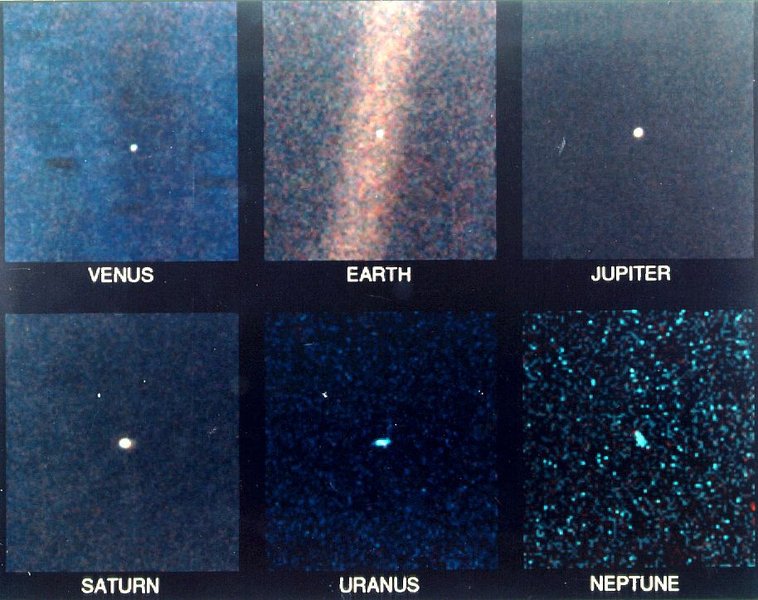
An iconic "Solar System Family Portrait" captured by Voyager 1, showcasing Earth as a "Pale Blue Dot."
Venturing into the Unknown: Interstellar Space
After completing its planetary encounters, Voyager 1's trajectory was altered to continue its journey outward, eventually crossing into interstellar space. This phase of the mission began in August 2012, when the spacecraft officially exited the heliosphere—the protective bubble of particles and magnetic fields generated by the Sun. Its transmissions from this new frontier have provided unprecedented data on:
- Plasma Waves: Voyager 1 detected the presence of a "plasma wave" in the interstellar medium, providing crucial insights into the characteristics of space beyond our solar system.
- Cosmic Rays: The spacecraft has shown that cosmic radiation in interstellar space is very intense, and demonstrated how charged particles from the Sun interact with those from other sources.
- Magnetic Fields: Data from Voyager 1 has been instrumental in understanding the magnetic field structures at the edge of the heliosphere and beyond.
The Language of the Cosmos: Voyager 1's Communication System
Communicating with a spacecraft over 15 billion miles away is an immense engineering feat. Voyager 1 transmits data to Earth via NASA's Deep Space Network (DSN), a global array of large radio antennas. A signal from Earth takes approximately 22.5 hours to reach Voyager 1, and another 22.5 hours for a response to return, making each round-trip communication nearly two days long.
The Deep Space Network and Data Transmission
Voyager 1 primarily uses an X-band radio transmitter, operating at frequencies of 2.3 GHz or 8.4 GHz, to send data to Earth. Signals from Earth to Voyager are transmitted at 2.1 GHz. The spacecraft's 3.7-meter (12 ft) diameter high-gain Cassegrain antenna is crucial for this communication. Despite its age, this system has proven remarkably robust.
This video provides an excellent overview of the challenges NASA faced and the innovative solutions employed to restore communication with Voyager 1 after its recent anomaly.
Recent Communication Challenges and Triumphs
In November 2023, Voyager 1 experienced a significant anomaly, ceasing to send readable science and engineering data. The transmissions became garbled, a repeating pattern of zeros and ones, even though mission controllers could still tell the spacecraft was receiving commands.
NASA engineers at the Jet Propulsion Laboratory (JPL) launched a meticulous troubleshooting effort, analyzing the corrupted data from billions of miles away. They identified the problem as a failed memory chip within the Flight Data Subsystem (FDS), one of the spacecraft's three onboard computers responsible for packaging data before transmission.
The solution involved an audacious "poke" command sent in March 2024, instructing the FDS to try different software sequences to bypass the corrupted memory. On April 18, engineers transmitted commands to relocate the affected software code to a new, working memory location. After a nail-biting two-day wait for the signal to return, on April 20, Voyager 1 successfully sent back decipherable engineering data, confirming the fix.
Following this success, in May 2024, Voyager 1 resumed returning science data from two of its four functioning instruments: the cosmic ray telescope and the plasma waves experiment. Work is ongoing to restore data from the other two instruments (the low-energy charged particles experiment and the magnetometer).
Thruster Resuscitation
Adding to its saga of resilience, in May 2025, NASA engineers successfully revived thrusters aboard Voyager 1 that had been dormant since 1980. These trajectory correction maneuver (TCM) thrusters were reactivated to help keep the spacecraft's antenna precisely pointed towards Earth, crucial for maintaining communication as its primary attitude control thrusters degrade. This unexpected reactivation further extends the mission's operational lifespan.
The Future of Voyager 1: A Fading, Yet Persistent Voice
Despite its remarkable longevity, Voyager 1's power supply, derived from radioisotope thermoelectric generators (RTGs), is slowly dwindling. NASA estimates that the spacecraft's RTGs may provide enough electric power to return engineering data until approximately 2036. To conserve power, many non-essential components, including its cameras, were turned off decades ago. The mission continues to adapt, turning off other instruments as needed to extend operations.
Voyager 1's transmissions are not just engineering data; they are a continuous stream of revelations about the interstellar medium, pushing the boundaries of human knowledge. Its journey will continue for tens of thousands of years, carrying the Golden Record—a compilation of sounds and images from Earth—as a message to any potential extraterrestrial discoverers.
A Legacy of Exploration
The Voyager program has fundamentally reshaped our understanding of the outer Solar System and the space beyond. Voyager 1's transmissions have consistently surprised scientists, revealing a dynamic and complex universe far different from what was envisioned at its launch.
Voyager 1's Resilience and Scientific Prowess
The following radar chart illustrates Voyager 1's performance and scientific contributions across various dimensions, based on its decades of operation and recent recovery efforts.
This chart demonstrates Voyager 1's outstanding achievements across various metrics. Its "Longevity & Durability" are nearly unmatched, having operated for over 46 years, far beyond its initial design. The "Interstellar Data Return" highlights its unique position as the only spacecraft providing direct measurements from beyond the heliosphere. "Engineering Resilience" reflects the mission team's incredible ability to diagnose and fix issues from billions of miles away. "Planetary Discovery Impact" underscores its foundational contributions to our understanding of Jupiter and Saturn. While "Communication Reliability" has seen recent challenges, the team's swift and ingenious recovery efforts have largely mitigated these, keeping the venerable probe talking.
A Comprehensive Look at Voyager 1's Data Transmissions
Voyager 1's transmissions cover a vast range of scientific and engineering data, allowing Earth-bound scientists to monitor its health and continue unraveling the mysteries of deep space. Here's a summary of the types of data it sends back:
| Data Category | Details Transmitted | Significance |
|---|---|---|
| Engineering Telemetry | Health and status of onboard systems (power, temperature, thruster performance, attitude articulation and control system - AACS, Flight Data Subsystem - FDS). | Crucial for monitoring the spacecraft's operational health, troubleshooting anomalies, and planning future commands to ensure continued functioning and antenna pointing towards Earth. |
| Science Data (Interstellar Medium) | Measurements from four active instruments: Cosmic Ray Subsystem, Low-Energy Charged Particle instrument, Magnetometer, and Plasma Wave Subsystem. | Provides direct measurements of the interstellar environment, including cosmic ray intensity, magnetic field direction and strength, and plasma density and waves, offering unique insights into the region beyond our Sun's influence. |
| Navigation & Ranging Data | Information used to precisely determine the spacecraft's distance and velocity from Earth. | Essential for tracking Voyager 1's exact location, predicting its future trajectory, and ensuring accurate command transmission and data reception via the Deep Space Network. |
This table illustrates the diverse types of information Voyager 1 continually transmits, highlighting its dual role as a resilient robotic explorer and a scientific observatory at the very edge of human reach.
Frequently Asked Questions About Voyager 1's Transmissions
How long does it take for a signal from Voyager 1 to reach Earth?
Is Voyager 1 still sending back images?
What caused Voyager 1's recent communication issues?
How did NASA fix Voyager 1's communication problem?
What kind of data is Voyager 1 currently transmitting?
How much longer is Voyager 1 expected to transmit data?
Conclusion
Voyager 1 stands as a testament to human ingenuity and perseverance. From its groundbreaking surveys of Jupiter and Saturn to its ongoing exploration of interstellar space, the data it has transmitted back to Earth has consistently redefined our cosmic neighborhood. Despite its advanced age and the immense challenges of communicating across billions of miles, its recent recovery from a critical technical glitch underscores the remarkable dedication of the NASA team and the inherent robustness of the spacecraft itself. Voyager 1 continues to be humanity's most distant outpost, a faint but persistent voice whispering secrets from the very edge of the unknown, paving the way for future interstellar missions.
Recommended Further Exploration
- Explore how the Voyager probes efficiently traversed the solar system using planetary gravity assists.
- Delve into the global network of antennas crucial for deep space communication.
- Understand the Sun's protective bubble and the implications of escaping it.
- Discover the messages humanity sent into space aboard the Voyager probes.
References
Last updated May 21, 2025