

The identity \( \theta \wedge ( V \lrcorner \text{vol} ) = g ( \theta , V^\flat ) \text{vol} \) is a cornerstone in differential geometry, bridging several crucial concepts: the wedge product, the interior product, the metric tensor (and its induced inner product), the musical isomorphism (flatten operator), and the volume form. This identity reveals the deep interconnectedness of algebraic and geometric structures on a manifold. Understanding it requires a grasp of how these individual components operate and how they combine to express geometric notions like volume and orientation.
Key Insights into the Fundamental Identity
- The Wedge Product (∧) Defines Oriented Volume: The wedge product is central to the concept of oriented volume. When applied to k-forms, it effectively measures the (oriented) k-dimensional volume spanned by a set of vectors. Its anti-commutative nature means that swapping two arguments changes the sign, reflecting the orientation of the spanned volume.
- The Interior Product (⏊) Reduces Dimension: The interior product (also known as contraction) acts by "inserting" a vector into a differential form, effectively reducing the degree of the form. Geometrically, it measures the "slice" of a k-dimensional volume orthogonal to the given vector, resulting in a (k-1)-dimensional form.
- The Metric Tensor (g) and Musical Isomorphisms (♭) Bridge Vectors and Forms: The metric tensor allows us to define an inner product on vector fields and, crucially, on differential forms. The "flat" operator (\(V^\flat\)) uses the metric to convert a vector field \(V\) into a 1-form, enabling us to measure lengths and angles within the framework of differential forms.
Delving into the Components of the Identity
To fully appreciate the identity, we must first understand its individual constituents.
The Wedge Product: A Foundation for Oriented Multivectors
The wedge product, denoted by \( \wedge \), is a fundamental operation in exterior algebra. It extends the concept of multiplication from scalars and vectors to higher-order objects called differential forms. Unlike the traditional cross product, which is limited to three dimensions, the wedge product generalizes the notion of oriented area and volume to arbitrary dimensions.
For two 1-forms, \( \alpha \) and \( \beta \), their wedge product \( \alpha \wedge \beta \) is a 2-form. Geometrically, it represents the oriented "area" element defined by the parallelogram spanned by the vectors that the 1-forms act upon. Key properties include:
- Anticommutativity: For any two forms \( \alpha \) and \( \beta \) of degrees \( p \) and \( q \) respectively, \( \alpha \wedge \beta = (-1)^{pq} \beta \wedge \alpha \). This means that for 1-forms (\(p=1, q=1\)), \( \alpha \wedge \beta = - \beta \wedge \alpha \). A direct consequence is that \( \alpha \wedge \alpha = 0 \) for any 1-form \( \alpha \), as swapping a form with itself should result in no change, yet also a sign change, implying it must be zero. This reflects the idea that a degenerate parallelogram (one whose sides are linearly dependent) has zero oriented area.
- Associativity: \( (\alpha \wedge \beta) \wedge \gamma = \alpha \wedge (\beta \wedge \gamma) \). This allows for unambiguous chaining of wedge products.
- Bilinearity: The wedge product is linear in each argument.
The wedge product is crucial for defining volume forms, such as the standard Euclidean volume form \( dx^1 \wedge dx^2 \wedge \dots \wedge dx^n \) in \( \mathbb{R}^n \). This form effectively measures the oriented volume of an n-dimensional parallelepiped.
Visualizing the Wedge Product
In two dimensions, \( dx \wedge dy \) represents an oriented area element. If you have two vectors, \( \mathbf{v} = (a,b) \) and \( \mathbf{w} = (c,d) \), then \( dx \wedge dy \) applied to these vectors yields the determinant of the matrix formed by their components, which is the oriented area of the parallelogram they span: \( (dx \wedge dy)(\mathbf{v}, \mathbf{w}) = \det \begin{pmatrix} a & c \ b & d \end{pmatrix} = ad - bc \). This connection to determinants is fundamental, as the wedge product provides a basis-independent formulation of volume.
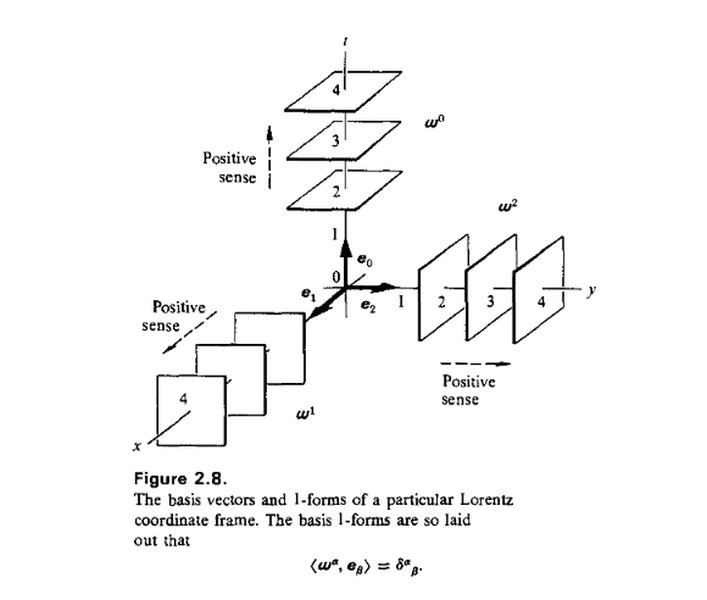
The wedge product \( v \wedge w \) can be geometrically interpreted as the oriented area of the parallelogram spanned by vectors \( v \) and \( w \).
The Interior Product: Contraction and Dimension Reduction
The interior product, also known as the interior derivative or contraction, is an operation that takes a vector field \( V \) and a k-form \( \omega \) and produces a (k-1)-form, denoted \( V \lrcorner \omega \). It essentially "contracts" the form with the vector field.
Formally, if \( \omega \) is a k-form and \( V, V_1, \dots, V_{k-1} \) are vector fields, then the interior product is defined as:
\[ \huge ( V \lrcorner \omega ) (V_1, \dots, V_{k-1}) = \omega (V, V_1, \dots, V_{k-1}) \]Geometrically, if \( \omega \) represents an oriented k-volume element, then \( V \lrcorner \omega \) can be thought of as the (k-1)-volume element "sliced" by the vector \( V \), perpendicular to \( V \). For instance, if \( \text{vol} \) is the n-dimensional volume form, then \( V \lrcorner \text{vol} \) is an (n-1)-form that measures the oriented (n-1)-volume of the hypersurface "orthogonal" to \( V \).
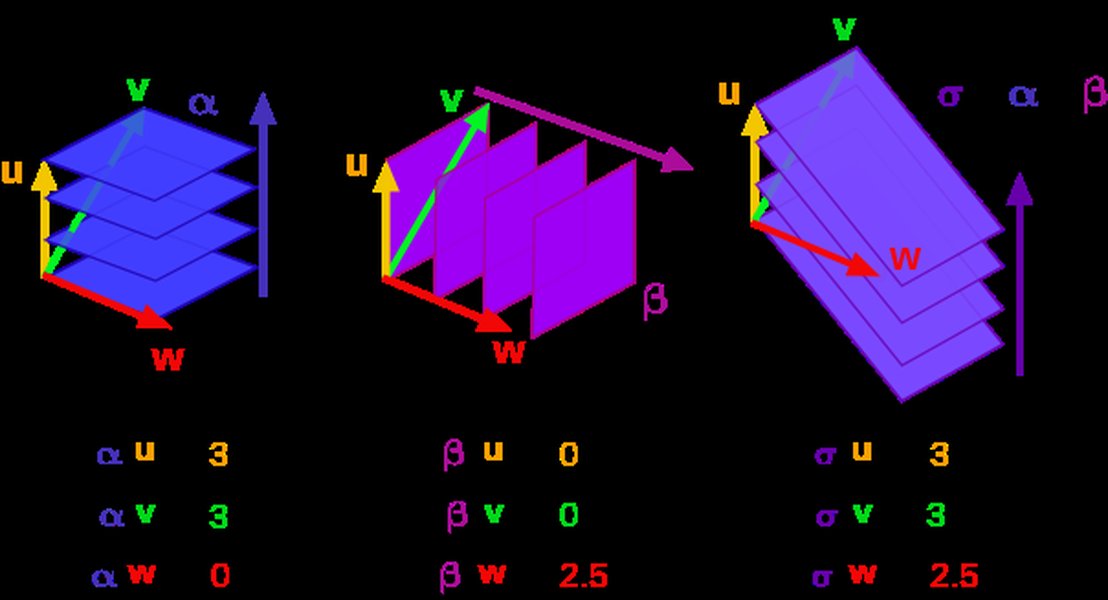
Visualizing 1-forms as measuring density along lines, and higher forms measuring flux through surfaces or volumes. The interior product effectively reduces this dimensionality.
The Metric Tensor and Musical Isomorphisms: Bridging Vectors and Forms
The metric tensor, denoted by \( g \), is a fundamental tool in differential geometry that allows us to measure lengths, angles, and volumes on a manifold. It provides an inner product \( g(V, W) \) for any two vector fields \( V \) and \( W \). This inner product can also be extended to differential forms.
Crucially, the metric tensor provides a canonical isomorphism between vector fields and 1-forms, known as the musical isomorphisms. The "flat" operator \( \flat \) (or \( \text{g}^\flat \)) maps a vector field \( V \) to a 1-form \( V^\flat \) (read as "V-flat") such that for any vector field \( W \):
\[ \huge V^\flat (W) = g(V, W) \]Conversely, there's a "sharp" operator \( \sharp \) that maps a 1-form back to a vector field. These isomorphisms are essential because differential forms naturally operate on vectors, while the metric provides the machinery to perform vector-like operations (like inner products) in the world of forms.
The term \( g(\theta, V^\flat) \) in the identity therefore represents the inner product of the 1-form \( \theta \) with the 1-form obtained by flattening the vector field \( V \). This effectively provides a scalar value that relates \( \theta \) and \( V \) via the metric.
The Volume Form: The Ultimate Volume Element
The volume form, denoted \( \text{vol} \) (or sometimes \( dV \), \( \Omega \), or \( \mu_g \)), is a non-zero, top-degree differential form on an oriented manifold. It provides a way to measure the volume of regions on the manifold. In an n-dimensional manifold, the volume form is an n-form. In local coordinates \( (x^1, \dots, x^n) \), it is typically expressed as:
\[ \huge \text{vol} = \sqrt{|\det(g_{ij})|} dx^1 \wedge dx^2 \wedge \dots \wedge dx^n \]where \( g_{ij} \) are the components of the metric tensor. The determinant term ensures that the volume form scales correctly with coordinate changes and reflects the intrinsic geometry imparted by the metric.
The Identity Explained: \( \theta \wedge ( V \lrcorner \text{vol} ) = g ( \theta , V^\flat ) \text{vol} \)
Now, let's break down the identity \( \theta \wedge ( V \lrcorner \text{vol} ) = g ( \theta , V^\flat ) \text{vol} \). This identity fundamentally expresses a relationship between how volume elements behave under contractions and how forms interact with vector fields through the metric. It is a powerful statement about how the underlying geometry (captured by the metric and volume form) constrains the algebraic operations (wedge and interior products).
Intuitive Breakdown
Consider an n-dimensional space. The volume form \( \text{vol} \) is an n-form. When we take the interior product \( V \lrcorner \text{vol} \), we are essentially "removing" the component of the volume perpendicular to \( V \). This leaves us with an (n-1)-form, which can be thought of as an oriented (n-1)-dimensional "surface element" that is orthogonal to \( V \).
Now, we wedge this (n-1)-form with a 1-form \( \theta \). The result is an n-form. This operation essentially "completes" the volume. The wedge product \( \theta \wedge ( V \lrcorner \text{vol} ) \) captures how the 1-form \( \theta \) contributes to the total n-volume when combined with the "sliced" volume element orthogonal to \( V \).
The right-hand side, \( g ( \theta , V^\flat ) \text{vol} \), involves the scalar \( g ( \theta , V^\flat ) \) multiplied by the full volume form \( \text{vol} \). The scalar \( g ( \theta , V^\flat ) \) measures the inner product of the 1-form \( \theta \) with the 1-form \( V^\flat \). This value essentially quantifies how "aligned" \( \theta \) is with \( V \) according to the metric. If \( \theta \) and \( V^\flat \) are perfectly aligned and normalized, this scalar is 1, implying that the two sides of the identity are proportional to the volume form itself.
Formal Proof Sketch (using local coordinates)
While a full rigorous proof involves abstract algebraic properties, a coordinate-based approach can provide insight. Let \( \text{vol} = \sqrt{|g|} dx^1 \wedge \dots \wedge dx^n \), where \( g = \det(g_{ij}) \). Let \( \theta = \theta_k dx^k \) and \( V = V^j \frac{\partial}{\partial x^j} \).
The interior product \( V \lrcorner \text{vol} \) can be written as:
\[ \huge V \lrcorner ( dx^{i_1} \wedge \dots \wedge dx^{i_n} ) = \sum_{j=1}^n (-1)^{j-1} V^{i_j} dx^{i_1} \wedge \dots \wedge \widehat{dx^{i_j}} \wedge \dots \wedge dx^{i_n} \]Applying this to \( \text{vol} \) and then wedging with \( \theta \), and performing the necessary calculations involving the Levi-Civita symbol and Kronecker delta, one arrives at the identity. The core of the proof often relies on the property that the inner product \( g(X, Y) \) can be related to the interior product and the volume form through the Hodge star operator, which is intrinsically linked to the metric.
This identity is a manifestation of the fact that the interior product \( V \lrcorner \text{vol} \) effectively produces a form that is "dual" to the vector \( V \) with respect to the volume form, and the inner product \( g(\theta, V^\flat) \) quantifies the relationship between \( \theta \) and \( V \) in a metric-dependent way. The identity shows that these two seemingly different ways of relating \( \theta \) and \( V \) to the volume form are equivalent.
Why the Identity Holds
The identity holds due to the fundamental relationships between the operations defined on differential forms and the structure provided by the metric. In essence, it captures how the "volume contribution" of a 1-form \( \theta \) when completing a "partial volume" (created by contracting the full volume with \( V \)) is precisely quantified by the metric-induced alignment between \( \theta \) and \( V \).
Think of it this way: the interior product \( V \lrcorner \text{vol} \) gives you an (n-1)-form which acts like the normal vector to the hypersurface defined by \( V \). When you wedge a 1-form \( \theta \) with this (n-1)-form, you are essentially asking how much \( \theta \) contributes to the total oriented volume. This contribution is directly proportional to how much \( \theta \) "points in the same direction" as \( V \) (as measured by the metric), scaled by the total volume element.
This identity is extremely useful in various branches of mathematics and physics, especially in general relativity and gauge theories, where differential forms are used to describe physical quantities and their interactions on curved manifolds.
The Interplay of Concepts: A Mindmap
The concepts involved in this identity are deeply intertwined. This mindmap illustrates their relationships and how they contribute to the overarching framework of differential geometry.
This mindmap visually represents the intricate connections between the wedge product, interior product, metric tensor, musical isomorphisms, and the volume form, all culminating in the central identity.
Further Applications and Related Concepts
The concepts encapsulated by this identity extend to many areas of mathematics and physics. For example, in Riemannian geometry, the metric tensor is fundamental for defining connections, curvature, and geodesics. In electromagnetism and fluid dynamics, differential forms and their operations (like the exterior derivative and Hodge star) are used to express Maxwell's equations and continuity equations in a coordinate-independent manner.
The Hodge Star Operator
Closely related to the identity is the Hodge star operator, \( \star \). The Hodge star maps a k-form to an (n-k)-form on an n-dimensional oriented Riemannian manifold. It requires a metric and an orientation. The identity \( \theta \wedge ( V \lrcorner \text{vol} ) = g ( \theta , V^\flat ) \text{vol} \) can often be derived or understood through the properties of the Hodge star operator, especially its relationship to the inner product and volume form. For example, in 3D, the cross product \( \mathbf{u} \times \mathbf{v} \) can be related to the wedge product \( u^\flat \wedge v^\flat \) and the Hodge star. The identity provides a general framework that underpins many specific relationships found in vector calculus and continuum mechanics.
Connection to Vector Calculus Operations
In \( \mathbb{R}^3 \), differential forms and their operations offer a powerful generalization of traditional vector calculus. The wedge product of two 1-forms is related to the cross product, and the wedge product of a 1-form and a 2-form is related to the dot product. This identity implicitly leverages these connections, providing a robust framework that extends beyond specific dimensions.
For instance, in 3D, the volume form is \( \text{vol} = dx \wedge dy \wedge dz \). If \( V = V_x \partial_x + V_y \partial_y + V_z \partial_z \), then \( V \lrcorner \text{vol} \) is a 2-form representing the flux through a surface whose normal is parallel to \( V \). The identity then provides a fundamental relation between this flux, the form \( \theta \), and the metric.
This video explains how the Minkowski inner product can be lifted to the space of 2-forms and 3-forms, providing a deeper context for the role of inner products in understanding differential forms.
Frequently Asked Questions (FAQ)
What is a differential form?
Why is the wedge product anti-commutative?
How does the metric tensor relate to the inner product?
What is the purpose of musical isomorphisms?
What is the significance of the volume form?
Can this identity be generalized?
Conclusion
The identity \( \theta \wedge ( V \lrcorner \text{vol} ) = g ( \theta , V^\flat ) \text{vol} \) is a profound statement in differential geometry, revealing the intricate relationships between algebraic operations (wedge and interior products) and geometric structures (metric and volume form). It demonstrates how the inner product, mediated by the metric, provides the scalar factor that governs the combination of a 1-form with a contracted volume element to recover the full volume form. This identity is not merely an abstract mathematical curiosity; it underpins many physical theories, providing a rigorous language to describe phenomena in general relativity, electromagnetism, and fluid dynamics where measurements of length, angle, and volume are paramount. By understanding its components and their interplay, one gains a deeper appreciation for the elegance and power of differential forms as a language for geometry and physics.
Recommended Further Queries
- Explain the Hodge star operator and its role in differential forms.
- How is the exterior derivative related to classical vector calculus operations?
- What are the applications of differential forms in general relativity?
- Discuss the properties of the metric tensor and its importance in Riemannian geometry.