
Unveiling the Cosmic Shortcuts: A Deep Dive into Wormholes
Exploring the Theoretical Tunnels Through Spacetime and Their Mind-Bending Implications
Key Insights into Wormholes
- Theoretical Shortcuts: Wormholes are hypothetical tunnels through spacetime, predicted by Einstein's theory of general relativity, offering potential shortcuts across vast cosmic distances.
- Exotic Matter Requirement: For a wormhole to be stable and traversable, it would likely require "exotic matter" with negative energy, a substance not yet observed in nature.
- Time Travel Paradoxes: If traversable wormholes exist, they could theoretically enable time travel, leading to complex paradoxes that challenge our understanding of causality.
Wormholes, often depicted as fantastical portals in science fiction, are more than just imaginative constructs; they are theoretical passages through the fabric of spacetime, emerging from the profound equations of Albert Einstein's theory of general relativity. Imagine our universe as a vast, stretched sheet. To travel from one distant point to another traditionally means traversing the surface. A wormhole, however, would be like folding that sheet and piercing a hole through it, allowing for a much shorter journey through a higher dimension. This concept was first hypothesized in 1916 by Austrian physicist Ludwig Flamm, though the term "wormhole" itself was coined much later in 1957 by American physicist John Wheeler, drawing an analogy to the tunnels a worm creates through an apple.
While the mathematical framework for wormholes exists, their physical existence remains unproven. Despite their theoretical basis within a well-tested theory like general relativity, the immense challenges associated with their formation, stabilization, and traversal make them subjects of intense scientific debate and ongoing research. The allure of wormholes lies in their potential to revolutionize interstellar travel and even offer glimpses into the possibility of time manipulation, making them one of the most captivating topics in modern astrophysics.
The Essence of a Wormhole: Bending Spacetime
Understanding the Fabric of the Cosmos
To grasp the concept of a wormhole, one must first understand spacetime. Einstein's theory of general relativity posits that space and time are not separate entities but are interwoven into a single, four-dimensional fabric called spacetime. Massive objects, like stars and planets, warp this fabric, and this warping is what we perceive as gravity. In essence, gravity is not a force pulling objects together, but rather the curvature of spacetime dictating how objects move.
A Bridge Through Dimensions
A wormhole is a special solution to Einstein's field equations that describes a "shortcut" or "tunnel" connecting two distinct points in this spacetime fabric. These points could be vastly separated in space, different moments in time, or even different universes. Imagine two distant towns separated by a formidable mountain. Instead of traveling all the way around the mountain, a tunnel dug straight through it would significantly reduce travel time. A wormhole serves an analogous purpose in the cosmic landscape, theoretically allowing for journeys that would otherwise take millions of years to be completed in mere hours or minutes.

Conceptual illustration of a wormhole bending spacetime, creating a shortcut.
Structurally, a typical wormhole is envisioned as having two "mouths" and a "throat" connecting them. The mouths are often depicted as spheroidal openings, which might contain supermassive objects that contribute to the warping of spacetime. The throat is the tunnel-like region that bridges the two mouths, acting as the shortcut.
The Enigma of Exotic Matter and Stability
The Crucial Role of Negative Energy
While mathematically permissible, the stability and traversability of a wormhole pose significant challenges. The primary hurdle lies in the requirement for "exotic matter." Ordinary matter, which we encounter daily, has positive energy density and always exerts a gravitational pull. This pull would cause a wormhole's throat to collapse almost instantaneously, making it impossible to traverse.
Defying Gravity with Negative Energy
To counteract this gravitational collapse and keep the wormhole open for a duration long enough to allow passage, a substance with negative energy density is theorized to be necessary. This "exotic matter" would exert an outward gravitational push, effectively propping open the wormhole's throat. The Casimir effect provides a theoretical glimpse into negative energy densities in quantum field theory, but there is currently no experimental evidence of naturally occurring exotic matter in the quantities required for a stable, macroscopic wormhole.
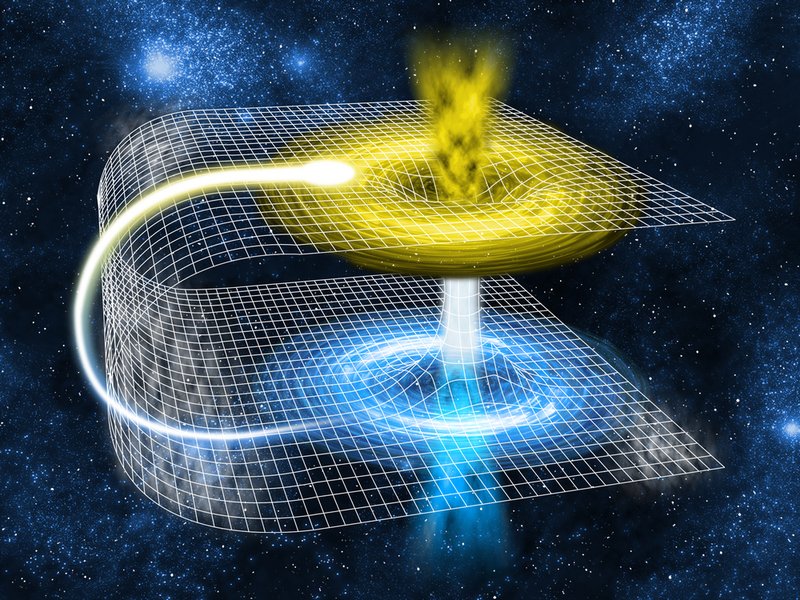
Visualizing the challenging concept of exotic matter stabilizing a wormhole's throat.
Physicists like Stephen Hawking and Kip Thorne have explored theoretical mechanisms to stabilize traversable wormholes, often involving such exotic matter. However, the exact nature and feasibility of creating or sustaining such matter remain at the forefront of theoretical physics and quantum gravity research.
Wormholes and the Grand Challenge of Time Travel
Navigating Causality and Paradoxes
One of the most intriguing, and perhaps unsettling, implications of traversable wormholes is their potential for time travel. Because wormholes connect points in spacetime, they could theoretically link different locations and different moments in time. The mechanism would involve accelerating one end of the wormhole to a significant fraction of the speed of light and then bringing it back to its point of origin. Due to time dilation effects from special relativity, the accelerated end would experience less time, effectively becoming "younger" than the stationary end.
The Grandfather Paradox and Beyond
Stepping into the "younger" mouth of such a wormhole would theoretically allow a traveler to emerge in the past relative to the stationary mouth. This immediately raises concerns about causality and the famous "grandfather paradox," where one could travel back in time and prevent their own existence. While such paradoxes are a cornerstone of science fiction, they pose profound theoretical challenges for physicists. Some theories, such as the Novikov self-consistency principle, suggest that any actions taken by a time traveler would already be part of a consistent timeline, preventing paradoxes.
Current Research and the Quantum Frontier
From Theory to Experimentation
Despite the lack of direct observational evidence, the study of wormholes is not confined to theoretical musings. Scientists are actively exploring ways to detect or even simulate wormhole dynamics. One exciting development came in 2022 when physicists purportedly created a "wormhole" using a quantum computer. This experiment, based on the AdS/CFT correspondence (a theoretical duality between certain quantum field theories and theories of gravity), managed to send a signal through the simulated wormhole. While this was a quantum simulation and not a macroscopic, traversable wormhole in physical space, it offered insights into the connection between quantum entanglement and spacetime geometry, an area of active research known as ER=EPR.
This video explores recent breakthroughs in wormhole research and their theoretical implications.
Further research into wormholes also involves looking for indirect observational evidence, such as specific gravitational wave signatures that might be emitted by objects interacting with wormholes. While still speculative, these endeavors demonstrate the scientific community's persistent curiosity and efforts to probe the boundaries of our understanding of the universe.
Comparing Cosmic Phenomena: Wormholes vs. Black Holes
Distinct Yet Related Cosmic Entities
Often confused, black holes and wormholes are distinct, though related, concepts within general relativity. Black holes are regions of spacetime where gravity is so strong that nothing, not even light, can escape. They are formed from the collapse of massive stars. Wormholes, on the other hand, are theoretical bridges connecting disparate points in spacetime.
Key Distinctions and Similarities
While some solutions of general relativity allow for wormholes where the mouth of each is a black hole, a naturally occurring black hole does not, by itself, create a wormhole. The critical difference lies in the event horizon. A black hole has an event horizon, a point of no return beyond which escape is impossible. A traversable wormhole, if it exists, would theoretically allow for passage through its throat without crossing an inescapable event horizon, provided it is stabilized by exotic matter. The table below summarizes key differences and similarities.
| Feature | Wormhole | Black Hole |
|---|---|---|
| Nature | Theoretical shortcut through spacetime | Region of spacetime with extreme gravity |
| Existence | Hypothetical, no observational proof | Observed (e.g., event horizon telescope images) |
| Formation | Theoretical solutions to Einstein's equations, requiring exotic matter for stability | Formed from the gravitational collapse of massive stars |
| Traversability | Theoretically traversable with exotic matter | Not traversable; anything that crosses event horizon cannot escape |
| Connection | Connects two distant points in spacetime (or different universes) | A singularity at its core; acts as a one-way street to oblivion |
| Time Implications | Potential for time travel (paradoxes) | Time dilation effects are extreme near event horizon |
The Speculative Realities: Assessing Possibilities
The Outlook for Wormhole Existence
The existence of wormholes remains one of the most profound unanswered questions in physics. While mathematically elegant, their physical realization hinges on several unresolved issues, primarily the existence and behavior of exotic matter. The current scientific consensus is that while wormholes are fascinating theoretical constructs, there is no direct evidence to suggest they exist in our universe. However, the history of science is replete with examples of phenomena once considered purely theoretical, only to be later confirmed (e.g., black holes, gravitational waves).
The ongoing exploration of quantum gravity, the nature of spacetime at its most fundamental level, and experimental efforts like quantum simulations continue to push the boundaries of what is known. As our understanding of the universe evolves, the prospect of discovering these cosmic tunnels, or definitive proof of their impossibility, remains a captivating frontier.
This radar chart illustrates a qualitative comparison between the current scientific understanding of wormholes and their common portrayal in science fiction. While science acknowledges their theoretical basis, it emphasizes the significant challenges like observational evidence and the need for exotic matter. Science fiction, conversely, often prioritizes their potential for rapid space travel and time manipulation, often simplifying or omitting the physical obstacles.
Frequently Asked Questions About Wormholes
Are wormholes proven to exist?
How do wormholes relate to black holes?
Can wormholes be used for time travel?
What is "exotic matter" and why is it needed for wormholes?
Conclusion
Wormholes stand as a testament to the mind-bending implications of general relativity and the boundless possibilities of the cosmos. As theoretical shortcuts through spacetime, they offer a tantalizing vision of rapid interstellar travel and even time manipulation. However, the immense scientific challenges, particularly the need for exotic matter and the unresolved paradoxes of causality, place them firmly in the realm of hypothesis. While no definitive proof of their existence has been found, the ongoing advancements in quantum physics and observational astronomy continue to inspire research into these fascinating cosmic phenomena, keeping the dream of traversing the universe through a wormhole alive in the hearts of scientists and enthusiasts alike.
Recommended Further Exploration
- What is the theory of general relativity and how does it describe gravity?
- How do quantum computers contribute to our understanding of wormholes?
- Explore the various paradoxes associated with time travel via wormholes.
- Learn more about the concept of exotic matter and its potential role in physics.
Referenced Search Results
 amazon.com