
The Fascinating Phenomenon of Lake Turnover: A Seasonal Deep Dive
Unraveling the Mysteries of How and Why Lakes Mix Their Waters
Lake turnover is a natural and vital process where the entire volume of water in a lake mixes from top to bottom. This phenomenon is driven primarily by the unique density properties of water in response to seasonal temperature changes and is crucial for maintaining the health and ecological balance of freshwater ecosystems. While it might sound dramatic, it's a gentle, natural mixing that happens regularly in most temperate lakes, typically twice a year.
Key Insights into Lake Turnover
- Water's Unique Density: Unlike most liquids, water is densest at approximately 39 degrees Fahrenheit (4 degrees Celsius). This unusual property is the fundamental driver of lake stratification and subsequent turnover.
- Seasonal Stratification and Mixing: Lakes form distinct thermal layers (stratification) during warm and cold periods. Turnover events occur when these layers break down, allowing the entire water column to mix, most notably in spring and fall.
- Ecological Significance: Lake turnover is essential for replenishing dissolved oxygen levels throughout the lake, distributing vital nutrients, and helping to manage algae and harmful bacteria by circulating them to deeper, less sunlit waters.
Understanding Thermal Stratification: The Foundation of Turnover
Before a lake can "turn over," it must first establish distinct thermal layers, a process known as thermal stratification. This layering occurs due to the sun's heating and water's peculiar density characteristics. During periods of stable temperatures, lakes typically divide into three main layers:
- Epilimnion: This is the uppermost layer, warmed by the sun and typically less dense. It is well-mixed by wind and contains higher levels of dissolved oxygen due to direct atmospheric contact and photosynthesis from aquatic plants.
- Metalimnion (Thermocline): Situated beneath the epilimnion, the metalimnion is a transitional zone where the water temperature rapidly changes with depth. This layer acts as a thermal barrier, separating the warmer surface water from the colder bottom water.
- Hypolimnion: This is the deepest and coldest layer, often stagnant and less oxygenated. Decomposition of organic matter by bacteria in this layer consumes available oxygen, leading to lower dissolved oxygen levels compared to the surface.
The stability of these layers is determined by the temperature difference between them. The greater the difference in density, the harder it is for the water to mix.
The Role of Water Density in Lake Dynamics
The critical factor driving lake turnover is water's maximum density at approximately 39°F (4°C). This unique property means that water is lighter and less dense both when it's warmer than 39°F and when it's colder (approaching freezing at 32°F). This characteristic is fundamental to how lakes stratify and mix throughout the year. If water's greatest density were at 32°F, lakes would freeze from the bottom up, drastically altering aquatic life.
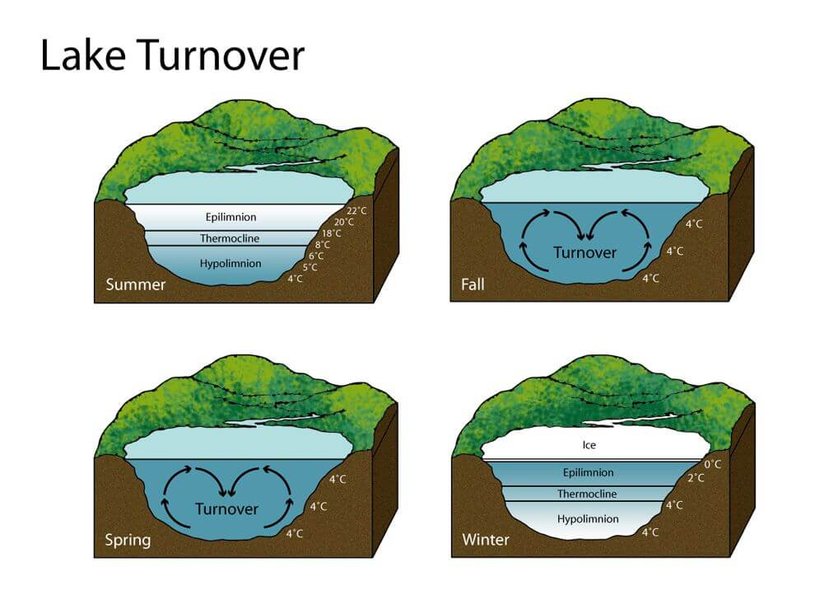
An illustration showing the seasonal stratification and mixing patterns in a dimictic lake.
The Mechanics of Lake Turnover: Spring and Fall Events
Most temperate lakes, known as "dimictic" lakes, experience turnover twice a year: once in the spring and once in the fall. This twice-yearly mixing is vital for the entire aquatic ecosystem.
Spring Turnover
As winter gives way to spring, the ice cover (if present) melts, and the surface water begins to warm. Initially, the coldest, densest water (around 39°F) was at the bottom, while ice (less dense) was on top. As the surface water warms to approximately 39°F (4°C), its density increases, causing it to sink. This downward movement, combined with increasing wind activity typical of spring, helps to break down any remaining stratification from winter. When the entire water column reaches a uniform temperature, typically around 39°F, the wind can easily mix the entire lake, circulating oxygen and nutrients from top to bottom. This process rejuvenates the lake, preparing it for the productivity of the warmer months.
Fall Turnover
Following the warm summer months, the surface water (epilimnion) begins to cool as air temperatures drop. As the surface water cools, it becomes denser and sinks. This continues until the temperature of the surface water matches that of the deeper, colder hypolimnion, usually around 39°F (4°C) or 50°F (10°C) depending on the lake. Once the lake reaches a uniform temperature and density throughout its depth, winds can easily mix the entire water column. This "fall turnover" brings oxygen-rich water to the bottom and nutrient-rich water (which may also contain decaying organic matter and sulfurous gases, causing an odor) to the surface. This process is crucial for replenishing oxygen in the deeper parts of the lake before winter stratification sets in, especially if ice cover is anticipated.
Influence of Wind and Lake Morphology
While temperature and water density are the primary drivers, wind plays a significant role in facilitating lake turnover. Strong winds blowing across the surface create turbulence and help to physically mix the water column, especially once the thermal stratification weakens. The size, depth, and shape of a lake also influence how and when turnover occurs. Shallow lakes, less than 15-20 feet deep, may mix more frequently throughout the year (polymictic) or even continuously, as they don't form stable thermal layers. Very large lakes or those with complex bottom structures might experience turnover differently or in localized areas.
The Profound Importance of Lake Turnover for Ecosystem Health
Lake turnover is far more than just a seasonal mixing event; it's a critical ecological process that sustains aquatic life and maintains the overall health of lake ecosystems.
Oxygen Replenishment and Nutrient Redistribution
One of the most vital functions of lake turnover is the replenishment of dissolved oxygen throughout the entire water column. During summer stratification, the hypolimnion often becomes depleted of oxygen as bacteria decompose organic matter. Without turnover, these deeper waters would become anoxic (devoid of oxygen), making them uninhabitable for most aquatic life, including fish. Turnover brings oxygenated surface water to the depths and circulates oxygen-starved bottom water to the surface where it can be re-oxygenated. Simultaneously, nutrients that have settled and accumulated at the lake bottom are brought to the surface, becoming available for phytoplankton and aquatic plants, fueling the base of the food web.

A diagram illustrating how temperature and dissolved oxygen vary with depth in a stratified lake, highlighting the importance of turnover.
Impact on Aquatic Life and Water Quality
The mixing of oxygen and nutrients during turnover directly affects fish populations and other aquatic organisms. Fish that prefer colder, oxygenated water can access deeper habitats. The circulation helps in dispersing algae and bacteria, preventing excessive localized blooms and carrying dead algae into deeper, less sunlit areas for decomposition. While turnover is generally beneficial, rapid or intense turnovers, especially those caused by sudden cooling events in smaller ponds, can sometimes lead to temporary decreases in overall dissolved oxygen if oxygen-depleted water mixes too quickly with oxygenated water, potentially causing fish kills. However, this is more common in small, managed ponds than large natural lakes.
Recognizing a Turnover Event
While often unnoticed by casual observers, a lake undergoing turnover might exhibit a few tell-tale signs. These can include a murky appearance of the water as sediments and organic material from the bottom become suspended, and sometimes an unpleasant sulfurous odor due to the release of gases like hydrogen sulfide that have accumulated in the oxygen-poor hypolimnion. Water clarity often decreases during this period.
Factors Influencing Lake Turnover Dynamics
Not all lakes turn over in the same way or to the same extent. Several factors can influence the timing, duration, and completeness of lake turnover:
| Factor | Influence on Turnover | Typical Outcome |
|---|---|---|
| Depth | Deeper lakes (typically >20 ft) are more prone to stable stratification and distinct turnover events. Shallow lakes (<15-20 ft) may mix more frequently. | Dimictic (twice-yearly turnover) in deep lakes; Polymictic (frequent mixing) in shallow lakes. |
| Surface Area / Wind Exposure | Larger surface areas and greater exposure to wind promote more efficient mixing during turnover periods. Lakes protected from wind may only mix briefly. | More complete and vigorous turnover in larger, wind-exposed lakes. |
| Temperature Fluctuation | Significant seasonal temperature changes are necessary to create the density differences that drive stratification and turnover. | Temperate lakes experience consistent bi-annual turnover. Tropical lakes may stratify year-round. |
| Inflow/Outflow (River Systems) | Lakes with constant river inflow/outflow may not experience classic turnover as the constant water movement provides mixing. | Less pronounced or absent turnover in heavily flowing systems. |
| Salinity/Chemical Content | High salinity or dissolved solids (like chloride from road salt) can make bottom layers denser, preventing complete mixing (meromictic lakes). | Permanent stratification; no complete turnover. |
The Spectrum of Lake Mixing Regimes
While "dimictic" lakes (those mixing twice a year) are common in temperate regions, other types of lakes exist based on their mixing patterns:
- Monomictic Lakes: These lakes mix once a year.
- Cold Monomictic: Mix in the summer when temperatures are above 4°C, and are ice-covered and stratified in winter (rare).
- Warm Monomictic: Mix in the winter when temperatures are below 4°C and are stratified year-round above this temperature (common in warmer climates).
- Polymictic Lakes: These are shallow lakes that mix frequently or continuously throughout the year, as stable stratification rarely forms due to wind and temperature fluctuations.
- Meromictic Lakes: A special case where lakes have a deep, dense bottom layer (monimolimnion) that is permanently stagnant and does not mix with the upper layers. This often occurs due to a strong salinity gradient at the bottom.
Visualizing Lake Dynamics: A Radar Chart Analysis
To further illustrate the multifaceted nature of lake turnover and its drivers, consider the following radar chart. This chart provides a conceptual overview of how various factors contribute to the intensity and effectiveness of lake turnover in different lake types. The scores are opinion-based to highlight the relative influence of each parameter.
This radar chart visually compares three lake types based on characteristics relevant to turnover. A "Dimictic Lake" shows high scores across most parameters, indicating regular, healthy turnover. A "Polymictic Lake" has high wind exposure and oxygen distribution due to frequent mixing, but perhaps less dramatic nutrient cycling as stratification doesn't fully develop. A "Meromictic Lake," lacking full turnover, shows low oxygen and nutrient cycling but potentially higher odor potential due to stagnant, anoxic bottom waters, with water clarity often being less impacted by turnover itself. This chart emphasizes how the absence or presence of turnover significantly impacts key lake health indicators.
Delving Deeper: The Impact on Fishing
For anglers, understanding lake turnover is particularly important as it can significantly affect fish behavior and location. During turnover, the sudden mixing of water can temporarily disorient fish as their preferred oxygen and temperature zones are disrupted. The murky water and potential sulfurous odors can also make fishing challenging for a few days or weeks. However, fish still need to eat, and once the lake stabilizes, the newly oxygenated deeper waters and redistributed nutrients often lead to improved fishing conditions as fish can utilize the entire water column.
This video explains what the fall turnover means for bass fishing, highlighting how water conditions influence fish behavior during this natural event.
The video above provides an insightful perspective on how lake turnover impacts bass fishing. During the fall turnover, for instance, baitfish that have grown all summer might be distributed differently, influencing where predatory fish like bass can be found. Anglers often adapt their techniques, sometimes using larger baits that create more disturbance to attract fish in murkier water, or switching to slower, more methodical finesse techniques in high-percentage areas like main lake points and channel banks. The key is to understand that while fishing might be tougher during the turnover itself, the process is essential for the long-term health of the fishery, making it a critical aspect for any serious angler to comprehend.
Challenges to Natural Turnover
While lake turnover is a natural process, human activities and climate change can impact its frequency and effectiveness. Increasing levels of chloride from road salt, for example, can collect at the bottom of lakes, making the water denser and potentially preventing complete turnover. This can lead to permanent stratification, mimicking meromictic conditions, and reducing oxygen availability in deeper waters. A changing winter season with less ice cover and warmer temperatures can also shift the timing and duration of mixing, potentially cascading through the food web and altering ecosystem services.
Frequently Asked Questions (FAQ)
What is lake turnover?
Why does lake turnover happen?
How often do lakes turn over?
What are the signs of lake turnover?
Why is lake turnover important?
Does lake turnover affect fishing?
Conclusion
Lake turnover is a remarkable natural process, fundamentally driven by the unique temperature-density relationship of water, that plays an indispensable role in the ecological health of freshwater lakes. From spring to fall, these biannual mixing events ensure the redistribution of vital dissolved oxygen and essential nutrients throughout the entire water column, preventing stagnation in deeper waters and fostering a thriving aquatic environment. Understanding this phenomenon not only deepens our appreciation for natural aquatic systems but also highlights the delicate balance that sustains life beneath the surface, reminding us of the interconnectedness of temperature, physics, and biology in our precious freshwater resources.
Recommended Further Reading
- How does climate change influence lake stratification and mixing patterns?
- What are the different classifications of lake mixing regimes besides dimictic?
- Why is dissolved oxygen so critical for aquatic life in lakes?
- What are the long-term ecological consequences of road salt on lake turnover?
References
Last updated May 21, 2025