
What Existed Before the Big Bang?
Exploring the Mysteries of the Universe's Origins
Key Takeaways
- Time and the Big Bang: Many theories suggest that time itself began with the Big Bang, making the concept of "before" the event ambiguous.
- Cosmic Inflation: A widely accepted theory proposes a rapid expansion phase preceding the hot Big Bang, characterized by cold and nearly empty space.
- Theoretical Models: Various hypotheses like the Big Bounce, multiverse, and cyclic models offer different perspectives on the universe's state before the Big Bang.
Understanding the Concept of Time and the Big Bang
The Big Bang theory is not only a model explaining the expansion of the universe from a hot, dense state but also posits the origin of time itself. According to this view, time as we understand it began with the Big Bang, rendering the question of what happened "before" the Big Bang potentially meaningless. This perspective is supported by several theoretical frameworks that suggest that time and space are intrinsically linked to the events of the Big Bang.
The Nature of Time in Cosmology
Time in cosmological terms is often treated as a dimension much like the spatial dimensions. If time began with the Big Bang, then the notion of "before" loses its traditional meaning because there was no temporal dimension outside or prior to the Big Bang. This has profound implications for how scientists and philosophers approach the origins of the universe.
Cosmic Inflation: A Prelude to the Big Bang
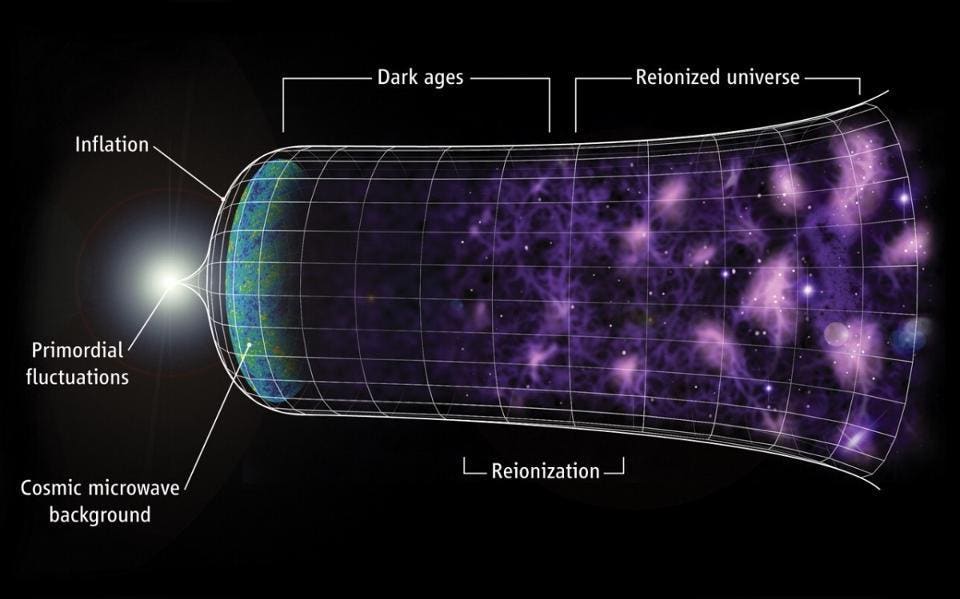
Cosmic inflation is a theory that describes an extremely rapid exponential expansion of the universe immediately following the Big Bang. This phase of inflation addresses several key issues in the standard Big Bang model, such as the horizon and flatness problems, by proposing that the universe expanded faster than the speed of light for a brief period.
Characteristics of the Inflationary Epoch
During cosmic inflation, the universe is thought to have expanded from a microscopic scale to a macroscopic scale in a fraction of a second. This rapid expansion was driven by a mysterious form of energy known as the inflaton field. The conditions during inflation were characterized by:
-
Extremely high expansion rates
-
Predominantly empty space with low matter density
-
Cold temperatures relative to the subsequent hot Big Bang phase
Impact on the Early Universe
The inflationary period set the initial conditions for the hot Big Bang, leading to the uniformity and flatness observed in the large-scale structure of the universe today. Quantum fluctuations during inflation are believed to have seeded the formation of galaxies and other cosmic structures.
Theoretical Models Addressing the Pre-Big Bang Universe
Various theoretical frameworks have been proposed to explore the state of the universe before the Big Bang. These models attempt to reconcile the origins of time and space with the observable expansion of the universe.
The Big Bounce Theory
The Big Bounce theory suggests that the universe undergoes infinite cycles of contraction and expansion. In this paradigm, the current expansion phase began after the universe "bounced" from a previous contracting phase. This cyclical model eliminates the need for a singular beginning, proposing instead a perpetual oscillation of the cosmos.
Multiverse and Eternal Inflation
Multiverse theories posit the existence of multiple, perhaps infinite, universes beyond our observable one. In eternal inflation models, different regions of space undergo inflation at different rates, leading to the formation of numerous "bubble" universes with varying physical properties. Our universe would be just one such bubble within a vast multiverse.
Quantum Cosmology and the No-Boundary Proposal
Quantum cosmology explores the universe's origins using principles of quantum mechanics. The Hartle-Hawking no-boundary proposal, for example, suggests that the universe is finite but has no boundaries in time or space, effectively "rounding off" the initial singularity and removing the concept of a "beginning" in a traditional sense.
Cyclic and Oscillatory Models
Similar to the Big Bounce, cyclic and oscillatory models envision the universe undergoing continuous cycles of expansion and contraction. These models aim to address the entropy problem and provide a framework where the universe has no definitive starting point.
Quantum Fluctuations as Triggers
Some theories propose that quantum fluctuations in a pre-existing vacuum state could trigger the Big Bang. These fluctuations would create regions of higher density that expand to form new universes, effectively serving as the seeds for cosmic inflation.
Challenges and Limitations in Understanding the Pre-Big Bang Era
Despite the fascinating theories, there are significant challenges in empirically validating any models that describe the universe before the Big Bang. The primary obstacles include:
Observational Constraints
The extreme conditions of the early universe, especially before and during the Big Bang, make it nearly impossible to obtain direct observational evidence. The cosmic microwave background radiation provides a snapshot of the universe shortly after the Big Bang, but accessing information from before this epoch remains beyond our current technological capabilities.
Theoretical Limitations
Many pre-Big Bang theories rely on speculative physics that extends beyond the Standard Model. Quantum gravity, a yet-to-be-confirmed theory, is essential for understanding the conditions at the Planck scale, where both quantum mechanics and general relativity play critical roles. Without a complete theory of quantum gravity, our understanding remains incomplete.
Philosophical Implications
The notion of a multiverse or cyclic models raises philosophical questions about the nature of reality and the limits of scientific inquiry. Some argue that these models may be untestable and, therefore, fall outside the realm of empirical science.
Comparative Overview of Pre-Big Bang Theories
| Theory | Description | Key Features | Challenges |
|---|---|---|---|
| Big Bounce | Universe undergoes cycles of contraction and expansion. | No singular beginning; perpetual oscillation. | Lack of empirical evidence; entropy concerns. |
| Multiverse | Our universe is one of many in a vast multiverse. | Diverse universe properties; eternal inflation. | Unobservable other universes; speculative nature. |
| No-Boundary Proposal | Universe has no boundaries in time or space. | Finite but boundary-less; eliminates singularity. | Theoretical complexity; lacks empirical support. |
| Cyclic Models | Continuous cycles of expansion and contraction. | Addresses entropy; no definitive start. | Observational validation; theoretical constraints. |
| Quantum Fluctuations | Quantum fluctuations trigger the Big Bang. | Seed for cosmic inflation; links quantum mechanics. | Theoretical uncertainty; empirical testing issues. |
Current Scientific Consensus and Future Directions
While numerous theories attempt to explain what, if anything, existed before the Big Bang, there is currently no scientific consensus. The majority of models remain speculative and are constrained by the lack of empirical evidence. However, advancements in technology and theoretical physics continue to push the boundaries of our understanding.
Research and Technological Developments
Future observational tools, such as more sensitive cosmic microwave background detectors and gravitational wave observatories, may provide indirect evidence supporting or refuting existing theories. Additionally, progress in quantum gravity and string theory could offer new insights into the fundamental nature of the universe.
Philosophical and Methodological Considerations
The exploration of pre-Big Bang conditions also involves philosophical debates about the nature of reality, causality, and the limits of scientific explanation. As theoretical models become more sophisticated, interdisciplinary collaboration between physicists, philosophers, and mathematicians becomes increasingly important.
Potential Paradigm Shifts
Breakthroughs in our understanding of dark energy, dark matter, and the fundamental forces could lead to paradigm shifts that redefine our comprehension of the universe's origins. Such shifts might open new avenues for exploring the earliest moments of existence and the conditions preceding the Big Bang.
Conclusion
The question of what existed before the Big Bang remains one of the most profound and challenging inquiries in cosmology. While current theories like cosmic inflation, the Big Bounce, and multiverse models offer intriguing possibilities, definitive answers remain elusive due to significant observational and theoretical obstacles. As scientific exploration advances, future discoveries may shed more light on the enigmatic conditions that preceded the birth of our universe.
References
Last updated February 12, 2025