
Unlock the Secrets of Change: What Exactly is Calculus?
Dive into the mathematics of motion, growth, and accumulation that shapes our world.
Calculus is a powerful and fundamental branch of mathematics primarily focused on the study of continuous change. Think of it as the language used to describe and analyze things that don't just stay static but evolve, move, grow, or accumulate over time or space. While arithmetic deals with fixed numbers and algebra explores relationships between variables, calculus provides the tools to understand dynamic situations where quantities are constantly varying.
The term "calculus" itself originates from the Latin word for "small stone," hinting at the method of understanding complex systems by breaking them down into infinitesimally small parts. This core idea manifests in its two main branches, which, although distinct, are deeply interconnected.
Key Insights into Calculus
- The Mathematics of Change and Accumulation: Calculus provides the framework for understanding rates of change (how fast things change) and accumulation (how amounts build up).
- Two Interconnected Branches: It is primarily divided into Differential Calculus (analyzing rates of change and slopes) and Integral Calculus (dealing with accumulation and areas), linked by the Fundamental Theorem of Calculus.
- Foundation for Science and Engineering: Calculus is indispensable in fields like physics, engineering, economics, biology, and computer science for modeling and solving real-world problems involving dynamic systems.
The Two Pillars of Calculus
Calculus rests on two complementary branches, each offering a unique perspective on change.
Differential Calculus: The Study of Instantaneous Change
What is it?
Differential calculus focuses on the concept of the derivative, which measures the instantaneous rate at which one quantity changes with respect to another. Imagine zooming in on a curve until it looks like a straight line; the slope of that line at that precise point is what differential calculus helps determine.
Core Idea:
It's about "cutting" something into infinitely small pieces to see how it's changing at any given moment. If you have a function describing an object's position over time, differential calculus allows you to find its exact velocity (rate of change of position) or acceleration (rate of change of velocity) at any specific instant.
Applications:
Finding the slope of a tangent line to a curve, calculating velocities and accelerations, determining the rate of growth of a population, and finding maximum or minimum values of functions (optimization problems, like maximizing profit or minimizing cost).
Integral Calculus: The Study of Accumulation
What is it?
Integral calculus deals with the concept of the integral, which is used to calculate the accumulation of quantities. It essentially sums up infinitely many infinitesimally small pieces to find a total amount.
Core Idea:
It's about "joining" or "integrating" small pieces together to determine the whole. If you know the rate at which a quantity changes (like the velocity of a car), integral calculus helps you find the total accumulated amount over an interval (like the total distance traveled).
Applications:
Calculating the area under a curve or between curves, finding the volume of complex shapes, determining the total distance traveled given velocity, calculating the total work done by a varying force, and finding the average value of a function over an interval.
The Bridge: The Fundamental Theorem of Calculus
These two branches are not isolated; they are intrinsically linked by the Fundamental Theorem of Calculus. This crucial theorem establishes that differentiation and integration are inverse operations, much like addition and subtraction or multiplication and division. This connection provides a powerful method for solving many problems involving both derivatives and integrals, simplifying calculations significantly.
Visualizing Calculus Concepts
Core Concepts Mindmap
This mindmap provides a visual overview of the key elements that define calculus, including its branches, foundational ideas, historical context, and broad applications.
motion, and accumulation"] id2["Core Branches"] id2a["Differential Calculus"] id2a1["Focus: Instantaneous rates of change"] id2a2["Tool: Derivatives"] id2a3["Concept: Slopes, Velocity, Acceleration"] id2a4["Analogy: Cutting into small pieces"] id2b["Integral Calculus"] id2b1["Focus: Accumulation of quantities"] id2b2["Tool: Integrals"] id2b3["Concept: Area under curves, Volume, Total change"] id2b4["Analogy: Summing up small pieces"] id2c["Fundamental Theorem of Calculus"] id2c1["Connects Differentiation and Integration"] id2c2["Inverse Processes"] id3["Foundational Concepts"] id3a["Limits"] id3a1["Behavior of functions near a point"] id3a2["Basis for derivatives and integrals"] id3b["Functions"] id3c["Infinitesimals (Historical Concept)"] id3d["Infinite Series"] id4["Key Developers"] id4a["Isaac Newton (Late 17th Century)"] id4b["Gottfried Wilhelm Leibniz (Late 17th Century)"] id4c["Ancient precursors (Greece, Egypt, India, etc.)"] id5["Applications"] id5a["Physics (Motion, Gravity, Forces)"] id5b["Engineering (Design, Stress Analysis, Fluid Dynamics)"] id5c["Economics (Marginal Cost/Revenue, Optimization)"] id5d["Biology (Population Growth, Spread of Disease)"] id5e["Computer Science (Graphics, Algorithms)"] id5f["Finance & Actuarial Science"]
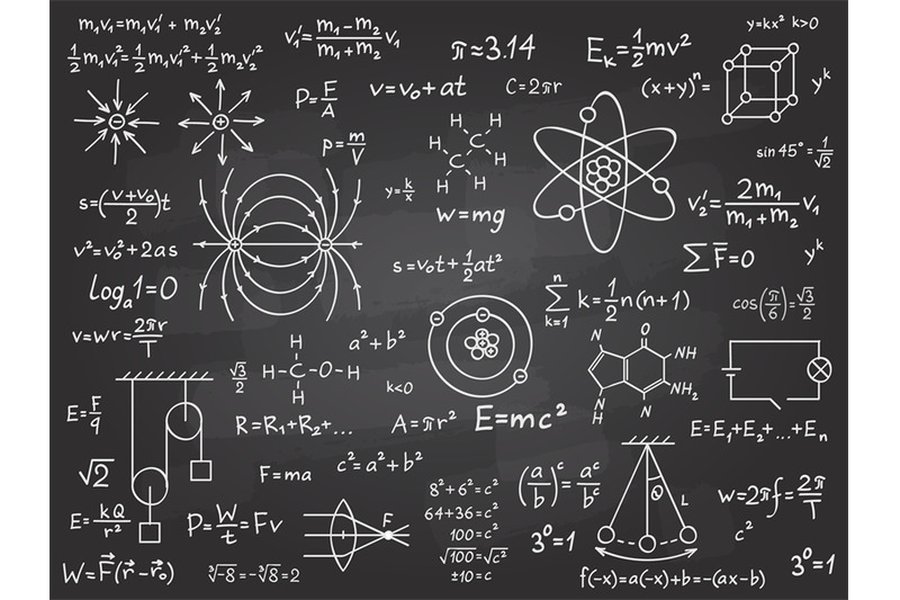
Calculus involves complex formulas and concepts, often visualized on blackboards in academic settings.
Why is Calculus So Important? Real-World Applications
Calculus isn't just an abstract mathematical exercise; it's a vital tool for understanding and shaping the world around us. Its principles are applied across an astonishing range of disciplines:
- Physics: Essential for describing motion, forces, gravity, electricity, and magnetism. Newton's laws of motion and universal gravitation are expressed using calculus.
- Engineering: Used to design bridges and buildings, calculate structural loads, model fluid flow, optimize electrical circuits, determine rates of change in chemical reactions, and predict stress on materials. Calculating the pressure behind a dam is a classic application.
- Economics and Finance: Helps model market trends, calculate marginal cost and revenue, optimize business strategies for maximum profit or minimum loss, and analyze financial derivatives.
- Biology and Medicine: Used to model population dynamics (growth and decay), understand the spread of diseases, analyze drug concentration in the body over time, and process data from medical imaging like CT scans.
- Computer Science: Underpins algorithms in computer graphics (creating realistic curves and surfaces), machine learning (optimization algorithms), and scientific computing.
- Space Exploration: Crucial for calculating trajectories of spacecraft, predicting planetary orbits, and navigating missions like tracking a space shuttle.
- Actuarial Science: Used to assess risk and calculate insurance premiums based on probabilities and life expectancies.
Essentially, any field that deals with systems involving changing quantities or the accumulation of effects relies heavily on the framework provided by calculus.
Comparing Differential and Integral Calculus
While intrinsically linked, the two main branches of calculus address different aspects of change and accumulation. This table summarizes their key differences and relationship:
| Feature | Differential Calculus | Integral Calculus |
|---|---|---|
| Primary Focus | Instantaneous rate of change | Accumulation of quantities |
| Core Concept | Derivative | Integral |
| Geometric Interpretation | Slope of a curve at a point | Area under a curve over an interval |
| Key Question | How fast is something changing right now? | How much has accumulated over time/space? |
| Physical Example | Finding velocity from position | Finding distance from velocity |
| Analogy | Analyzing a single frame of a movie | Watching the entire movie to see the total change |
| Fundamental Operation | Differentiation (Finding the rate) | Integration (Summing the parts) |
| Relationship | Inverse operations, linked by the Fundamental Theorem of Calculus | |
Relevance of Calculus Concepts Across Disciplines
Calculus concepts have varying degrees of emphasis depending on the field of application. This radar chart illustrates a qualitative assessment of the relative importance of core calculus ideas (Limits, Derivatives, Integrals, Theorems like the Fundamental Theorem, and specific Applications) across major scientific and engineering disciplines. The scale represents perceived relevance or frequency of use within each field, based on typical curricula and research areas (Scale: 1=Minimal relevance, 10=Essential).
This visualization highlights how different fields utilize the tools of calculus. For instance, Physics and Engineering rely heavily on both derivatives and integrals, while Economics places a strong emphasis on derivatives for optimization (marginal analysis). Limits form the theoretical bedrock for all, while the direct application focus is universally high.
A Brief History: Newton, Leibniz, and Beyond
While elements related to calculus concepts appeared in ancient Egypt, Greece (notably Archimedes), China, India, and the Middle East centuries earlier, modern calculus was formally developed in the late 17th century. Two mathematicians, working independently, are credited with its creation:
- Sir Isaac Newton (England): Developed his "Method of Fluxions" (an early form of calculus) to help formulate his laws of motion and theory of universal gravitation. His work was driven by problems in physics.
- Gottfried Wilhelm Leibniz (Germany): Developed a comprehensive system for calculus around the same time as Newton. His notation system (like the \( \frac{dy}{dx} \) for derivatives and the ∫ symbol for integrals) proved highly effective and is largely the system still used today. He focused more on the formalism and rules of calculus.
Their independent discoveries led to a famous priority dispute. However, both made monumental contributions. The foundational concepts they introduced, like infinitesimals (infinitely small quantities), were later put on a more rigorous footing in the 19th century with the formal definition of limits by mathematicians like Cauchy and Weierstrass.
Understanding Calculus Intuitively
Calculus can seem daunting, but its core ideas can be grasped intuitively. It's fundamentally about understanding change by looking very closely (differentiation) or summing up many small contributions (integration).
This video, "The Essence of Calculus" by 3Blue1Brown, offers an excellent visual and intuitive introduction to the core ideas behind calculus. It explores the geometric and physical motivations behind derivatives and integrals, helping to build a conceptual understanding beyond just formulas.
Frequently Asked Questions about Calculus
What is the difference between Calculus and Algebra/Pre-Calculus?
Algebra and Pre-Calculus deal primarily with static situations and relationships between known and unknown quantities using equations and functions. They provide the foundational tools (manipulating expressions, solving equations, understanding functions) needed for calculus. Calculus, however, introduces the concept of limits to study change and motion. It tackles dynamic problems: how fast things change (derivatives) and how quantities accumulate (integrals), which are generally beyond the scope of algebra alone.
Why is it called 'Calculus'?
The word "calculus" comes from Latin, meaning "small stone" or "pebble." In ancient times, pebbles were used for counting and calculations (like on an abacus). The name reflects the core method of calculus: breaking down complex problems into many small, manageable parts (like tiny stones) to analyze them, and then summing up these parts to understand the whole system.
Is Calculus difficult to learn?
Calculus introduces new concepts like limits, derivatives, and integrals, which can be challenging as they require a different way of thinking compared to algebra or geometry. It often involves abstract ideas and requires a strong foundation in pre-calculus topics. However, with good instruction, consistent practice, and focusing on understanding the underlying concepts rather than just memorizing formulas, many students successfully master calculus. Difficulty is subjective, but it is generally considered a significant step up in mathematical rigor.
What are limits in Calculus?
Limits are a fundamental concept in calculus that describe the value a function "approaches" as the input (or variable) gets arbitrarily close to some point. They are essential for defining continuity, derivatives, and integrals rigorously. Limits allow us to handle situations involving infinity or points where a function might be undefined, forming the bedrock upon which differential and integral calculus are built.
Recommended Further Exploration
- What is the Fundamental Theorem of Calculus and why is it important?
- Can you provide more real-life examples of how derivatives are used?
- How exactly does integral calculus help calculate the area under a curve?
- What were the main differences between Newton's and Leibniz's approaches to calculus?
References

Last updated May 4, 2025