
Unlocking the Infinite Potential of Your Mind: The Creative Thinking Revolution
Discover how creative thinking transforms ordinary problem-solving into extraordinary innovation across every aspect of life and work
The Essence of Creative Thinking
- Creative thinking is the cognitive ability to generate novel ideas and innovative solutions that transcend conventional boundaries
- It combines divergent thinking (generating multiple possibilities) with convergent thinking (evaluating and selecting optimal solutions)
- This skill can be systematically developed through specific techniques and mindset shifts, regardless of innate talent
Creative thinking is the mental process of developing original ideas, solutions, or perspectives that challenge conventional norms and established patterns. At its core, it's about approaching problems and situations from fresh angles, making unexpected connections between seemingly unrelated concepts, and generating innovative solutions. Unlike standard analytical thinking that follows established logic paths, creative thinking ventures into uncharted territory, embracing ambiguity and experimentation.
This cognitive skill isn't confined to artistic domains – it's a fundamental capacity that enhances problem-solving across all fields, from business and science to technology and education. Creative thinking enables individuals to adapt to changing circumstances, overcome complex challenges, and discover opportunities that remain invisible to conventional thinkers.
The Anatomy of Creative Thinking
Creative thinking encompasses several interconnected mental processes that work together to produce innovative outcomes. Understanding these components helps develop a more structured approach to enhancing creative capabilities.
Core Components of Creative Thinking
Divergent Thinking
This involves generating a wide array of ideas without immediate judgment. It's characterized by fluency (producing many ideas), flexibility (shifting between different categories of thought), originality (generating unique ideas), and elaboration (developing details). Divergent thinking expands the solution space, creating more possibilities to explore.
Convergent Thinking
After generating multiple ideas, convergent thinking narrows down options by evaluating their feasibility, effectiveness, and alignment with goals. This critical analysis phase transforms raw creativity into practical solutions.
Cognitive Flexibility
The ability to switch between different concepts, perspectives, and approaches is essential for creative thinking. This mental agility allows thinkers to overcome functional fixedness – the tendency to see objects or ideas only in their traditional contexts.
Associative Thinking
Creating connections between seemingly unrelated ideas often leads to breakthrough innovations. Creative thinkers excel at recognizing patterns and relationships that others miss, combining disparate concepts into coherent new frameworks.
Risk Tolerance
Creative thinking requires comfort with uncertainty and a willingness to explore ideas that might initially seem impractical or unconventional. This psychological safety enables the experimentation necessary for innovation.
This radar chart illustrates how different levels of creative thinking proficiency manifest across key attributes. As individuals develop their creative thinking abilities, they typically show growth across multiple dimensions rather than in a single area.
The Creative Thinking Process
While creative breakthroughs may seem spontaneous, they typically follow a structured process that can be learned and refined. Understanding this process helps demystify creativity and provides a framework for deliberate practice.
This mindmap illustrates the typical creative thinking process, from initial preparation through implementation. While often depicted as linear, in practice, these stages frequently overlap and may be revisited multiple times throughout a creative project. The process combines both conscious analytical work and subconscious intuitive processing.
Creative Thinking Techniques
Numerous techniques have been developed to stimulate creative thinking. These structured approaches help overcome mental blocks, expand perspective, and generate innovative solutions.
| Technique | Description | Best Used For | Difficulty Level |
|---|---|---|---|
| Brainstorming | Generate as many ideas as possible without criticism; quantity over quality initially | Group problem-solving, early-stage ideation | Easy |
| Mind Mapping | Create visual diagrams that connect ideas and concepts radiating from a central theme | Organizing thoughts, exploring relationships | Easy |
| SCAMPER | Substitute, Combine, Adapt, Modify, Put to other uses, Eliminate, Reverse/Rearrange | Improving existing products or services | Moderate |
| Six Thinking Hats | Look at problems from different perspectives (factual, emotional, critical, optimistic, creative, process-oriented) | Group decision-making, thorough analysis | Moderate |
| Random Word Association | Connect a random unrelated word to your problem to force new associations | Breaking fixation, finding novel approaches | Easy |
| Provocation/What If | Propose outlandish scenarios to challenge assumptions and think differently | Breaking conventional thinking patterns | Moderate |
| Design Thinking | User-centered approach: empathize, define, ideate, prototype, test | Complex problems requiring user-focused solutions | Advanced |
| Analogical Thinking | Apply solutions from one domain to problems in another | Finding new approaches to stubborn problems | Moderate |
Visual Inspirations for Creative Thinking
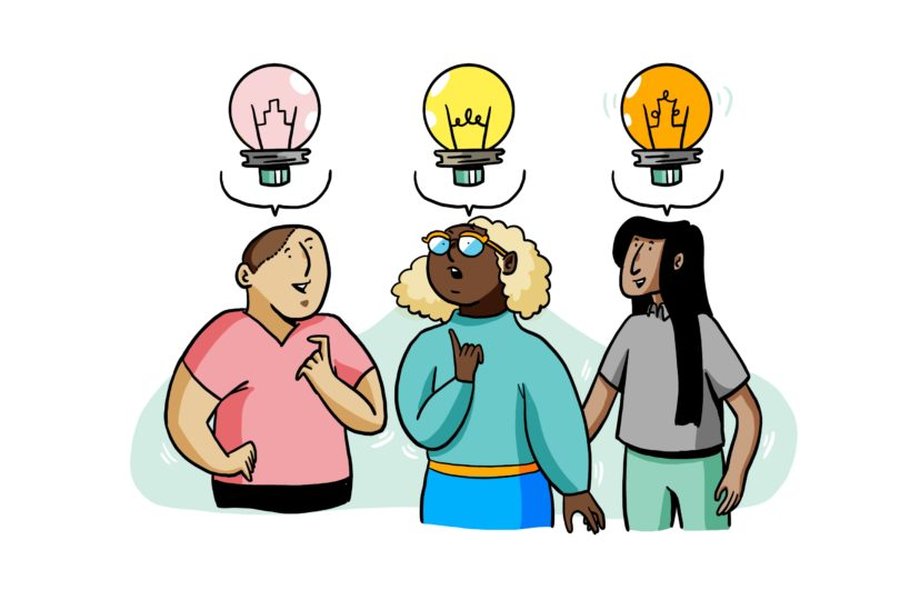
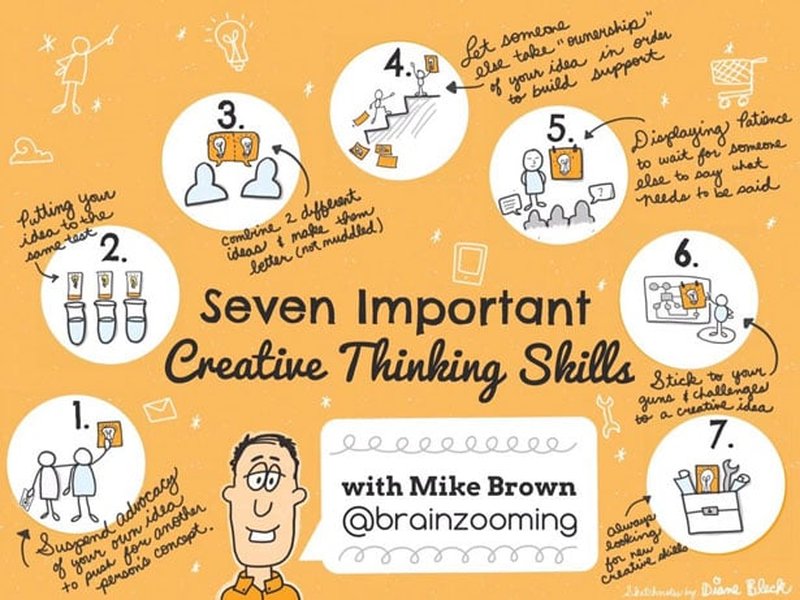
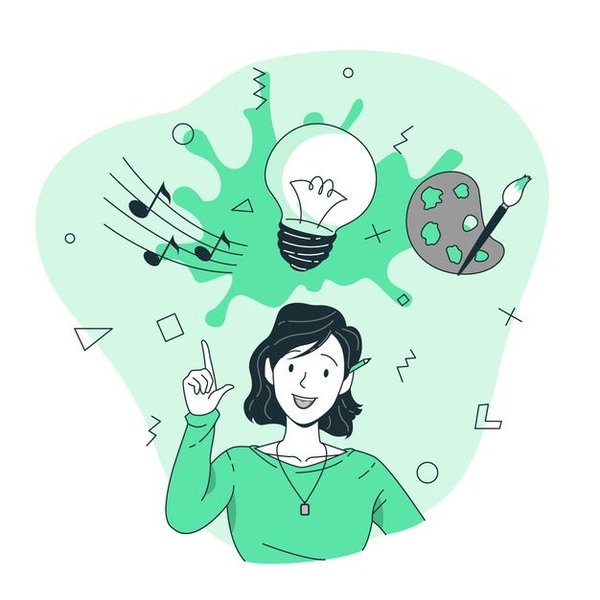
Visual representations of creative thinking processes help illustrate the non-linear, multifaceted nature of creativity. These images demonstrate how ideas can be captured, connected, and expanded through visual techniques like mind mapping, sketching, and collaborative brainstorming.
The Science Behind Creative Thinking
Modern neuroscience has provided fascinating insights into the biological basis of creative thinking. Understanding these mechanisms can help develop more effective approaches to enhancing creativity.
This video by Giovanni Corazza explores the foundations of creative thinking and how we can get "out of the box" to generate innovative ideas. It examines both the theoretical and practical aspects of creativity, offering insights into how anyone can enhance their creative capabilities through deliberate practice and mindset shifts.
Developing Creative Thinking Skills
Creative thinking is not simply an innate talent but a skill that can be systematically developed and enhanced through deliberate practice. The following strategies can help cultivate stronger creative thinking abilities:
Mindset and Environmental Factors
Cultivate Curiosity
Approach the world with wonder and questions rather than assumptions. Curiosity drives exploration of new ideas and perspectives, providing the raw materials for creative connections. Actively seek knowledge outside your domain of expertise to broaden your reference framework.
Create Psychological Safety
Establish environments where taking creative risks is encouraged and failure is viewed as a learning opportunity rather than something to be feared. This safety enables the experimentation necessary for innovation to flourish.
Practice Mindfulness
Regular meditation and mindfulness practices can enhance awareness, reduce fixation on particular thought patterns, and create mental space for new ideas to emerge. These practices help quiet the inner critic that often inhibits creative exploration.
Practical Exercises
Seek New Experiences
Deliberately expose yourself to unfamiliar environments, cultures, and ideas. Novel experiences provide fresh neural connections and perspectives that can spark creative insights when applied to familiar problems.
Challenge Assumptions
Regularly question why things are done in certain ways. Identify and challenge the underlying assumptions in any situation to open up possibilities for innovative approaches that might otherwise remain invisible.
Embrace Constraints
Rather than viewing limitations as obstacles, use them as catalysts for creativity. Constraints often force more innovative thinking by eliminating obvious but conventional solutions, pushing exploration into new territories.
Frequently Asked Questions
References
- Creative Thinking: Definition, Examples, and How to... - The Muse
- What Is Creative Thinking? - The Balance
- What Is Creative Thinking? - Forage
- What Is Creative Thinking? Its Importance and Benefits - The Knowledge Academy
- Creative Thinking Skills: Definition and Examples - The Knowledge Academy
- Creative Thinking Skills: Strategies for Innovation - Mario Peshev
- How to Develop Creative Thinking Skills - Indeed
- What is Creative Thinking? Benefits and Examples - UNIS Hanoi
Recommended Searches
Last updated April 6, 2025