
Unveiling the Invisible: What is Dark Matter?
Exploring the Mysterious Substance That Shapes the Cosmos
The universe, in its vastness and complexity, holds many mysteries. Among the most profound are the concepts of dark matter and dark energy. While we can observe and study the luminous stars, galaxies, and gas that make up ordinary matter, this visible component constitutes only a small fraction of the total cosmic inventory. The majority of the universe's matter and energy are attributed to these enigmatic entities that do not interact with light.
Dark matter, unlike ordinary matter, does not absorb, reflect, or emit light or other electromagnetic radiation, making it invisible to conventional telescopes and detectors. Its presence is inferred solely through its gravitational effects on visible matter and the large-scale structure of the universe. Scientists hypothesize that dark matter is a form of unidentified subatomic particle, interacting primarily through gravity.
Key Insights into Dark Matter
- Invisibility and Detection: Dark matter is undetectable by conventional means because it does not interact with the electromagnetic force, meaning it doesn't emit or interact with light. Its existence is inferred through its gravitational influence.
- Gravitational Dominance: Despite being invisible, dark matter makes up a significant portion of the universe's mass (approximately 27%) and plays a crucial role in the formation and evolution of galaxies and galaxy clusters.
- Evidence from Cosmic Phenomena: Observational evidence for dark matter comes from various sources, including the rotation curves of galaxies, gravitational lensing, and the cosmic microwave background radiation.
The Mystery of the Missing Mass
The concept of dark matter first emerged in the 1930s when Swiss-American astronomer Fritz Zwicky observed that the visible mass in the Coma cluster of galaxies was insufficient to explain the observed speeds of the galaxies within the cluster. He inferred the presence of unseen matter – the "missing mass" – required to hold the cluster together gravitationally.
Decades later, in the 1970s, astronomer Vera Rubin's work on the rotation curves of spiral galaxies provided further compelling evidence. She found that stars in the outer regions of galaxies were orbiting the galactic center much faster than expected based on the distribution of visible matter. This suggested that galaxies are embedded in massive, invisible halos of dark matter that extend far beyond the luminous regions.
Historical Context: Pioneers of Dark Matter Research
The journey to understanding dark matter has involved numerous brilliant minds. While Zwicky and Rubin provided foundational evidence, many others have contributed to refining our understanding and developing theoretical models. Their work has been instrumental in shifting the scientific consensus towards the existence of this unseen component of the universe.
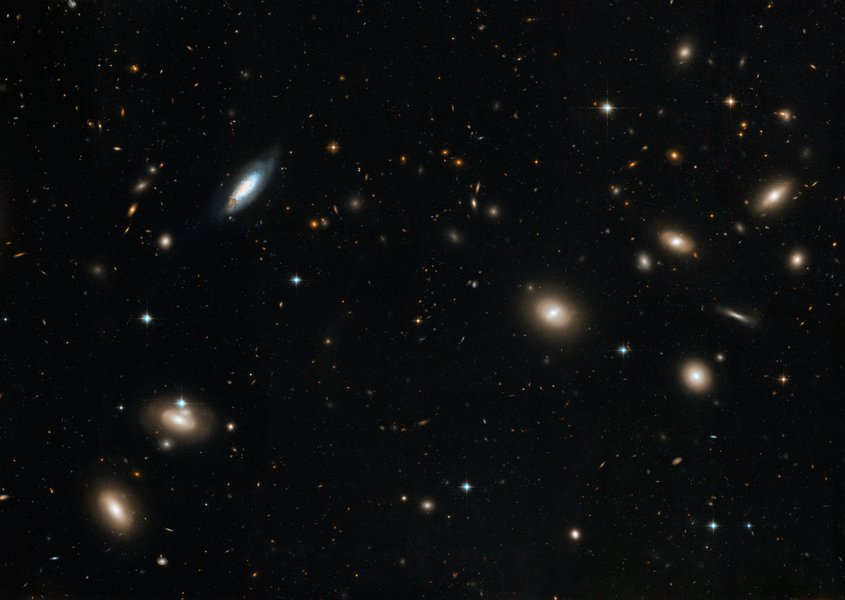
Artist's impression illustrating the gravitational influence of dark matter in the Coma Cluster of galaxies, a region where Fritz Zwicky first inferred the presence of unseen mass.
Observational Evidence: Peering into the Darkness
While we cannot directly "see" dark matter, its gravitational effects provide strong evidence for its existence. Several key astronomical phenomena support the dark matter hypothesis:
Galaxy Rotation Curves
As mentioned earlier, the observed rotation speeds of stars and gas within spiral galaxies do not match the predictions based on the visible matter alone. The outer regions of galaxies rotate at nearly the same speed as the inner regions, suggesting the presence of a significant amount of unseen mass distributed in a halo around the galaxy. This "flat" rotation curve is a strong indicator of dark matter.
Gravitational Lensing
Massive objects, including galaxy clusters, warp the fabric of spacetime, bending the path of light from distant objects. This phenomenon, known as gravitational lensing, allows astronomers to map the distribution of mass in these clusters, including the invisible dark matter. Observations of gravitational lensing consistently show that the total mass of galaxy clusters is much greater than the mass of their visible components.
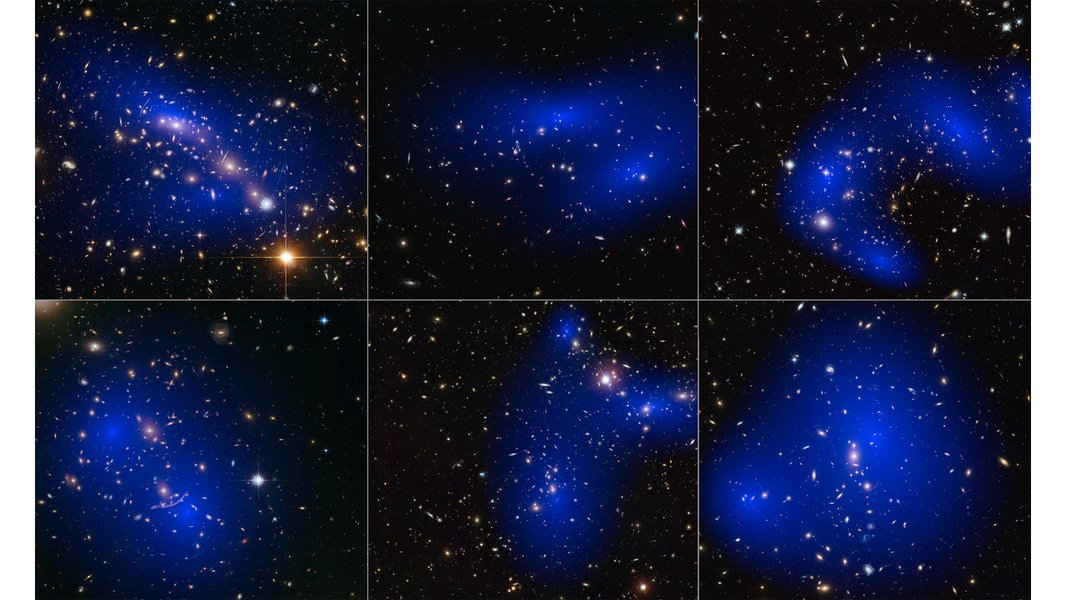
This image shows gravitational lensing effects around galaxy clusters, where the light from distant galaxies is distorted by the immense gravitational pull of the cluster's total mass, including dark matter.
The Cosmic Microwave Background (CMB)
The cosmic microwave background radiation, the afterglow of the Big Bang, contains subtle temperature fluctuations that provide a snapshot of the early universe. The pattern of these fluctuations is consistent with cosmological models that include dark matter, which played a crucial role in the formation of the first structures in the universe.
Structure Formation
Dark matter is essential for explaining the formation of large-scale structures in the universe, such as galaxies and galaxy clusters. In the early universe, tiny fluctuations in density were amplified by gravity. Because dark matter does not interact with light, it could begin to clump together earlier than ordinary matter, providing the gravitational scaffolding upon which visible structures later formed.
The Bullet Cluster
The Bullet Cluster, a system formed by the collision of two galaxy clusters, provides particularly compelling evidence for dark matter. Observations show that the bulk of the mass in the colliding clusters, as determined by gravitational lensing, is separated from the hot gas (which makes up most of the visible matter). This separation is difficult to explain with modified theories of gravity and strongly supports the idea of a non-interacting dark matter component.
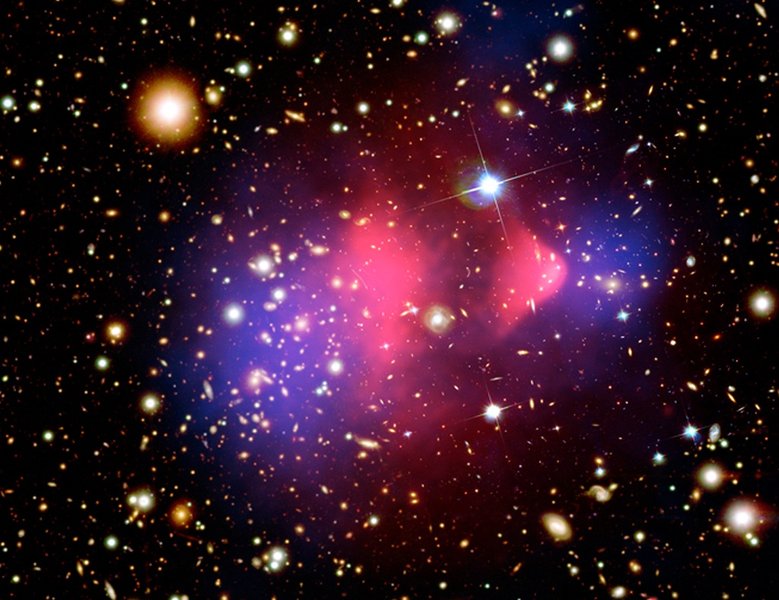
The Bullet Cluster, a result of a galaxy cluster collision, provides key evidence for dark matter. This image highlights the spatial separation between the hot gas (pink) and the inferred dark matter distribution (blue), demonstrating dark matter's non-interaction with electromagnetic forces.
Composition and Nature of Dark Matter
While the gravitational evidence for dark matter is robust, its fundamental nature remains unknown. Scientists are actively searching for the particle or particles that constitute dark matter. The leading candidates fall into two main categories:
Non-Baryonic Dark Matter
The vast majority of dark matter is believed to be non-baryonic, meaning it is not composed of protons, neutrons, and electrons like ordinary matter. Potential candidates for non-baryonic dark matter include:
- Weakly Interacting Massive Particles (WIMPs): Hypothetical particles that interact with ordinary matter primarily through gravity and the weak nuclear force. Experiments are underway to directly detect WIMPs as they pass through Earth.
- Axions: Another hypothetical particle, much lighter than WIMPs, proposed to solve a problem in particle physics.
- Sterile Neutrinos: A hypothetical type of neutrino that interacts even more weakly than the known neutrinos.
Baryonic Dark Matter
A smaller fraction of dark matter could potentially be baryonic, consisting of ordinary matter that is simply not luminous enough to be detected. Examples include:
-
MACHOs (Massive Astrophysical Compact Halo Objects): These could be faint objects like brown dwarfs, white dwarfs, or black holes that reside in the halos of galaxies. However, microlensing surveys have ruled out MACHOs as a significant component of dark matter.
Based on observations of the cosmic microwave background and the abundance of light elements formed in the Big Bang, baryonic matter (both luminous and dark) accounts for only about 5% of the total mass-energy content of the universe. The remaining 26% is attributed to non-baryonic dark matter, and approximately 68% to dark energy.
The Search for Dark Matter Particles
Scientists are employing various strategies to directly or indirectly detect dark matter particles:
Direct Detection Experiments
These experiments aim to detect the faint interaction that might occur if a dark matter particle collides with an atomic nucleus in a highly sensitive detector, typically located deep underground to shield from cosmic rays.
Indirect Detection Experiments
These experiments look for the products of dark matter particle annihilation or decay, such as gamma rays, neutrinos, or antimatter particles, which could be produced in regions where dark matter density is high, like the galactic center or dwarf galaxies.
Collider Experiments
Particle accelerators like the Large Hadron Collider (LHC) at CERN are searching for evidence of dark matter particles being produced in high-energy collisions. If dark matter particles are created, they would pass through the detectors unnoticed, but their presence could be inferred from the missing energy and momentum in the collision byproducts.
Dark Matter vs. Modified Gravity
While the dark matter hypothesis is the prevailing explanation for the observed gravitational anomalies, a minority of scientists explore alternative theories that propose modifications to the laws of gravity on large scales. These Modified Newtonian Dynamics (MOND) theories attempt to explain the rotation curves of galaxies without invoking dark matter. However, these modified gravity theories face challenges in explaining the full suite of cosmological observations, particularly the evidence from gravitational lensing in galaxy clusters and the cosmic microwave background.
The Cosmic Significance of Dark Matter
Dark matter is not just a theoretical curiosity; it plays a fundamental role in the structure and evolution of the universe. Without the gravitational influence of dark matter, galaxies would not have formed and clustered in the way we observe today. It is an essential component of the standard cosmological model, known as the Lambda-CDM model, which describes the universe's composition and evolution.
Frequently Asked Questions About Dark Matter
Why is it called "dark" matter?
It is called "dark" because it does not interact with light (electromagnetic radiation), making it invisible to telescopes. The "matter" part signifies that it has mass and exerts gravitational influence.
How much of the universe is made of dark matter?
Current estimates suggest that dark matter makes up about 27% of the total mass-energy content of the universe. Ordinary visible matter accounts for only about 5%, while dark energy makes up the remaining approximately 68%.
Is dark matter the same as dark energy?
No, dark matter and dark energy are distinct components of the universe. Dark matter is a form of matter that attracts through gravity and helps structure the universe. Dark energy is a mysterious force that is causing the accelerated expansion of the universe.
Can we ever directly observe dark matter?
Directly observing dark matter with conventional telescopes is impossible because it doesn't interact with light. However, scientists are attempting to directly detect dark matter particles through their rare interactions with ordinary matter in specialized detectors.
What are the leading candidates for dark matter particles?
The leading candidates for the non-baryonic dark matter particle include WIMPs (Weakly Interacting Massive Particles), axions, and sterile neutrinos.
Composition of the Universe
To put the significance of dark matter into perspective, here is a breakdown of the universe's composition based on current cosmological models:
| Component | Approximate Percentage of Total Mass-Energy |
|---|---|
| Ordinary Matter (Baryonic Matter) | 5% |
| Dark Matter | 27% |
| Dark Energy | 68% |
This table highlights the fact that the universe is dominated by components that we cannot directly see or fully understand, underscoring the significant mysteries that remain in cosmology and particle physics.
Exploring Dark Matter Further
For those interested in delving deeper into the subject, the following video provides a visual explanation of dark matter:
This video, titled "Why 95% of the Universe is Invisible | Dark Matter Explained," offers a clear and accessible explanation of the concepts of dark matter and its importance in understanding the universe's composition and evolution. It complements the information presented here by providing a visual and auditory perspective on this complex topic.
References
Last updated April 22, 2025