
Connecting the City: Unveiling the Power of Metropolitan Area Networks (MANs)
Discover how MANs bridge the gap between local and global networks, enabling high-speed communication across urban landscapes.
A Metropolitan Area Network, commonly known as a MAN, represents a crucial layer in the hierarchy of computer networks. It's designed specifically to interconnect users and resources across a geographic area larger than a typical Local Area Network (LAN) but smaller and more geographically focused than a Wide Area Network (WAN). Think of it as the digital backbone connecting different parts of a city, a large university campus, or multiple towns within a metropolitan region.
Key Highlights of MANs
- Intermediate Scale: MANs typically cover areas ranging from 5 to 50 kilometers (or sometimes up to 100km), perfectly suited for connecting multiple LANs within a city or large campus.
- High-Speed Connectivity: Leveraging technologies like fiber optics and Metro Ethernet, MANs provide significantly faster data transfer speeds (often Gbps or higher) compared to traditional WAN links over similar distances.
- Resource Sharing Hub: Their primary purpose is to enable efficient sharing of resources (like internet access, databases, applications) and facilitate communication between different organizational sites (offices, campuses, government buildings) within the metropolitan footprint.
Understanding the Architecture and Operation
How MANs Weave a City's Digital Fabric
MANs function by creating a high-speed backbone that links multiple separate LANs. Imagine different office buildings, university departments, or government facilities, each with its own LAN. A MAN provides the dedicated, high-capacity connections needed to bridge these isolated networks together seamlessly.
Backbone Technologies
The backbone of a MAN is critical for its performance. Common technologies deployed include:
- Fiber Optic Cables: The most prevalent technology, offering extremely high bandwidth (ranging from 1 Gbps to 100 Gbps or more), low latency, and resistance to electromagnetic interference, making it ideal for densely populated urban areas. Single-mode fiber, initially used for long-distance telephony, became a key enabler for MANs.
- Wireless Links: Technologies like Microwave, WiMAX (Worldwide Interoperability for Microwave Access - based on IEEE 802.16 standards), or other fixed wireless solutions can be used, especially where laying fiber is difficult or cost-prohibitive. These offer flexibility but can be susceptible to interference and environmental factors.
- Copper Cabling: While less common for new high-speed backbones, existing twisted pair or coaxial cable infrastructure (like those used by cable TV companies) can also form part of a MAN.
- Metro Ethernet: This is a crucial standard, extending familiar Ethernet LAN protocols to the scale of a MAN. It allows service providers to offer scalable and manageable Ethernet services across a metropolitan area.
Interconnecting LANs
LANs are typically connected to the MAN backbone using high-speed interfaces, often via routers or Layer 3 switches. The MAN acts as a transit network, efficiently routing traffic between the connected LANs or providing a shared gateway to external networks like the internet (WAN). Exchange points, like the historical Boston Metropolitan Exchange Point, facilitate data exchange between different MAN providers and national carriers, ensuring smooth interoperability.
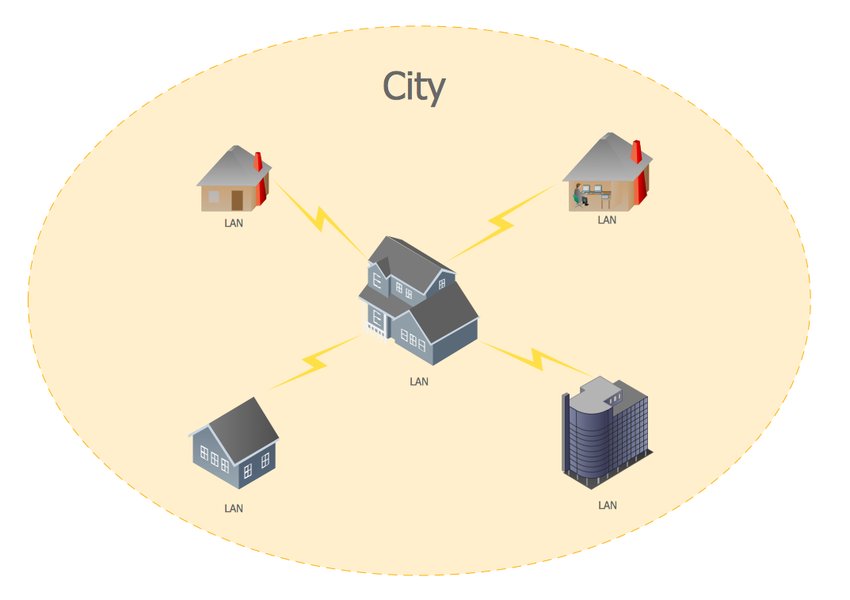
Conceptual diagram of a MAN linking different entities within a city.
Visualizing the MAN Ecosystem
A Mindmap Overview
This mindmap provides a visual summary of the core concepts surrounding Metropolitan Area Networks, highlighting their definition, characteristics, technologies, and applications.
Network connecting LANs
within a metropolitan area
(city, large campus)"] id2["Scale & Scope"] id2a["Larger than LAN"] id2b["Smaller than WAN"] id2c["Typically 5-100 km coverage"] id3["Purpose"] id3a["Interconnect multiple LANs"] id3b["High-speed data communication"] id3c["Resource sharing (Internet, databases)"] id4["Key Technologies"] id4a["Fiber Optics"] id4b["Metro Ethernet"] id4c["Wireless (WiMAX, Microwave)"] id4d["Dedicated Backbones"] id5["Examples & Applications"] id5a["Corporate Branches"] id5b["University Campuses"] id5c["Government Facilities"] id5d["Cable TV / ISP Networks"] id5e["Smart City Infrastructure"] id6["Benefits"] id6a["High Speed & Bandwidth"] id6b["Cost-Effective (vs. WAN for area)"] id6c["Reliability & Redundancy"] id6d["Efficient Resource Sharing"] id7["Challenges"] id7a["Management Complexity"] id7b["Geographic Limitation"] id7c["Security Considerations"] id7d["Wireless Interference"]
MAN vs. LAN vs. WAN: A Comparative Analysis
Understanding Network Scales
Metropolitan Area Networks occupy a specific niche in network typology. Comparing MANs with Local Area Networks (LANs) and Wide Area Networks (WANs) helps clarify their distinct roles and characteristics. The radar chart below visually contrasts these network types across several key parameters.
Interpreting the Chart
As shown, LANs excel in speed within a small area but have limited coverage. WANs offer vast coverage but typically involve higher costs, complexity, and potentially lower speeds or higher latency over long distances. MANs strike a balance, providing high-speed connectivity across a significant metropolitan area, making them faster and often more cost-effective than extending a WAN for intra-city connections, while being more complex and costly than simple LANs.
Real-World Applications and Use Cases
Where MANs Make a Difference
MANs are not just theoretical constructs; they are vital infrastructure in many modern settings:
- Corporate Connectivity: Businesses with multiple offices or buildings within the same city use MANs to create a unified network, allowing seamless data sharing, centralized server access, and internal communication (e.g., VoIP, video conferencing).
- Educational Institutions: Large universities with sprawling campuses rely on MANs to connect various faculty buildings, libraries, student residences, and research centers, providing ubiquitous access to academic resources and the internet.
- Government Networks: Municipalities often build or lease MANs to connect city halls, police departments, fire stations, libraries, and other public service buildings, improving operational efficiency and citizen services.
- Healthcare Networks: Hospitals and clinics within a metropolitan area can use MANs to securely share patient records (EHR/EMR), medical imaging, and facilitate telemedicine consultations between facilities.
- Internet Service Providers (ISPs) & Cable TV Operators: These companies extensively use MAN infrastructure (often based on fiber or coaxial cable) to distribute internet access, television programming, and telephone services to homes and businesses across a city.
- Smart City Initiatives: MANs form the backbone for many smart city applications, connecting traffic lights, surveillance cameras, environmental sensors, public Wi-Fi hotspots, and utility grids, enabling real-time monitoring and control.

MANs are foundational for developing interconnected Smart City infrastructure.
Deep Dive: Video Explanation
Visualizing MAN Concepts
For a concise visual and auditory explanation of Metropolitan Area Networks, the following video provides a helpful overview. It covers the basic definition, scale, and purpose of MANs, reinforcing the concepts discussed above.
This video effectively illustrates how MANs fit between LANs and WANs, highlighting their role in connecting locations across a city using various technologies. It serves as a good introduction or refresher on the core idea of a MAN.
Advantages and Disadvantages
Weighing the Pros and Cons
Advantages of MANs:
- High Speed & Bandwidth: Offer significantly higher data rates than typical WAN connections over the same distance, supporting bandwidth-intensive applications.
- Extended Reach Beyond LANs: Effectively connect multiple locations across a city or large campus.
- Cost-Effectiveness (Relative): Can be more economical than leasing multiple dedicated high-speed WAN lines for intra-city communication. Sharing the MAN infrastructure can reduce costs.
- Resource Sharing: Facilitates easy sharing of expensive hardware, software, and data resources among connected sites.
- Support for Diverse Traffic: Capable of efficiently handling data, voice, and video traffic simultaneously.
- Reliability: Often designed with redundancy and backup paths to ensure high availability, crucial for business and public services.
Disadvantages of MANs:
- Higher Cost than LANs: Implementing and maintaining a MAN involves significant investment in infrastructure (like fiber optics) and equipment compared to a LAN.
- Management Complexity: Require skilled personnel for configuration, management, monitoring, and troubleshooting due to their scale and complexity.
- Security Challenges: Covering a larger area and potentially interconnecting multiple organizations increases the attack surface, demanding robust security measures (firewalls, encryption, access controls).
- Geographic Limitation: Limited to the metropolitan area; connections beyond require integration with WANs.
- Potential for Interference (Wireless): MANs relying on wireless technologies can be susceptible to signal disruption from weather, buildings, or other radio frequency sources.
- Scalability Planning: While scalable, expansion requires careful planning and potentially significant further investment.
Network Comparison Table
LAN vs. MAN vs. WAN at a Glance
This table provides a side-by-side comparison of Local Area Networks (LANs), Metropolitan Area Networks (MANs), and Wide Area Networks (WANs) across key characteristics.
| Feature | LAN (Local Area Network) | MAN (Metropolitan Area Network) | WAN (Wide Area Network) |
|---|---|---|---|
| Geographic Coverage | Small area (single building, office floor, small campus) | Medium area (city, large campus, multiple nearby towns, 5-100 km) | Large area (country, continent, global) |
| Typical Speed | Very High (1 Gbps - 10 Gbps+) | High (1 Gbps - 100 Gbps+) | Variable, Generally Lower (Mbps - Gbps, often depends on leased line capacity) |
| Primary Technology | Ethernet (Twisted Pair, Fiber), Wi-Fi | Fiber Optics, Metro Ethernet, Wireless (Microwave, WiMAX) | Leased Lines (MPLS, Fiber), Satellite, Cellular, Internet (VPNs) |
| Ownership/Management | Typically owned and managed by a single organization | Can be private (single org), public (city gov't), or operated by service providers | Often relies on public carriers or multiple service providers; can be private for large enterprises |
| Implementation Cost | Low | Moderate to High | High to Very High |
| Latency | Very Low | Low to Moderate | Moderate to High (due to distance) |
| Primary Use | Connecting devices within a limited local area for resource sharing | Interconnecting multiple LANs within a city for high-speed regional communication | Connecting geographically dispersed LANs and MANs over long distances |
Security and Reliability Considerations
Ensuring Robust MAN Operations
Given their scale and the critical services they often support, security and reliability are paramount in MAN design and operation.
Security Measures
Because MANs often traverse public spaces or interconnect different organizations, they require strong security protocols. This includes:
- Firewalls: Placed at network boundaries to control traffic flow and block unauthorized access.
- Encryption: Encrypting data transmitted over the MAN backbone protects against eavesdropping, especially important if links pass through untrusted areas. Technologies like IPsec or MACsec can be used.
- Access Control Lists (ACLs): Implemented on routers and switches to restrict traffic flow based on predefined rules.
- Intrusion Detection/Prevention Systems (IDPS): Deployed to monitor network traffic for malicious activity and block threats.
- Virtual Private Networks (VPNs): Can be used over MAN links to provide secure, encrypted tunnels, particularly if parts of the MAN infrastructure are shared or leased.
Reliability and Redundancy
Network uptime is crucial. MANs often incorporate redundancy to minimize downtime:
- Redundant Links: Using multiple physical paths (e.g., diverse fiber routes) between key points ensures connectivity even if one path fails.
- Backup Equipment: Having standby routers, switches, and power supplies ready to take over in case of hardware failure.
- Resilient Network Protocols: Employing protocols like Spanning Tree Protocol (STP) variations or routing protocols that can quickly reroute traffic around failures.
- Monitoring and Maintenance: Continuous network monitoring to detect issues early and regular maintenance to prevent failures.

Robust MAN infrastructure requires careful planning for security and reliability.
Frequently Asked Questions (FAQ)
Quick Answers about MANs
How is a MAN different from a Campus Area Network (CAN)?
A Campus Area Network (CAN) is very similar to a MAN but is typically confined to a smaller, well-defined geographic area like a university campus or a corporate park. While a CAN interconnects LANs within that campus, a MAN usually covers a larger area, potentially spanning an entire city or multiple towns. Functionally, they are similar, but the scale and administrative boundaries often differ. A large university might have a CAN, but if it connects multiple campuses across a city, that infrastructure might be better described as a MAN.
Who typically owns and operates a MAN?
MAN ownership varies. It can be:
- Private: Owned and operated by a single large organization (like a corporation or university) for its own use across multiple sites.
- Public: Built and maintained by a city government or public utility to provide connectivity for municipal services or to lease capacity to businesses.
- Service Provider: Owned and operated by a telecommunications company or ISP that sells MAN services (like Metro Ethernet) to various customers within the metropolitan area.
Is using the public internet with VPNs considered a MAN?
Generally, no. While VPNs over the public internet can connect sites within a city, a traditional MAN implies dedicated or high-performance infrastructure (often private fiber or leased lines from a carrier providing specific MAN services like Metro Ethernet) designed for higher speed, lower latency, and potentially better reliability than relying solely on the public internet backbone for intra-city connections. Public internet connections are typically considered part of the WAN infrastructure.
What is Metro Ethernet?
Metro Ethernet is a service offered by carriers that extends Ethernet connectivity beyond the traditional LAN environment to cover a metropolitan area. It allows businesses to connect their various locations within a city using familiar Ethernet interfaces and protocols, providing a simpler, more scalable, and often cost-effective alternative to older MAN technologies like Frame Relay or ATM. It's a key technology underpinning many modern MANs.
Recommended Reading
- How do the speed and cost of MANs compare directly to WANs for city-wide connectivity?
- What specific technologies are involved in implementing Metro Ethernet services?
- Can you provide detailed examples of how MANs are used in specific smart city projects?
- What are the best practices for securing a Metropolitan Area Network against cyber threats?
References
Last updated May 5, 2025